Seemingly Sappy, Family-Friendly, Conservative-Minded Saga
December 29, 2025
Another Unseen Bardot Film On My Checklist
December 29, 2025
Rally Round The Marty Flag, Boys!
December 29, 2025
A Michael FlemingVarietystoryquoted by In Contention‘s Kris Tapley announces that Chris Nolan‘s Shadow of the Bat, his third and final Batman film for Warner Bros., will open in the summer of 2012. It also contains two major-league shockers.
Pic will once again use the Riddler as the prime villain — the third go-round after Frank Gorshin‘s Riddler on the ’60s Batman TV series and Jim Carrey‘s Riddler in 1995’s Batman Forever. The surprise is that Carrey will again play the role in Nolan’s Shadow.
The other “come again?” is that directors Tim Burton, the creator of Batman and Batman Returns, and Joel Schumacher , helmer of Batman Forever and Batman and Robin, have been brought on as consultants to the production.
“Tim and Joel had two completely different visions of the Batman, visions that contrast vastly with my own,” Nolan toldVariety. “But I don’t feel that negates the possibility of a creative convergence. Batman is more than the ideas of one person, of one team of artists. He is the result of seven decades of pop culture influence and innovation.”
WB is sadi to be eyeballing a May 2012 release date to coincide with the 73rd anniversary of Batman’s first comic book appearance in 1939.
Nolan begins shooting his latest film, Inception, with Leonardo DiCaprio later this year for a 2010 release.
“It wasn’t until the 20th century that modern-type sunglasses came to be. In 1929, Sam Foster, founder of the Foster Grant company, sold the first pair of Foster Grant sunglasses on the Boardwalk in Atlantic City, NJ. By 1930, sunglasses were all the rage.” — from ideafinder.com‘s page on sunglasses.
Robert Downey, Jr., as Sherlock Holmes — fictionally born in 1854, first appearance in an Arthur Conan Doyle story in 1887, etc. It’s fairly safe to say that shades weren’t around during Holmes’ youth or middle age. Unless, of course, Holmes invented them.
My just-received copy of Nick Dawson‘s Being Hal Ashby, taken inside the good old Skylight Diner on 9th Avenue and 34th Street following 6 pm screening of Observe and Report.
First bloom, 9th and 42nd Street, 3.31.09, 4:10 pm.
I knew something was wrong last night when a friend and I walked into Sant Ambreous, a little restaurant at the corner of West 4th Street and Perry Street. It was around 9:30 pm. The atmosphere felt a little too stiff and formal, and they were all too glad to see us. Restaurants that have their act together never show excitement when a customer walks in. It’s always a sign of desperation. They need to just smile and keep their zen cool.
On top of which the waiters wore pink shirts with black ties. Village restaurants should always use waitresses who look like Sylvia Plath and who wear black leotard tops or somewhat tight sweaters, or…whatever, young, sharp-looking guys who may or may not be gay but who look it. But nobody wears ties — what is this, the Radisson in St. Paul?
Another trouble sign was that the bartender, a young girl from Brazil, spoke with heavily-accented English, and a little too softly. Bartenders always look you in the eye and speak plainly and with confidence, like a banker.
A voice was telling me to leave right away but we stayed because it was cold out. The voice was actually screaming at me to leave. As Lawrence Tierney‘s gangster character said in Reservoir Dogs, “When you’ve got instinct you don’t need proof.”
The pasta I ordered was so drenched in oil and garlic that it was almost pasta soup. But the defining death blow was the fact that my friend and I had brought a bag with two pieces of cake (i.e., that pear cake from a couple of nights ago) inside some tin foil, and we wanted to sample it. We’d already spent about $62 dollars and had a relatively decent time, but we were the last people in the place and asked the bartender if we could have a couple of forks. It was the end of the night, we’d spent our money and we just wanted a couple of bites of that Dean & Deluca cake.
The bartender asked the manager — a guy in his late 40s or early 50s, also wearing a pink shirt and black tie — and a minute later he came up behind us (we were sitting at the bar) and said he couldn’t oblige. “We have many fine desserts here,” he explained. “You should try one of them.” I saw red. I told him I would never return to his place, and that I would do what I can to dissuade others from visiting. Which is what I’m doing right now.
If it were my restaurant and it was late and a couple that had just ordered a fair amount of food and drink wanted to sample their own dessert…fine. If it was right in the middle of the dinner rush, I might politely decline. But when it’s pushing 11 and your staff is cleaning up and putting chairs on top of tables, what’s the difference?
I was talking an hour or so to this Expedia customer service guy about a flight to Spain that would initially land in Lisbon, Portgual. Which this Expedia guy kept referring to as Lizbonn — Liz Taylor plus Bonn, Germany. My irritation grew with each mispronunciation. “Look, it’s pronounced Lizbuhn…okay?,” I finally said. “Lizbuhn. You should kinda know how to pronounce these cities.” How cut off from civilization do you have to be to get a six-letter word wrong? Is it a matter of education, ethnicity, rural dialect? I knew how to say Lisbon when I was seven or eight after watching Casablanca on the tube.
The entire Epstein documentary, lasting 78 minutes, is on YouTube in eight parts. I missed the ’04 showings at the Toronto and New York film festivals and on the tube, and it’s not available on DVD — but its very easy to watch on YouTube, and anyone who’s never seen it is urged here and now and now to take the time.
I hated Heaven’s Gate when I first saw it 28 and a half years ago, and I couldn’t stay with it when I tried it a second time at home about six years ago. I therefore feel it’s still worth quoting N.Y. Times critic Vincent Canby when he noted that director Michael Cimino‘s approach to his subject in Heaven’s Gate “is so predictable that watching the film is like a forced, four-hour walking tour of one’s own living room…for all of the time and money that went into it, it’s jerry-built, a ship that slides straight to the bottom at its christening.”
I attended the second critics screening at the Cinema I on November 17th or 18th of 1980, and stood at the bottom of the down escalator as those who’d seen the afternoon show were leaving. I asked everyone I knew what they thought on a scale of 1 to 10. I’ll never forget the deflated, zombie-like expression on the face of journalist Dan Yakir as he muttered “zero.”
History long ago noted that renowned critic F.X. Feeney is primarily responsible for recasting Heaven’s Gate as a film deserving of revisionist respect. I never bought into this but Feeney’s efforts in this regard are a reminder of what a genuiinely caring and impassioned film critic can do when he/she puts his/her mind to it. Or at least was capable of doing in the old days.
“With just five features in 13 years, Wes Anderson has established himself as the most influential American filmmaker of the post-Baby Boom generation,” says Matt Zoller Seitz in the first of a five-part narrated video series (along with a printed essay) that will run over the next five weeks.
(The video is very nicely done, Matt — hats off. But the automatic play-reboot function is impossible. Send me a code without it and I’ll put it up again.)
Publishing a pro-Anderson manifesto is, at the very least, an idiosysncratic if not brave thing for Seitz to have done. I mean, is it not the prevailing view that Anderson pretty much shot his wad with Bottle Rocket and Rushmore? And that he’s been slipping more and more into WesWorld and getting more and more caught up in Wes-aesthetics-for-their-own-sake ever since?
Apart from his brilliant ’06 American Express commercial and that Jason Schwartzman and Natalie PortmanHotel Chevalier short that accompanied The Darjeeling Limited, Anderson’s post-Rushmore features have come to symbolize an approach to filmmaking that is so poised, precious and fussed over that the primal dramatic stuff doesn’t come through like it needs to.
As David Amsdenwrote in a New York profile of Anderson in late September of ’07, “Pepper in some resurrected classic-rock songs; deadpan dialogue; themes of failure, nostalgia, and fractured families; and the result, at its best, is a world unto itself.”
The other prevailing view is that former collaborator Owen Wilson provided an influence that kept Anderson from getting too Wessy. Like the also-faltering M. Night Shyamalan, Anderson needs to find a way to write his screenplays with (i.e., trust) a bright somebody or other with anti-foo-foo roots and convictions who can save him from himself.
The beginning of the fall-off wasThe Royal Tenenbaums. The first big uh-oh was The Life Aquatic. The Darjeeling Limited, for me, was the Big Thud. And yet Seitz’s essay, I have to say, is great stuff. The passion is right there. It made me fall in love with Rushmore all over again, and feel hope for Anderson’s future works. One hopes in particular that The Fantastic Mr. Fox (which had a test screening in New Jersey a little while ago) will pan out.
“What makes Wes Anderson distinctive is the sheer range of art that has fed his imagination,” Seitz writes. “Nnot just recent American and foreign films, but films from 30, 50, even 70 years ago, plus newspaper comics, illustrations, and fiction. The spectrum of influence gives his work a diversity of tone that his imitators typically lack. It is a style of substance.
“Anderson’s scavenger-hunt aesthetic stands him in good company, alongside Quentin Tarantino, David Gordon Green, James Gray, and the other Anderson, P.T. This series may incidentally illuminate why Anderson-esque movies — from Garden State to Son of Rambow — can seem, no matter what their virtues or pleasures, a weak substitute for the real thing.”
On 9.24.07 I posted a short list of “career-saving suggestions for Anderson to consider: (a) Do a T.E. Lawrence and join the Army or Marines as a raw recruit with a fake name, and serve in Iraq for a year; (b) get a job in Iraq as an ambulance driver, and have an affair with a nurse if he gets sent to the hospital if and when he gets maimed by an I.E.D.; (c) do a T.E. Lawrence and take a low-level job in some blue-collar industry in Missouri or Mississippi for a year, again under a fake name; (d) do a John Pierson and run a repertory movie theatre in some far-off territory for a year — soak up the exotic atmosphere, get to know the locals, etc.”
I met briefly with We Live in Public director Ondi Timoner and her five-year-old son Joaquim early this afternoon inside the Manhattan offices of Murphy P.R. Her film, which won the 2009 Sundance Film Festival Grand Jury prize, is about living virtual at the expense of natural, and how we’re all sinking deeper and deeper into it. (It’s certainly the story of my life, I can tell you.) We Live In Public is showing at New Directors, New Films this week. I’ll most likely run the piece along with the audio tomorrow.
The legendary movie-score composer Maurice Jarredied yesterday in Los Angeles at age 84, following a long bout with cancer. I’m probably not the only one who’s feeling a bit forlorn about this. Jarre’s music could be a little sappy at times, a little too on-the-sleeve. But his melodic gifts seemed almost heavenly at times, and he was one of Hollywood’s most impassioned old-time maestros — right up there with Miklos Rosza, Dimitri Tiomkin, Elmer Bernstein, Bernard Herrmann, Alex North, etc.
You can love or admire various films, directors, actors, screenwriters, choroegraphers, directors of photography, screenwriters, etc. But music goes right into your heart and makes the spirit take flight. Jarre’s Lawrence of Arabia music is arguably a more vital component in that film’s appeal than Peter O’Toole‘s performance or Robert Bolt‘s screenplay. (They are at least equally matched.) I never loved Dr. Zhivago, but I can’t listen to Jarre’s overture for that 1965 David Lean film without feeling a slight melting in my chest.
His music for Richard Brooks‘ The Professionals (’66) was electric, crackling, alive, heartfelt. I’m also a big fan of Jarre’s score for John Frankenehimer‘s The Train (’64). And his scores for two great Peter Weir films of the ’80s — The Year of Living Dangerously and Witness — are also among his best. I’m humming the Living Dangerously theme right now. The closing-credits music he created for Witness was a profound counter-point to the Philadelphia detective and Amish farmer cultures shown in the film — it stood its own ground.
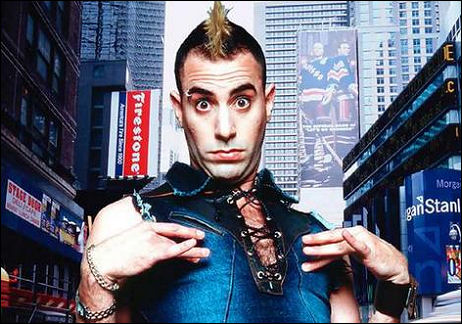
The first thing I saw on the iPhone after coming out of my second viewing of State of Play this afternoon was the NC-17 rating given to Sacha Baron Cohen‘s Bruno. This is surprising? What kind of rep would this 7.10 Universal release have if the MPAA’s ratings board had given it a nice obliging R? Please.
The idea with Bruno is to make average folks in all socio-political realms (i.e., not just red-state males) cringe and go “eeeww!”, and to do that right it has to top the naked wrestling “eewws” in Borat, so what else could have happened?
The Wrap‘s Sharon Waxmanreported last night that the offensive footage includes Cohen having “anal sex with a man on camera” — big deal. Jim Carrey does some fairly brazen ass-banging in the M.I.A. I Love You, Phillip Morris. I mean, we are experiencing the Fall of the Roman Empire and the End of Civilization as we know it…are we not? So why not allow such scenes to be included in adult fare?
Why can’t U.S. society at least be more like Sweden or Denmark? They aren’t so wang-averse over there. I thought that Billy Crudup‘s blue schlong in Watchmen signified a sea change in U.S. values.
There was also a reported MPAA objection to Cohen being shown “sneaking naked into the tent of an unsuspecting non-actor” on a hunting trip. Piffle.
A scene showing “two naked men attempting oral sex in a hot tub while one of them holds a baby” is, according to a Universal spokesperson, “not on the list that the MPAA finds objectionable.”
Another story I missed last Friday (and all weekend, for that matter) was the last gasp of L.A. City Beat, the smallish alternative weekly. They’re dead, buried, a memory. I was going to use “financially afflicted” as an adjective, but is there any print publication anywhere that isn’t sliding down the slope?
The only reason I picked up City Beat year after year was to read the esteemed film critic Andy Klein, and when they whacked Klein last January in a cost-cutting move I said to myself, “The hell with these guys.” I was actually thinking of a scene in Out of the Past when Jane Greer hopes for the quick death of Kirk Douglas . To which Robert Mitchum replies, “Give him time.”