But dishonesty is even worse, and I’ve really come to believe in not skirting or ducking whatever’s happening of a significant nature as long as it connects or reflects on some level. No icky stuff, of course. This has always been a movie-related column but sometimes an occasional random confession is in order.
I’m just going to blurt this out. The results of this morning’s medical exam gave me pause. All my life I’ve enjoyed excellent health, and right now I feel robust and bulletproof. I feel like I’m 37. But an element of doubt or at the very least uncertainty has crept into the room. I’m not feeling spooked as much as…I don’t know, somber or something.
Nobody of any age is ever assured of blue skies and fair weather. We’re all playing it one day at a time, etc. Who knows what lies around the corner? I’ll leave it there, I think. Right now it’s all tuttobene. I just can’t figure a way to write this daily fucking column (“let it all hang out”) without at least acknowledging this. Curtly.
Without getting into details I’ll be submitting to an examination procedure this morning around 10:30 am, and that’s all I’m going to say. Nothing wrong — just something I have to do. I’ll be out of it and presumably recovering by 12:30 or 1 pm.
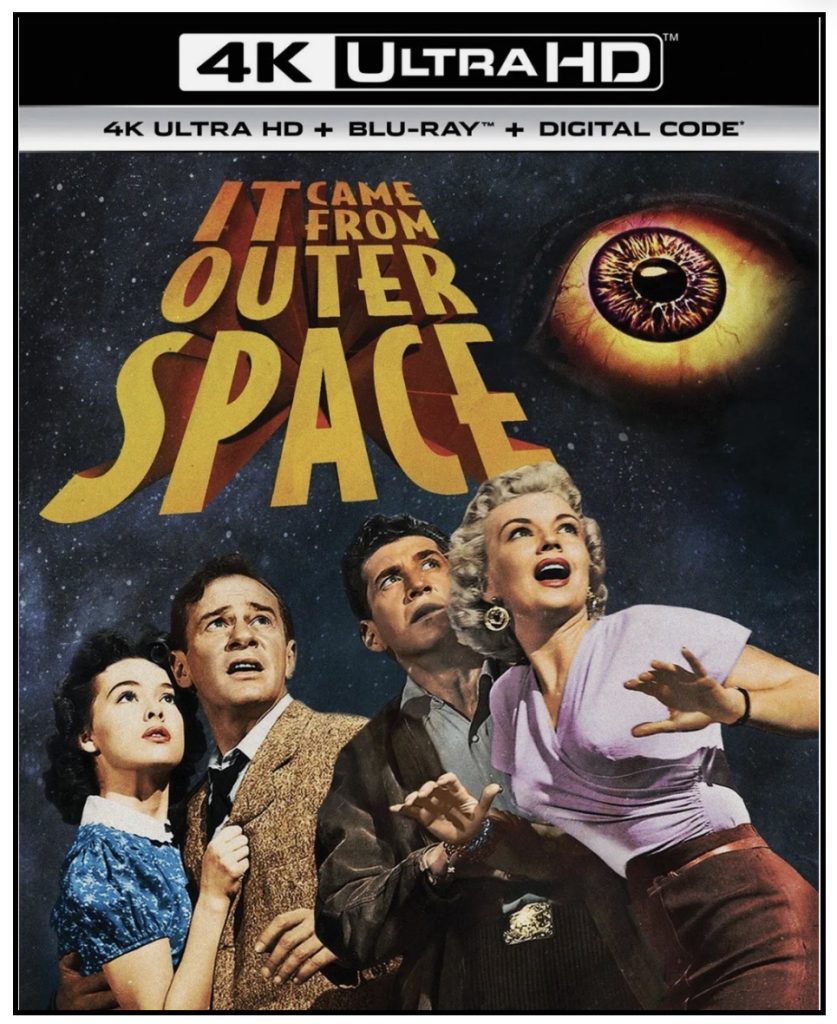
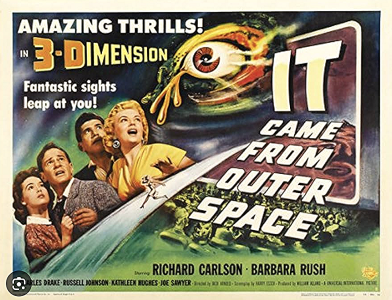
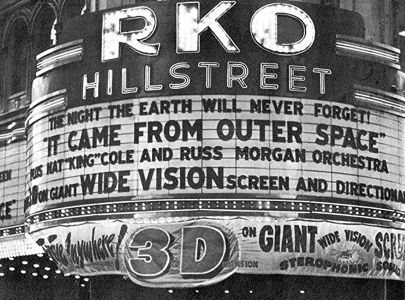
All this time I had somehow failed to realize that Jack Arnold’s ItCameFromOuterSpace (‘53), which is based on a Ray Bradbury film treatment called “The Meteor”, was a clear forerunner of Don Siegel’s InvasionoftheBodySnatchers (‘56).
Both were black-and-white chillers about bucolic, small-town communities besieged by aliens with the power to surreptitiouslyreplaceresidentswithcreepy, emotion–lesssubstitutes, the difference being that Arnold and Bradbury’s visitors aren’t aggressively evil or looking to harm anyone and certainly don’t serve as metaphorical seed agents for ‘50s-era conformity, as they did in BodySnatchers.
And both focused on a cerebral alpha male hero figure (Richard Carlson, Kevin McCarthy) and nearly identical brunette wifey-girlfriend love partners (Arnold’s Barbara Rush, Siegel’s Dana Wynter) who are taken over by aliens in the third act.
There are too many scenes in which Carlson tries and fails to persuade fellow townies that some kind of alien invasion is actually happening. Over and over and over. Charles Drake’s Sheriff Warren finally comes around toward the end, but by then the skepticism horse has been beaten to death.
I was expecting to engage with Kathleen Hughes, the blonde on the 4K Bluray jacket cover, but she’s only in one brief scene.
I was delighted by the relatively recent digital restoration of ItCameFromOuterSpace. Clifford Stine’s cinematography looks about as proficient and ace-level as this kind of boilerplate big-studio monochrome effort gets. At times the image quality seems as clean and rich as, say, the VistaVision lensing of William Wyler’s The Desperate Hours (‘55), especially during the outdoor-simulating sound stage scenes.
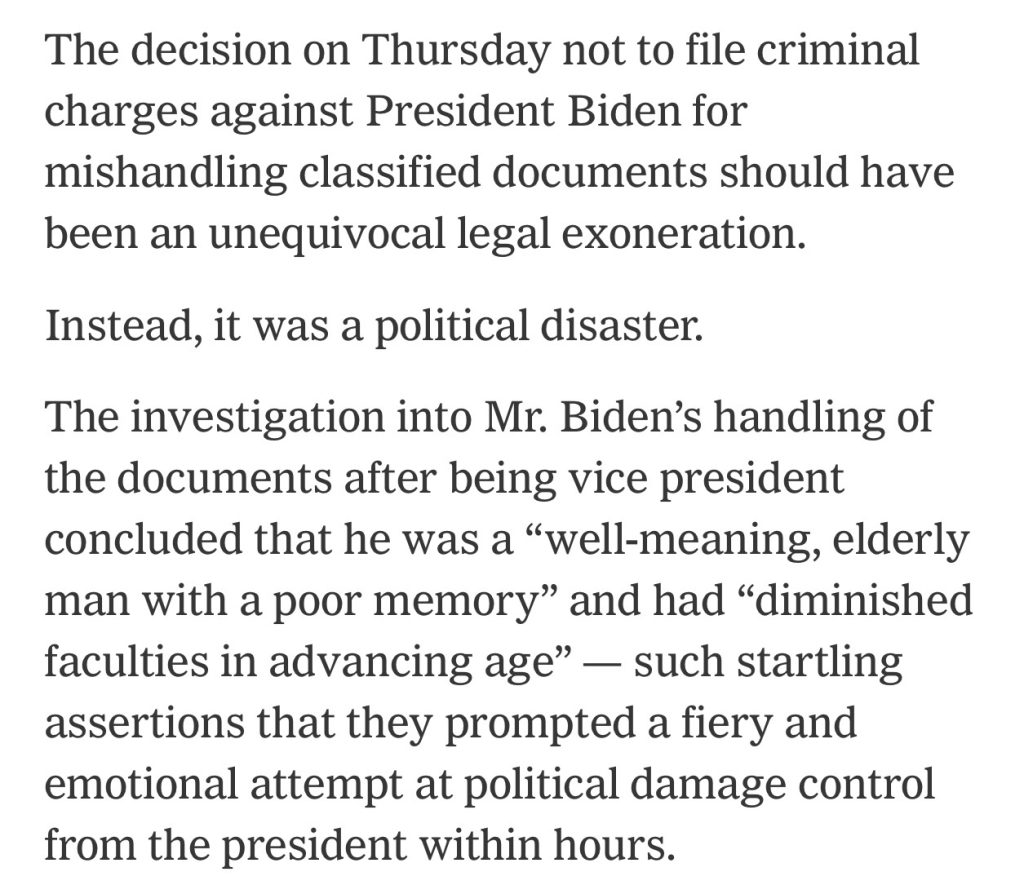
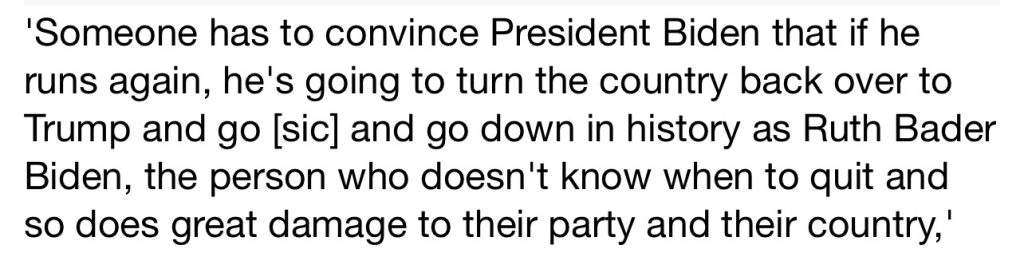
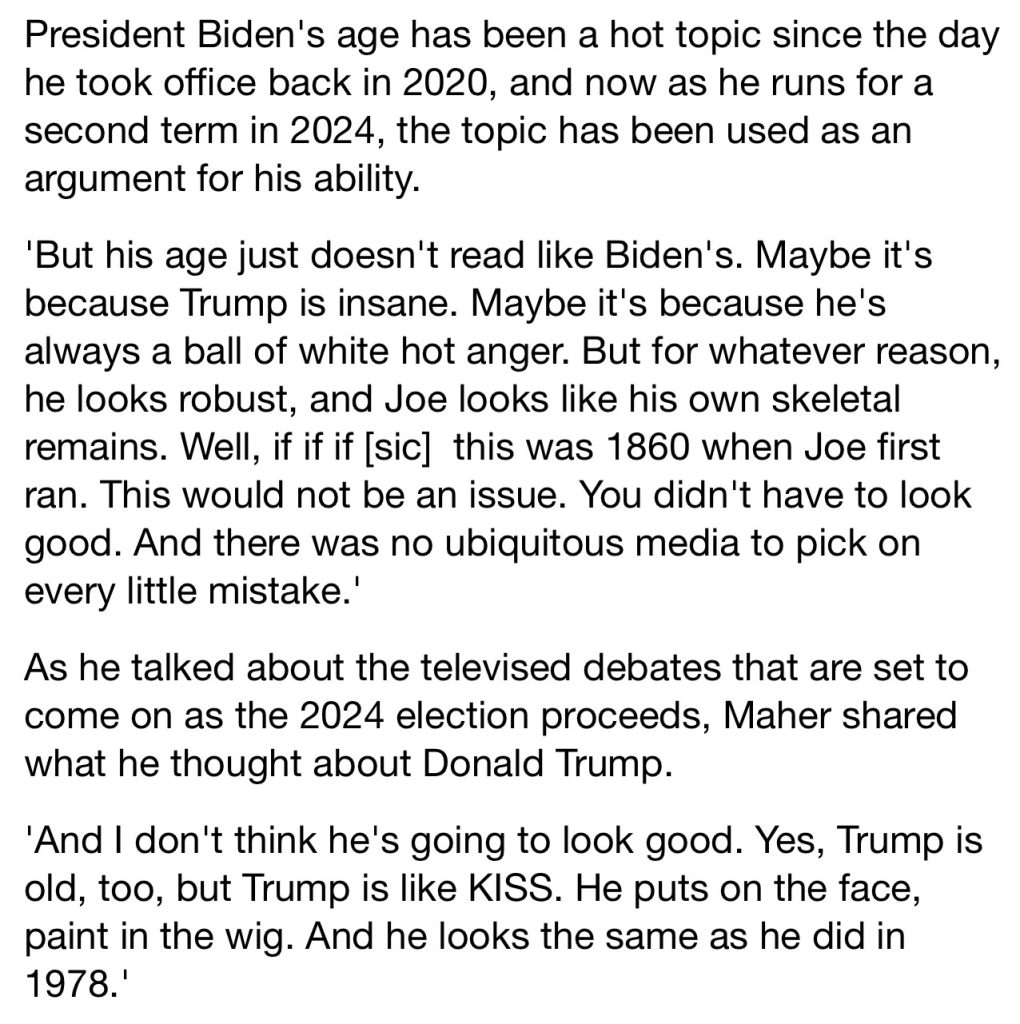
We all know the great-grandfatherly Joe Biden, 81, “looks like his own skeletal remains,” as Bill Maherremarked on a 9.30.23 “New Rules” segment, and that he almost certainly lacks the mental agility and high-octane strength to run an effective campaign against the insane but grotesquely resilient, fat-as-a-cow Donald Trump, 77.
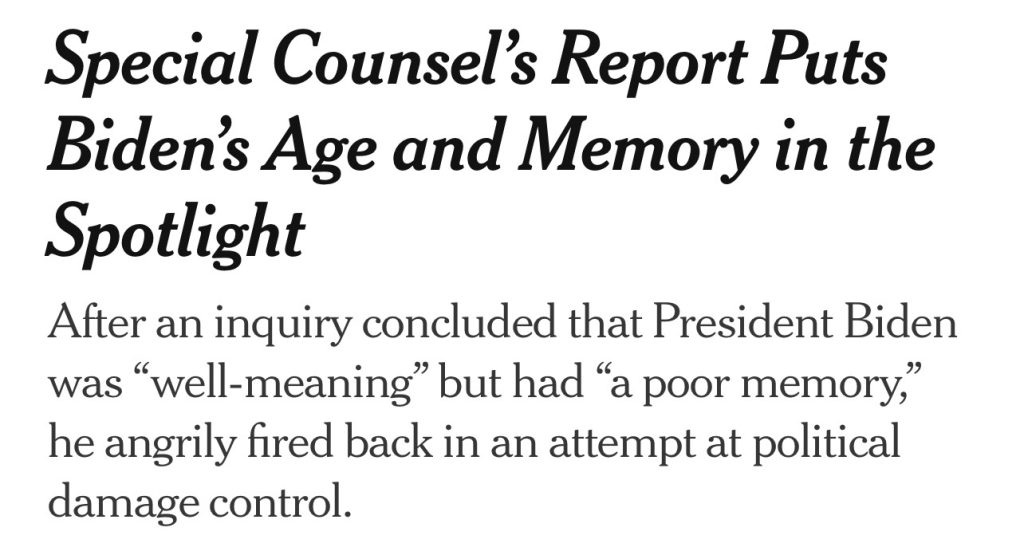
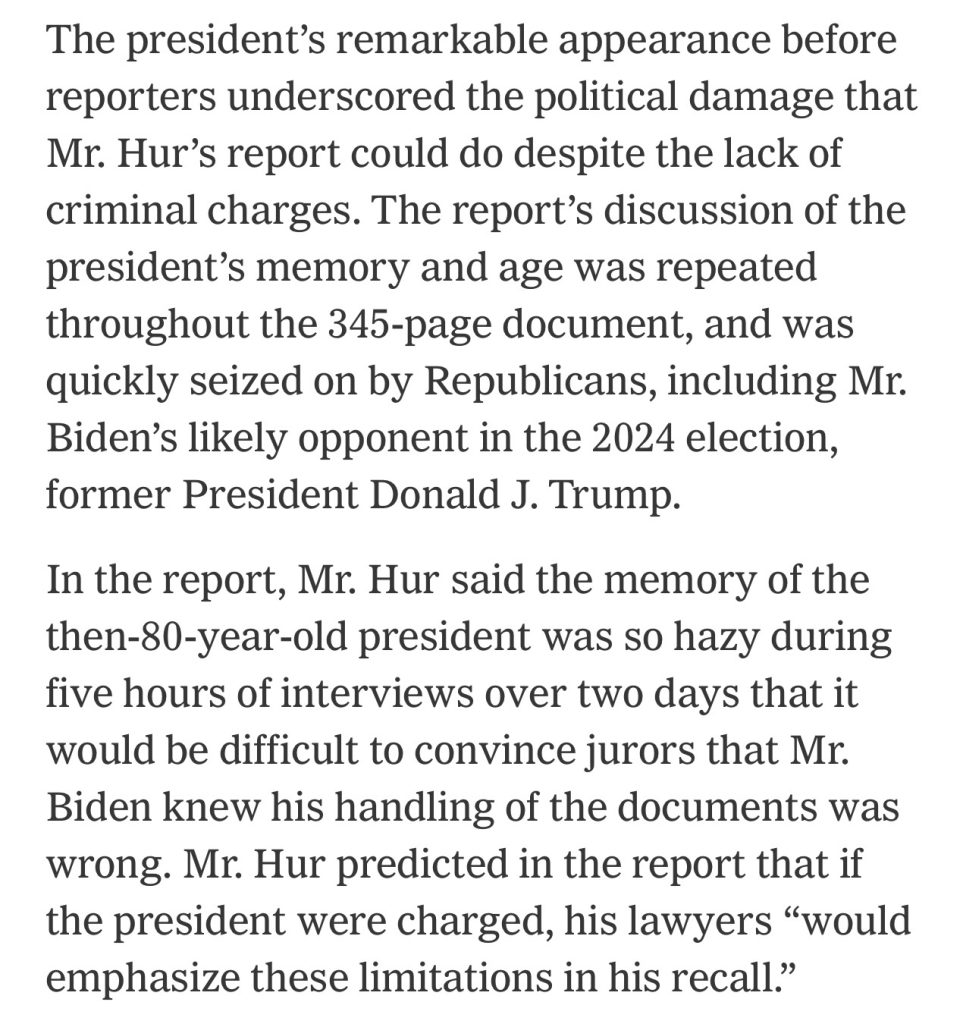
Every American of voting age, in short, has locked into “Biden is too old to serve another term,” so it was no shock to read that special counsel Robert K. Hur has noted, in his just-released report about President Biden’s occasionally errant handling of documents, that he comes off as a “sympathetic, well–meaning, elderlymanwithapoormemory” — basically a rote confirmation of what everyone has long perceived or suspected so what’s the biggie?
But during Thursday evening’s impromptu press encounter at the White House Biden intensifiedtheover–the–hillimpressions by angrilybarkingat and sneeringabout Hur’s observations…a gruff and blustery short-tempered response that failed to exude even a semblance of the usual cool poise and confident assurance that Presidents have routinely been associated with.
My father used to behave like this in his 80s…grumpy, hair–trigger, junkyarddog–like.
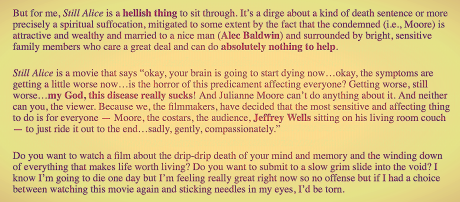
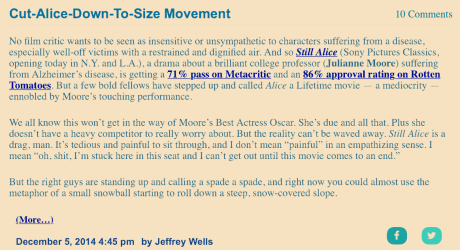
Did you know there was a 2014 Alzheimer’s movie called Still Alice, written and directed by Richard Glatzer and Wash Westmoreland, and that no one has rewatched it since and yet Julianne Moore not only won the Best Actress Oscar that year but her win that was locked in tight from the very beginning of the 2014 Oscar season? The fix was totally in, and no one said “wait…do we have to give it to Moore?”
The answer was yes, they had to because her Best Actress competitors simply weren’t that formidable — Marion Cotillard in Two Days, One Night, Felicity Jones in The Theory of Everything, Rosamund Pike in Gone Girl and Reese Witherspoon in Wild.
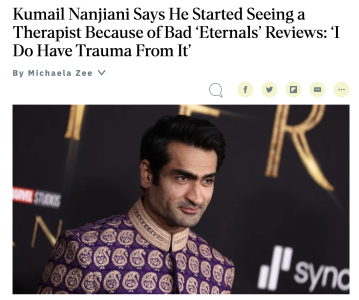
HE to Kumail Nanjiani: You’ve smart, funny-witty and appealing every which way. Everyone hated The Eternals but that was Chloe Zhao‘s fault, not yours. You did nothing wrong. You were well paid, right? And you became slightly more famous because of the promotion? Let it go, move on, you’re fine.
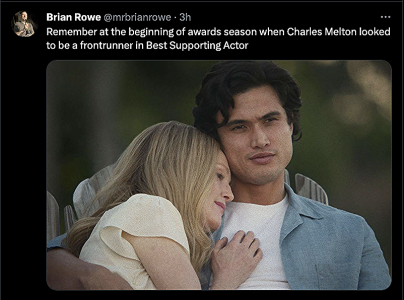
…about the melting of the Charles Melton award-season bandwagon, which was basically a touchy-squishy thing from the get-go (South Korean identity plus symbolic empathy for victims of sexual abuse)…the sensitives tried to slip this in and were shut down by the sensibles. Another indication that woke insanity is gradually losing its hold? I’d certainly like to think so.
An excellent article about great casting feats was posted four years ago (1.14.20) on passionweiss,com. The title was “Creating and Awarding the Last 20 Years of ‘Best Casting Director’ Oscars”, and the author was Abe Beame (no relation to the New York City mayor of the mid ’70s).
Beame says one of the best-ever jobs of casting was Gail Levin‘s casting of Almost Famous. Levin is a Cameron Crowe homie from way back (We Bought a Zoo, Elizabethtown, Mean Girls, Vanilla Sky, Jerry Maguire, Empire Records, What’s Eating Gilbert Grape).
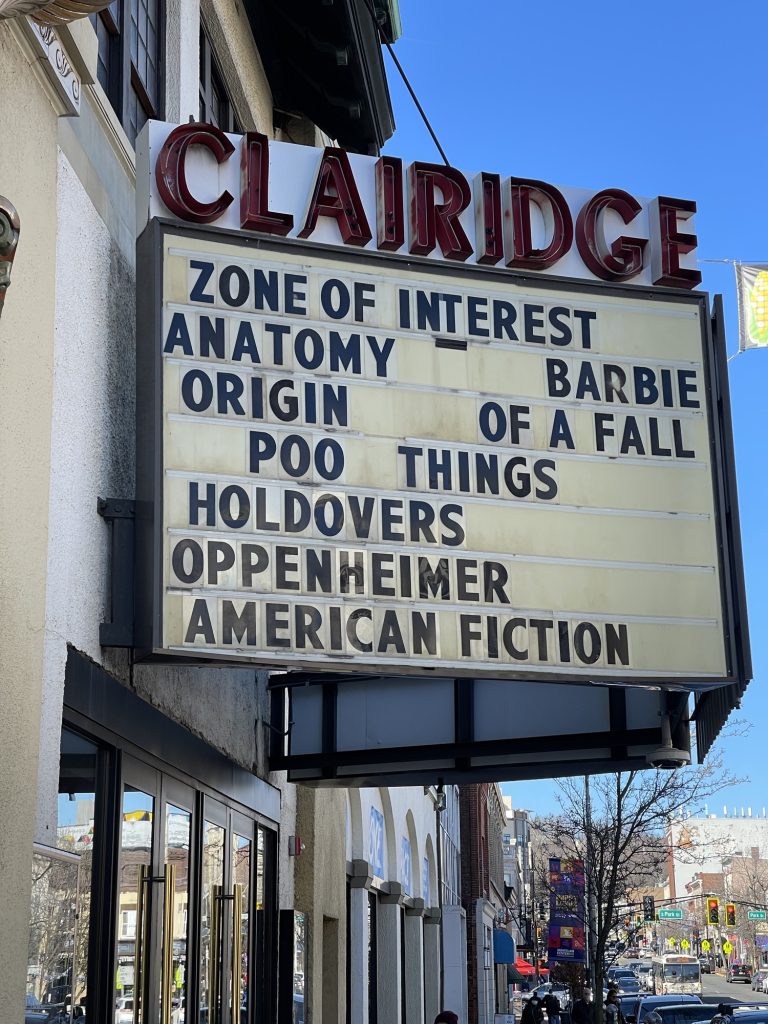
…to the version that began to peek out 20 years ago…Birth (’04), Under the Skin (’13) and The Zone of Interest (’23).
Eight days ago my heart sank when it was announced that Justin Chang, a Millennial wokester with a particular focus on ethnic representation, will be elbowing aside New Yorker critic Anthony Lane, a young boomer whose writings have never seemed to follow woke doctrine.
I almost wept this morning when I re-read Lane’s 23-year-old review of Jonathan Glazer‘s Sexy Beast. It’s very sad to consider that this kind of writing (aloof wit, verve, panache) is, in a sense, being put out to pasture, at least within The New Yorker‘s movie realm…I just feel gutted.
Lane‘s “Exiles,” posted on 6.19.21: “You will be relieved to learn that the title of Jonathan Glazer‘s Sexy Beast is dripping with irony. How could it be otherwise, given that the movie hails from England? Take Gal (Ray Winstone), charring himself like a fat salmon beside his Spanish pool. Gal used to be a London crook, and his wife, Deedee (Amanda Redman), used to be big in porno. These days, they have nothing to do but drink and dine with their good friends Aitch (Cavan Kendall) and Jackie (Julianne White), who share the leathery look of those who have weathered enough for one lifetime.
“But here comes trouble, in a neat, fast package: Don Logan (Ben Kingsley), a man whose mere name, like that of Keyser Söze, is enough to bring any civilized company to a lurching halt.
“Don wants Gal to return to London for the sake of one more job. You would think that the heist itself, a raid on a safe-deposit vault, would be the core of the plot. Not so. What rouses Sexy Beast, against all expectations, is the central, Iago-like act of persuasion: one scene after another, in which Don sits or stalks around Gal’s villa and rails away at him, as if to show not that Gal’s defenses are breachable but that they were hardly defenses in the first place…just patches of softness, the pressure points of a sad slacker. The trailer now showing in theatres presents Sexy Beast as a thriller, which means that moviegoers may be heading for a surprise; what they are about to witness resembles nothing so much as Harold Pinter in a really foul mood.
Obviously the Supremes are much more focused on the potential fallout from the highest court agreeing with the Colorado Supreme Court. They’re not even addressing the fundamental preventative reason that Section 3 of the 14th Amendment was adopted in the first place, way back in 1868.
LIVE: Supreme Court hears Donald Trump’s appeal on Colorado ballot disqualification | REUTERS
This morning the U.S. Supreme Court began hearing arguments in former President Donald Trump‘s fight to prevent being kicked off state presidential ballots for his actions involving the 2021 Capitol attack.
Last weekend’s Oscar Poker podcast was postponed due to Sasha being under the weather (cough, scratchy voice)….apologies. We recorded the current one (“Suspended Animation”) yesterday. Here’s the link.
Without an agenda or any sense of urgency, Sasha and Jeff acknowledge that there’s nothing to discuss about the Oscars other than the Best Actress situation (i.e., Emma Stone vs. Lily Gladstone) and that nothing will be finally and absolutely known until the SAG Awards on 2.24, which is two and a half weeks hence. (Good God.)
Sasha believes that the Golden Globes, Critics Choice and BAFTA awards are next-to-meaningless and that only when the big guilds are heard from we understand what the real sentiments are.
Sasha also mentions that now is the time for the various campaigners to turn up the heat and also for whisper campaigns, and Jeff asks “who is whispering anything about Gladstone?” because no one (and I mean NO ONE) has whispered a damn word. Because they don’t dare.