Fresh Cannes News

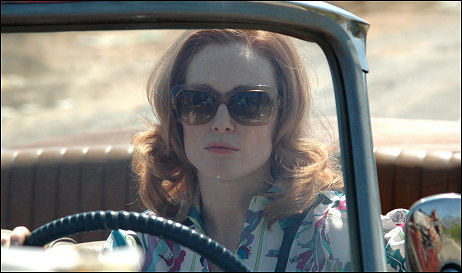
Variety‘s Todd McCarthy reported at 9:30 pm this evening that Clint Eastwood‘s Changeling (Universal, 11.8), a 1920s mystery drama with Angelina Jolie, John Malkovich, Amy Ryan and Colm Feore, will compete at next month’s Cannes Film Festival.

With the official Cannes announcement due tomorrow morning, McCarthy also revealed three other surprises:
(a) Woody Allen‘s Vicky Cristina Barcelona, which stars Penelope Cruz, Scarlett Johansson and Javier Bardem, “will appear in Cannes after all, with Allen attending the fest over the initial weekend.”
(b) There may be a sliver of sunshine peeking through the clouds regarding the reported not-quite-ready situation concerning Steven Soderbergh‘s two Che Guevara films, The Argentine and Guerilla. “No one is saying the situation has definitely changed, but the competition schedule is being left flexible enough to accommodate Soderbergh in case he decides the films are in shape to present to the public — a result for which Cannes programmers have evidently been given some reason to hope,” McCarthy wrote.
(c) Barry Levinson‘s widely reviled What Just Happened? may not close the festival, despite an earlier report that it would.

Nazi Blahs

Due respect, but Michael Cieply‘s 4.23 N.Y. Times story about Tom Cruise and Paula Wagner‘s Valkyrie — twice-delayed and presumed to be troubled — adds next to nothing to the story.

All it does is (a) offer a cursory sum-up of the situation that followed the announcement of the second push-back on 4.8.08 (Cieply believes that negative web reaction was the most noteworthy aspect) and (b) allows Wagner to sound tough and resolute with statements like “we will not be daunted,” “anybody trying to dismiss us or write us off doesn’t understand the business,” “nothing is going to stop us” and “we are determined to make this work.”
I obviously know what this sounds like, but I feel that the piece I threw together on August 9th provided a more interesting photograph of things as they seemed to stand 14 days ago than Cieply’s piece does now at looking back and reviewing the hoo-hah.

Late-Arriving Spies

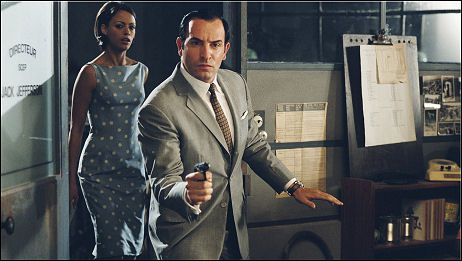
I was disappointed after missing a screening of OSS 117: Cairo, Nest of Spies, a French- produced James Bond/Austin Powers spy satire, at the Seattle Film Festival in June 2006. It had opened to great reviews and strong business in France two months earlier, and it seemed like all the rage. (As far as a French- made film can be said to be the rage of anything.) A year and a half later it played at the St. Louis International Film Festival.

And now it’s here…almost. But too late! A little more than two weeks hence (i.e., on May 9th), it will finally open commercially in this country. I’m sitting here and I’m going, “They expect me to feel enthusiasm about an ’06 movie?” It should have at least opened last summer. The current has wound down. Flatline.

Closer

5:52 pm Update: First it was “too close to call,” then “too early to call” and now Pensylvania has been called a Clinton win with — right now — a 10% margin, 55% to 45% in her favor. If the margin of victory doesn’t go down to 5% or 6% or 7%, it’ll be a bit of an Obama bummer. Were those exit polls indicating a 4% margin between Clinton and Obama — 52 to 48 — anywhere near accurate?

“Whuhht?…naaah”

Answer the following after watching this trailer for The Wackness (Sony Classics, 7.3). Josh Peck obviously does well at playing young urban white guys who talk in a street argot that is part imitation “black” and part whatevuh but in any case suggests a total inability to convey an air of refinement and higher education. But answer me this…

Is there any circumstance in which any casting director, no matter how whacked, would use this guy to play a small-town cop in Oregon, an assistant to a U.S. Senator, a young suburban dad, a used-car salesmen from Cranford, New Jersey, or anything other than a what-up homie who sells tabs of ecstasy and dilaudid in Tompkins Square Park?
In other words, Josh Peck is basically Leo Gorcey. Nothing wrong with that, exactly, except that he has one trick and one rap and thassall.

Proof in the Pudding

If I were totally alone in my galumph-aversion to Forgetting Sarah Marshall‘s Jason Segel, would Universal have taken his face off the film’s posters? Segel told David Letterman last Friday night that “they tested posters with my face on them and there was an unfavorable reaction to my face. I’m not quite good-looking enough to be the good-looking guy, but I’m not bad-looking enough to be the hilarious guy.” Obviously there’s a silent majority out there that feels the same pain.

All in the Family

Any film about sexual obsession and kinky-deranged inclinations has to have attractive actors — no ifs, ands or buts. That means you keep things within….how to say it?…somewhat conventionally appealing limits, which means steering clear of dweeby-looking actors with boney bods, pale freckly skin and red hair with that “just arrived from the Planet Uranus” look in their eyes. In this respect, Julianne Moore as the notorious Barbara Daly Baekland works just fine, but Eddie Redmayne as her totally weird son Antony does not.

Here’s the trailer.
The IMDB keywords for Tom Kalin’s film (IFC First Take, 5.30) are “masturbation,” “hand job, ” “incest,” “mother-son incest” and “woman on top.” The Wikipedia entry on the late Ms. Baekland says it all. To be honest and comprehensive about it, I should also mention that any film costarring Stephen Dillane presents a problem for me. (For me, the only digestible Dillane performance — recently, I mean — has been his Thomas Jefferson in HBO’s John Adams miniseries.)

Recession Preems

I suggested yesterday that Envelope columnist Elizabeth Snead should have attempted an explanation why the Sex and the City is blowing off a big-ass debut screening at the Cannes Film Festival in favor of one in London, especially since Sarah Jessica Parker said Cannes was a possibility in a Snead article that ran on 3.14.
Today Snead ran a portion of an interview with an anonymous Warner Bros. insider, who offered at least a partial answer to the London-not-Cannes question. “A WB insider who refused to go on record told me, ‘One word: recession,'” Snead wrote,. “[The source added] that movie studios were feeling the pinch of a devalued U.S. dollar and that a Cannes fete done right would be far more costly than a red carpet event in London.”
I don’t believe this is the entire reason for one shaved millisecond. There’s no doubting the fact that Cannes is going to be horrifically expensive for everyone this year, but London is no cheap deal either. Everything hurts when you’re in London. I was there last March and I know. It’s just as bad as France. So if you ask me the “London is cheaper” explanation is at least partly bullshit.

Dignity Out The Window

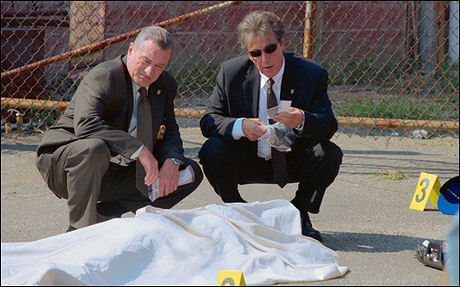
Laments about the once-great Robert De Niro and Al Pacino having sold their souls for a series of straight-paycheck performances in a string of shitty films is an old tune ’round these parts. (I mentioned it in a recent item about De Niro’s humorous remarks at the Meryl Streep tribute, and in this March riff about the Righteous Kill trailer.) And now L.A. Times columnist Patrick Goldstein has jumped on the bandwagon.

“[These] two icons of ’70s New Hollywood, heroes to a generation of young actors and filmmakers, have become parodies of themselves,” he writes, “making payday movies and turning in performances that are hollow echoes of the electrically charged work they did in such films as Serpico, Dog Day Afternoon, Mean Streets and Taxi Driver.
“I don’t envy Pacino or De Niro. They’re in a bind, having come of age at a time when actors could still get provocative dramas made without everyone having to work for peanuts. Today they’re grumpy old men, relegated to raking in loot from cartoonish comedy and generic thrillers.”

As Long As It’s Truthful

Last Thursday evening And The Winner Is blogger Scott Feinberg attended some kind of official North American premiere of Errol MorrisStandard Operating Procedure (4/25, Sony Pictures Classics) at Brandeis University. He posted an obviously positive reaction to the film this morning, but he also included what may be regarded in some circles as a sticky-wicket graph that gets into the fact that Morris paid the doc’s interview subjects — specifically the Abu Ghraib prison veterans who tortured and humiliated their Iraqi prisoners (and who were dumb enough to take dozens of photos of these acts).
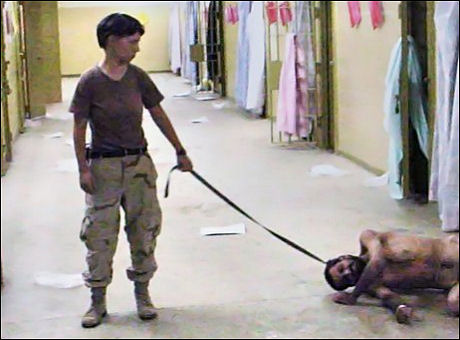
I don’t have a problem with Morris having paid money to induce these people to talk. Notebook reporters can’t pay for information — that’s completely out and always has been — but documentaries are a different matter, I feel. As long as what the subject says to the documentarian can be verified to be a portion of absolute truth and nothing but, I don’t see the problem.
Everyone who talks to a journalist or TV reporter or a documentary filmmaker about an important or hot-button subject does so because they’ve decided there’s something in it for them. This is how it works every time. For some it’s wanting to be briefly famous. For some it’s wanting to elevate their media profile — to be regarded as a player of some importance. Others talk in order to make themselves look better, smarter or less odious if the story in question is some kind of negative expose. Others talk in order to settle a score with someone else — payback — or because the interview subject feels he/she was “right” and that persons they’re speaking about were “wrong” in a reported situation, and they want people to consider their viewpoint.
The Abu Ghraib veterans probably said to themselves, “Why should I talk? I’m just going to look like a fool and a degenerate and my grandchildren and great-grandchildren are going to see this film someday and they’ll see me in this light also, so why should I talk?” And then Morris (or somebody working for him) put some cash on the table to cover this or that expense and these people thought it over and said to themselves, “Okay, now I’m getting a little something out of this so I guess I’ll talk.”
Here‘s how Feinberg relates the issue and how it was answered: “I was a bit surprised by the answer that Morris gave to one question about the interviews after the film. The questioner, a noted journalist, asked Morris how he convinced these notorious figures to agree to be interviewed for his film, and specifically if he paid them at all, ‘which is not okay in my profession.’ Morris eventually acknowledged that he did, in fact, pay his interview subjects, jokingly explaining that he did so because ‘I have a lot of money and want to share it’; he did not disclose an amount of money or if this is his standard practice.
“I, frankly, don’t really have a problem with this — it got these people to sit down and talk about their behavior, and I don’t see how it would in any way encourage them to speak anything other than the truth — except for the fact that, to the best of my knowledge, this compensation was not openly acknowledged, as it should have been since this is a documentary that purports not to have any agenda other than seeking the truth, and in my estimation does not.
“Because Morris did not do so, those who wish to disparage SOP, for whatever reason,will latch onto this as evidence of some secret agenda, just as they have done in response to his use of re-enactments in his films, including this one.”
Here’s Morris’s statement on this:
“As documentaries have become more and more mainstream entertainment, people are aware that there is money involved. The more successful documentaries become, the harder and harder it is to get people to do them for nothing.
“People [are] aware of my success and respond accordingly. I never paid people for the interviews in The Thin Blue Line, but Stephen Hawking was paid a lot of money for the rights to his book and his participation in A Brief History of Time. Fred Leuchter was paid when I asked him to appear in several scenes, e.g., the scene of him riding up and down in a van de Graff generator at the Boston Museum of Science. I did not pay him for the interview, but if he had insisted I might have done so. McNamara was not paid a fee for The Fog of War, but of course we paid his travel and hotel. Why wouldn’t we?
“The professor who asked the question at Brandeis is a print journalist. I don’t know if she has ever done a seventeen-hour interview over two days, as I did with Janis Karpinski. I didn’t pay Karpinski, but we paid for hotel, travel and per diem. It is customary in the motion picture business. To do [otherwise] would be (I believe) unconscionable. It is difficult to ask people for such an investment of time without taking care of them in some way — and that may involve paying them.
“I paid the ‘bad apples’ because they asked to be paid, and they would not have been interviewed otherwise. Without these extensive interviews, no one would ever know their stories. I can live with it.”
There’s a discrepancy in that Feinberg has reported that Morris said last Thursday that he “paid” his subjects and Morris saying he didn’t “pay” them but covered their hotel, travel and per diem. I’m sure this will be cleared up later today but even if Morris had paid them a flat fee in exchange for spilling, it would be okay in my book because (a) documentaries are different than news stories and (b) everybody wants something — it’s the way of the world. What matters is whether or not the subject passes along a portion of verifiable truth.