It Came From Our National Psyche

“In a way, what Cloverfield does is put a name on the unthinkable,” director Matt Reeves tells L.A. Times guy Mark Olsen in a piece posted yesterday afternoon. He’s alluding to the 9.11 echoes — collapsing skyscrapers, mass evacuations across the Brooklyn Bridge, travelling dustclouds engulfing downtown streets — that makes the film “a repository for the collective unease felt in the wake of a national tragedy,” as Olsen puts it.
It’s intended, in other words, “to explore the very real and obvious fears we are all living with everyday, to let the audience have the experience but in a much more safe and manageable way,” says producer JJ Abrams.
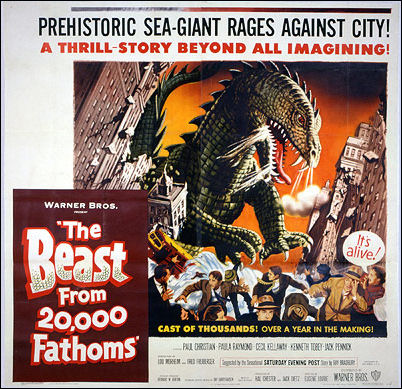
But the subhead of Olsen’s piece — “JJ Abrams aims to provide an old-time rush” — is way off. The basic concept aside, there’s little about this film that stirs specific memories of rampaging monster flicks from the ’50s — those black-and-white B classics like The Beast From 20,000 Fathoms or It Came From Beneath The Sea — or the color-photographed Japanese variants of the late ’50s and ’60s.
As I suggested last week in my inital review, Cloverfield is significantly different from those stop-motion or guy-in-a-monster-suit movies in two ways.
The old monster films were chock-a-block with attempts at rational explanations for the invasion (a beast awakened from a primordial sleep by nuclear testing, etc.) while the characters in Cloverfield don’t know anything and in fact barely get around to asking questions. (There’s one half-assed moment in which the actors try to piece it all together, but the dialogue is in the vein of “whoa, Wikipedia, dude.”)

And the old-time old monster flicks were always about prehistoric-looking beasts or variations thereof — King Kong, Rodan, Mothra, Gorgo, etc. The titanic Cloverfield brute is so divorced from this tradition and in fact is so “nonsensical” that he/she/it stirs associations that are more surreal than anything else. It’s more “whaat?” than “oh my God!,” this thing.
It’s almost a monster film by way of Luis Bunuel. I wrote before that the title could be It Came From Somewhere Deep in the National Psyche, but what we actually see is like a young boy’s nightmare or, as I wrote last week, like a half-nutty, half-horrible dream in the head of a Manhattanite on the morning on 9.12.01.
“I believe there are a whole lot of people who want to have that kind of catharsis and who don’t necessarily want to see documentaries about the very issues they are grappling with internally,” Abrams tells Olsen.

Brad Renfro, 25, is dead

TMZ is reporting that Brad Renfro, 25, was found dead at his Los Angeles home this morning. No cause determined, but it’s well known that the poor guy had grappled with drug problems (smack being one of the substances) for a long while. The report says Renfro “had been working valiantly to stay clean, especially since [last] summer.”

Renfro had recently completed filming The Informers, a Gregor Jordan film based on a Brett Easton Ellis novel set in the ’80s. His costars were/are Winona Ryder, Billy Bob Thornton, Kim Basinger, Mickey Rourke and Brandon Routh.
Renfro “has had a rough time personally since moving from Tennessee to Los Angeles,” the report says. “His parents split, and we’re told he did not have real guidance from adults as he tried navigating the treacherous movie industry.”
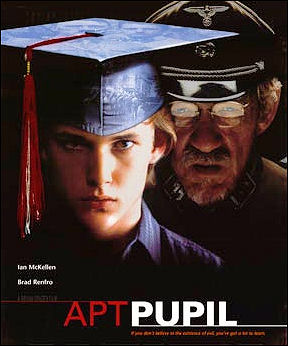
Renfro first splash was in Joel Schumacher‘s The Client (’94), but his breakout role — performance-wise — was in Bryan Singer‘s Apt Pupil (’98), which he shot when he was 15 or thereabouts. His last decent film was Terry Zwigoff‘s Ghost World, which was released six years ago.

Foundas on “4 Months” Shafting Debacle

“Tuesday, January 15, 2008 — a date that shall live in Academy Awards infamy,” writes L.A. Weekly critic Scott Foundas in a piece titled “How Do You Say ‘Oscar Scandal’ in Romanian?” He’s referring to the shafting earlier today of Cristian Mungiu‘s 4 Months, 3 Weeks and 2 Days by the Academy’s foreign-language committee.

“I’ve had better days,” producer and Foreign Language nominating committee chairman Mark Johnson told Foundas late this afternoon. Referring to a recently instituted two-phase nominating process, Johnson said, “I thought we had made big strides last year, but apparently not big enough.”
When Foundas asked if “further retooling (including the possible involvement of more active Academy members earlier in the nominating process) may lie in the future” — code for 86ing the geriatric fuddy-duds whose aesthetic taste buds have obviously become a problem — Johnson was unambiguous. “That’s what has to be done, because in my mind it can’t continue like this. I don’t believe these choices reflect the Academy at large.”

BAFTA nominations

The BAFTA nominations will be announced tomorrow morning — Wednesday, 1.16 — at 7:40 am London time, or 11:40 pm tonight in Los Angeles. Some kind of announcement ceremony in the vein of the Oscar noms. They’ll be online at www.bafta.org after the lah-dee-dah is finished.

Tubercular Friar Tuck

If you’re going to link to a piece in which an EW guest columnist (Juno screenwriter Diablo Cody) complains about what she feels is an unflattering drawing, as Red Carpet District‘s Kris Tapley did this morning, shouldn’t you show readers what she’s on about?

“Direct your gaze, if you will, to the illustration (or ‘illo,’ as they say in the publishing game) in the center of this page,” she writes. “That black-lipped, beady-eyed ghoul is supposed to be me!
“Now, I’m hardly the cutest columnist to occupy this space, but I had no idea I resembled a tubercular Friar Tuck with sperm for eyebrows. You hear that whistling sound? That’s my self-esteem plummeting from ‘obscene” to ”healthy.’ Perhaps this is EW‘s concession to readers who complain that Stephen King’s column isn’t scary.”

R.I.P, Dear “Sweeney”

“R.I.P, dear Sweeney,” writes The Envelope‘s Tom O’Neil, having finally accepted that Tim Burton‘s film will not be a Best Picture nominee. “Put your razor away. You reaped your revenge on screen and history will hail Burton’s genius in future years, as many film critics and filmgoers appreciate it now ($41 million so far — $2 million more than Michael Clayton).
“Who knew that the cutthroat Hollywood crowd would turn away so squeamishly from a little cartoonish blood when they spill so much more of the real stuff down studio halls every day? You will have ultimate revenge again, my friend.
“Just not at the Oscars and you are in good company. Other masterworks snubbed for best picture: The African Queen, East of Eden, Psycho, Some Like It Hot, A Star Is Born, 2001: A Space Odyssey and Whatever Happened to Baby Jane?. Oh, yes, and Dreamgirls.”

“Private Ryan” on the cheap

I hate the obnoxious soundtrack to this little here’s-how-it’s-done video — just turn off the sound entirely. But it shows again how just a few guys with the right digital software can make a big Saving Private Ryan/Longest Day-type movie for a lot less money. Just three actors played hundreds of soldiers, and the digi-vid tools were all consumer-grade.

I prefer organic reality. I can usually smell digital manipulation and the odor, for me, isn’t appealing. But this video does makes you believe that more and more indie low-ballers are going to find it within their power to make films that will look and sound nearly as high-grade as studio product, and once they can get themselves a delivery system that will shoot their stuff over high-speed internet connections and right into TVs, they’ll be playing on a relatively level playing field with the big distributors, which means that the power that the big guys have had all these decades is sure to gradually diminish.

A solution in sight for WGA strike?

If a deal between the Director Guild and the Alliance of Motion Picture & Televison Producers is indeed “imminent” — a term used in a 1.15 story by Hollywood Reporter‘s Carl DiOrio, and perhaps referring to next week, which is when the next negotiating session is set to take place — will the Writers Guild negotiators take this deal also, which will bring the strike to an end?
DiOrio wrote that “Hollywood has the collective sense that the DGA and the Alliance of Motion Picture & Television Producers (AMPTP) will quickly hammer out a new contract to replace the pact set to expire June 30.”
Doesn’t the Apple TV idea — digitally providing movies straight to the tube via a high-speed internet connection — open things up considerably? The whole world, I mean? DVD and Blu-Ray are now looking at the end of the road. In ten years or so (perhaps sooner) it’ll all be digital downloads straight to your television. WGA and DGA members now receive penny-ante payments from the number of DVDs sold to retailers…right? Shouldn’t everyone be looking at rates based on digital downloads on this or that film? Won’t this be the basic commercial magilla sooner or later?
It’ll all come down to how insultingly low a revenue percentage will the AMPTP offer the WGA. Probably something between 1% and 2%, I’m guessing. If the DGA takes something along these lines, the WGA will have to go with this also…no?

Apple TV announced by Jobs

Yesterday at the Macworld Expo Apple honcho Steve Jobs announced a decision to jump into online movie rentals with Apple TV. All six major distributors will provide flicks to service subscribers, sending them via high-speed internet right into the the living-room tube. The films won’t be downloadable, however, until 30 days after they’re released on DVD.

“With Apple TV, you don√ɬ¢√¢‚Äö¬¨√¢‚Äû¬¢t need a computer to rent digital movies — you rent them directly from your TV,” the website reads. “The completely redesigned Apple TV interface makes it easy to browse, rent, and watch movies from every major Hollywood studio. Best of all, you get instant movie gratification. Without losing your spot on the sofa.”