

Hollywood Chicago‘s Adam Fendelman talking recently to a subdued, almost whispery John Cusack about Grace is Gone.
Lewis on that final wham
There Will Be Blood star Daniel Day Lewis speaking to the N.Y. Observer‘s Sarah Vilkomerson about the film’s startling ending: “To me, the symmetry was absolutely right. It may be outrageous, that last scene, but to me it seemed absolutely right. I love that there’s an exuberance to it.”
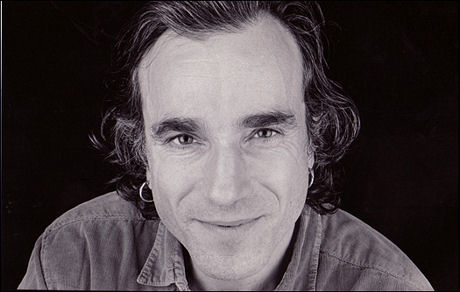
Exuburance…absolutely. But this scene wouldn’t work without that final period, that final “Day in the Life” chord, that All The President’s Men typewriter-key wham: “I’m finished.” (And no, this is nothing like a spoiler. You can say these words when you’ve finished eating or watching a film, when you’re ready to go to bed, when you’ve fucked up royally or when you’ve finally completed a great task. Context is everything.)
And this: “Paul [Thomas Anderson] thought we were making a blockbuster. I thought we were making a film that would have us sort of drummed out of town with bell, book and candle. So I feel we’re going to achieve some kind of middle ground. It’s just so great Paul thought that. I just love it: There’s no woman, no romance, no nothing — just fucking filthy guys digging holes in the ground.”
Cates projections about Oscar show
Statement #1 by Oscar show producer Gil Cates to USA Today‘s Anthony Breznican, spoken last Friday: “The only thing I can tell you without any equivocation is that the [Oscar] show is going to go on. That’s absolutely for certain.”
Cates statement #2, spoken two days ago: “It’s my fondest hope that the strike will be over by [2.24.08].
SAG nominations
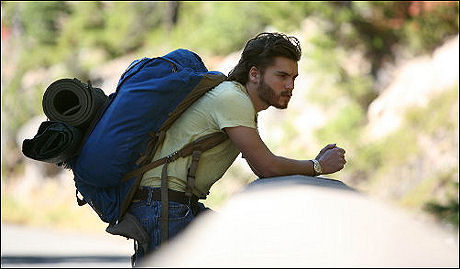
The Screen Actors Guild award nominations …blah, blah. No surprises, no startling calls….everything pre-digested, pre-approved, pre-vetted. Four noms for Into the Wild — Emile Hirsch (Best Actor), Hal Holbrook (Best Supporting Actor), Catherine Keener (Best Supporting Actress) and Best Ensemble Cast. This is nonetheless the biggest uptick for Wild since the season began.
No Country for Old Men got Best Ensemble Cast plus one each for Tommy Lee Jones and Javier Bardem (Best Supporting Actor), and three Michael Clayton players were honored — George Clooney (Best Actor), Tom Wilkinson (Best Supporting Actor) and Tilda Swinton (Best Supporting Actress).
Other totally expected standout noms: Daniel Day-Lewis (Best Actor, There Will Be Blood…deserved), Cate Blanchett (Best Actress for Elizabeth: The Golden Age…c’mon!), Julie Christie (Best Actress, Away From Her), Marion Cotillard (La Vie en Rose), Angelina Jolie (Best Actress, A Mighty Heart), Ellen Page (Best Actress, Juno), Cate Blanchett (Best Supporting Actress, I’m Not There…naturally), Amy Ryan (Best Supporting Actress, Gone Baby Gone).
Del Toro and Jackson
Yesterday afternoon Entertainment Weekly‘s Missy Schwartz posted a chat with director Guillermo del Toro about the possibility of his directing the two Hobbit movies for producer Peter Jackson. Del Toro said he’s “heard some rumblings but nothing official. I don’t want to think about it because it’s such an eventuality.”

And may it go no further than that. Del Toro is way, way above Jackson’s class — his work has steadily matured, becoming cleaner, richer and more confident, with each new film. Jackson hasn’t advanced a single aesthetic notch since Braindead. He’s about two things and two things only — “look at what I can do!” and “wheeee!” He’d only cramp Del Toro’s vision and style.
The Hobbit “is the only Tolkien book I read,” Del Toro said. “I tried my best to read Lord of the Rings, the trilogy. I could not. I could not. They were very dense. And then one day, I bought The Hobbit. I read it and I loved it. So it would be a privilege. But listen, I wish I knew. At this stage, after Hellboy II, I’m unemployed!
“I met Peter and Fran [Walsh, Jackson’s life/creative partner] when we were trying to do Halo. I think what they’re doing in New Zealand is amazing. What they√ɬ¢√¢‚Äö¬¨√¢‚Äû¬¢re doing, in terms of the way they approach filmmaking — the way I see it is, it’s Hollywood the way God intended it. Because it’s a filmmaker’s dream and a filmmaker’s facility. So it’s heaven. The question is: Will I go to heaven? I have no idea.”
Schwartz says that “the idea of you and Peter Jackson working together is enough to make every geek’s head explode” and Del Toro says, “It would make my head explode! But you know, I think it’s an eventuality. I would love to, but as my agent says, ‘You’re currently unemployed.'”
Testy Little Spat
Here’s a testy little spat between The Envelope‘s Tom O’Neil and Oscar show producer Gil Cates about the possible effects of the WGA strike upon the late January Golden Globes awards and the 2.24.08 Oscar show.
“Awards shows are the best chance that writers have to prove how valuable they are,” O’Neil said in a 12.18 AP story. “Without a script, we may finally find out how vapid and empty these stars really are. The awards shows will have no choice but to go on with the show, but not the telecast.”
“That’s totally ridiculous!,” Cates replied in the same damn story. “There will absolutely be a (televised) show one way or another. There are awards to give out.” And miles to go before I sleep!
O’Neil has pointed to the radical change being planned by the January 8th Peoples’ Choice Awards, which “will present a show that the nominees and winners don’t have to attend with winners being taped ahead of time at remote locations. There will be no red carpet and arrivals. And no suspense about who wins. But there’s never been any suspense surrounding who claims the Peoples’ Choice Awards. Winners have always been tipped off ahead of time.
“Thus, it’s not a suspense-driven awards show like the Oscars, Golden Globes, Grammys and Emmys. So such a retooled show is probably not an option for the other kudos.”
O’Neil also reminds that 30 Rock writer Brett Baer said in the same AP article that the guild is aiming specifically at kudos shows, saying, ‘If we could shut down the awards shows, that would be great.’
“Mr. Cates, why do you think the Oscars will be different?”
Clinton vs. Obama Xmas ads
Of all the Xmas presidential front-runner ads, I have to admit that Hilary Clinton‘s is a tiny bit craftier — idea, production values, acting (i.e., lines that don’t demand too much emoting), no “C” word — than Barack Obama‘s, although Barack’s is certainly warmer and more comforting.
Fincher on story permutations
“There’s this whole school of thought that movies are always so great when you’re 10 or 12 years old, and the reality of it is, when you’re 10 or 12 years old, you’ve only seen 100 stories. By the time you get to be 25, you’ve seen 3,000. You’ve seen every permutation of every dramatic arc. And when somebody takes that and stands it on its head, that can be exciting.” — Zodiac director David Fincher to Variety‘s Justin Chang.
Spears’ parenting book cancelled
“Lynne Spears‘ book about parenting has been delayed indefinitely, her publisher said Wednesday. Lindsey Nobles, a spokeswoman for Christian book publisher Thomas Nelson Inc., said that the memoir by the mother of Britney Spears was put on hold last week. She declined to comment on whether the delay was connected to the revelation that Spears’ 16-year-old daughter, Jamie Lynn, is pregnant.”
“Vulture” synchronicity
It’s comforting to read that New York‘s “Vulture” column shares at least some of my advance loathing for Peter Jackson‘s two Hobbit movies (“So, uh, great — the sequel’s going to be some Silmarillion- inspired filler crap, like all those scenes of Aragorn and Arwen pitching woo at each other, except not written by Jackson? Count us out.”) And also that they’ve picked up on my thought about Juno‘s Oscar chances possibly being affected by the real-life pregnancy of 16 year-old Jamie Lynn Spears and…uhm, Lily Allen.
Henry Lowe’s fate
I’ve noticed an interesting difference between a late work-print version of Denzel Washington‘s The Great Debaters that I saw a few weeks ago and the release- print version that I saw last night at Harvard University. It’s a big change regarding the fate of Nate Parker‘s Henry Lowe character — the most charismatic and gifted Wiley College debater, although one with an occasional weakness for booze and women.
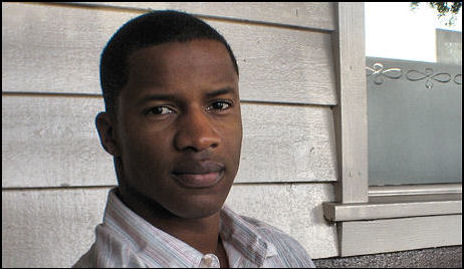
Nate Parker, snapped during a West Hollywood HE interview in late November
In the work-print version of the epilogue crawl (i.e., the what-happened-to-the- characters info that fact-based dramas often supply), it said that after graduating Lowe simply disappeared — an indication that he may have succumbed to his addictions, etc. It seemed like an interesting call since inspirational films usually pass along uplifting information, blah blah. Lowe is a composite character (i.e., not based on a specific real-life figure) so Washington was free to write any fate he chose. Saying that Lowe didn’t build upon the potential of his early life was, at the very least, against the grain and admirable for that.
But this dark-fate decision, apparently, didn’t go down with research audiences. In the final-release version, it is said that Lowe went into the ministry — an obvious hint that he turned to God and the cloth as a way of controlling his demons. A more upbeat and positive fate, yes, but an indication of a certain artistic flexibility on Washington’s part. This is a small thing I’m mentioning. The Great Debaters is still sharply written, forthright, not sappy, well-shaped. It’s “commercial” and likely to catch on. (Probably.) It’s just that conveying Lowe’s downbeat fate added an interesting counter-shade.
The good-looking Parker gives the most vivid performance in The Great Debaters. He comes off as confident, centered…settled into himself. The guy most likely to get a bounce off this film, I’m betting.
The only real-life, history-based debater in the film is James Farmer, Jr. (Denzel Whitaker), who went on in real life to found the Congress of Racial Equality and become a major civil-rights movement leader.