Lane on “Sunshine”

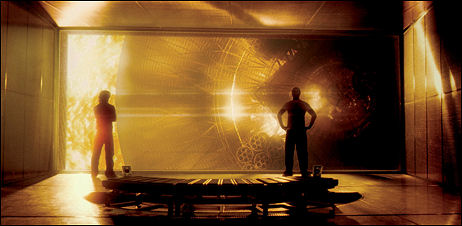
Danny Boyle‘s “change of tack” at the end of Sunshine (Fox Searchlight, 7.20) “feels jagged with impatience and panic,” writes New Yorker critic Anthony Lane in one of the best-written critiques of this interesting but enormously infuriating sci-fier that I’ve read anywhere. (It’s suddenly hit me that I haven’t posted a word myself — sometimes I just turn away and say nothing when a film seems as shockingly miscalculated as this one.)

“Villainy descends upon the spaceship, but so pressing is the question of why and how it got there, and what factor sun cream it must have been lathering on, that Boyle tries to disguise the uncertainty with visual effects, smearing almost every shot into a distorted haze.
“Beware of filmmakers who shy from clarity just when we need it most, and ask yourself what happened to the Boyle who offered that unflinching view of drug abuse in Trainspotting, with its scabrous highs. He has not so much taken leave of his senses, I think, as allowed them to overwhelm him. Blame it on the sunshine.”

Spielberg, China, Darfur, Steidle

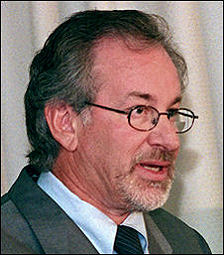
That 7.26 ABC News story by Russell Goldman stating that Steven Spielberg “may quit his post as artistic adviser to the 2008 Beijing Olympics unless China takes a harder line against Sudan” has so far been disputed twice — in a piece yesterday by Deadline Hollywood Daily‘s Nikki Finke, and in a portion of an audio interview I posted earlier this week with The Devil Came on Horseback spokesperson/figurehead Brian Steidle.
In that Tuesday, 2.24 interview I asked Steidle about the Spielberg/Beijing Games/Darfur situation, and he said that he and other Darfur experts had sat down with Spielberg several weeks back and had gone over everything, and that their recommendation was that Spielberg not quit his post as creative director of the ’08 Olympic Games (the thought being that the Chinese don’t respond to ultimatums) and that he should use the position to press quiet but forceful diplomacy upon Beijing. He said that Spielberg seemed more or less inclined to follow their advice.
The topic comes up almost exactly at the halfway point, i.e., just above the play button.

Kubrick Collection coming

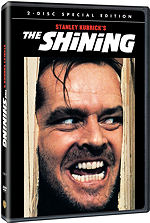
Warner Home Video will release a nine-disc “Director Series: Stanley Kubrick Collection” on 10.23.07. New two-disc special editions of 2001: A Space Odyssey, A Clockwork Orange, Eyes Wide Shut and The Shining as well as a “deluxe edition” of Full Metal Jacket (which would be…?). Also included: the doc called Stanley Kubrick: A Life in Pictures. The whole kit ‘n’ kaboodle with set you back $79.92, but titles will also be sold individually for $26.99 a throw.

“Red Dawn” returns

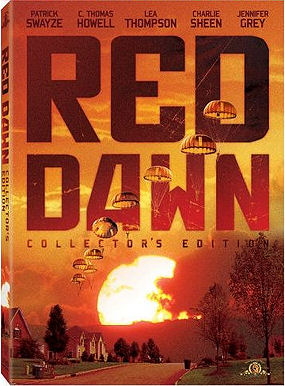
Ruthless, ogre-ish, heavily-armed invaders descend from the sky, take over the reins of government, and before you know it rebel groups are forming into grass-roots militias, fighting back like proud guerillas and asserting their nativist rights — this is our country! Death to the invaders! Death before submission! Does this like, uhm.. remind anyone of anything?

This double-disc DVD of John Milius’ Red Dawn hit stores on 7.17. Do you think the MGM/UA Home Video guys had any ideas about present-day parallels, or were they just after some 20th anniversary bucks? I once asked Milius himself about the Iraqi rebellion angle — he didn’t bite, but he didn’t strenuously argue it either.

Karen Allen in “Indy IV”

An MTV.com observer at today’s Paramount panel at Comic-Con reports that Karen Allen appeared on a video feed earlier this afternoon to confirm that she’ll have some kind of supporting or cameo role in Indiana Jones IV.


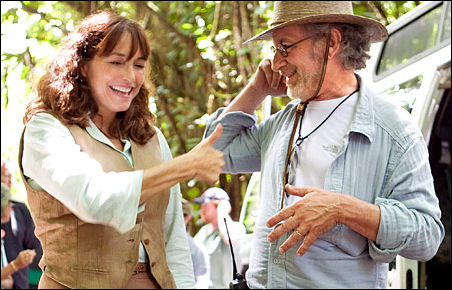
Spielberg and Allen on Indy IV set in Hawaii.

Steven Spielberg, Harrison Ford, Shia LaBeouf and Ray Winstone “were all appearing via satellite when Spielberg left the scene for a moment to [grab] another director’s chair. He came back with a chair with Marion Ravenwood written on it, and of course the crowd went bananas” — bananas? — “and then out came Allen to talk briefly about her return to the series.”
One of my most excruciating movie-watching memories of all time is listening to Allen go “Indiiieee!” in Raiders of the Lost Ark. I saw that movie three or four times during the summer of ’81 (loved it) but Allen’s distress squeal made the second, third and fourth viewings something of a mixed bag.

Iklipz Lindsay Lohan Lohan

A brilliantly edited spoof trailer for I Know Who Killed My Career, the Lindsay Lohan film that ought to be opening this weekend, by an outfit called the Mashturbators (who don’t have their own website). Should have had this up earlier. Sitting on Iklipz.com.

Farrow vs. Spielberg

Mia Farrow has told Slate‘s Kim Masters why she submitted that blistering public letter last March to Steven Spielberg (via a Wall Street Journal article) about how China’s bankrolling of the Darfur genocide might mean that his serving as artistic director for the 2008 Beijing Olympic Games would paint him with a Leni Reifenstahl brush.


Mia Farrow, Steven Spielberg

The short answer is that Farrow sent Spielberg two urgently-worded letters that were either (1) blocked by obsequious staffers or (b) were seen by Speilberg and duly ignored until Farrow submitted that now famous WSJ article that finally got his attention.
Masters reports that Farrow “had written Spielberg two letters several months before the op-ed piece appeared. In the first, she asked for advice on what to do with footage she had compiled on a visit to the Darfur region. Included was a photo album with handwritten annotations. ‘I used each photograph to convey the enormity of the situation and the staggering statistics,’ she says. ‘And I thought the faces that I showed him spoke so eloquently.’ That communication also contained information about China’s role in the crisis, she adds.
“Farrow got no response. Then she read that Spielberg was going to be an artistic director of the games. ‘I wrote him a letter of conscience saying I hoped he knew all these things,’ she says. ‘I really suggested he think twice. And then when I didn’t hear back, I had a vision of a box within a box within a box — that he has an office, and then there’s a real office behind that and maybe a really real office after that and maybe three letters a month actually get to him. So to be fair, maybe he didn’t get any of my letters.”
Wells to Farrow: Hey, maybe you’re right. Maybe Spielberg was too busy to give those letters a quick scan. Give him the benefit of the doubt, right? I think your first reaction was dead-on, though. He’s a guy who operates in such a deep and heavily protected membrane that the real world gets in only occasionally, and then only by luck or chance.
“[But] I’m on another time schedule where ten thousand people a month are dying. So you wait two weeks, that’s five thousand people right there. I just could not wait any longer. So the piece was born.”

“No End in Sight” review

“If failure, as the saying goes, is an orphan, then Charles Ferguson‘s No End in Sight can be thought of as a brief in a paternity suit, offering an emphatic, well-supported answer to a question that has already begun to be mooted on television talk shows and in journals of opinion: Who lost Iraq? On Mr. Ferguson√ɬ¢√¢‚Äö¬¨√¢‚Äû¬¢s short list are Donald Rumsfeld, Dick Cheney, Paul Wolfowitz and L. Paul Bremer III. None of them agreed to be interviewed for the film. Perhaps they will watch it.” — from A.O. Scott‘s 7.27 review in the N.Y. Times.


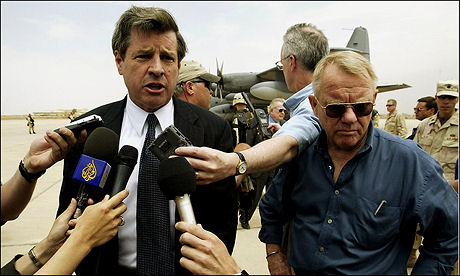
Bush administration boob & bad guy L. Paul Bremer III (l.) and retired Army general Jay Garner in Iraq in 2003

No heroes anywhere

“You’ve mentioned that your father served in WW II (Iwo Jima ,wasn’t it?). I wasn’t close to my father, but he served also. I may not have known him well, but he didn’t consider himself a hero, as I suspect your father didn’t. We may not always agree, but that’s the meaning I took upon reading your parenthetic on ‘Iraq war hero.’ I don’t think Audie Murphy considered himself a hero either.” — HE reader Chuck Wagner.

“Sweeney Todd” tremors

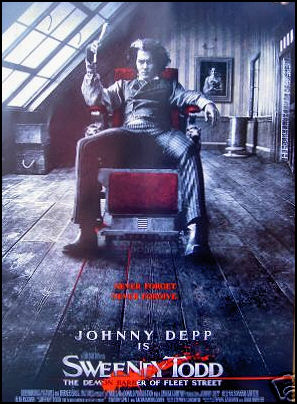
“Never forget, never forgive”? A slouching Johnny Depp in striped pants and a shock of white hair with a big straight razor? Tim Burton doing his usual indulgent production-design wallow with cooler-than-cool photography? Is this anyone’s idea of a likable slogan and an enticing “key” image for a big-studio, gotta-see-it, end-of-the-year musical?

I’ve seen Sweeney Todd twice on stage and enjoyed it greatly both times — it’s a brilliant work — but there’s something about the energy and attitude that this DreamWorks-funded film (opening 12.21.07) is putting out that I don’t much care for. Call me nuts, but this is translating into (I’m admitting it) a donkey-like resis- tance to the film, sight unseen. I’m not saying I can “tell” anything. Obviously I’m clueless about how the movie plays. Completely. I’m just being honest. Something about this film is dislikable.
I can’t quite figure what this is about except for my belief that Burton is over. Well, isn’t he? His last half-decent film was Sleepy Hollow, and that was eight years ago — two or three zeitgeists have come and gone since then. The appalling Planet of the Apes was the first harbinger of the downturn, Big Fish was under- whelming at best (it certainly didn’t come together emotionally), and if you ask me Charlie and the Chocolate Factory was poison. I’ve done no calling around, but something tells me others may be feeling the same way.
Every now and then an audacious, high-profile, summer or year-end movie gets beaten up and slapped around by everyone (straight press, bloggers, critics), and something’s telling me that Sweeney Todd is shaping up to be one of those punching bags — the Munich of musicals. I’m not trying to be a jerkwad. I’d seriously like to be wrong. I’d love to see Sweeney Todd work as a film musical. I’d like to see Burton come back. I’m just saying that three and half months out, something feels twitchy…not right.
This piece was triggered by a snap of a Sweeney Todd one- sheet that I received today. There’s no poster art sitting on the official website. I’ll admit that David Poland got me going about Sweeney Todd way back when he predicted last February that Depp “is a 95% bet to be nominated for Best Actor” for his lead performance in Burton’s film, but that was then and this is now.

Young People Fucking

“We both were looking to do something different. We both were single at the time, and we would compare these stories [about our personal lives]. We wanted to do a frank, romantic comedy about sex and relationships. Aaron Abrams is fond of saying romantic comedies usually end with a kiss. But for us, the really interesting stuff happens after the kiss.” — Vancouver-based director Martin Gero speaking about Young People Fucking, his $1.5 million feature that ThinkFilm has picked up, and which will launch Canada First! program at September’s Toronto Film Festival.
Does that title set off warning alarms with anyone out there? I don’t know squat about this movie — for all I know Gero is the new Francois Truffaut — but I’ve learned over the years that films with pistol-hot, attention-grabbing, hot-marquee titles can be worrisome.

Cieply Hollywood Iraq

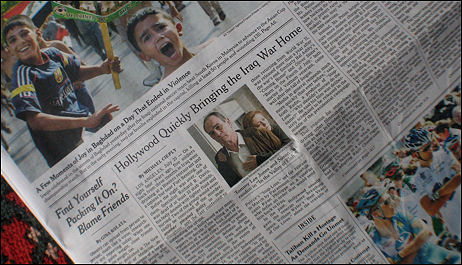
Paul Haggis‘s In The Valley of Elah (Warner Independent, 9.14) turns on an act of savage murder by a group of soldiers recently returned from the Iraq War, and the efforts of the father of a victim of this act (Tommy Lee Jones) to find out what the hell happened. In the view of N.Y. Times reporter Michael Cieply, Elah will be asking moviegoers “to decide if the killing is emblematic of a war gone bad.”
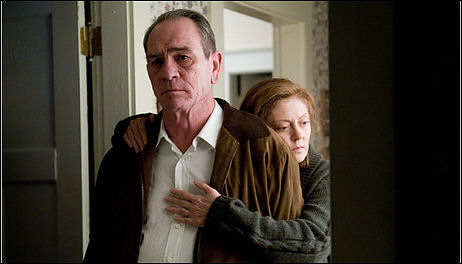

Tommy Lee Jones, Susan Sarandon in Paul Haggis‘s In The Valley of Elah

In a broader context, Cieply observes, this anti-war viewpoint puts Elah in the vanguard “of a new and perhaps risky willingness in the entertainment business to push even the touchiest debates about post-9/11 security, Iraq and the troops’ status from the confines of documentaries into the realm of mainstream political drama.”
Ciepley’s piece (titled “While Real Bullets Fly, Movies Bring War Home”), which appears on the front page of today’s Times and not the Arts section, reviews various upcoming Hollywood films that “use the damaged Iraq veteran to raise questions about a continuing war.”
In this light as well as own one of general “immediacy” he mentions Kimberly Pierce‘s Stop-Loss, Paul Greengrass‘s currently-preparing Imperial Life in the Emerald City, Brian De Palma‘s Redacted, James C. Strouse‘s Grace is Gone and Gavin Hood‘s Rendition.
Cieply doesn’t mention Kathryn Bigelow‘s The Hurt Locker, a film about an elite bomb squad unit in Iraq that’s either rolling right now or fiarly close to that status. And he doesn’t mention the Americans-in-Afghanistan films — Robert Redford‘s Lions for Lambs, Mike NicholsCharlie Wilson’s War, and Oliver Stone‘s planned movie of Jawbreaker. Or Peter Berg’s The Kingdom (FBI guys in Riyahd). Or Marc Forster‘s The Kite Runner, which is set in Kabul, spoken largely in Farsi, and, as far as I’ve been able to tell, doesn’t reflect upon political or cultural conflicts caused by or involving Americans at all…but then I haven’t read the book.
But “among the new films, Valley of Elah is sure to be one of the most closely examined,” Cieply says, “thanks to Mr. Haggis’s credentials — he shared an Oscar for writing Million Dollar Baby and was nominated for another as co-writer of Letters From Iwo Jima — and because of his opposition to United States policy in Iraq.”