Russell’s legacy vs. Doug Wick

David O. Russell will adapt and direct Sammy’s Hill, a film based on Kristin Gore‘s chick-lit, inside-the- Washington-beltway book about a single woman coping with romantic and job-pressure issues, and that’s good news all around. People forget from time to time how good Russell can be, and that real talent mitigates bad behavior. (My view is that loud profane arguments are not a problem if you’re up against Russell — the problem is when the yellers are second- and third-raters.)

But producer Doug Wick struck exactly the wrong chord when he told THR‘s Tatiana Siegel that Sammy’s Hill “will do for Washington, D.C., what Talladega Nights did for race car driving.”

What WIck should have said (and what I hope to God he really meant) is that Sammy’s Hill will do for Washington, D.C. relationships and power games what Russell’s Flirting With Disaster did to illuminate late ’90s relationships and anxieties. You really can’t get farther away from the smart, subversive spirit of David O. Russell than to mention an oafish, blue-collar comedy like Talledega Nights…I mean, c’mon.

“We are going for a bold, subversive comedy,” Wick elaborated, “and David O. Russell is one of the most original voices working in comedy.” Fine and good.

Russell is “working closely” with Kristin Gore (i.e., Al Gore‘s daughter), Dave Jeser and Matt Silverstein on the screenplay, writes Siegel. Wick and Lucy Fisher are producing. Sony suits Matt Tolmach and Rachel O’Connor are overseeing for the studio, and Rachel Shane is “shepherding” the project (i.e., she personally relates to the book, knows Gore, provided the relationship hook-up, urged the optioning/buying of rights) for Wick and Fisher’s Red Wagon.

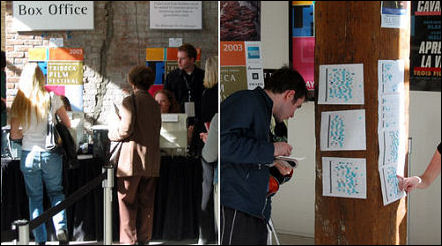
Tribeca Film Festival costs too much

“The price of a ticket at the emerging Tribeca Film Festival is increasing by 50% this year,” reports Indiewire’s Eugene Hernandez. “While most tickets for last year’s festival were sold for $12, this year tickets for the majority of screenings are priced at $18” — a higher per-ducat price than at any other major American film festival .” The TFF launched on the spirit of downtown recovery from 9.11.01, but now it has a new rep — the nation’s most avaricious and money-grubbing film festival.

“The price of seeing a movie at the Tribeca Film Festival is increasing dramatically in an area of New York City where the cost of daily life seems to be on a continual incline,” Fernandez writes. “The cost is higher than all other festivals in major American urban cities but perhaps not totally surprising to those who face some costly cultural event prices in New York City where a ticket to MoMA infamously hit $20 and the price of a ticket to a Broadway show often exceeds $100.”

It’s not the surprise — it’s the arrogance. Not the $18 tickets in and of themselves (although $18 per ticket definitely sucks) as much as the 50% bump over last year’s prices and the accompanying greed-head vibe overtaking the festival’s founding spirit

More Cannes speculation

The official lineup for the 2007 Cannes Film Festival (5.16 through 5.27) won’t be revealed until 4.19, but Cineuropa is reporting that “according to different sources,” the event will open with Wong Kar Wai‘s My Blueberry Nights and close with David Fincher‘s Zodiac, with Francis Coppola‘s Youth Without Youth expected to join Steven Soderbergh‘s Ocean’s Thirteen as an out-of-competition title.


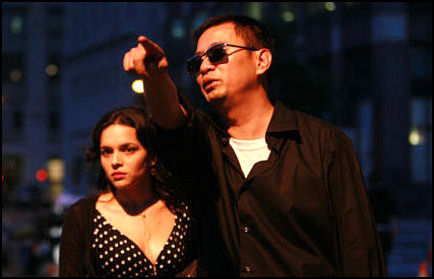
My Blueberry Nights star Norah Jones (l.) with director Wong Kar Wai. The English-language romantic drama costars Jude Law, Natalie Portman, Rachel Weisz, David Strathairn, Tim Roth and Ed Harris.

I ran a Peter Howell-inspired piece a few weeks ago that covered a lot of the same likelies and maybes. The only thing I missed earlier is the relatively fresh news that a longer version of Quentin Tarantino‘s Death Proof will be shown as a stand-alone feaure.

Potential Golden Palm contenders, in the view of Europa’s editor[s], include Denys Arcand‘s Age of Innocence, Todd HaynesI’m Not There, Joel and Ethan Coen‘s No Country for Old Men, Hou Hsiao Hsien’s Ballon rouge, Gus Van Sant‘s Paranoid Park and Emir Kustarica‘s Promise Me This.

Other distinct possibilities include Takeshi Kitano’s Kantoku Banzai, Im Kwon-taek‘s Beyond The Years and Carlos ReygadasSilent Light.

.

The Europa item says that “an air of uncertainty” hangs over Woody Allen‘s Cassandra’s Dreams, Sean Penn‘s Into the Wild, Michael Moore‘s Sicko and Michael Winterbottom‘s A Mighty Heart. Hey, what about Martin Scorsese‘s Rolling Stones documentary?

Papa and the Kraut

“The thing about the Kraut and me is that we have been in love since 1934, when we first met on the Ile de France, but we’ve never been to bed. Amazing but true. Victims of unsynchronized passion.” — Ernest Hemingway to biographer A.E. Hotchner on his never-consummated love affair with Marlene Dietrich, as regurgitated in this N.Y. Times piece by Ashley Parker about some “racy letters” from Hemingway to Dietrich that will soon be unsealed.

Coddling Quentin Tarantino

“Quentin works when he wants to,” Harvey Weinstein says to Anne Thompson in her latest Variety column. “There’s no pressure from us to work at all. It’s better when he’s excited about something. He blends his life and his art. He’s not a journeyman director. He doesn’t have to make a movie every year.”

No pressure? Wanton unstructured types like Tarantino secretly crave it deep down. If Harvey and brother Bob were able to somehow force Tarantino to crank out a movie every eighteen months or two years (instead of one every three or four years, which is his average so far), it would check his natural wank-off tendencies and shape him into being a much more commanding and refined filmmaker. This discipline might even goad him into writing and directing something that’s not a knockoff or a genre riff. (I know, I know — we’re talking about Tarantino here.)

Infantilization of everything

Yesterday’s collapsing-values, fall-of-the- Roman-empire statement came from former DreamWorks marketing ace Terry Press: “Everybody knows that culturally, kids rule the roost. The numbers for kids and the age they adopt things like iPods (and) cell phones…all show that kids are growing up faster. If you make records or something you want consumed in the culture, you have to resonate with kids.” She’s right, of course, but an entertainment culture that caters first and foremost to toddlers, tweeners and young teens has opted for dilution and marginalization and essentially removed itself from the hallowed circle. This is a tired old gripe. I know I need to grow up and embrace the infantilization process. Please forgive the foot-dragging.

“The Silence”

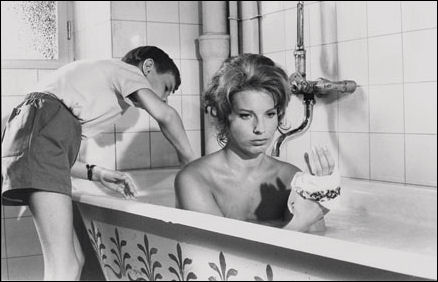
No arguments with the choices of the Nerve.com team for the Most Important (i.e., brazen, influential, talk-stirring) Nude Scenes of all time, but most of us recognize that nude scenes are about “importance” second and erotic intrigues and arousals first. The good ones are, at least. And in this sense Ingmar Bergman‘s The Silence has almost no parallel. Sven Nykvist‘s black-and-white photography of the sultry, vaguely self-disgusted Gunnel Lindblom in various states of undress in that downtown hotel room (and bathroom) is the stuff that lifelong dreams are made of.

Hawk Is Dying

Indiewire columnist Anthony Kaufman recently passed along a two-pronged statement from producer Ted Hope about The Hawk Is Dying, the somewhat morose Paul Giamatti movie that opens at Manhattan’s Cinema Village tomorrow (on 3.30). Hope said Hawk is now in better shape than when it played to lousy reviews at Sundance 2006, and that he’s so proud of it that “if you go and aren’t truly glad you went, I will personally refund your money…just send me your ticket stub at This is That in New York…I promise.”
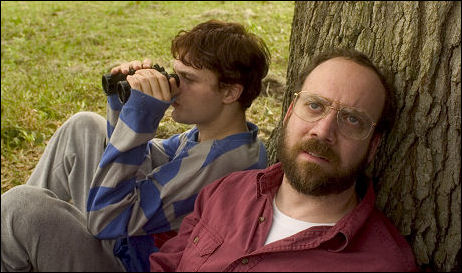

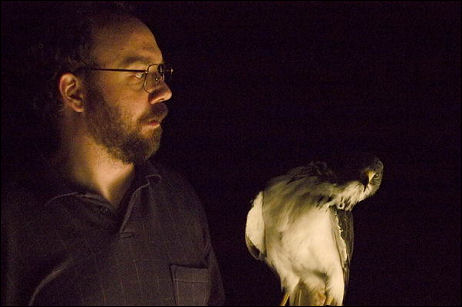
Michael Pitt, Paul Giamatti

I saw the Sundance version of Hawk, and it’s nothing close to the kind of film that might prompt anyone to demand a refund. What it is, or was when I saw it, is a movie that lulls you into a nice meditative calm, and then (if you’re running on less than five hours sleep the night before) slumber. I started thinking about catching a snooze very soon after this film began, and the impulse was at least partly about content. It didn’t seem a huge concern — I’ve become disciplined enough at sleep- ing during festival films that I can make myself wake up every ten minutes just to keep up with the plot.

The Hawk is Dying is basically about delusional losers putzing around. It’s not an embarassment, and I don’t see it hurting Giamatti’s career. We all have to work and pay the bills, and sometimes we work with friends for the wrong reasons, and moviegoers understand this, I think.

Set in the south, Hawk is about an owner of an auto upholstery shop named George (GIamatti) who lives with his grotesquely fat sister and her mentally challenged son Fred (Michael Pitt). George is into training falcons, and the footage of him capturing and training a red-tailed falcon is…uhm, educational. And intended as a metaphor about finding vigor and passion and overcoming the mundane stuff.

But any movie that makes a Giamatti performance seem dull or running on empty is definitely doing something wrong, and Pitt really needs to play an average guy soon. Someone who smiles and wears clean clothes and brushes his teeth and talks in complete sentences. Pitt always plays barely articulate zone cases, and I’m starting to wonder if he can do anything else. And if you add a grotesquely fat character of either gender (even in an unobtrusive supporting role) you’ve got an oh-for-three situation.

“The film truly deserves to be seen on the big screen,” says the indefatigable Hope. “We are woefully close to a time when such films will only be available for download, but this, like many others, truly deserves to be seen with light passing through glorious celluloid. I know you know how crucial the early days of a film release are, so please if you don’t have plans for the end of the month, do all you can to get to Cinema Village (or wherever it is playing near you).

“It captures a tour de force performance by Paul Giamatti, raw and incredibly human. [Director Julian Goldberger’s expressionistic style is so well suited to Harry Crews’ tale (his first novel to make it to the screen), both are reinvented in the process. Ten years ago, this would be a film celebrated by the entire industry, but now that indie means something synonymous with the ‘cinema of quality’ that the French New Wave rebelled against so long ago, it gets marginalized precisely because of the wonderful risks it takes — the same very risks that made me and the great team that worked on it want to collaborate with Julian in the first place.

“I do love the phrase (perhaps slightly ironically) ‘vote with your dollars’, but I do think a ticket here is a vote against a steady diet of Norbits and Wild Hogs,” Hope adds. “I truly struggle every day on how we can make sure there is a business that can work that embraces challenging films, films that dare to aim towards art, that involve risk as part of their design. And of course, the key part is all of us buying tickets.”

Read more