Leo vs. Leo

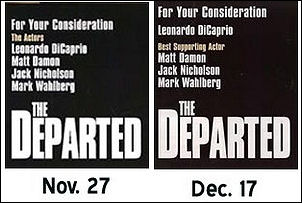
The problem isn’t that Warner Bros. marketers waited too long to start emphasizing Leonardo DiCaprio‘s Best Actor performance in The Departed in trade ads. (It was the problem but no longer, I mean.) The problem is that The Envelope‘s Tom O’Neil, composing this comparative piece of art for an article he wrote about Leo’s once-upon-a-time Oscar hopes, didn’t properly tweak the November trade ad so it looks as sharply focused as the December one.

Why Arndt Was Briefly Fired

I realize that FORA is an acronym for something, but I don’t know what. (Federation of Ravenous Alpha-Dogs?) Obviously it’s a web TV thing. They sent me an excerpt of Little Miss Sunshine screenwriter Michael Arndt talking about how how and why he was briefly fired off the project. No, wait…there’s an entire program of Arndt talking about everything. You just have to click on it. It’s free to watch. (Apparently.)

Laura and Ellen

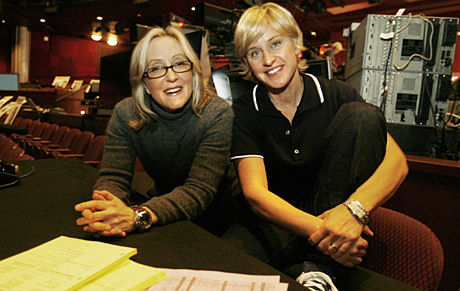
In an interview with USA Today‘s Anthony Breznican, the reigning Oscar Night ladies — producer Laura Ziskin and host Ellen DeGeneres — are a study in opposite attitudes and sensibilities. DeGeneres is a brainy, free-associative, improvisational wit. Ziskin wants to be hip and alpha-like, but she sounds like an affluent ooh-lah-lah control freak who’s terrified (or at the very least alarmed) by spontaneity.

The Oscar show, I’ve just realized, is going to be a kind of war between the two. Ziskin will dominate, of course, being the big-shot producer in the control room, but many of us are going to be pulling for DeGeneres to somehow make things a little more loosey-goosey than Ziskin might prefer.

Freewheeling DeGeneres: “I came up with a really fun idea for the end of my monologue that I think is going to set this room off.”

Humorless control-freak Ziskin: “This is the first I’m hearing about it.”

Freewheeling DeGeneres: “I want somebody to do a one-armed pushup. I want somebody to streak.”

Humorless control-freak Ziskin: “Those days are gone.”

Freewheeling DeGeneres: “It’s just that everybody is so body conscious: I would streak, but I’m bloated.’ ”

Humorless control-freak Ziskin: “People are so nervous, so terrified, not just the nominees, but the presenters. She releases us, makes us happy and forget about ourselves.”

Freewheeling DeGeneres: “I didn’t realize that was my job. I’m going to have to change my entire monologue.”

And yet Ziskin says to prepare for a 210-minute running time, minimum. “You get your popcorn and invite your friends over. Or get in bed by yourself or with someone you like, and you wait to see what’s going to happen.”

Freewheeling DeGeneres: “We’re taking all the seats out of the theater, and we’re bringing in beds, popcorn and pajamas. We’ll pair everyone up, real nice.”

Gary Arnold annoyances

Washington Times film critic Gary Arnold trumpets the virtues of the Paul Greengrass‘s United 93 — good move — but in the same piece calls The Departed “terminally wretched,” praises Doug McGrath‘s Infamous as “far and away the superior biopic about Truman Capote” and describes Inconvenient Truth avatar Al Gore as “an alarmist pseudo-authority.” I used to admire Arnold when he was the critic for the Washington Post back in the ’70s and ’80s. I don’t know what happened.

Alan Arkin brotherhood

A brotherly pat on the back to all those on Oscarwatch.com’s Final Oscar Prediction Chart who are predicting Alan Arkin to take the Best Supporting Actor Oscar — The Envelope‘s Tom O’Neil, Award Speculation, Buzzmeter, Spencer Shannon, Toronto Star‘s Peter Howell, Indiewire‘s Eugene Hernandez, N.Y. Daily News critic Jack Matthews and Trailer Spy‘s Julie Stone. Hollywood Wiretap‘s Pete Hammond (who didn’t send his picks into Oscarwatch, but he’s standing by Arkin in his latest Hollywood Wiretap column)

Almost everyone else is sticking with Eddie Murphy, and two or three stragglers are picking Jackie Earl Haley.

Good things occasionally happen to bad people, and you just have to roll with this when it happens. If Murphy wins, it will be because the anti-Murphy contingent didn’t rally around an alternative with enough uniformity. If you were to conduct an instant e-mail poll of all Academy members right now, Arkin would be the victor…but he only began to really surge over the last two or three weeks. The Movie Gods are, of course, foursquare against Murphy, but they were also pulling for Brokeback Mountain winning the Best Picture Oscar last year.

Ahead of Their Time

Eight or nine days ago, First Showing’s Alex Billington paid roundabout tribute to 300, a film he believes is waaay ahead of its time, by listing a dozen motion pictures that were similarly ahead of the curve in their time and place. But with the exception of Mike Judge‘s Office Space and Fritz Lang‘s Metropolis, the films Billington lists are actually fanboy standard-setters. They did something fairly fresh and striking that led to commercial paydirt, and everyone followed suit in order to get in on a profitable new thing.

Films that are truly ahead of their time are most often ignored or scorned — only later do people say to each other, “Aah, yes…that film was onto something….I should have paid closer attention” A good example of a film far ahead of its time is/was John Frankenheimer’s The Manchurian Candidate, which searingly satirized McCarthyism, foresaw the assassinations that would eventually color the American political landscape of the ’60s, and anticipated the political paranoia which would permeate the culture in the early to mid ’70s. Another example in this vein would be Michelangelo Antonioni‘s L’Avventura.

Billington’s list of standard-setters are Psycho, 2001: A Space Odyssey, Jaws, Star Wars, Tron, War Games, Terminator 2, Jurassic Park, The Fifth Element, Starship Troopers, Office Space and The Matrix.

British actors rule

Why do British actors often seem much more accomplished than their American cousins? The Guardian‘s Charles McNulty boils the answer down to two words — theatrical training — which allows for all kinds of delightful tonalities and wonderfully resonant deliveries, as well as the ability to make a line work on more than just one level.

“It’s hard not to marvel at the virtuosic command of speech” that British actors possess, “the way Judi Dench, Helen Mirren and Peter O’Toole make music out of spoken thought,” he begins. “Steeped in Shakespeare and a culture committed to live performance, they have by necessity developed their physical instruments and, in particular, that region of the body that lies between the back of the throat and the tip of the tongue.

“Listening to Dench narrate, from her character’s perspective, the lurid events unfolding in Notes On a Scandal is like listening to a Stradivarius. You can practically feel her vocal chords luxuriously vibrating as she unfurls a commentary that is at once ruthlessly aggressive and perfectly civilised.

“And in Venus, when O’Toole’s Maurice recites — no, verbally caresses — Shakespeare’s famous Sonnet 18 (‘Shall I compare thee to a summer’s day?’) to the young woman he has fallen haplessly in lust with, storm-clouds of emotion blow in, as if his articulation carried the very beauty and loss animating the poem’s vision.

“But it’s not just glorious sound that sets British veterans apart. They invite us not just into their characters’ minds but into their intricate thought processes as well. It’s not a strictly realistic affair. These talents are drawn from a theatrical heritage that recognizes drama as more than a slice of life. [And yet] too many U.S. actors have become enslaved to a form of behavioral banality in which the highest value is placed on mimicking everyday life; at its worst fetishising the commonplace at the expense of the revelatory.”

Fuck it…none of ’em

The Oscar field “seems to have left a number of academy voters feeling dispirited,” writes Slate‘s Kim Masters. “One director said he stared at the ballot and considered leaving the best picture category blank. Then he gave Clint a tribute vote. A publicist told us he did not check favorites in a couple of major categories for the first time in his years of voting. ‘I just said, ‘Fuck it, I don’t like any of ’em,’ he explained.”

“Alfred Hitchcock Presents”

With both Need (a somewhat “bent” relationship drama with Nicole Kidman and Naomi Watts) and Dirty Tricks (a women-of- Watergate movie with Meryl Streep as Martha Mitchell and Gwynneth Paltrow as Maureen Dean) in pre-production, it could never be said that director Ryan Murphy (Running With Scissors) is one to let grass grow under his feet.

But who would’ve imagined Murphy directing something as unusual and film-buffy as Alfred Hitchcock Presents, a drama about the making of Hitchcock’s Psycho, and particularly the hurdles and roadblocks that the great British director (possibly to be played by Anthony Hopkins) went through in order to bring it come to fruition. Hitchcock was discouraged left and right from making it. The script was seen as way too dark and perverse (especially with the lead female star getting killed off after 45 minutes), and no one wanted to see a movie based more or less on the macabre exploits of serial killer Ed Gein.

Hopkins has played his share of famous willful men — Pablo Picasso, Richard Nixon, John Quincy Adams, Dr. John Harvey Kellogg — and he’s planning to portray Leo Tolstoy in Michael Hoffman‘s The Last Station. But there’s something extra delicious about the prospect of him playing Hitchcock.

Question is, will Murphy’s film circumvent whatever it was that underwhelmed viewers of RKO 281, a TNT drama about the making of Citizen Kane?

I don’t know exactly when Alfred Hitchcock Presents might shoot, but I was told earlier this evening it’s definitely real. Universal, Hitchcock’s home studio for the last 15 or so years of his life, may be involved as a financier-distributor. (Of course, nothing is “likely” until it actually happens so take this with a grain.)

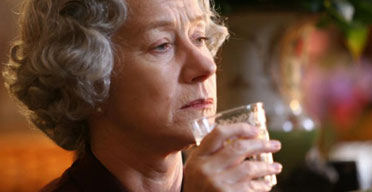
If and when it happens, the plan is for Helen Mirren to play Alma Reville, Hitch- cock’s wife and lifelong creative collaborator. Psycho was shot for Paramount, although Universal founder and Hitchcock confidante Lew Wasserman occupies a portion of the script. Psycho costars Anthony Perkins and Janet Leigh are also “characters,” I’m told, but not large ones. Presumably screenwriter Joseph Stefano will also figure in.

Goldstein vs. Caspar Gutman

Alright now, settle down: all Patrick Goldstein meant by digging into “Oscar bloggers” at the end of his “Winners & Losers: Big Picture Extra” column and saying that “after the millions of words they wrote pontificating about the Oscars they could’ve come up with a better pick for best picture winner than Dreamgirls” …we all know what he meant.

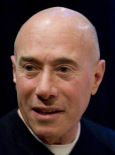
He was, yes, tut-tutting all those prognosticators who’d been asserting for months and months that Dreamgirls was a guaranteed Best Picture nominee (a group that includes yours truly, Tom O’Neil, Sasha Stone, Pete Hammond and Goldstein himself) and, according to some, an almost-certain winner. But of course, Gold- stein was really flipping off David “the Bloviator” Poland, a.k.a., the Caspar Gutman of Dreamgirls blog-boosters who still maintains that Bill Condon’s film would have won the big prize had it been nominated.

Geffen dishes on HiIlary to Maureen

Hillary Clinton “didn’t stand outside the gates to David Geffen‘s mansion [last night], singing the Jennifer Hudson protest anthem ‘And I Am Telling You I’m Not Going,'” writes N.Y. Times columnist Maureen Dowd. “But she’s not exactly Little Miss Sunshine, either.

“Hillary loyalists have hissed at defecting donors to remember the good old days of jumping on the Lincoln Bedroom bed. ‘Hillary is livid that [Barack] Obama‘s getting the first big fund-raiser here,’ one friend said.

“Who can pay attention to the Oscar battle between The Queen and Dreamgirls when you’ve got a political battle between a Queen and a Dreamboy?

Dowd spoke to Geffen for her column, and the quotes are fantastic.

“I don’t think anybody believes that in the last six years, all of a sudden Bill Clinton has become a different person,” Geffen tells her, “adding that if Republicans are digging up dirt, they’ll wait until Hillary’s the nominee to use it. ‘I think they believe she’s the easiest to defeat,’ he says.

Hilary “is overproduced and overscripted. ‘It’s not a very big thing to say, `I made a mistake’ on the war, and typical of Hillary Clinton that she can’t,’ . Geffen says. ‘She’s so advised by so many smart advisers who are covering every base. I think that America was better served when the candidates were chosen in smoke-filled rooms.”

The babble here is not about Babel; it’s about the battle of the billionaires. Not only have Ron Burkle and David Geffen been vying to buy the Los Angeles Times — they have been vying to raise money for competing candidates. Burkle, a supermarket magnate, is close to the Clintons, and is helping Hillary parry Barry Obama by arranging a fund-raiser for her in March, with a contribution from Steven Spielberg.

“Did Spielberg get in trouble with the Clintons for helping Senator Obama? “Yes,” Mr. Geffen replies, slyly. Can Obambi stand up to Clinton Inc.? “I hope so,” he says, “because that machine is going to be very unpleasant and unattrac- tive and effective.”

Obama is inspirational, and he’s not from the Bush royal family or the Clinton royal family. Americans are dying every day in Iraq. And I’m tired of hearing James Carville on television.”