Dead Girl Blues

It’s not a rumor — several of the performances in Karen Moncrief‘s The Dead Girl (First Look, 12.29) are knockout. And I’m not talking about efforts by guys. This is an honest, penetrating but extremely maudlin film about women suffering greatly — the term “deeply depressing” doesn’t begin to describe — and yet it’s a wow on a case-by-case, actress-by-actress basis.
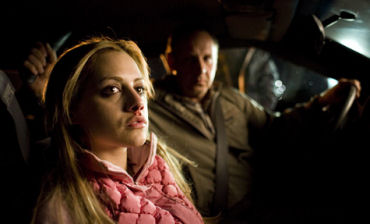
Brittany Murphy‘s inhabiting of a damaged-goods, irrevocably doomed prostitute/ absentee mom is prickly, agitated and full-on. She’s both pathetic and breathtak- ing. It’s a cliche-ish thing to say that Murphy has expanded her range and career prospects in one fell swoop, but that’s pretty much fact. She’s only on-screen for 20 minutes or so, and there isn’t time for her character to express more than two or three shades of desperation. She’s playing a woman with so many problems that the only question is when, not if, a random collision with this or that predator will take her down for good, but Murphy’s blending of feisty combativeness and sadness feels volcanically alive.
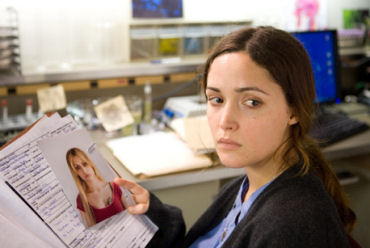
Marcia Gay Harden, who plays Murphy’s mom, has proved again how precise and soulful a performer she can be. Mary Beth Hurt is mesmerizing in a weird, over-the-hill way as a lonely and unbalanced partner of a fiendishly secretive middle-aged man. (It’s obviously sexist of me to report that the twitchy neurotic fox from Interiors and The World According to Garp has been eradicated by age, but it’s a fact nonetheless.) Also top drawer are Toni Collette, Piper Laurie, Rose Byrne and Kerry Washington.
But the color palette in The Dead Girl is pale and splotchy, and the mood of it is down, down…all the way down. Moncrief, who wrote and directed, has invested herself and her cast in an orgy of dingy, hopeless, lower-depths misery. Her female characters (the guys are mostly creeps or louts) are either sad or trauma- tized or badly bruised, or a combination thereof. There’s no question that Moncrief regards them with the utmost compassion and respect, but she’s mainly interested in how it feels to be in their cages — caught, desperate, unable to escape.
There’s a saturation point with films like this, a point at which you mutter to your- self “enough already” as you realize (or re-realize, having been here before) that for some filmmakers being immersed in grief and despair and down-headedness deli- vers a kind of perverse emotional high. Yeah, I know…strange.

Rose Byrne

It needn’t be this way. Rodrigo Garcia‘s Nine Lives — another film with superb female performances — was a more balanced and compassionate piece; you could feel Garcia’s generosity of feeling, as you can with Pedro Almodovar‘s Volver. These men care for their characters; they want them to some how pull through — and I don’t get this feeling from Moncrief at all. It’s not the hurting-women thing that’s hard to roll with — it’s the aroma of futility and put-upon female victimization that Moncrief is obviously queer for.
Moncrief’s Blue Car, which I saw at Sundance ’02, convinced me she was a comer. Now I’m starting to wonder. Why would a director-writer want to go so far down into a well that there’s no sunlight or air?
But once again, hats off to Murphy, Harden, Hurt, Collette, et. al. Murphy is good enough to be considered for a supporting actress honor, but The Dead Girl is going to die so quickly — it’s going to make about $950 dollars, if that — that her only chance is for thousands of screeners to be sent to press and Academy members (like the Lionsgate team did last year for Crash), and I doubt if First Look has the resources to do this, so the odds aren’t favoring.
Forgotten to death

The loyalty and respect factors among the media in the elite Clint Club run so deep that until very recently, no one had seriously considered actually looking the esteemed director of Flags of Our Fathers and Letters From Iwo Jima in the eye and saying straight from the shoulder, “You’ve made an honorable film but it’s not a homer or even a triple, so don’t expect great waves of support from us when it comes to critic awards.” None of the loyalists could ever bring themselves to actually say the words. But now that Flags is sinking fast with the public (it’s losing theatres and will only earn about $2,717,000 for the weekend), no one has to do anything. To paraphrase a Paddy Chayefsky line in The Hospital, Clint’s Iwo Jima film is on the verge of being “simply forgotten to death.” Who could have foreseen such a situation two months ago? How swiftly the tide recedes.

Obama again

The Democratic surge last Tuesday — “Voters were sick of phony swaggering, blustering and bellicosity, absent competency and accountability [and] were ready to trade in the deadbeat Daddy party for the sheltering Mommy party,” in the view of N.Y. Times columnist Maureen Dowd — is further proof that the winds are favoring for a Barack Obama run at the presidency, and so there really isn’t any need to try and corner the guy. It doesn’t matter what he said or didn’t say to George Clooney because there’s almost no way he won’t be going for it.

Saturday numbers

Borat‘s Sunday-night total will be just north of $25,000,000…maybe a bit higher when all is said and done. (It did $9,546,000 last night.) Flushed Away and The Santa Clause 3 will come in at #2 and #3 — the former, off 15%, is projected to hit $15,918,000, and the latter, off 19%, will end up with close to $15,715,000.
The fourth-place Stranger Than Fiction will have an okay $14,576,000 by Sunday night with $6490 a print. (Nothing to frown about, but hold the champagne.) Saw III will be fifth with $6.046,000. Sixth-place Babel is doing fine in the blue cities but is being viewed as a hard sell in red America — in 1200 situations it’ll have a Sunday- night cume of $5,029,000, or $4020 per print.
The Return will have a Sunday-evening tally of $4,871,000, or $2460 a print. The Prestige will have $4,677,000 for a so-far cume of $46 million. (A mezzo-mezzzo hit — obviously heading toward $50 million but well shy of heavyweight status.) The Departed will end up with $4,663,000 for a total cume of $109,202,000. And A Good Year, the Russell Crowe south-of-France reverie, is a stiff — $3,652,000 or $1700 a print.
Clint Eastwood‘s Flags of Our Fathers , which lost 400 theatres, will end up with $2,717,000 for the weekend, or $1700 a print — obviously dying on the vine with a so-far cume of about $30,856,000.
The Queen, still playing limited, will end up with $2,455,000. David Ayer‘s Harsh Times is a fizzle — $1,926,000 for the weekend at a little over $2000 a print. Copy- ing Beethoven, the Ed Harris movie playing in about 26 theatres, wil end up with $68,000 or $2600 a print — dead.

Queenan vs. Johansson

The Guardian‘s Joe Queenan is brutally writing off Scarlett Johansson…dissing, dismissing…tossing her onto the slag heap. “Somewhere along the line” — right after Lost in Translation, he means — “people who should have known better began to cast Johansson in roles for which she was not suited. And once the actress was asked to play anyone other than a 20-something Yank born and raised on the east coast in the waning years of the 20th century, it became apparent that she wasn’t much of an actress.
“Listless and vacant in The Girl With The Pearl Earring, Johansson was hopelessly miscast as an action babe in The Island, passive and useless in Woody Allen‘s Match Point” — not true at all! Johansson is almost Brando-esque in that film –“thoroughly implausible in Allen’s wretched Scoop, ridiculously out of her league as a postwar vamp in Brian de Palma‘s abysmal The Black Dahlia, and now entirely extraneous as a duplicitous magician’s assistant in The Prestige.
“Basically, her acting repertory consists of staring intently at the person she is speaking to, keeping her lips spread apart, and hoping no one will notice that she is no threat to Meryl Streep, and not all that much of a threat to Hilary Duff. Increasingly, the very fact that Johansson is in a film suggests that it will not make very much money, not be any good, or both. Because Johansson has made so many movies in such a short period of time, and because most of them have been so bad, and because several of these movies have been outright disasters at the box office, it’s starting to look like the actress is the kiss of death.”

O’Toole moved to GG Drama category

The Envelope‘s Tom O’Neil is reporting that Miramax strategists yesterday decided to not submit Venus star Peter O’Toole in the Golden Globe competition for a Best Actor in a Comedy category, apparently out of concern that Sacha Baron Cohen‘s Borat performance might ace him out. So they’ve entered O’Toole into the Best Actor in a Drama category instead.
To which I can only wonder why Miramaxers thought O’Toole should have been in the Best Actor in a Comedy slot in the first place. Venus is amusing here and there — arch, whimsical, spirited — but there’s no way anyone in a sober state of mind would call O’Toole’s performance even somewhat comedic. Venus is a drama with fizz and bittersweet spritz, but O’Toole’s playing a withered actor who’s getting closer and closer to death, and yet is clinging to life all he can through his feelings of lust and affection for a young girl. A touching situation but hardly a “funny” one.
O’Neil mentions that the Hollywood Foreign Press Association’s eligibility committee might not agree with the switch and move O’Toole back to comedy, although it usually defers to the preference of the contender. This is insane.

Good Shepherds everywhere

At the very end of Universal’s The Good Shepherd trailer a subtitle appears: The Untold Story About the Birth of the CIA. Well, yeah…I guess. But Robert De Niro‘s spy drama is basically a psychological portrait of a generic workaholic, and the theme is about how an insatiable need for work, earnings, discipline and productivity has a way of eventually separating the workaholic from everything and everyone else. It’s a portrait, in short, of tens of millions of people out there whose marriages are slowly dying on the vine, whose children are growing up alone, whose health is suffering because they eat obsessively and don’t work out enough (if at all). That’s the thread in this film. The late 40s to early ’60s historical CIA stuff (i.e., the particulars about James Jesus Angleton, the real-life spook played in the film by Matt Damon) comes second.

Busch sues Ovitz

Former Los Angeles Times, Variety and Entertainment Weekly reporter Anita Busch — whom accused wiretapper Anthony Pellicano tried to intimidate a few years ago with that dead fish “STOP!” message left on the windshield of her car — has alleged in a civil lawsuit that former CAA honcho and talent manager Michael Ovitz “participated with indicted private investigator Anthony Pellicano and others to intimidate and threaten her.”
Ovitz’s attorney James Ellis told L.A. Times reporters Andrew Blankstein and Greg Krikorian that his”client “had nothing to do with this. It’s unfortunate that Ms. Busch has chosen to involve him in this matter.”
The idea is to make Ovitz sweat his past offenses and presumably squeeze him for some kind of cash settlement. We all know Ovitz sent Busch that bottle of MSG years ago (she’s lethally allergic to the stuff) and that she’s never had much affection for him either. All fair-minded people hope Bush achieves her goals in this matter because she’s basically conducted herself honorably and because people who strive to intimidate the press deserve the blowback.

Dargis on Rossellini

In Open City, Paisan, Europa, Stromboli and other films by legendary Italian neorealist Roberto Rossellini, the “reality principle is ephemeral and profound. He helped usher the world back into cinema by mixing authentic people and locations in with actors and studio sets. But neo-realist directors like Rossellini and Vittorio De Sica do not, to paraphrase the critic Andre Bazin, simply deck out a formal story with touches of reality, as if reality were bits of tinsel.
“Instead, they offer fragments of reality that retain all of its mystery and ambiguity and whose meaning we piece together, much as the characters do. Others put reality, Bazin writes, ‘in a cage or teach her to talk, but De Sica talks with her, and it is the true language of reality that we hear, the word that cannot be denied, that only love can utter.'” — from a piece by N.Y. Times critic Manohla Dargis about a forthcoming Rossellini retrospective at the Museum of Modern Art.”

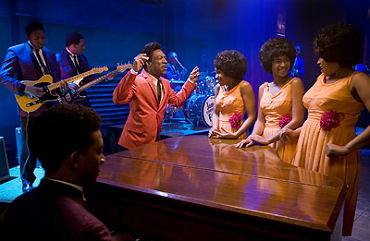
Dreamgirls via Steve Daly

Entertainment Weekly‘s Steve Daly has been shown Dreamgirls (DreamWorks, 12.15) and has seen “some arresting stuff,” he proclaims. But he doesn’t explain in great detail what stuff he’s talking about. The piece is basically a blah-blah tap dance that delivers almost nothing. In terms of what we want to hear, I mean.

There are two minor chickenshit reveals. Daly writes that Beyonce Knowles is “resplendent in a disco-era silver-lame cape and long, corkscrew-curl wig.” He also says costar Jennifer Hudson kicks splendid ass. Daly declares that “judging from an early look at Dreamgirls, director Bill Condon ‘s “crash course [with Hudson]” — goading her into some flamboyant attitude and bitchy behavior — “worked spectacularly well.”
And that’s all. The world is hungering for a seasoned, sophisticated opinion about a film Daly knows full well is being looked to as the last possible hope for a Best Picture slam-dunk (or not) and he all he can do is give an “attagirl!” to Hudson and describe Beyonce’s gown and wig.
No other observations, anecdotes or judgments are rendered about the finished film. Too early, I guess. (Even though it’s being shown to the world starting this Sunday.) The rest of the story is all backstage stuff, and it’s not that arresting.

Farewell Jack Palance

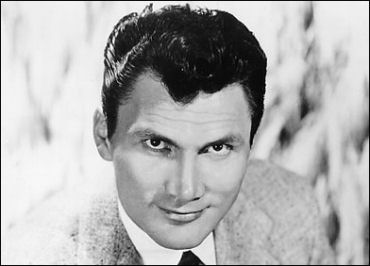
A fond farewell to Jack Palance, a great character actor whom, during his heyday in the ’50s and ’60s, exuded a sublime aura of sinister silkiness. Palance, a big guy with cheekbones you could shave roast beef with, died today at age 85 (or possibly 87) at his home in Montecito, near Santa Barbara.

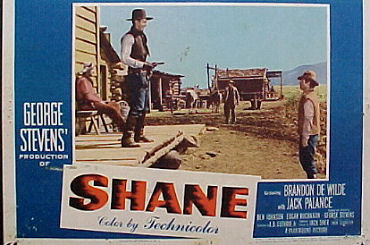
Palance’s first big career score was playing the hired gun “Jack Wilson” in George Stevens ‘ Shane, a guy so creepy and reptilian that a dog in the film would always get up and leave the room when he walked in. He has a great showdown scene with Elisha Cooke, Jr., slowly putting on his black gloves and drawing his big six-shooter like lightning, and then waiting a couple of seconds before drilling Cooke and sending him flying backwards into the mud. (The gun sounds like a two-ton cannon.)
In another scene Palance mounts a horse like a lizard, pulling himself up and then freezing for three or four seconds before swinging his legs over and climbing into the saddle — one of the most brilliant bad guy bits ever delivered in a western.
40 years later Palance won a Best Supporting Actor Oscar for his performance as “Curly Washburn” in City Slickers, opposite Billy Crystal.
Palance’s Wikipedia bio reads as follows: “Stepping onstage to accept the award, the intimidatingly fit 6′ 4″ actor looked down at the 5′ 7” Crystal, and joked, ‘Billy Crystal… I crap bigger than him.’ He then dropped to the floor and demonstrated his ability, at age 73, to perform one-handed push-ups.

“Crystal then turned this into a running gag. At various points in the broadcast, he announced that Palance was backstage on the Stairmaster; had ‘just bungee-jumped off the Hollywood sign‘; had rendezvoused with the Space Shuttle in orbit; had fathered all the children in a production number; had been named People magazine’s Sexiest Man Alive; and had won the New York primary election. At the end of the broadcast, Crystal told everyone he’d like to see them again ‘but I’ve just been informed Jack Palance will be hosting next year.’
“The following year, host Crystal arrived on stage atop a giant model of the Oscar statuette, towed by Palance with a rope in his mouth.”
I always found Palance’s performance in Tim Burton‘s Batman to be irritatingly over-mannered, but I liked him a lot in Robert Aldrich‘s Attack, Jean Luc Godard‘s Contempt and Richard BrooksThe Professionals.
The son of a Ukranian coal miner, Palance’s birth name was Volodymyr Palanyuk.

Siddig and “Nativity”

Catherine Hardwicke‘s The Nativity Story (New Line, 12.1) has screened this week and will junket this weekend, and I’ve been told “it’s a very nicely made Christmas movie…it’s one of those films that The Passion has begotten and is clearly aimed at the audience that loved that film. It definitely delivers a traditional spiritual capturing of Christmas, which is something Hollywood rarely does.”


Alexander Siddig

He’s saying, in other words, that it’s sweeter (his first term was “more sugar coated’) than, say, Martin Scorsese‘s The Last Temptation of Christ. “It’s very well made but it’s definitely not dark or plain…it’s more traditional,” he says. Meaning it’s fairly literal-minded in terms of the Biblical iconography. The film stops short of what director William Wyler did in his depiction of the Nativity scene in Ben-Hur, which was to have a moving star literally travel across the heavens and then stop and beam a kind of spotlight down upon the manger, “but it has a lot of shots ot the heavens with Bibilical connotations.”
He says Hardwicke even plays one of the familiar Christmas hymns — he couldn’t remember if it was “O Little Town of Bethlehem” or one of the others — on the soundtrack as Mary and Joseph (Keisha Castle Hughes, Oscar Isaac) make their way to Egypt.
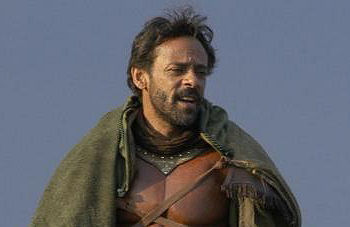
I was intrigued to learn that Alexander Siddig, the North African-born, English- educated actor who was very fine in Syriana and Kingdom of Heaven, plays the angel Gabriel in Hardwicke’s film. A friend who’s seen The Nativity Story thought he might be playing God since he isn’t identified as Gabriel — he doesn’t introduce himself and he’s not carrying a brass horn of any kind — but the IMDB says he’s playing Gabriel so let’s go with that.
Floating and (naturally) ethereal, a bearded Siddig appears before Mary and Joseph toward the end to explain the basic divinity-of-Jesus plan, the virgin conception, what’s literally to come. This news is profoundly comforting to Joseph, who’s been clueless and confused up to this point.
Mike Rich‘s screenplay for the film was originally called Nativity — obviously a simpler, cleaner title. I wonder what genius-brain producer or New Line exec suggested adding the “The” and “Story”, and what his/her reasoning might have been?