

In Open City, Paisan, Europa, Stromboli and other films by legendary Italian neorealist Roberto Rossellini, the “reality principle is ephemeral and profound. He helped usher the world back into cinema by mixing authentic people and locations in with actors and studio sets. But neo-realist directors like Rossellini and Vittorio De Sica do not, to paraphrase the critic Andre Bazin, simply deck out a formal story with touches of reality, as if reality were bits of tinsel.
“Instead, they offer fragments of reality that retain all of its mystery and ambiguity and whose meaning we piece together, much as the characters do. Others put reality, Bazin writes, ‘in a cage or teach her to talk, but De Sica talks with her, and it is the true language of reality that we hear, the word that cannot be denied, that only love can utter.'” — from a piece by N.Y. Times critic Manohla Dargis about a forthcoming Rossellini retrospective at the Museum of Modern Art.”
Dreamgirls via Steve Daly
Entertainment Weekly‘s Steve Daly has been shown Dreamgirls (DreamWorks, 12.15) and has seen “some arresting stuff,” he proclaims. But he doesn’t explain in great detail what stuff he’s talking about. The piece is basically a blah-blah tap dance that delivers almost nothing. In terms of what we want to hear, I mean.
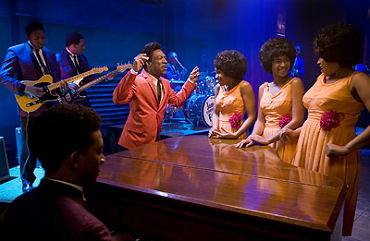
There are two minor chickenshit reveals. Daly writes that Beyonce Knowles is “resplendent in a disco-era silver-lame cape and long, corkscrew-curl wig.” He also says costar Jennifer Hudson kicks splendid ass. Daly declares that “judging from an early look at Dreamgirls, director Bill Condon ‘s “crash course [with Hudson]” — goading her into some flamboyant attitude and bitchy behavior — “worked spectacularly well.”
And that’s all. The world is hungering for a seasoned, sophisticated opinion about a film Daly knows full well is being looked to as the last possible hope for a Best Picture slam-dunk (or not) and he all he can do is give an “attagirl!” to Hudson and describe Beyonce’s gown and wig.
No other observations, anecdotes or judgments are rendered about the finished film. Too early, I guess. (Even though it’s being shown to the world starting this Sunday.) The rest of the story is all backstage stuff, and it’s not that arresting.
Farewell Jack Palance
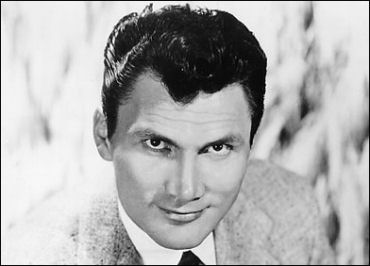
A fond farewell to Jack Palance, a great character actor whom, during his heyday in the ’50s and ’60s, exuded a sublime aura of sinister silkiness. Palance, a big guy with cheekbones you could shave roast beef with, died today at age 85 (or possibly 87) at his home in Montecito, near Santa Barbara.
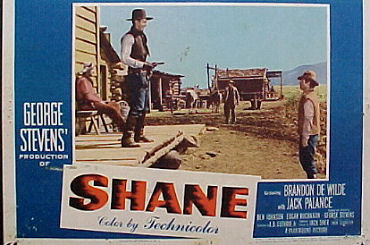
Palance’s first big career score was playing the hired gun “Jack Wilson” in George Stevens ‘ Shane, a guy so creepy and reptilian that a dog in the film would always get up and leave the room when he walked in. He has a great showdown scene with Elisha Cooke, Jr., slowly putting on his black gloves and drawing his big six-shooter like lightning, and then waiting a couple of seconds before drilling Cooke and sending him flying backwards into the mud. (The gun sounds like a two-ton cannon.)
In another scene Palance mounts a horse like a lizard, pulling himself up and then freezing for three or four seconds before swinging his legs over and climbing into the saddle — one of the most brilliant bad guy bits ever delivered in a western.
40 years later Palance won a Best Supporting Actor Oscar for his performance as “Curly Washburn” in City Slickers, opposite Billy Crystal.
Palance’s Wikipedia bio reads as follows: “Stepping onstage to accept the award, the intimidatingly fit 6′ 4″ actor looked down at the 5′ 7” Crystal, and joked, ‘Billy Crystal… I crap bigger than him.’ He then dropped to the floor and demonstrated his ability, at age 73, to perform one-handed push-ups.
“Crystal then turned this into a running gag. At various points in the broadcast, he announced that Palance was backstage on the Stairmaster; had ‘just bungee-jumped off the Hollywood sign‘; had rendezvoused with the Space Shuttle in orbit; had fathered all the children in a production number; had been named People magazine’s Sexiest Man Alive; and had won the New York primary election. At the end of the broadcast, Crystal told everyone he’d like to see them again ‘but I’ve just been informed Jack Palance will be hosting next year.’
“The following year, host Crystal arrived on stage atop a giant model of the Oscar statuette, towed by Palance with a rope in his mouth.”
I always found Palance’s performance in Tim Burton‘s Batman to be irritatingly over-mannered, but I liked him a lot in Robert Aldrich‘s Attack, Jean Luc Godard‘s Contempt and Richard Brooks‘ The Professionals.
The son of a Ukranian coal miner, Palance’s birth name was Volodymyr Palanyuk.
Siddig and “Nativity”
Catherine Hardwicke‘s The Nativity Story (New Line, 12.1) has screened this week and will junket this weekend, and I’ve been told “it’s a very nicely made Christmas movie…it’s one of those films that The Passion has begotten and is clearly aimed at the audience that loved that film. It definitely delivers a traditional spiritual capturing of Christmas, which is something Hollywood rarely does.”
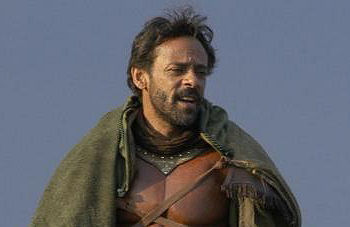
Alexander Siddig
He’s saying, in other words, that it’s sweeter (his first term was “more sugar coated’) than, say, Martin Scorsese‘s The Last Temptation of Christ. “It’s very well made but it’s definitely not dark or plain…it’s more traditional,” he says. Meaning it’s fairly literal-minded in terms of the Biblical iconography. The film stops short of what director William Wyler did in his depiction of the Nativity scene in Ben-Hur, which was to have a moving star literally travel across the heavens and then stop and beam a kind of spotlight down upon the manger, “but it has a lot of shots ot the heavens with Bibilical connotations.”
He says Hardwicke even plays one of the familiar Christmas hymns — he couldn’t remember if it was “O Little Town of Bethlehem” or one of the others — on the soundtrack as Mary and Joseph (Keisha Castle Hughes, Oscar Isaac) make their way to Egypt.
I was intrigued to learn that Alexander Siddig, the North African-born, English- educated actor who was very fine in Syriana and Kingdom of Heaven, plays the angel Gabriel in Hardwicke’s film. A friend who’s seen The Nativity Story thought he might be playing God since he isn’t identified as Gabriel — he doesn’t introduce himself and he’s not carrying a brass horn of any kind — but the IMDB says he’s playing Gabriel so let’s go with that.
Floating and (naturally) ethereal, a bearded Siddig appears before Mary and Joseph toward the end to explain the basic divinity-of-Jesus plan, the virgin conception, what’s literally to come. This news is profoundly comforting to Joseph, who’s been clueless and confused up to this point.
Mike Rich‘s screenplay for the film was originally called Nativity — obviously a simpler, cleaner title. I wonder what genius-brain producer or New Line exec suggested adding the “The” and “Story”, and what his/her reasoning might have been?
Leaking “Apocalypto”
“The Apocalypto word has seeped out,” writes Variety editor Peter Bart. “Small screenings of the still-uncompleted film are quietly taking place, [and] from Mel Gibson‘s dark, troubled mind has emerged yet another brilliant exercise in filmmaking, extremely violent, yet compelling. The inner demons that play havoc with his personal life continue to energize his creative vision.
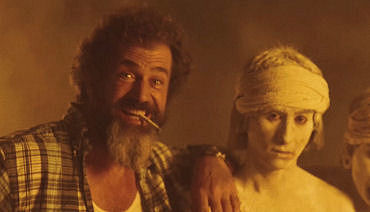
“But how will his work be judged? The film is being released not just as Apocalypto, but as Mel Gibson’s Apocalypto. Will the very community that understandably has been offended by Gibson’s inebriated diatribes be willing to pass fair judgment on his artistic contributions?”
Perhaps not, but Hollywood Elsewhere can…or would, rather, if the people at Disney publicity had the elemental moxie to get in touch with guys like me and show it under the usual circumstances. A friend doubts that Disney is running, and that Mel ‘s emissaries at Icon Productions are probably pulling the strings.
“The film itself represents a defiantly maverick voice,” Bart says. “Subtitles run throughout. The cast is totally non-professional. The action is virtually nonstop and the confrontations brutal.
“A fiercely original work like this normally would be screened and promoted for Oscar nominations and critics plaudits. This will not be the case with Gibson’s film. Hence, the looming Apocalypto Syndrome: Mel Gibson is not exactly a poster boy for tolerance. And that’s the paradox: Acceptance of his work demands exactly that.”
“Borat’ cretin lawsuit
Those erudite and sophisticated young men who shared a scene in a trailer with Sacha Baron Cohen in the last third of Borat — you know, the ones who somehow come off as drunken low-life cretins — are suing everyone, says TMZ.com, because they claim they were told the film wouldn’t be shown in the U.S. and they’re embarassed. These guys are obviously animals (they make John Belushi‘s Bluto look like Averell Harriman) and yet they’re claiming they’ve suffered “humiliation, mental anguish, and emotional and physical distress, loss of reputation, goodwill and standing in the community…” because the movie has been released in the U.S.
Lynch and his cow
Defamer’s Mark Lisanti reported yesterday that Inland Empire director David Lynch is “RIGHT NOW sitting on the corner of Hollywood and La Brea with a cow on a leash and a picture of Laura Dern that says ‘For Your Consideration.'” Lynch is obviously desperate, but his oddball streak is why most of us love the guy and a stunt like this is vintage.
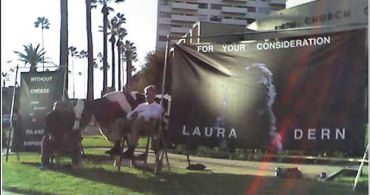
Lynch “also has a sign that says ‘without cows there would be no cheese in the Inland Empire.’ This is one of those things that a person needs to see. I wish I wasn’t chained to a desk.'” This sounds better than Terry Gilliam panhandling for quarters in Manhattan. I’m sorry I wasn’t faster on the draw. Too bad somebody with Lynch didn’t put out an advance notice of some kind.
Ridley on Modern Niggers
“Black America should have been singing hosannas about the ascendancy of Condoleezza Rice” because “it is time to celebrate the New Black Americans — those who have sealed the Deal, who aren’t beholden to liberal indulgence any more than they are to the disdain of the hard Right,” screenwriter John Ridley has written in the December Esquire. “It is time to praise blacks who are merely undeniable in their individuality and exemplary in their levels of achievement.
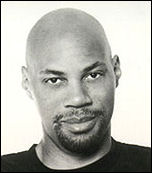
“But Condi was Republican. So never mind. Never mind she’d spent a lifetime facing down racism. Born in Birmingham at the peak of race hate, Condi was a schoolmate of Denise McNair, one of the ‘four little girls’ bombed to death in September of ’63 at the Sixteenth Street Baptist Church. [But] niggers and old-school shines couldn’t abide her.
“Same as with Clarence Thomas, they let her politics obfuscate her accomplishments. They stamped her: Not Officially Black. Loggers tagged her a ‘Sally Hemming for the 21st Century.’ Left-leaning pundits smeared her with the slurs ‘Aunt Jemima’ and ‘brown sugar.’ Julian Bond, reaching deep into the old-school bag of tricks, turned to rhyme to asperse Dr. Rice’s authenticity: ‘Just because they are your skin folks, doesn’t mean they’re your kinfolks.'”
The title of Ridley’s piece is “The Manifesto of Ascendancy for the Modern American Nigger.”
Back Home
As Paul Newman says to Robert Redford in The Sting, “Revenge is for suckers.” Meaning that it doesn’t really satisfy, not finally, and that to move on with your life you have to give up your hates and resentments because they’ll only pull you down in the end. But how do put aside your rage when the people you’re looking to settle a score with have not only murdered your mother (or so you’ve been led to thnik) but hundreds of thousands of innocent people?
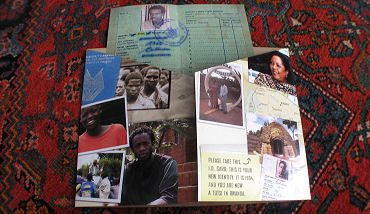
We’re talking about a young Rwandan guy named J.B. Rutagarama, the director of a jarring but gentle autobiographical documentary called Back Home, and, of course, the Rwandan massacre of 1994.
This is the fourth or fifth film I’ve seen about the Rwandan genocide, and the most humane and compassionate by far. Because it’s the most intimate and particular; the one most concerned with heart and family issues. And how one guy learned to grapple with the unimaginable and finally let it go. Terry George‘s Hotel Rwanda and Michael Caton Jones‘ Shooting Dogs were strong dramas that told Rwandan massacre stories, but Back Home is the real, particular, deep-down thing — a first-hand story of a nice guy with a very big heart.
The Rwandan massacre was about the brutal killings of roughly 800,000 (possibly closer to a million) ethnic Tutsis and moderate Hutus in Rwanda, which were largely carried out by two extremist Hutu militia groups for a period of about 100 days, from early April through mid-July of that year.

The hate that fed that massacre was created in a seminal way by Belgian colonists who decided decades back to give the better-paying, professional-level jobs to the Tutsi tribesmen and to basically give the economic shaft to the under-class, working-class Hutus. Mass slaughters always seem to be about economic and class resentment — a certain group believed to have enjoyed an unfair advantage over another, either through designation or exploitation. The mid ’70s genocide in Cambodia and the Nazi holocaust against European Jews were driven by such feelings.
Back Home, directed by Rutagarama and produced by former hard-news reporter and former Fox network talk-show host Linda Vester, is about the amazing and intense arc of Rutagrama’s life over the last twelve years — a story that began in horror and involved incredible luck and amazing changes.
The 17 year-old Rutagarama was nearly killed by machete-wielding Hutus in the midst of the genocide. He and his brother managed to escape…just. On the other side of the border, J.B. was lucky or determined enough to strike up a conversation with Vester and a British-based NBC producer (her name escapes me — the press notes didn’t provide it) who were covering the tragedy, which led to a job as their translator. Rutugarama later moved to England and was effectively adopted by these two and given college schooling. He was gradually networked into a job as a camera operator at a Manhattan-based TV show.

He finally decided in the wake of the 9/11 disaster to return to Rwanda and directly deal with his grief and his demons . He needed to learn the fate of his mother and brother, and to find some way to resolve or grow past the horror of what had happened. The particulars are quite moving, but I won’t relay them. Consider instead what J.B. has written:
“I should be dead by now, or at least very bitter. By luck I am not dead; by choice I am not bitter. Dozens and dozens of my relatives were slaughtered in Rwanda’s genocide. . At first, I tried to forget everything that happened. Then I was consumed by rage. Then sorrow. Now I simply want to be at peace.
“s much of the world today is gripped by war, I am standing up to say that despite all that was done to me, I refuse to be part of the cycle of violence. I do not want revenge. Reconciliation in a war zone is not easy. It is awkward, imperfect and slow. But it is possible. We need only to find the courage to try.”
In a sense, J.B.’s story is that of Charlton Heston‘s in Ben Hur (‘1959). William Wyler‘s Oscar-winning film is about an innocent man who is horribly wronged by a vicious enemy and nearly put to death, while his family — his mother and sister — are presumed to be dead, and all of this caused by a man he once considered to be a good friend, but who fell under the grip of evil.
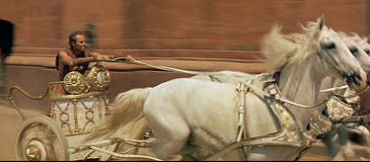
Lew Wallace’s original “Ben-Hur” novel was subtitled”A Tale of the Christ” because Ben-Hur finally finds a way to forgive and move on with his life due to the influence of Jesus of Nazareth. But of course, Ben-Hur is not a Tale of the Christ, not really …and we all know it would be deeply unsatisfying as a drama if it weren’t for the big chariot race, which shows us Ben-Hur defeating his enemy Messala (Stephen Boyd), who is trampled by horses and left a bloody pulp and soon after dies.
I was touched by Back Home and I admired its heart and wisdom — a person who can’t move beyond past evils and dreams of vengeance is truly living in a prison — but it has no chariot race and no bloody Messala figure writhing in agony before he dies. And that, in the end, for me, makes it unsatisfying. There’s something in our genes that demands justice, and yet the film doesn’t tell us about the punish- ment that was meted out to the leaders of the Hutu massacre and many of their lieutenants. (A lot of them are serving life terms.)
Instead, it just stays with J.B. and recalls his life in chapters and stays with him as he discovers that his mom is alive after all, and mainly listens to his heart. That’s fine — beautiful, really — but my inner Dirty Harry felt serious frustration all through it. We all need to get with the groove and find peace, but I’m also a believer in “as you shed blood, so shall your blood be shed.”

J.B. Rutagarama
“Spider-Man 3”
Peter Parker’s dark side takes over and Luke becomes Darth…revenge…just to underline things, Spider-Man hangs the red-and-blue suit on a hook in the closet and puts on a dark grey one instead…”this guy killed my uncle, and he’s still out there!!”…he means Thomas Haden Church‘s “Sandman”…a possible marriage to Kirsten Dunst‘s Mary Jane Watson is threatened by her shock and dismay at Peter Parker becoming an Angel of Vengeance …”what’s happened to you?”..could this be the end of Spider-Man?….a different kind of energy for Part 3, fine, but the same bullshit regardless…a far more interesting Tobey Maguire performance (how could it not be?) awaits in Steven Soderbergh ‘s The Good German.
Soderbergh at the Clarity
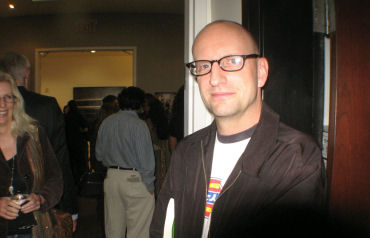
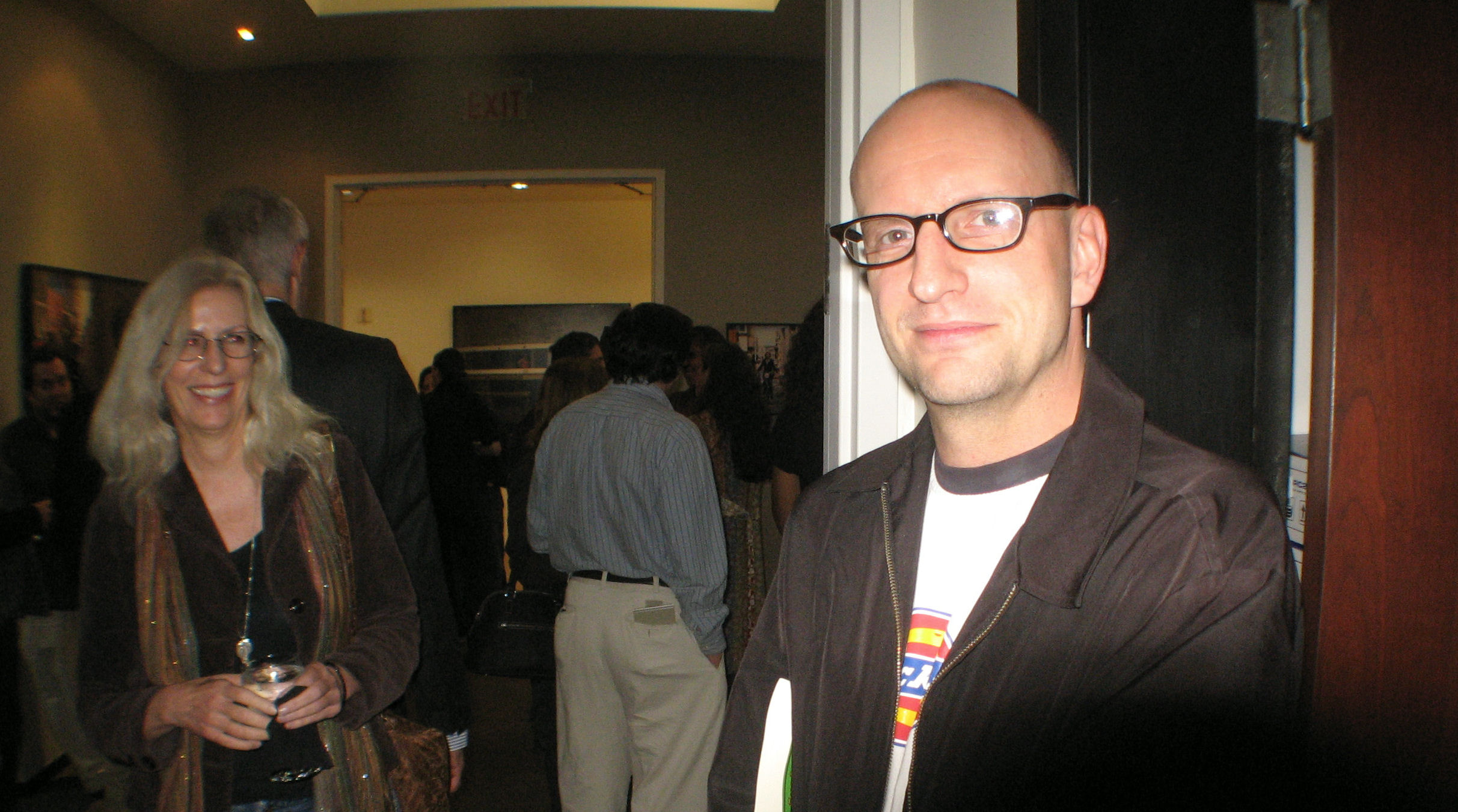
The Good German director Steven Soderbergh prior to a showing of the Berlin-set 1940s drama (Warner Bros., 12.15) at the Clarity Screening Room in downtown Beverly Hills — Thursday, 11.9.06, 7:40 pm. L.A. Times editor Betsy Sharkey (partly obscured) stands to the left.
Mindless violence
After trying for nearly a week to get hold of an mp3 file of Bobby Kennedy‘s “mindless menace of violence” speech that’s heard during the final moments of Bobby — it easily constitutes the most moving portion of Emilio Estevez‘s film– I discovered today that it’s the final track on the original motion picture soundtrack. Thanks to the Weinsten Co. publicist who sent it over today. It’s hard to hear the words with the music mixed in, but give it a listen — it really sinks in.