Per Custom, ’23 Cannes Awards Will Most Likely Be Nutso

…or certainly infuriating, no matter who the jury chairman is or what the general mood may be.

Celebrating films of quality has come to matter less than celebrating films with the right socio-political narratives. That’s certainly been the rule since the woke virus began to infiltrate the Cannes bloodstream six or seven years ago. Or perhaps over the last decade, now that I think about it.

Many felt that the Jane Campion-led, mostly female jury, for example, had taken leave of their senses when they didn’t hand the Palme d’Or to Andrey Zvagintsev‘s drop-dead brilliant Leviathan (’14) and gave it instead to Nuri Bilge Ceylan‘s Winter Sleep, a respectably solemn but slow-moving 196-minute drama that no one was over the moon about.

Okay, I applauded when Ruben Ostlund‘s The Square won the Palme d’Or in 2017 — a good, smart call.

But two years later Bong Joon-ho‘s Parasite won the Palme d’Or, and with that awarding the crazy bird had flown the coop. That movie obviously and completely crippled itself when the con artist family let the fired maid indoors during that rainstorm, but the Alejandro G. Inarritu-led jury (which included Elle Fanning, Yorgos Lanthimos, Paweł Pawlikowski, Kelly Reichardt and Alice Rohrwacher) didn’t want to know from nothing. Rich vs. poor, class-warfare social satire + a bespectacled, food-loving Asian director known for focusing on genre fare — the right kind of director had made the right kind of film, and nobody much cared about script flaws or how well the film’s final third had been assembled.

It was even more wackazoid when Julia Ducournau‘s Titane, admittedly a fierce and metallic act of erotic imagination, won the Palme d’Or in 2021.

Ostlund, the savagely satiric Swedish helmer of Triangle of Sadness, The Square and Force Majeure, is heading this year’s jury. Given the attitude of his films, it’s my presumption that Ostlund will not be in favor of bestowing Cannes jury prizes for reasons of virtue signalling and social justice warrior motives. It would be truly delightful if the ’23 Cannes winners were to be determined by actual artistic merit as opposed to woke points.

That probably won’t happen, of course. The Cannes awards pattern is almost set in stone — films strongly preferred by Cannes journos will almost certainly not win the top prizes (Palme d’Or and Grand Prix). The juries live and breathe on their own planet.

“Margaret” Is All But Finished Theatrically

Most critics couldn’t control themselves when it came to over-praising Are You There, God? It’s Me, Margaret. Yesterday they were panting and shrieking and hyperventilating, and guess what? Joe and Jane Popcorn pulled a “meh” and mostly stayed away in droves. Playing on 3,343 screens, Margaret managed a lousy $673 per screen for a projected weekend gross of around $6 million.

Bottom line: Moviegoers didn’t want to pay to see an ABC After-School Special set in 1970. HE called it a generally decent little film, but it couldn’t cut the box-office mustard. Out of time, out of mind.

Deadline’s Anthony D’Alessandro:

Dated Dialogue We’d All Like To See Removed

Steven Spielberg recently apologized for digitally altering E.T.: The Extra-Terrestrial by replacing handguns with walkie-talkies, and everyone seemed to agree — it’s better to leave awkward 20th Century scenes alone and not try to cater to 21st Century sensibilities.

Hollywood Elsewhere agrees in the matter of E.T. but not in other cases. I’m referring to unwelcome dialogue in Goldfinger (’64), One Two Three (’61) and Rear Window (’54).

There’s a post-coital scene in Guy Hamilton‘s Goldfinger when Sean Connery explains to Jill Eaton about the proper temperature for drinking champagne. “My dear girl, there are some things that just aren’t done,” Connery says, “such as drinking Dom Perignon ’53 above the temperature of 38 degrees Fahrenheit. That’s as bad as listening to the Beatles without earmuffs.”

It’s amazing that the Beatles/earmuffs line made it into the script, which was written by Richard Maibaum and Paul Dehn. It makes James Bond sound like a stuffed shirt who doesn’t get it, and it’s almost astonishing to consider the fact that no one on the Goldfinger shoot said “wait, do we want 007 sounding like some crabby old guy who hates British rock music?”

The scene really does stop the film cold for a few seconds, and I wouldn’t have a problem if someone wanted to change Connery’s line to something less clueless.

There’s a moment in Billy Wilder‘s One Two Three when three MPs (led by Red Buttons) enter the Coca Cola bottling plant and explain to James Cagney that they’re looking for “some dame who has ‘Yankee Go Home’ tattooed on her chest.” (:50 to 1:07 — below)

There’s a great bit when Cagney does his neck-shrug thing and Buttons goes right into a Cagney imitation — “Oh, okay, buster!” But a few minutes later Buttons open up a locker and glances at a polka dot dress with two balloons with “Yankee go home” lettering. Buttons freaks out, slams the locker door and claims he saw a “naked” woman inside the locker except “one of [her breasts] was green, and the other was yellow….take me away!”

This isn’t just an atrocious joke that kills the mood of the film for 20 or 30 seconds — it may be the worst joke line that Wilder and I.A.L. Diamond ever wrote. For years I’ve been telling myself that the whole locker room scene needs to be cut out. I would have no argument with this…none whatsoever.

The third offender is a scene in Alfred Hitchcock‘s Rear Window. During one of Wendell Corey‘s visits to James Stewart‘s Greenwich Village apartment, the discussion turns to whether or not Raymond Burr‘s landlord may have been told about the departure of of Burr’s wife.

Corey hears Grace Kelly preparing food in the kitchen and notices that an open overnight bag with a folded negligee. Corey gives Stewart a teasing look and asks “do you tell your landlord everything?”

This is Hitchcock’s way of suggesting to 1954 audiences that it’s vaguely immoral for single apartment dwellers have sex with each other. That may not have sounded like a ridiculous notion to Ma and Pa Bumblefuck back in ’54, but most audiences were surely okay with sex outside the bonds of wedlock, and certainly between sophisticated New Yorkers like Stewart and Kelly.

In any event I always wince when Corey says that stupid line, and I wouldn’t have the slightest difficulty with the line being eliminated for good.

Musk, Maher, “Woke Mind Virus”

HE haters can take shots at Elon Musk and repeat their woke-denying bullshit, but please tell me how it’s a good, approvable thing for a typical high-school student to be asked what he/she knows about George Washington, and the first thing out of his/her mouth is “he was a slave owner.” That’s the woke mind virus in a nutshell.

Don’t Count Him Out

Did those cruel paparazzi shots that surfaced a couple of weeks ago inspire Jack to return to his courtside seat?

If I were Jack I wouldn’t stop there. I would concurrently (a) drop 30 or 40 pounds on a Zen diet, (b) get a Hollywood Elsewhere micro-hair-plug Prague special, and (c) color my my hair so it’s dark gray, not borderline white. But that’s me.

Those perfectly tinted eyeglasses — half amber, half sunset red — are magnificent.

Read more

One Fond Memory

There’s a moment in Martin Scorsese‘s After Hours (’85) when Griffin Dunne‘s miserable lost soul eyeballs a graffiti drawing of a guy’s schlong getting chomped on by a shark.

That’s the one transcendent, pure-light moment in this dark, hard-to-swallow situation “comedy” about how a thirtysomething Manhattan male gets swallowed up by a predatory vortex of Soho hostility.

But After Hours isn’t really about the vortex as much as Dunne’s feelings of panic, helplessness and self-loathing. Why does this guy refuse to man up and figure his way out of a difficult but far-from-insurmountable situation? And why have we paid to watch a film about this wormy?

All the hipsters and know-it-alls swear by After Hours, but it’s not very good..it really isn’t.

In the same sense that Parasite slit its own throat when the drunken con artist mom allowed the fired maid into the home of the rich family, After Hours never even tries to sell the idea that Dunne would visit Soho to see about trying to fuck Roseanna Arquette with a lousy $20 in his pocket (just under $60 in 2023 dollars), or that the $20 would somehow fly out of the taxicab window, or that Dunne believed he was actually stuck and stranded in Soho when all he had to do was hop the turnstile and catch a subway back home.

If he was too chicken to hop the turnstile all he had to do was scrape together 90 cents, which is what a subway ride cost at the time. 90 cents!

Criterion will release a 4K and 1080p Bluray combo of After Hours on 7.11.23. Why would anyone want to pay $40 for this?

Bound By Science, Facts, Reality

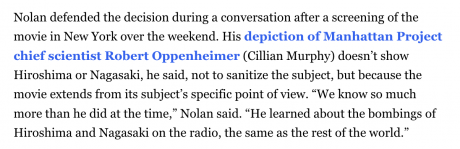
When was the last time Chris Nolan had no choice but to explore or otherwise settle into a reality realm — a realm defined by the same terms that all sane earthlings are more or less obliged to live by? The answer, of course, is 2017’s Dunkirk. But before that, Nolan’s last RR flick (i.e., no exceptional visual augmentation) was Insomnia, which is nearly 20 years old. (It opened at the Tribeca Film Festival on 5.3.22, and commercially on 5.24.02.)

If you ignore Dunkirk, Nolan World was defined by indulgent, highly imaginative flights of visual fancy for 15 years — Batman Begins, The Prestige (HE’s 2nd least favorite Nolan film), The Dark Knight, Inception, The Dark Knight Rises, Interstellar (HE’s all-time unfavorite…most infuriating sound mix in motion picture history) and Tenet.

Memento (’00) is Nolan’s most satisfying reality-based film, hands down.