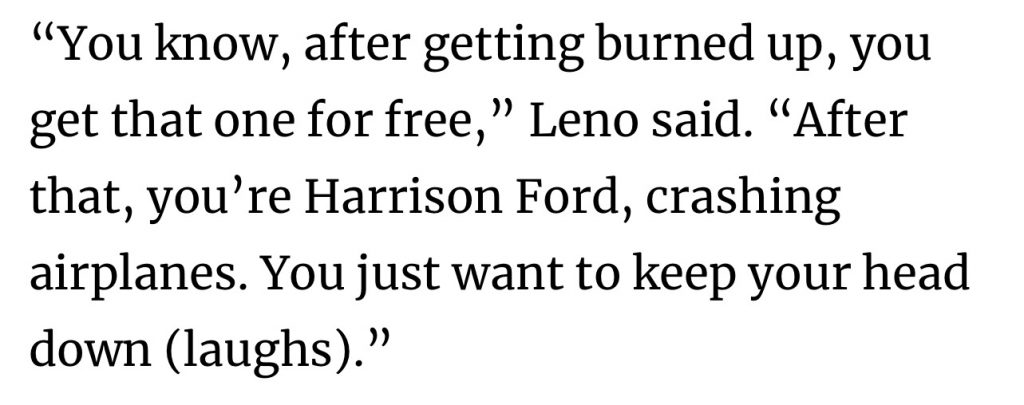
Jay Leno ‘s second auto–related injury (i.e., knocked off a moving Indian by an unmarked wire in a parking area, resulting in a few broken bones) has nudged him into Harrison Ford territory, and he knows it.

As I’ve said two or three times, I didn’t feel a great deal of affection for or emotional alignment with Andrea Riseborough’s performance as an all-but-incorrigible drunk in To Leslie, which relatively few have seen. Released by Momentum Pictures on 10.7.22, the film has earned a bit more than $27K so far.
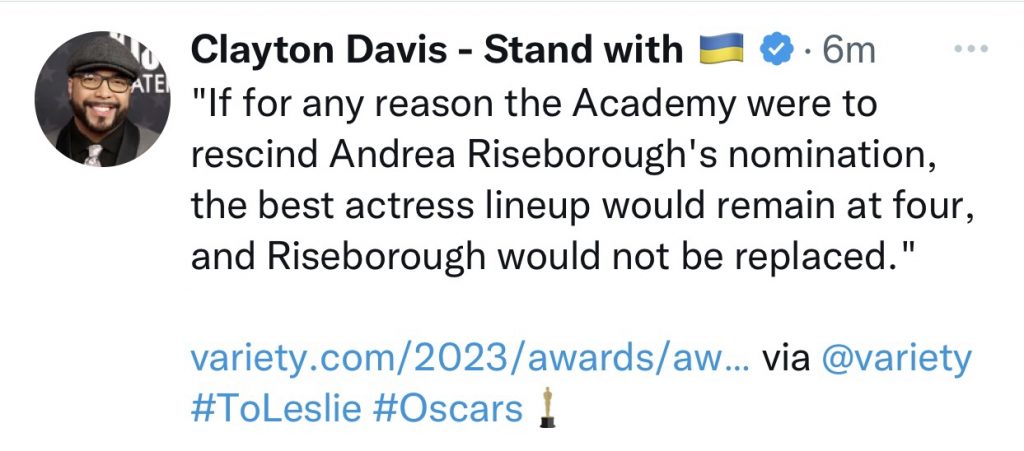
To Leslie is, however, being re-released this weekend in the wake of Riseborough landing a Best Actress nomination, which was totally surprising and seat-of-the-pants. But there’s an odd (do I mean oddly hysterical?) side angle to this.
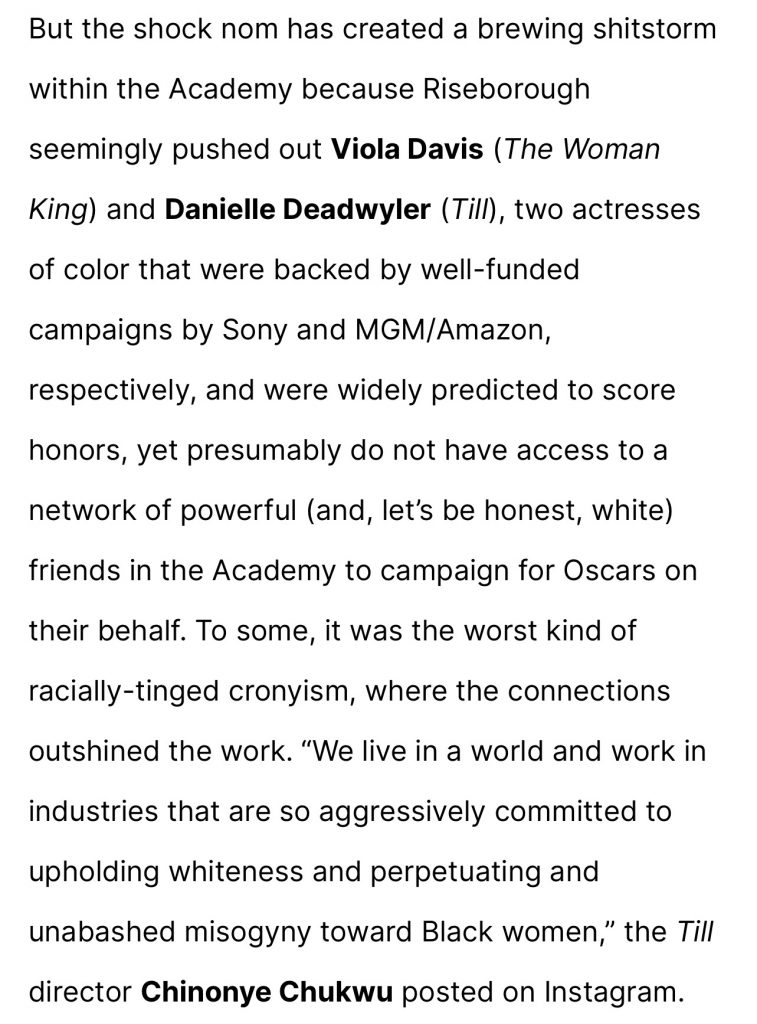
Hold onto your hats, but certain industry voices and at least one industry analyst are viewing the Riseborough insurgency with a degree of SJW alarm, suggesting that there was something (no invention or exaggeration) bluntly racist about it. “Racially-tinged cronyism”! A grass-roots campaign fortified by “a network of powerful (and, let’s be honest, white) friends in the Academy”!


From Matthew Belloni’s latest “What I’m Hearing” column:

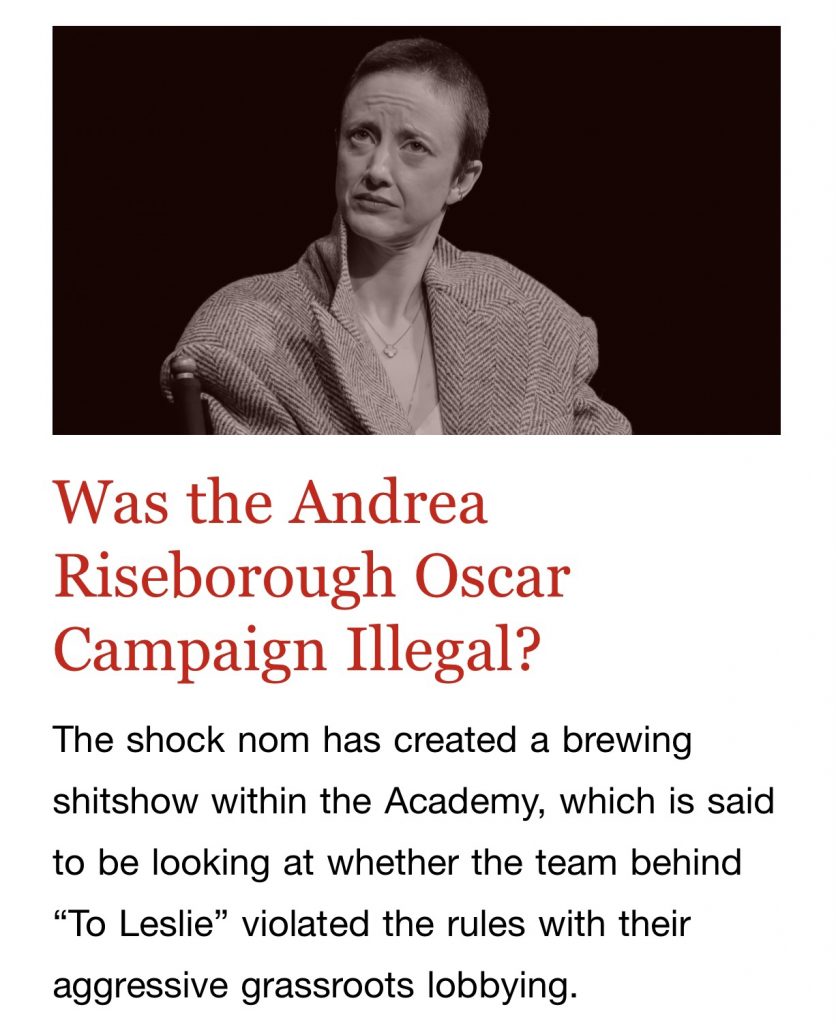
If you have any sporting blood you have to at least half-admire the fact that Team Riseborough (led by actress Mary McCormack, wife of To Leslie director Michael Morris, with vigorous assistance from Frances Fisher) managed to land Riseborough a Best Actress nomination. They basically mounted a grass-roots social-network campaign, but one that may have been “illegal,” according to Belloni.
If the general consensus was, in an alternate universe, that the Riseborough campaign had elbowed aside a couple of deserving paleface actresses instead of Viola Davis and Danielle Deadwyler, does anyone think that Belloni or anyone else would be talking about illegality?
Renegade Oscar campaigns go all the way back to The Alamo’s Chill Wills. It’s sometimes a rough and tumble game, and there are always questions and quibbles about tactics and line-crossings. But from this moment on, Andrea Riseborough is a name, a star, even a legend.
Did I not say a few days ago that I smelled trouble after watching the trailer for Shrinking (Apple, 1.27)?
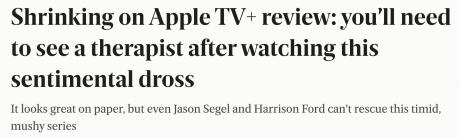
From Martin Robinson‘s recent review:
“The big question that comes from watching the new therapist comedy Shrinking, is: are there therapists who can help those who watched Shrinking?
“Oh boy, this is…bad. Which is very disappointing, because it looked great on paper. Jason Segel — has there been a more likeable actor ever? Harrison Ford — has there ever been a more beloved film icon? And though they may try hard (well, Segel tries hard; Ford phones it in, but that’s to be expected, he practically invented phoning it in the moment an Ewok starting hugging his leg in Return of the Jedi), the show has a death wish with regards to sentimentality: every pithy or mildly bruising encounter is followed by a plunge off a cliff into yet another musical montage of people bonding.
“Shrinking is about a therapist called Jimmy (Segel) whose wife has died, leading him into a breakdown in which he starts telling his clients what he really thinks about them and their problems. Much to the disdain of his curmudgeonly boss at the clinic, Paul (Ford), who has Parkinson’s and his own grief to deal with.
“It’s not a bad set-up, and you could imagine, say, Vince Gilligan bringing out all the darkly funny shades within that story. But here, Segel along with fellow co-creators Brett Goldstein (Ted Lasso) and Bill Lawrence (Scrubs), can’t seem to help but keep things easy and breezy and outright nauseating.
“So while our first sight of Jimmy is of him drinking and doing prescription drugs in his pool with two prostitutes while his teenage daughter is asleep inside the house, he’s really nice and shuts everything down when his neighbor complains, and… well, that’s the last we see of him doing anything self-destructive on the drink or drug related. That’s some addiction.”
Alluding to Robert Redford in the early ’70s, director Sydney Pollack once said that “in acting, you have to sense that there’s a reserve somewhere, that you’re seeing the top of the iceberg.”
That, to me, is everything in screen acting — conveying that there’s a lot more underneath than what you’re seeing and hearing in a given scene. Forget technique — if you don’t have the under-the-water iceberg thing, you have nothing.
As far as Academy membership is concerned, one measure of fairness and equity would be to have Academy membership reflect general U.S.population tallies in terms of tribal ethnicities and whatnot. What are the actual hard Academy percentages as far as this goes? I’m asking.
We all understand that the Academy has become much more diverse since 2015. Two and a half years ago the Academy invited 819 new members into the fold. On 6.30.20 Variety‘s Marc Malkin reported that total Academy membership thereafter stood at 9,412 “with 45% of the new members will be women and 36% are from underrepresented ethnic/racial communities…the international make-up is 49% from 68 countries.”
But right now (January ’23), what percentage of the Academy is white, African American. Asian-descended, LatinX and so on? I’m searching around for hard stats and not finding any from ’22. Then again I’m in a rush and haven’t the time. I’ve asked some colleagues but they’re probably gun-shy…too much of a sticky wicket.
Should Academy percentages roughly equate with U.S. population percentages? That would be one yardstick. Right now the U.S. is roughly 60% white, 12.6% African American, 18.9% Latino, 9% Asian and so on.
Or should the Academy percentages be higher, based on the number of POCs or non-whites working in the film/TV industry? I honestly don’t know. But there has to be some statistical basis for fairness and inclusion.
Yesterday a “woe to black women filmmakers…Oscars-so-white is back” essay appeared in the Los Angeles Times, which of course was one of many articles lamenting the failure of Danielle Deadwyler and Viola Davis to land Best Actress noms for their respective performances in Till and The Woman King.
Written by Robert Daniels, the piece was a complaint about a seeming failure of Academy voters to follow the dictates of equity and quota voting, which basically means “to hell with merit…we’re in an age of social justice course correction and therefore it’s just not right for both Deadwyler and Davis to have come up empty-handed or, if you will, to have been elbowed aside.”
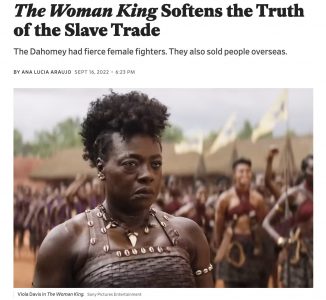
Do I have to remind that the chances of a Davis nomination were more or less out the window the minute those articles about Dahomey having profited from the slave trade appeared last September and October? They gave everyone an excuse to not vote for her.
And of course, Deadywler’s commanding lead performance aside, Till is just an okay or good enough film — it didn’t blow anyone’s socks off. So when Andrea Riseborough and her hardcore rummy performance in To Leslie busted into the conversation two or three weeks ago, it was inevitable (speaking from hindsight) that a weak sister contender would get pushed out. Fairly or unfairly, Deadwyler was the victim in this instance.
Riseborough to Deadwyler: “Excuse me, Danielle, but…wow, this is hard because I don’t know to put this. I absolutely adored your Till performance and all, but it’s not my fault that relatively few people saw it. The cold, cruel fact is that (a) I’m a latecomer and (b) I’m riding a surge, and I’m afraid somebody has to go. I know you’ve been working the circuit for several weeks plus you’re a presumed nominee for two reasons — how good you are in Till plus the equity thing. But I’m tapping you on the shoulder regardless. I’m in and you’re out…sorry.”

Comment thread repulsion: “I was convulsing with misery and dying to escape but boiled down EEAAO isnt so much about generic verse-jumping (although it is) or the IRS audit or Ke Huy Quan’s nerd husband wanting a divorce or James Hong’s grandfather Gong Gong or the hot dog fingers, etc.
“Boiled down the central story tension is about the discomfort and denial that Michelle Yeoh’s Evelyn, a laundromat owner, is going through about her daughter Joy (Stephanie Hsu) and her lesbian relationship with Becky (Tallie Medel) and particularly Becky’s annoying hair style — a situation reflected in the multiverse by Joy’s Jobu Tupaki vs. Alpha-Evelyn and Jobu’s threatening, Darth Vader-ish behavior (“omnicidal” in the multiverse) blah blah.
“The big EEAAO catharsis manifests not so much with a resolution over the audit (although that’s welcome) as much as Evelyn’s ultimate acceptance and embrace of Joy’s queerness. Evelyn has travelled outside of and within herself to find peace with Joy not being straight.
“Kill me now with a steak knife.”
Friendo: “EEAAO has everything that Woke Twitter needs to feel safe. Bad white lady vs. good older Asian woman at the nominal center, augmented or flavored by a neutered dweeb-husband type plus gay daughter representing how people SHOULD think.
“The whole movie is the gay daughter chasing her mother around saying ‘why are you like this?’
“It’s basically everything we’ve all lived through from 2020 onward. CG purée made out of woke dogma. Or, alternately speaking, a 2013 Tumblr thread made into a movie.”
If you carefully read Pete Hammond‘s Deadline assessment of the possible Oscar fortunes of Everything Everywhere All At Once, there’s reason to believe that it might lose.
One, Hammond writes that “critics can take credit” for putting this infuriating A24 release “into front-runner status” — overly obliging, finger-to-the-wind critics, he means, and not your grounded, rank-and-file industry types.
And two, EEAAO is “relatively weak in the crafts area” (no noms in visual FX, cinematography, production design, sound, hair and makeup), which “could be telling in its overall Academy appeal.” You bet your sweet booty!
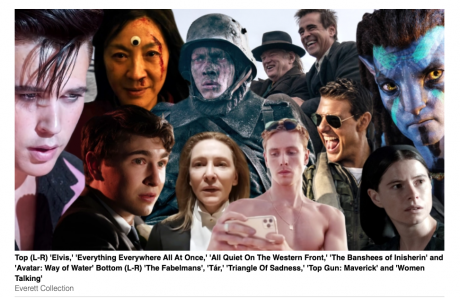
Friendo: “Right now I think EEAAO is the Best Picture frontrunner, principally challenged by Top Gun: Maverick and The Banshees of Inisherin.
“Top Gun is a mood-lifter and one of the only ones. Banshees has no reason to win. EEAAO is a woke odyssey — essentially a movie that explains wokeness. Explore inner realms beyond traditional day-to-day life, and in so doing redefine reality. A female small-business owner with a queer daughter experiences a great awokening.”

I’ve never seen (and probably never will see) Tammy and the Bachelor (’57), but this musical overture passage, composed by Frank Skinner, is mildly impressive in a schmaltzy sentimental sort of way.
I’ll admit it takes some effort to imagine a blissful romantic pairing between young Frank Drebin (30 year-old Leslie Neilsen) and the 24 year-old Debbie Reynolds.
Speaking of Neilsen: In the fall of ’88 I was delivering Dukakis for President literature in the Hollywood hills (Maggie and I were living at 8682 Franklin) and after knocking on the front door of a fairly sizable hilltop bungalow who should answer but Drebin himself! White-haired, wearing only gym shorts, in no mood for banter. I played it dry and casual.
Sundance friendo: “I loved Passages, Infinity Pool (NC-17 cut), Fair Play, Scrapper, Theatre Camp. Minor woke servings but definitely better than recent years. Everybody loves the Willie Nelson, Michael J. Fox and Brooke Shields docs. I’m still trying to see Magazine Dreams, Eileen, Polite Society. So far I’ve seen 10 films. I should be able to see about 10 more by the time the fest comes to an end.”
Sundance friendo #2: “Honestly, from what I’ve seen, this has been a terrible Sundance. The festival is getting worse and worse. I haven’t seen Past Lives, which is supposed to be the best movie that played there.”

Alejandro Gonzales Inarritu has reiterated his disdain for superhero movies. He recently told Variety‘s Marc Malkin that superheroes are “sad figures,” although inorganic or uninvested is probably closer to the mark. Overly confident, No pain or gain.
AGI seems to be alluding more to superhero fans and their attachment to repeatedly re-sampling those surges of adolescent euphoria…we’re all receptive to that stuff on a certain level, to the casual glory of it all…the basic selling point of every superhero flick.
“I see heroes every day,” AGI explained. “I see beautiful people really going through very difficult situations and doing incredible things. And [these are] the people that I kind of connect with. But superheroes…do we really need that?”
More to the point and aside from Chris Nolan, James Cameron and Sam Mendes, which world-class, major-league directors have truly embraced the basic superhero scheme from a fan perspective? They all pretty much hate them, don’t they?
Here’s an idea — imagine that five or ten genius-level directors (forget their ages) have been somehow forced to go superhero slumming as a one-off…forced to co-write and direct some kind of smartly imagined superhero flick. Who might perform well under these circumstances?
There’s a clear differences between superheroes and exceptional action stars, and most of us can roll with the latter. Seemingly invulnerable (or certainly difficult to kill) protagonists with extraordinary skills. No movie fan can truly enjoy the adventures of supermen because of the bullshit factor. But somewhat vulnerable figures with exceptional skills and determination…tactical intelligence wizards…action studs. That’s as far as I can go. Matt Damon‘s Jason Bourne…Denzel’s Creasy…that line of country.