Damien Chazelle‘s Babylon opens today (12.23). It’s probably too early to ask for reactions, but I was struck by a passage in Manohla Dargis‘s N.Y. Times review. For those who’ve seen it, do you agree or disagree with Dargis’s reaction? And why?
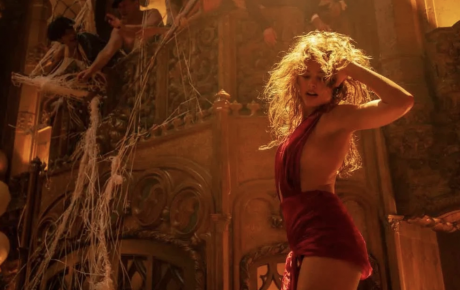
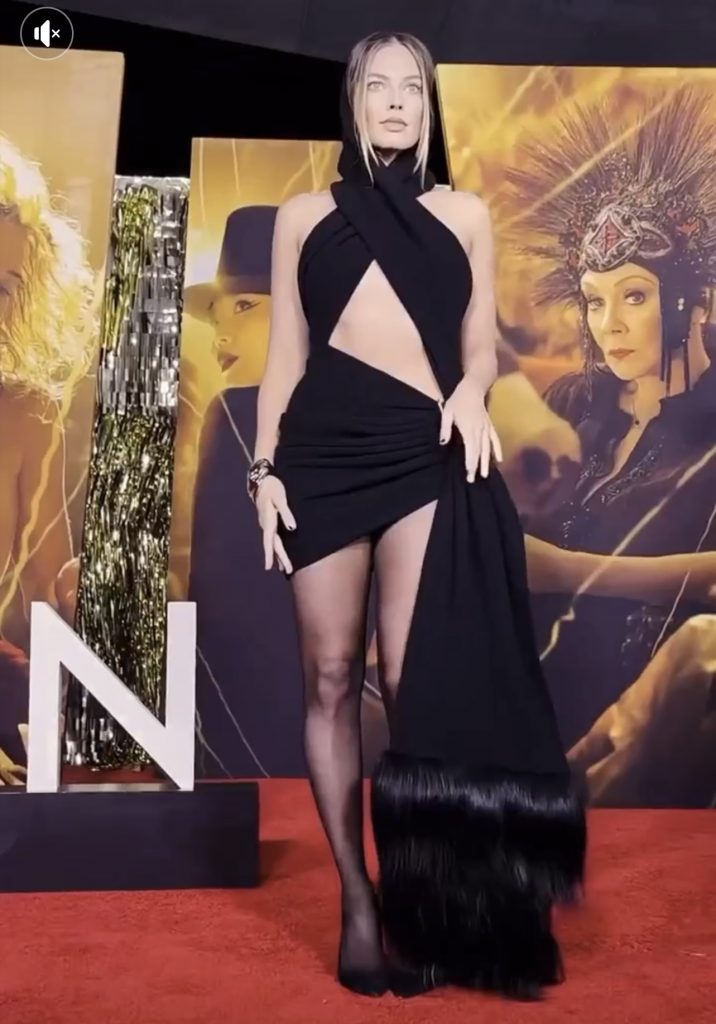
“Compared to the larger-than-life, at times cartoonish, more physically demonstrative performances delivered by Brad Pitt and especially Margot Robbie, Diego Calva is relatively tamped down and reactive, which brings his turn closer to contemporary notions of realism. These differences add complexity and much-needed rhythm changes.
“Similarly to his characters, Chazelle has embraced excess as a guiding principle in Babylon, and like his film La La Land, this one shifts between intimate interludes and elaborate set pieces, one difference being that Chazelle now has a heftier budget and is eager to show off his new toys. At the inaugural bacchanal, the camera doesn’t soar; it darts and swoops like a coked-up hummingbird.
“Despite the relentless churn on set and after hours, the movie is strangely juiceless. I don’t simply mean that it’s unsexy (which it is), but that there’s so little life in the movie, despite all the frantic action. There isn’t much going on other than the spectacle of its busily spinning parts, which might be tolerable if the first two hours weren’t so unrelievedly unmodulated, with everything synced to the same monotonous, accelerated pace.
“This hyperventilated quality initially serves the story and Chazelle’s concept of the era’s delirious excess, but the lack of modulation rapidly becomes enervating. After a while, it feels punishing.”
In Martin Scorsese‘s The Aviator (’04), Cate Blanchett‘s impersonation of Kate Hepburn (that fluttery Bringing Up Baby laugh on the golf course) earned her a Best Supporting Actress Oscar.
Seven years later Blanchett delivered another based-on performance, a financially fallen woman who was half Ruth Madoff and half Blanche DuBois, in Woody Allen‘s Blue Jasmine, this time snagging a Best Actress Oscar.
In Todd Field‘s TAR Blanchett plays an obsessive and emotionally ruthless orchestra conductor who gets eaten by cancel culture. It’s almost certainly her grandest and far-reachingest effort, and the first Oscar-heat performance that is entirely Blanchett’s creation — no echoes of perviously celebrated actress or notorious characters. And there’s really no way she doesn’t win her third Oscar for this on 3.12.23.
Partly because Blanchett’s competition is so comparatively underwhelming — nobody else is quite in her class.
Michelle Yeoh will be Best Actress-nominated for Everything Everywhere All at Once, but the film is a groaner, many 40-plus Academy members hate it, and Yeoh’s nomination will essentially be about her ethnicity…be honest. The EEAAO campaign is based on a DEI approval consensus. Ask yourself what the Academy reaction would be if EEAAO wasn’t about an Asian-American family (white folks don’t verse-jump as a rule but imagine it anyway) and if Yeoh’s character was a stressed-out 50something white woman played by, say, Laura Linney. Or by Jamie Lee Curtis with the IRS investigator played by Yeoh. Be honest.
There’s no question that Michelle Williams as the peculiar, emotionally eccentric mother in The Fablemans is a very broad and actressy performance. While Williams may be be nominated, the buzz has fallen away. I really don’t see her winning.
The most that Till‘s Danielle Deadwyler can hope for is a Best Actress nomination, because that’s as far as things will go.
I’ve heard people say that Margot Robbie‘s feisty, outsized performance in Babylon made them recoil, and given the negative reactions to Damien Chazelle‘s 1920s Hollywood epic I wouldn’t be surprised if Robbie is passed over.
Ana de Armas expertly did what she told to do in dramatizing the ache and trauma of Marilyn Monroe‘s sad life, but Andrew Dominik‘s Blonde is too deeply despised.
Viola Davis in The Woman King? No room at the inn.
I’ve been listening to Sarah Polley‘s podcast chat with Megan Daum (“The Unspeakable”). There’s a special focus, of course, on Polley’s Women Talking (UA Releasing, 12.23). Which many will respect but few outside of the feminist #MeToo take-power community is going to love…behonest.
Within its own realm Women Talking is a “respectable” effort, but it’s still a dialogue-driven political piece — a dimly-lighted, dusk-to-dawn discussion among several Mennonite women in a barn, about how they should respond to a series of horrific rapes within their community. The question is “do we stay or do we go?”
The question for critics is “where is the political upside for me if I say I have problems with this?” The answer is there is none, which is why almost all the critics (especially the wokester Branch Davidian types) have completely fallen for Polley’s film while insisting it’s a Best Picture contender
I know what Women Talking is, good and not-so-good, and that it’s aimed at a certain mindset and demographic even. Anyone who says “this film is just wonderful and eloquent and powerful and you simply have to see it”…if that’s all they say, they’re absolutely lying by omission.
From her first professional encounter with callous behavior on Terry Gilliam‘s The Adventures of Baron Munchausen (’88), Polley has been very concerned about safety…safety on sets, protection from abusers. This is partly who she is, what she’s experienced…naturally she’s drawing from this well. She’s a serious person and a serious filmmaker.
It’s just that her film didn’t speak to my older-white-dude way of seeing things. It certainly didn’t reach in and touch me. I was checking my watch, waiting for it to end.
Women Talking‘s basic idea is basically “stand up to the pigs…condemn them, abandon them, isolate them.” Agreed! But the idea isn’t that a few sex-starved, cold-blooded Mennonite men are brute beasts, but that the overall patriarchy (straight white men) is to be regarded with extreme suspicion as too many white males seem amoral, heartless and exploitive. They probably need to be fought tooth & nail and perhaps even overthrown.
Last September a friend opined that Polley’s film is “almost comically male-hating.” When the wimpy and wimpering Ben Whishaw is the only male they can trust, you know what Polley is saying…”tearful, guilt-stricken-on-behalf-of-their-gender gay men are cool but forget straight guys!!”
Really? There isn’t one decent straight guy in the community who can be trusted? Not one regular dude who’s disgusted by the rapes and pledges to support the women? Imagine how the film could be spiritually and emotionally opened up, so to speak, if there was such a character. Or if a second straight male were to intrude only to speak skeptically about the assaults and argue against leaving.
Women Talking is oppressive because (a) it’s oxygen-starved and visually claustrophobic, (b) there’s no dramatic tension to speak of because from the perspective of the horribly brutalized victims it’s ludicrous to argue for staying, (c) the characters don’t sound like isolated Mennonites but smart, educated, worldly women playing their idea of isolated Mennonites.
Presumably some HE regulars have seen it and would care to weigh in?
Wednesday night Jody and I were having a light dinner at Terrain, and a guitar lady (late 30s, cute face, pleasant pipes) was singing the usual pop Christmas tunes.
But we were hearing too many kid-level songs (“Jingle Bells,” “Frosty the Snowman”), so I asked the waitress if the troubadour would consider something a little more adult-sounding. Like, say, “Baby, It’s Cold Outside” — a once popular, more recently derided 1944holidaytune about a hound’s crude attempt at seduction. Icky, yes, but at least an improvement over “Rudolph, The Red-Nosed Reindeer.”
Our cheerful server pretended to be horrified — “Oh, she can’t sing that! Somebody’ll get mad.” Could you ask her to sing it anyway? I asked. Maybe she’ll brave it? The waitress said she’d pass along our request. Deaf ears. The thought passed.
But we ran into the singer as we were leaving and mentioned our interest in “Baby, It’s Cold Outside,” and to our surprise she said she was a fan and would’ve absolutely sung it, no prob. She seemed to simply like the idea of a Christmas holiday tune about possibly getting poked, and didn’t care about the 21st Century Harvey Weinstein creepitude**.
I’d forgotten that Alvin Lee, the fastest guitarist in the west, died in 2013 at age 68. Martin Scorsese was one of the camera guys filming this legendary Woodstock performance.
A big portion of the HE legend is a simulation of youthful vigor and bopping around like a 37-year-old…on the move, in the groove.
It’s therefore shattering to report that over the last 30-plus hours I’ve become a near-invalid. My left ankle is aching and swollen with osteoarthritis, and I can barely hobble around with a cane.
I started using the cane yesterday, and I could barely sleep through the night for the throbbing ache and discomfort. The first wake-up happened at 2:20 am. Spotty sleep for a subsequent four hours.
RichardRushfield calls himself The Ankler. As of this moment I have just as much of a claim to that term as he does.
Not my brand, not my style, not how I do things, humiliating, etc.
I really don’t recommend this shit to anyone except my enemies. I haven’t been through this much physical distress since I slipped and fellontheice in the Sierra Nevadas in mid-February of 2019.
I’ve been in perfect health all my life, and now this.
I’ve bought an ankle brace and gotten a strong anti-inflammatory. I’ll be seeing a podiatrist at 1:15 pm who will give me a shot of cortisone. I really hate this.
So is Cillian Murphy going to spend the entire film looking haunted and forlorn about being the father of the A-bomb? Because I don’t want to go on a guilt trip with this guy. I really don’t. If it hadn’t been for the Hiroshima and Nagasaki bombs that led to Japan’s surrender, my Marine lieutenant dad would’ve been ordered to take part in a huge land invasion of Japan. The odds of survival would have been quite low. Tens of thousands of U.S. servicemen would have died. War is hell, war is horrific…I don’t want to watch a movie about J. Robert Oppenheimer feeling bad and gloomy. I really don’t. He can go through the gloom later in life.
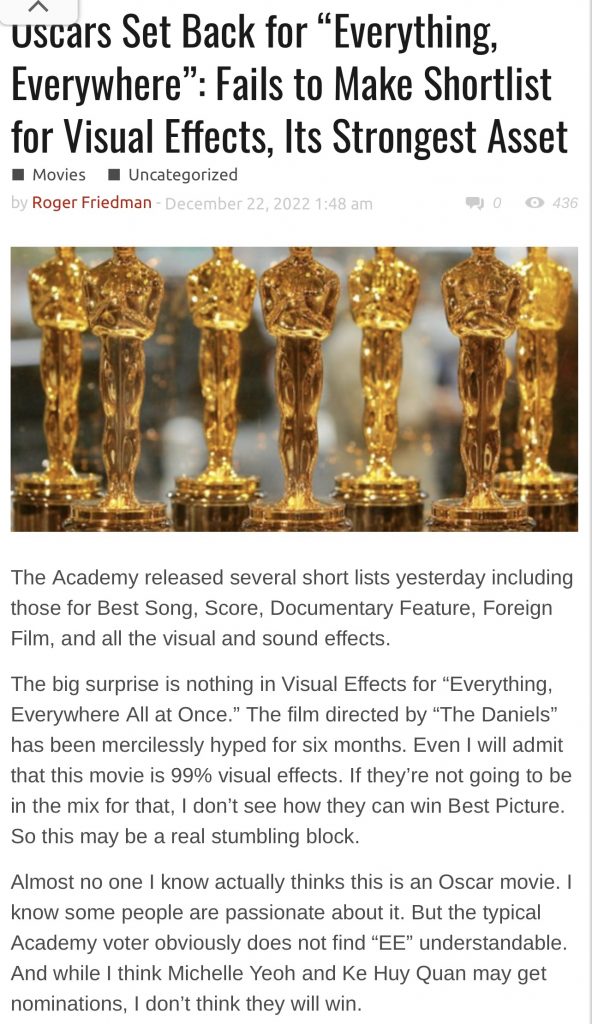
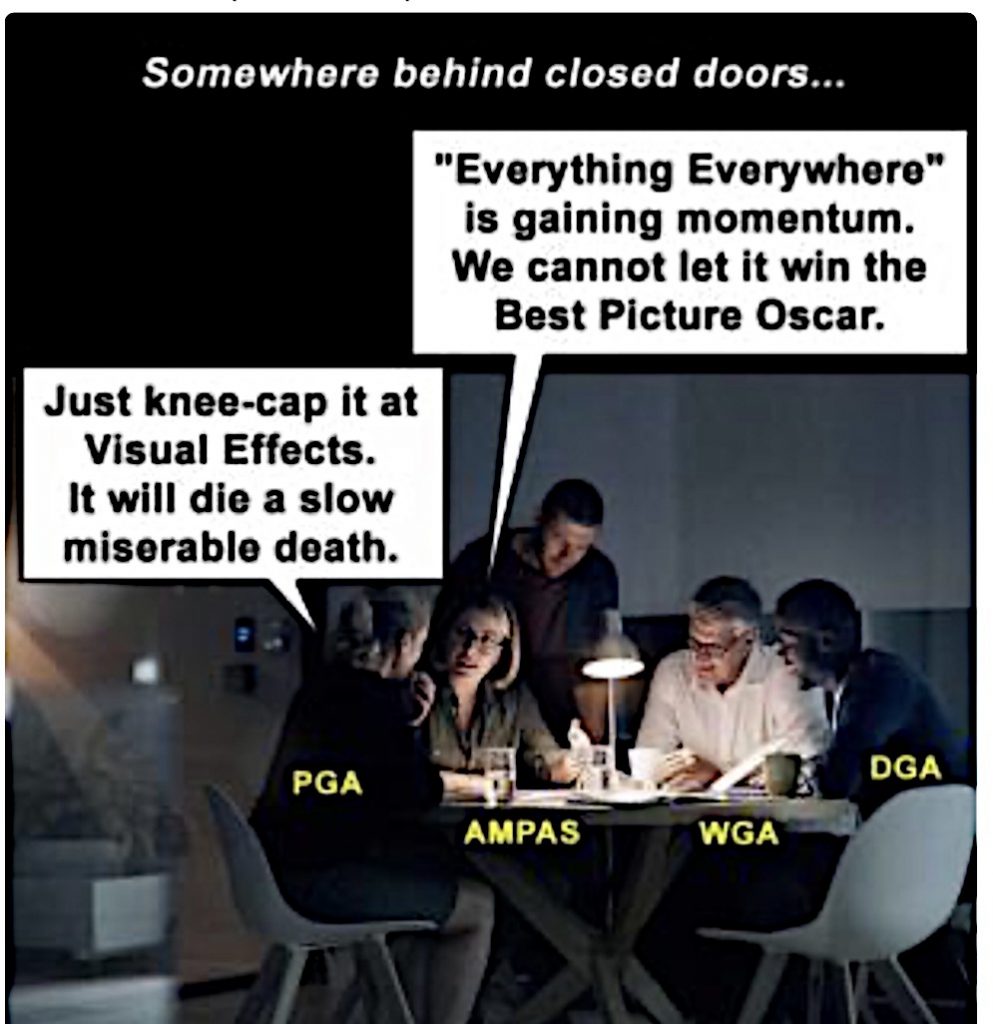
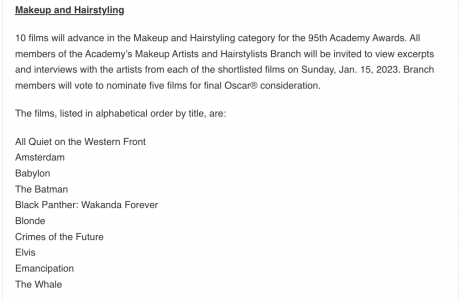
The failure of Everything Everywhere All At Once to be included on the Academy’s short lists for Visual Effects and Makeup & Hairstyling tells us that a serious percentage of Academy members aren’t fans of this A24 release, which suggests that support for it winning the Best Picture Oscar is a lot less than people think. (Yes, it might get nominated in that category.) If EEAAO was the juggernaut that its supporters believe it to be, it would have at least been included among the VFX and Makeup & Hairstyling shortlist nominees.
This is truly the happiest news of the day. I’m levitating off the couch. Thank you, God, for making my day…THANK GOD IN HEAVEN!
The intro is confusingly written, but for our secondpodcastSasha and I discussed HE’stop20filmsof ‘22…didn’t have time for all30. Sasha was in central Colorado as we recorded; she’s currently in the vicinity of Topeka, Kansas.
I hated this movie…hated it. Have there been any other movies shot in India that reemble The White Tiger? Films that operate in the realm of reality? That aren’t cartoonish, fantastical, ludicrous, overwhelming and over-produced? I’m certain that at least some Indian filmmakers are telling stories in a White Tiger-ish way.