Whenever someone passes at too young an age or due to some tragic mishap or a stroke of bad luck, someone always says that the recently departed “loved life.” Which I would call a nice but imprecise sentiment. It’s so vague it’s almost meaningless.
HE’s definition of a lover of life would be the Kinks guy who loves living adjacent to Waterloo Station.
I’m actually a lover of the splendor and symphony of all great European train stations. Ditto the great cities and towns — Paris, Rome, Munich, Hanoi, Hoi An, Milan, Prague, Venice, Arcos de la Frontera, Caye Caulker, portions of Key West, the Berkshires, Monument Valley, Lauterbrunnen — and the tens of thousands of beautiful pastoral vistas all over.
Ditto my cats, my granddaughter Sutton and her parents Jett and Cait and Sutton’s UncleDylan, black Volvo wagons, BMW rumblehogs, heavy leather jackets, Indian or Italian dishes, vinyl record albums, cookies & cream gelato, Italian suede lace-ups, etc.
The only negative that comes to mind amidst all this joy and nurture and rapture, the only aspect of life on planet earth that I consistently have problems with and which generally darkens my worldview are…well, people. Not everyone, of course. The majority are fine. I can just can’t with the three-toed sloths.
…to host the 95th Oscar telecast, I mean? Did the producers even reach out in this regard? Maybe not, but Jimmy Kimmel is fine.
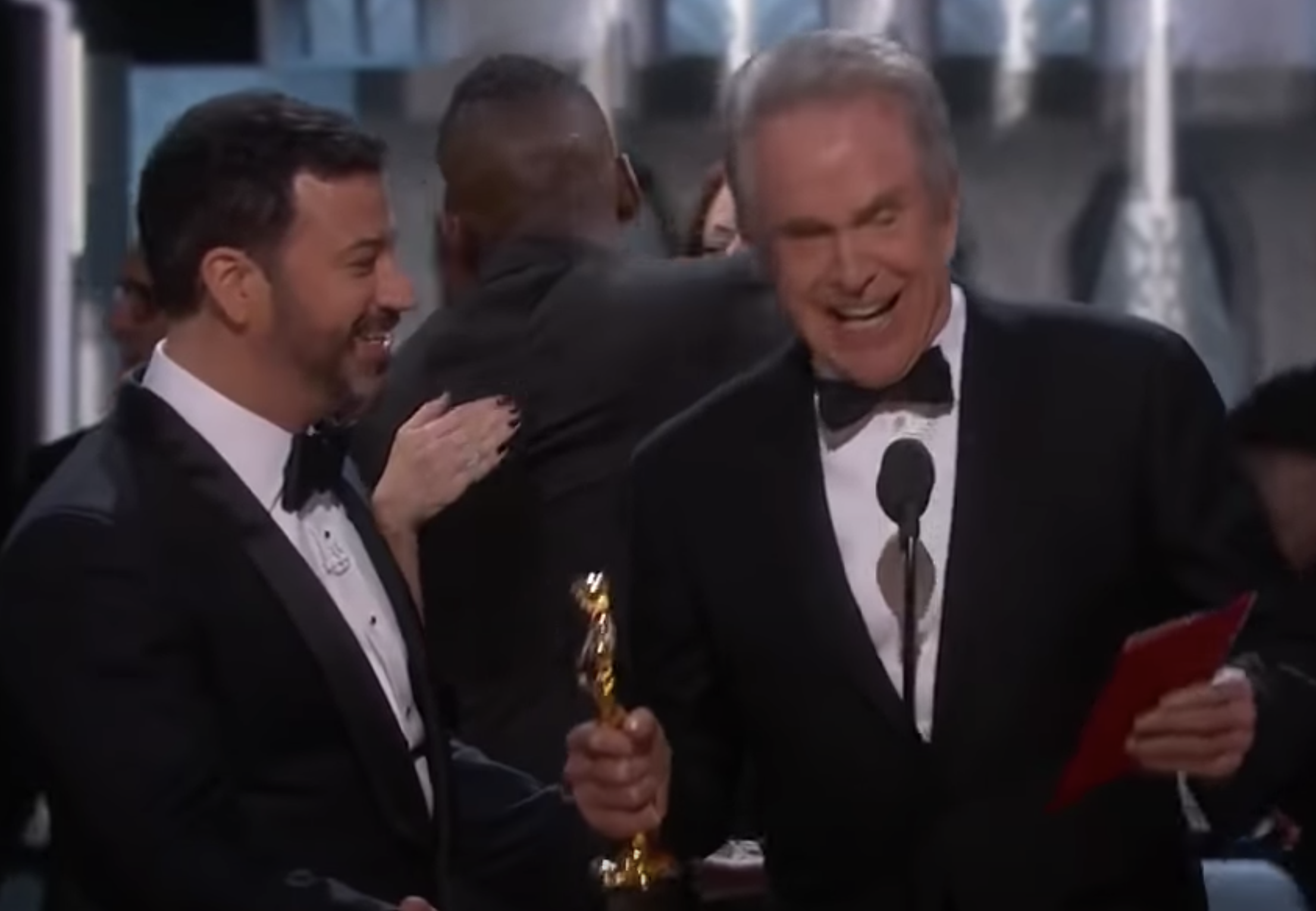
I’ll always associate Kimmel with what many of us feel was The Greatest Oscar Finale in Hollywood History — the ballot screw-up between Moonlight and La La land. I love watching the unedited footage of that snafu, and in my book Kimmel handled the chaos fairly well.
Is Kimmel’s brand of humor too woke? The right thinks so because he’s brutally lambasted Trump for so many years, but I’ve never felt that he was especially guilty on that score.
I also think the Oscar producers tapped Kimmel because they wanted to close the books on the Oscar slap. I also think they wanted to signal that the Oscars don’t necessarily have to be the Anglo Apology BIPOC awards.
Kimmel hosting again is a gesture that says to viewers “okay, we’re pulling back a bit…we’re reaching back to the vibe and attitudes of early ’17, or before the woke virus took over. Quality is quality and may the most gifted or politically popular contenders win, but we’re easing up on the white guilt or white apology factor.”
Last Thursday (11.3) an official trailer for Laure de Clermont-Tonnerre‘s Lady Chatterly’s Lover (Netflix, 12.2) appeared. The trailer is decently cut but it obscures a basic problem that I had with the film, which I caught a couple of months ago in Telluride.
HE review, posted on 9.7.22: “Actors should be allowed to play whomever or whatever. In a perfect world none of us would or should have a problem with a straight actor playing gay or vice versa, or a non-Latino playing Fidel Castro or you-name-it.
“Acting is about submitting and becoming, and whenever a particular effort succeeds it’s glorious. I can still enjoy Alec Guinness‘s Prince Feisal in Lawrence of Arabia, his actual ethnicity be damned. I’ve always believed in his storied brilliance. All Guinness has to do is speak a line or two…sold.
“Then why, I was asking myself, did I have trouble submitting to Emma Corrin‘s lead performance in Lady Chatterly’s Lover?
“Corrin was a perfect Lady Diana in The Crown, and yet I had difficulty accepting her as a wealthy cis British woman succumbing to runting passion in the 1920s blah blah. Nor did I believe that her earthy gamekeeper lover (Jack O’Connell) had any special passion for her. I felt only the effort.
“This is probably at least partly because Corrin has been somewhat pronounced about being queer (she came out in July 2021) and adopting “they/them” pronouns and being nonbinary and wearing breast flatteners and whatnot.
“Plus there’s just something about her that seems coy and stand-offish about sensuality in any form.
“I said a somewhat similar thing about the late Olivia De Havilland when she passed in late July 2020. To me OdH always seemed to lack a sensual ignition switch. Too goody two-shoes or something. I was immediately disciplined for saying so. Variety‘s Steven Gaydos accused me of ‘pissing on her coffin.’ I replied that detecting an absence of a sensual undercurrent in De Havilland was not dismissive or derogatory.
“I’ll never not appreciate Corrin’s first-rate skills, but I just couldn’t believe that her Lady Chatterly was hungry for the proverbial thrusting loins. I kept telling myself ‘forget Corrin’s stated real-life identities’ — just sink into her soul and absorb the feelings and let the movie wash over you and carry you along. But I couldn’t.
“And I’m saying this as someone who truly loved Jonathan Groff‘s straight FBI guy in Mindhunter, Cate Blanchett‘s vampy lipstick lesbian in Carol, Kevin Spacey‘s miserable married suburbanite in American Beauty, Peter Finch‘s gay doctor in Sunday Bloody Sunday and so on. Great acting is great acting, but…well, I’ve said it.”
I’ve been complaining about all-but-unintelligible movie dialogue for several years now, and the almost uniform response from the HE commentariat has been that it’s mostly my fault — my hearing isn’t what it used to be so I need to get a hearing aid and blah-dee-blah.
That may be true to some extent but movie dialogue has nonetheless been increasingly hard to understand over the last decade or so, and it’s absolutely not entirely my fault.
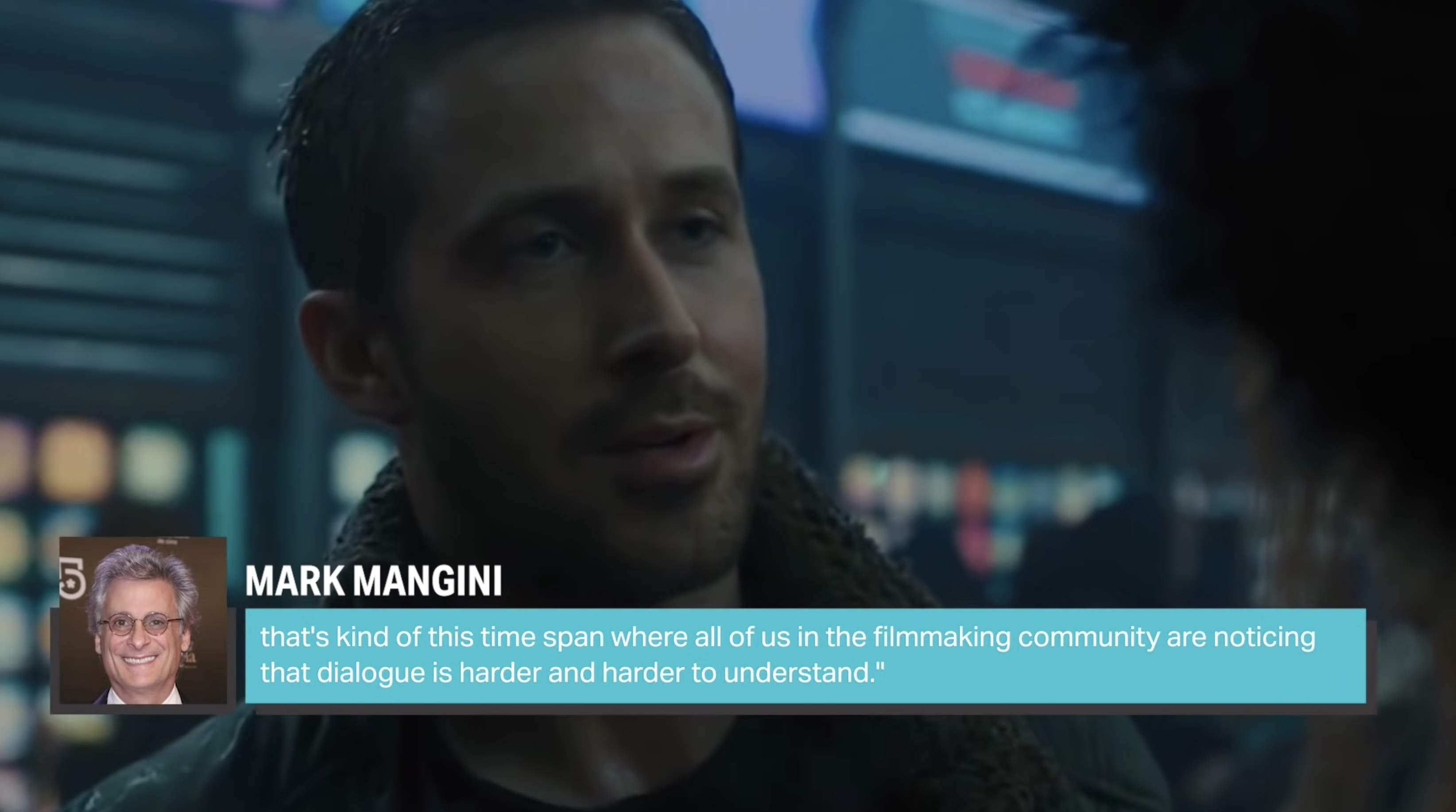
According to Slashfilm’s Ben Pearson and an absolutely historic article that I was too distracted to read until today, a good amount of the blame is on actors, mixing boards, theatre sound systems, Chris Nolan, etc.
Pearson says the chief culprits are (a) ChrisNolan, who has made a fetish out of mixing his films so you can barely hear the dialogue, (b) self-conscious actors who deliver “soft, mumbling, under-their-breath delivery of some lines,” (c) a lack of respect for sound recording during principal photography, (d) too many digital tracks resulting in de-prioritizing dialogue, (e) mixing for cinemas vs. mixing for streaming.
One thing Pearson doesn’t mention is vocal-fry murmur, which Millennial and Zoomer actresses began to project back in the early teens. I first wrote about the vocal-fry plague eight years ago.
All I know is that I’m really looking forward to watching Tar at home with subtitles — something tells me this will be transformative.
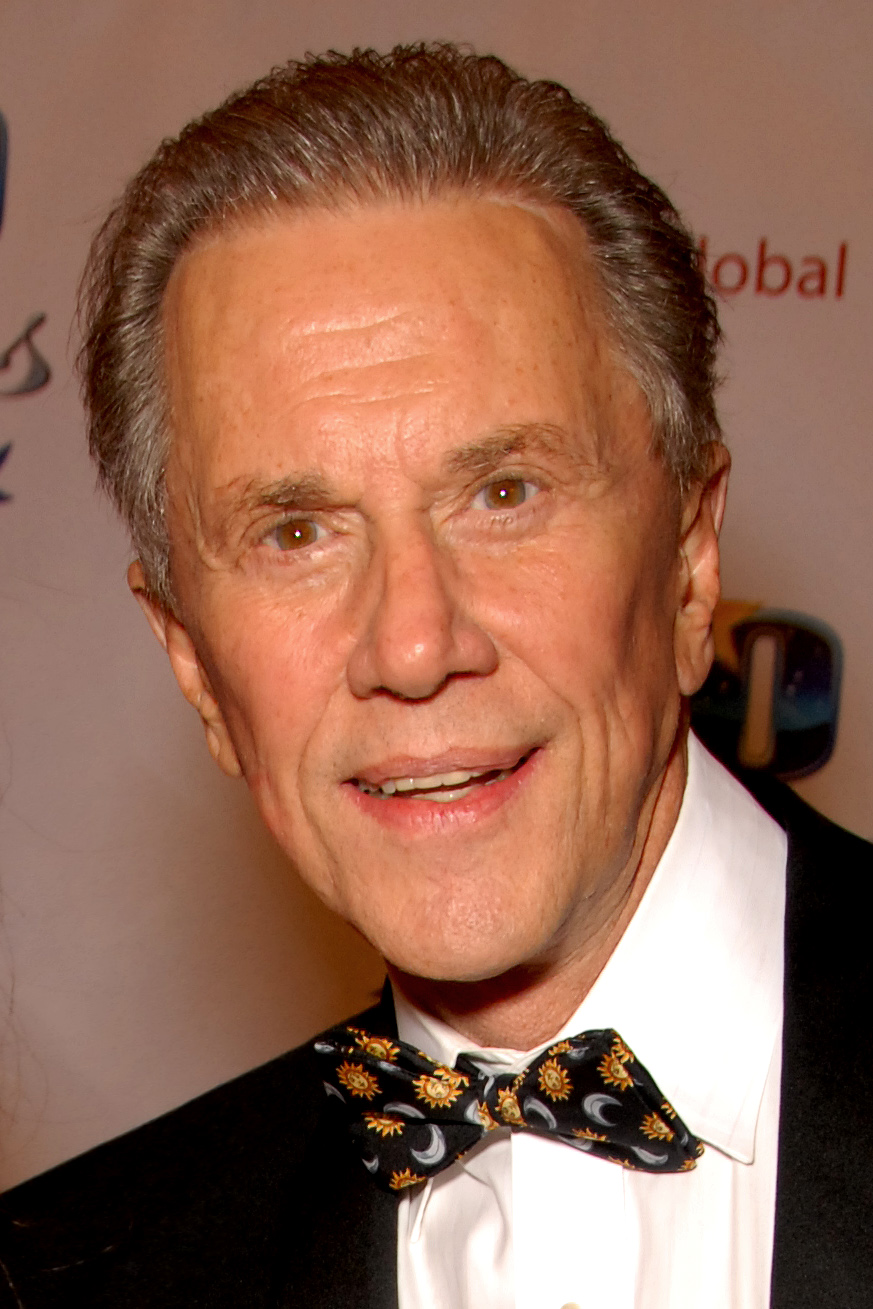
Andrew Prine, a respected character actor who drew from the water of episodic television and B movies for many decades, died a few days ago at age 86.
Prine was one of Quentin Tarantino’s favorite character actors. Alas, he never enjoyed a late-career, Tarantino-sponsored rennaissance like the late Robert Forster did. Prine died on 10.31 while on vacation with his wife in Paris. He liked wearing bow ties for some reason, but let’s not hold that against him.
Friendo to HE: “There are worse ways to go.” HE to friendo: “When my time comes I’d be honored to breathe my last in Paris. Preferably while strolling north on rue Veille-du-Temple, close to the intersection of rue de Bretagne.”
…but I honestly would’t want to spend a weekend in a glass house topped by an ostentatious, big-ass glass dome, much less hang with the guy who owns or has designed it.
Most of us understand that avoiding gauche, declasse people and their environments is a basic requirement in life. If I’m going to fraternize with super-wealthy or super-opportunistic folks I want to stay someplace cool and approvable in an architectural sense. In a home, for openers, that doesn’t say “boy, I sure am wealthy!”
…to come out of The Banshees of Inisherin will be Kerry Condon‘s Best Supporting Actress Oscar. Otherwise it’s an Irish death march — a well-composed, essentially nihilistic film about a self-destructive island of lost souls.
Steven Williams and Stefani Robinson‘s Chevalier (Searchlight, 4.7.23) is a rare historical drama that doesn’t, for a change, smack of presentism. It’s the real-deal saga of a gifted young mulatto fellow from Guadalupe (Kelvin Harrison‘s Joseph Bologne, aka Chevalier de Saint-Georges) vs. evil snooty racist whiteys of Paris and Versailles.
Bologne was a superb violinist-composer, a skilled sword-fencer and a lover second only to Warren Beatty‘s George Roundy in Shampoo. I have a vague idea of how this story will play out, but I’ll tell you this much — any movie in which Marton Csokas plays a venal bad guy is itself problematic.
Ty Burr: “Chevalier [is a lesson about] how to take a grand subject – the life and times of 18th-century Creole violinist-conductor-composer Joseph Bologne — and dumb it down into a strident, shallow melodrama pitched at the rear balcony.”
Friendo: “Evil white people again — do they think this is going to make money?” HE answer: “:In ’20 and ’21 there was a strong belief among Hollywood wokesters that evil-white-people movies would strike a chord. Not necessarily with palefaces but among BIPOCs. I suspect that they realize now that Chevalier is a flop waiting to happen. Shown in Toronto, they bumped the release into April ’23….what does that tell you?”
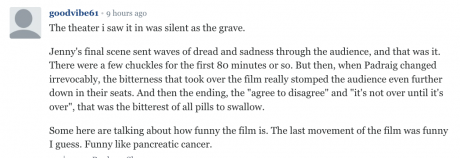
Regional friendo: “Saw Banshhes of Inisherin earlier today. Less than a dozen people in the theater.
“I think a lot of people are expecting one McDonagh thing — more In Bruges wackiness – and getting something entirely different. It’s a very downbeat film, not funny at all (okay, there are maybe one or two chuckle moments), and it quickly becomes obvious why it’s set during the Irish Civil War, which pitted brother against brother, friend against friend.
“What’s going on in Inisherin is the war in microcosm…the violence, the despair, the unforgiving nature. It takes place in an economically depressed setting, one that seems way behind the times with no electricity, no cars, no decent roads, where the police and the priesthood seem to rule over everything.
“Brendan Gleeson‘s character relies on his music to keep him from despair, but it doesn’t really help. Colin Farrell relies on his friendship with Gleeson to help pass the endlessly boring days. And Kerry Condon, truly the heart and soul of this film, knows she has to get off the Island or else turn into a bitter old hag, like the other women in the film.
“Can’t say I enjoyed the fecking movie, and I had some trouble with the fecking accents. But it’s deeper than I expected, and I appreciated where McDonagh was going with it. But boy, is it a downer!”
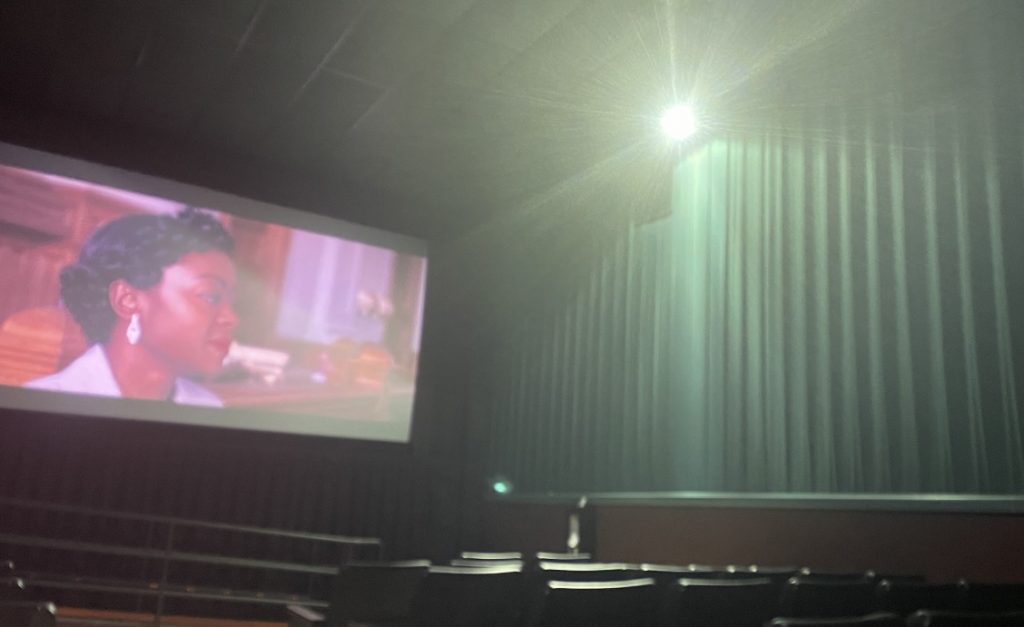
A friend wrote an hour ago about a movie theatre that decided against going dark during a showing of Till.
FriendotoHE: “This is just one more reason I watch films at home. Me alone at Till at Regal Cinema Hampton Bays on Long Island.”
HEtofriendo: “Uhm, what about that folksy, time-honored tradition of strolling into the lobby and asking theatre staffers to turn the lights out during a showing?”
Steven Spielberg is a big fan of Kirk Douglas and Stanley Kubrick‘s Spartacus (’60), and in this AFI interview clip (which appears to be 20 or 25 years old) he shares two or three things that he likes in particular.
One is the duel to the death between Kirk Douglas‘s Spartacus and Woody Strode‘s Draba — short sword vs. three-pronged trident and net. Except starting at 1:28, Spielberg’s memory fails him. This isn’t a felony (we all misremember stuff) but I’m amazed that the AFI crew didn’t stop him and suggest a re-take.
Spielberg recalls that Spartacus and John Ireland‘s Crixus had become friendly, which is true, but they don’t fight each other– Spartacus and Draba do. Spielberg nonetheless recalls that in the dark holding pen adjacent to the gladiator arena, Douglas is sitting across from Crixus…wrong. Douglas and Strode share the pen while Ireland and another guy are fighting. Ireland winds up killing his opponent, and then staggers away, exhausted.
The power of the sequence is that Draba, who has stoically kept his feelings to himself, had told Spartacus that “gladiators can’t make friends…I might have to kill you.” But when Draba has gained the upper hand in the arena and is one trident thrust away from killing Douglas, he instead tosses the trident at the Romans who’ve been watching them from above (Laurence Olivier‘s Crassus, John Dall‘s Glabrus, Nina Foch‘s Helena Glabrus, Joanna Barnes‘ Claudia Marius).
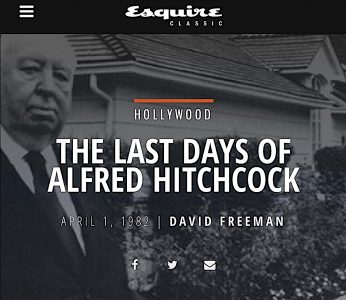
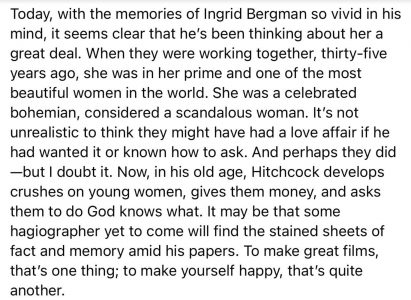
This morning I read portions of David Freeman‘s “The Last Days of Alfred Hitchcock,” a longish book excerpt which appeared in Esquire 40 years ago. From December ’78 to May ’79 Freeman worked with Hitchcock on a script of The Short Night, an espionage thriller what would have been Hitchcock’s 54th film.
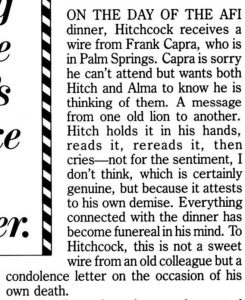
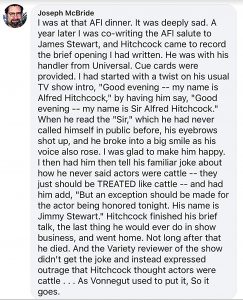
I was struck in particular by two passages, one about the AFI’s 1979 Life Achievement Award tribute to Hitchcock and Hitch’s reaction in particular to a note from an ailing Frank Capra, and another about Hitchcock’s occasional random interest in young women during his final year or two.
I watched the AFI tribute on the tube that year, and my impression was that Hitch seemed barely “there” — no apparent energy or intellectual aliveness or curiosity even. He appeared, frankly, to be on the verge of slipping into a coma. I remember in particular that he didn’t seem to recognize Sean Connery when the star of Marnie was at the lecturn. It made me feel quite sad.