<>/p>

<>/p>
Darren Aronofsky’s The Whale is a strange and shadowed study of self-imposed confinement. Brendan Fraser’s Charlie is a suffering sad sack, all right. I felt for the poor bloated guy, but what a tragedy. What a ghastly, grotesque experiment in plumbing the depths of regret and self-loathing, not to mention the drip-drip process of slow suicide.
Charlie’s choking-on-a-sandwich scene is one for the ages; ditto his eating binge + vomiting scene. Ditto his sweat-soaked, white-light death scene (i.e., my favorite moment in the film). James Whale and Todd Browning would be impressed; so would Montgomery Clift.
Obviously an intelligent filmed play, and mildly pleasurable for that. Fraser’s performance is a whopping, tearful freak show, but I felt the heart of it. And I was moved by that final gasp (partly a cry of release) when he finally goes to God. And yes, I’m proud that I got through it. I‘ve been terrified of watching this film for months, and now I’m past that hurdle. And I’ll never have to watch it again.
It’s been predicted that Brendan Fraser will take the Best Actor Oscar, and not Colin Farrell. The reason, I’ve been reminded, was stated by Michael Keaton during a 2015 visit to The David Letterman Show**: “Illness always wins.”
To which I replied, “How is turning yourself into a 600-pound sea lion an illness?” I was told I was mistaken, that an eating disorder is an illness. “Is anorexia an illness?,” the opposition said. “If so, then so is eating yourself to death.”
“Neither are actual illnesses,” I argued. “They’re psychological or emotional conditions rooted in an abusive history or some other psychological affliction. They’re certainly not illnesses like cancer or lupus or coronary artery disease or diabetes or what-have-you.”
It was pointed out that many in the medical community would argue that Fraser’s condition is an illness, regardless if it is psych-rooted
Farrell, I was told, is the Bob Hoskins of this year’s race. In 1986 Hoskins won just about every award for Mona Lisa. He was also a lock to win the Oscar. Except he wasn’t. Paul Newman won for The Color of Money. Newman had won the NBR award, and Hoskins had won everything else. It didn’t matter.
HE retort: “But Newman wasn’t playing a guy with an illness — he was playing Eddie Felson, an ex-pool shark. Plus Newman didn’t refuse to attend the Golden Globes because the HFPA official had touched his ass and briefly fingered his anus.”
You don’t understand Academy voter psychology, I was told. “Fraser’s touching performance and the comeback narrative is too good for the Academy to not give him the Oscar,” he said.
Nope, I replied. Fraser the actor is too much of a whineybaby. And as miserable as his morbidly obese character is, you can’t call him a victim of an illness. Not really.
** Go to the 13-minute mark.
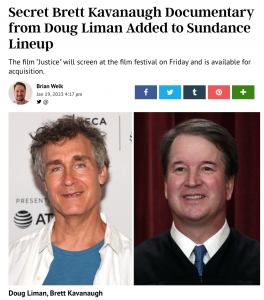
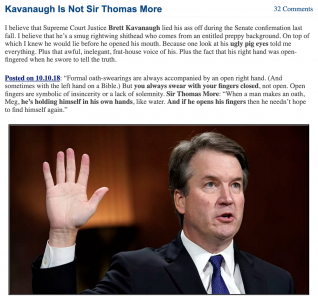
Doug Liman‘s Justice, a last-minute addition to Sundance ’23, is reportedly a deep-dig investigation into the behavior of Brett Kavanaugh during his beer-drinking hooligan days at Yale. It will screen this evening at 8:30 pm at the Park Avenue Theatre (aka the former Yarrow hotel at 1800 Park Ave, Park City, UT 84060). We all understand that Kavanaugh is a pernicious Trump conservative (he voted to overturn Roe v. Wade) and that Christine Blasey Ford was telling the truth, etc. But post-confirmation the general feeling seemed to be that despite Kavanaugh’s gross fratboy behavior, no adult should be hung out to dry over alleged louche college behavior he may have been guilty of in his late teens and very early 20s.
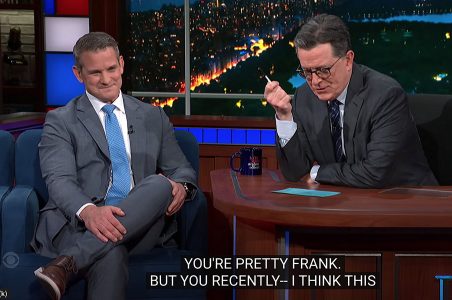
And then he goes on Colbert and blows a significant percentage of his cool-kat cred by wearing whitesides. Yes, I’m kidding but on another level I’m not. Okay, he’s still Adam Kinzinger and still a man of substance, but why would someone with his integrity and moral fibre thumb his nose at the Italian suede lace-up crowd? He surely understands that whitesides are a sartorial equivalent of a red flag. They certainly are on this site.
Wiki excerpt: “Kinzinger voted in line with President Donald Trump about 90% of the time and voted against Trump’s first impeachment, but he subsequently became a critic of Trump and made headlines as a rare Republican officeholder willing to criticize him. In summer 2020, Kinzinger denounced QAnon and other baseless conspiracy theories that gained currency among Republican voters. After the 2020 presidential election, which Trump lost to Joe Biden, Kinzinger denounced Trump’s claims that the election was stolen and criticized Trump’s attempt to overturn the results of the 2020 presidential election.”
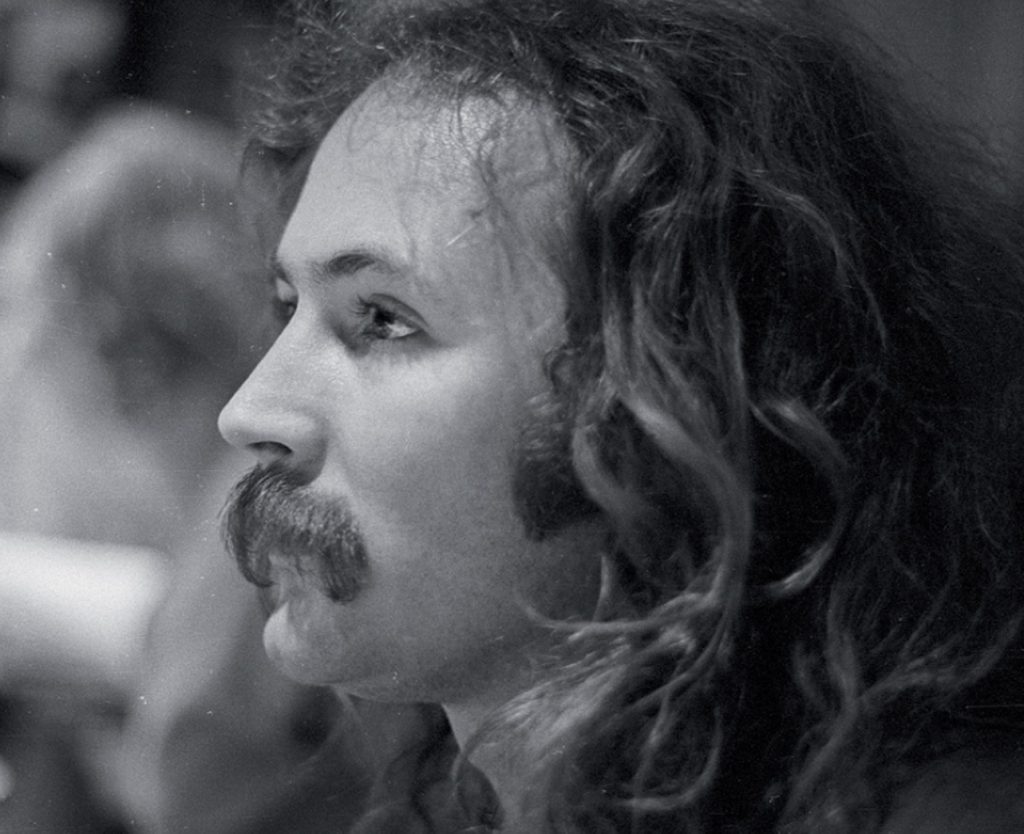
Robert Evans on aging, spoken directly to HE back in ‘96 or thereabouts: “Your hair turns gray, your nose gets softer, your ears get longer and your teeth get smaller.”
But noses don’t change their basic shape. Or at least mine never has. If you have, say, a button nose as a 22 year-old, you’re not going to end up with a Basil Rathbone nose when you’re 70.
Because he’s smooth, gracious, good-natured, soulful, self-effacing, offhandedly frank, confident, obviously likable. His Banshees of Inisherin performance is respected, but Farrell the good fellow will win because he’s an elegant package and he knows how to sell it.
BRAKES R US MECHANIC: I fixed your brakes.
GUY: Excellent, thank you. So the car is safe to drive?
BRAKES R US MECHANIC: What did I just say?
GUY: Brakes are vitally important, you know.
BRAKES R US MECHANIC: A very astute point. I should have that on a poster above the toilet.
GUY: I mean, I’d hate to drive off the lot and have the brakes fail….
BRAKES R US MECHANIC: You and me both.
GUY: …and plow through a farmer’s market or something.
BRAKES R US MECHANIC: Exactly. Who needs THAT aggravation?
GUY: Okay, then. I’m trusting that my brakes have been fixed.
BRAKES R US MECHANIC: Ayy! Would I let you drive outa here with faulty brakes? My reputation, as well as the lives and fresh produce of hundreds of local farmers, is at stake here.
GUY: Great!
[guy drives off, brakes fail, car plows through farmer’s market, many perish]
DA: I hereby charge you with involuntary manslaughter for driving with no brakes.
GUY: Makes sense.
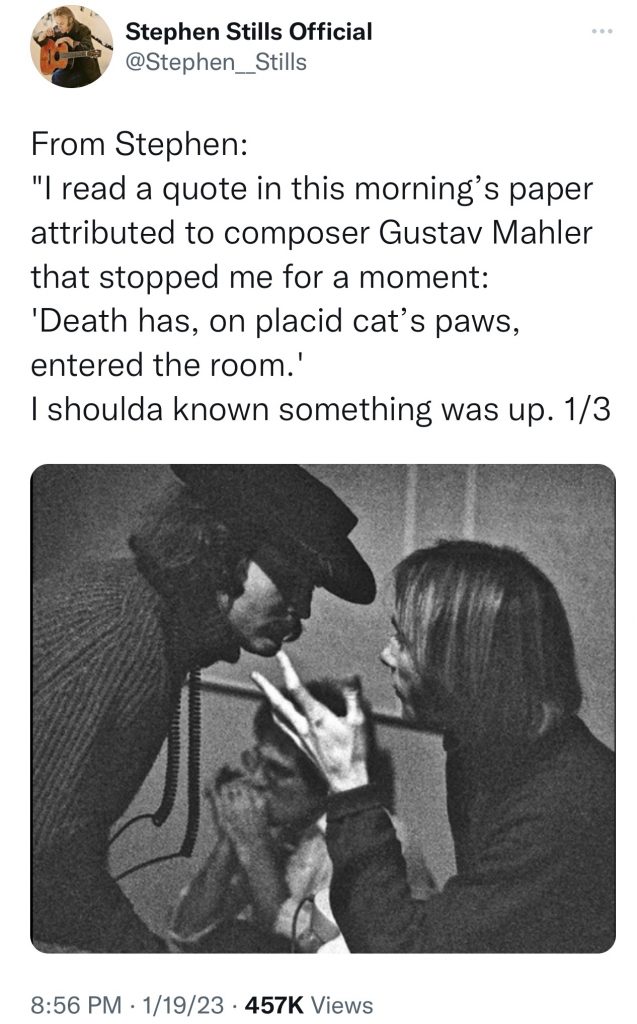
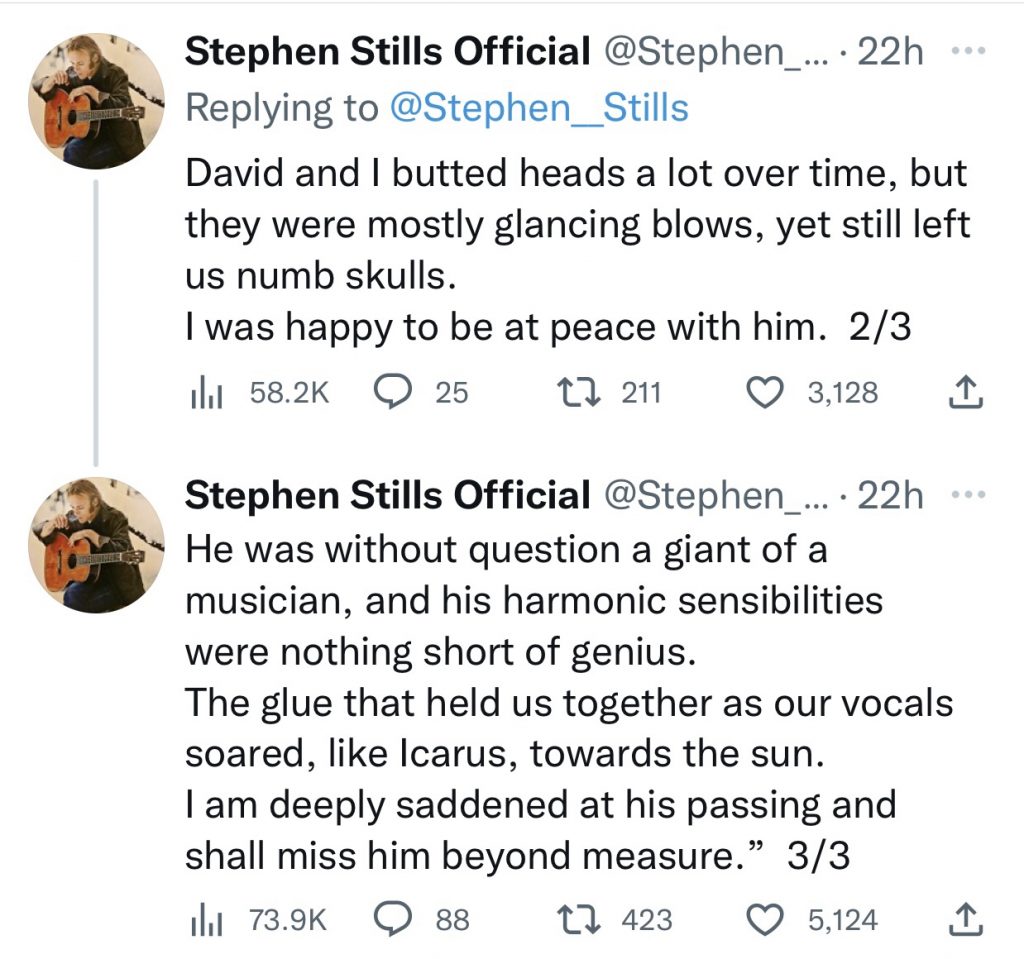
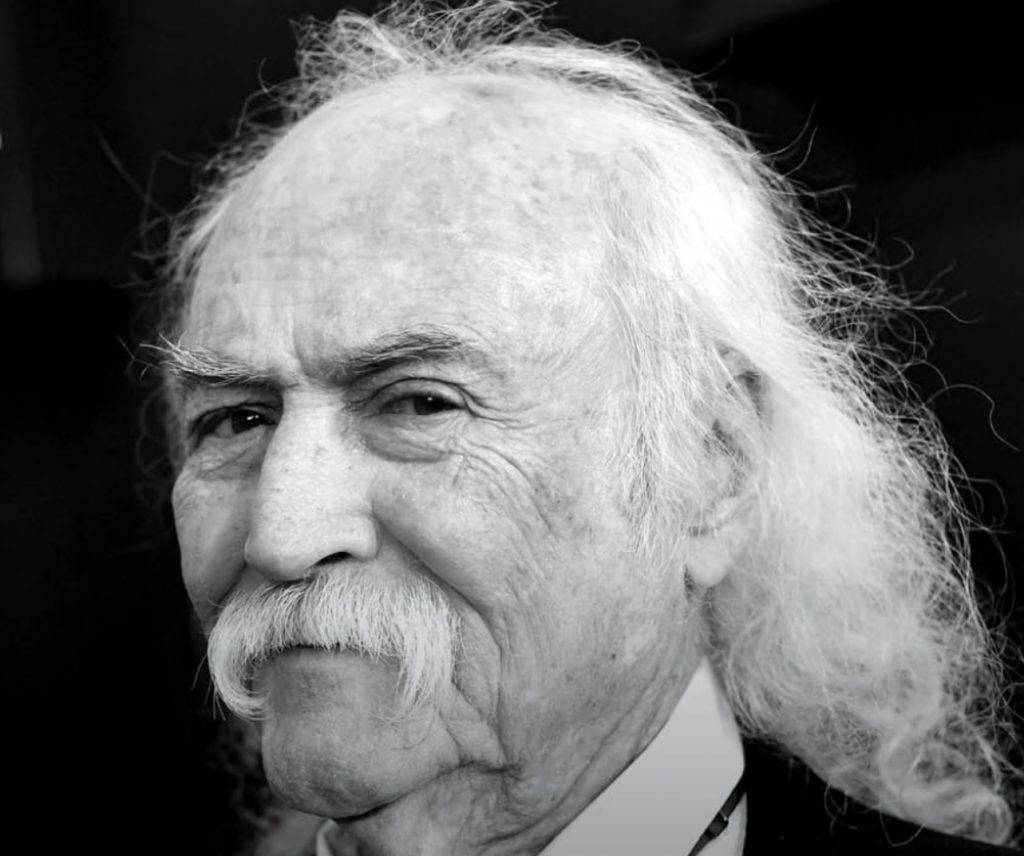
I’m very sorry about the death of David Crosby, 81, but he enjoyed one of the most amazing, up-and-down-and-back-up-again runs of any legendary rock star-slash-troubadour-slash-crazy man. I loved his truth-telling with all my heart. Sail on, brother.
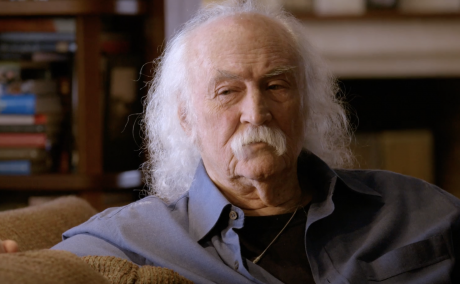
Posted on 1.27.19: After catching yesterday afternoon’s screening of A.J. Eaton and Cameron Crowe‘s David Crosby: Remember My Name, I sent the following email to Crowe:
“Triple grade-A doc…the antithesis of a kiss-ass, ‘what a great artist’ tribute, but at the same time a profoundly moving warts-and-all reflection piece…hugely emotional, meditative, BALDLY PAINFULLY NAKEDLY HONEST…God! There’s a special spiritual current that seeps out when an old guy admits to each and every failing of his life without the slightest attempt to rationalize or minimize…’I was a shit, I was an asshole, how is it that I’m still alive?,’ etc. Straight, no chaser.
“And this isn’t because I’m partial to boomer nostalgia flicks or because so many are being shown here, or because I grew up with the Byrds (12-string twangly-jangly), Joni Mitchell, Crosby, Stills and Nash and that whole long lyrical–frazzled history. It’s about the tough stuff and the hard rain…about addiction and rage and all but destroying your life, and then coming back semi-clean and semi-restored, but without any sentimentality or gooey bullshit.
“For me David Crosby: Remember My Name has EASILY been the most emotional experience of the festival thus far. Not to mention [Crowe’s] best creative effort since Almost Famous.”
Crowe: “SO HAPPY you were there, thrilled at your reaction. How amazing that Crosby got up there [after the screening] and shared his total shock at what we’d put into the movie. Such a real moment. He was emotionally devastated up there for a good three minutes — I don’t know if you could see that. Felt like the audience wrapped their arms around him at that point, and then he was okay. Amazing.”
From Steve Pond’s Wrap review: “As much as the film celebrates Crosby’s creativity and gazes unflinchingly at his failings, it also functions as a valedictory, almost a requiem of sorts. Think of it as the film version of the final albums made by Leonard Cohen and David Bowie, who made wrenching final statements that they likely knew would be their last.”
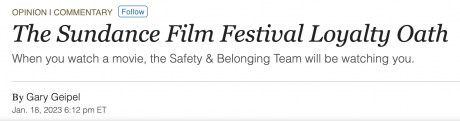
Posted yesterday in The Wall Street Journal, written by Gary Giepel: “Here’s a new form of woke authoritarianism: a demand that you sign a loyalty oath to go to the movies.
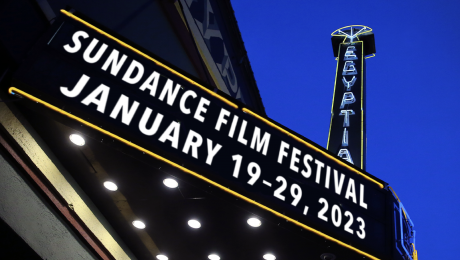
“I attended Utah’s Sundance Film Festival before the pandemic, then started watching its offerings online. This year’s festival begins [today — 1.19], and I looked forward to seeing new, small-market films from my recliner. But when I logged in to buy tickets, I was stopped at the virtual door.
“The site wouldn’t sell me tickets unless I affirmed the festival’s ‘Community Agreement.’ Among other things, I had to promise to be ‘vigilant in the fight against the spread of COVID-19,’ to avoid ‘unwelcome sexual attention, harassment, stalking, and inappropriate physical contact of any kind,’ and to refrain from ‘abuse or intimidation including that related to race, gender, position, or wealth.'”
HE interjection: What the hell is wealth intimidation? [Sing to the tune of “Mama Don’t Allow“] “Mama don’t want no wealth intimidation ’round here…I said mama don’t want no wealth intimidation ’round here…we don’t care what mama don’t allow, gonna wealth intimidate anyhow!”
“What if I slipped up and engaged in ‘intimidation related to wealth,’ whatever that means? Someone could squeal using a ‘name-optional reporting form,’ and the complaint would be ‘taken seriously and reviewed carefully by Sundance Institute’s Safety & Belonging team.’ The team has the authority to impose ‘exclusion from Sundance Institute programs, platforms, or spaces—including a complete ban on further participation in any Institute program or event.’
“I asked if I could buy tickets without affirming the agreement and was denied via an anonymous email. The damage I might have done to someone’s sense of ‘belonging’ while watching films from my Indiana basement, 1,500 miles from Park City, Utah, apparently was too much to risk.
“As a classical liberal with conservative sensibilities, I was often challenged and sometimes offended by Sundance films. Good. Movies can open our minds and make us think—as most good art does. But this depends on the freedom to think for ourselves and question established orthodoxies without fearing anonymous informers and Orwellian enforcement teams.
“Writing in the past tense about Sundance makes me sad. But more of us — patrons, donors and especially liberal-minded board members of arts organizations — have to learn to echo Aleksandr Solzhenitsyn: ‘No, not through me.’
“If we don’t, we can prepare for the Sundance loyalty oath to become the norm at cultural venues. And we should prepare our imaginations for whatever comes after that.”