Matt Walsh responds to a 10.4 Media Matters takedown piece, written by Ari Drennen and researched by Jason Campbell, Mia Gingerich & Alex Paterson.
“So here’s my official answer, for the record: Kiss my ass. I do not apologize, and in fact, by all rights, you sick freaks should be the ones apologizing to me. For lying and defaming me, and doing it all because I’m trying to prevent you from sexually mutilating children. I apologize for nothing. You damned monsters. You child-abusing psychopaths. I wouldn’t apologize to you soulless parasites if I had a gun to my head. I apologize for nothing. I concede nothing. I will never surrender a single inch of ground to a pitchfork mob of degenerate morons.”
…and you can barely feel it. Because in a certain sense, it isn’t quite “there.”
Remember that old story about Marlene Dietrich calling Fred Zinnemann to tell him that mobs of people were lined up for an opening-night showing of From Here to Eternity at Loews Capitol (B’way & 51st) and Zinnemann said “but there hasn’t been any promotion and publicity!” and Dietrich telling him “they can smell it”?
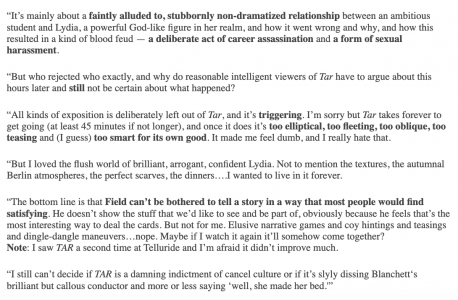
That’s what’s not happening with TAR right now. No one can “smell” a thing apart from highly suspicious assertions from critics (whom no one trusts at all) that it’s very good. And the safe assumption that Cate Blanchett is going to be Best Actress-nominated. Which I agree with.
Let me start again…
I’m not sure which trailers are more depressing to me personally — Black Panther: Wakanda Forever (Disney, 11.11), Black Adam (Warner Bros., 10.21) or Halloween Ends ((Universal, 10.14). They all feel like ironclad guarantees of this or that kind of dungeon entrapment.
The only trailer I can think of that doesn’t send me into a tailspin is Ticket to Paradise (Universal, 10.21), but that’s only because it promises a familiar and amiable ride — the bickering Bickersons (George Clooney, Julia Roberts) in Bali, trying to dissuade their daughter (Kaitlyn Dever, who doesn’t resemble either of them in the slightest way) from marrying a guy she doesn’t know all that well. The trailer says “this movie will not bite you or make you feel badly…it’ll be an easy sit.”
I was just thinking how I’d like to see Todd Field‘s about-to-open TAR yet again, but then I realized it’s only playing in a couple of Manhattan houses (Loew’s Lincoln Square, Angelika) with the wide break delayed until 10.28. A friend who saw it with me in Telluride says she’s having trouble remembering parts of it…that certain portions have liquified or vaporized in her brain.
“There’s no promise of an October blockbuster, like Venom: Let There Be Carnage or No Time to Die in 2021. Instead, the release schedule is peppered with tough little films of the sort that light up festivals, win awards and make critics fight — Tár, Till, The Swimmer, Call Jane, The Banshees of Inisherin, Armageddon Time and such.
“These are movies for insiders, to which outsiders — mass consumers — are invited on a very limited basis. That’s how the seasonal game is now played.”
TAR is such a brilliant, odd-duck, upper-stratosphere thing — elliptical and elusive, neither here nor there but at the same time alluring and fearless — that it makes insider types feel like outsiders.
It’s more about aroma than actual taste, and it refuses to come to you. And for a while that’s a turn-on…”piece by piece I’m putting it together,” you tell yourself during the first hour, “and eventually all the strands will come together…all will be revealed and known.”
Field is saying “no, you come to the film…it’ll require work on your part and maybe some feelings of uncertainty or frustration even, but when you finally get there you’ll feel sated and satisfied.”
Except a certain itchy feeling builds up as it goes along, and although TAR tantalizes and intrigues as it feeds you little hints of information and motivation (it’s basically about a brilliant Berlin-based conductor getting #Me-Too’ed to death) but without any of the meat-and-potatoes, Adrian Lyne-ish plot points and shock revealings that would tie it all together, at least for the dumb people in the room.
That’s what I didn’t like about TAR — it made me feel like a dumb-ass. I had to ask friends what had actually happened (or had seemed to happen) and even now I still don’t really get it. That’s why I want to see it for a third time, crazy as that might sound. Plus the fact that I love the cushy affluence of it all. The scarves, the great apartments, the five-star restaurants, the sublime lighting, etc. I wanted to move into TAR and never leave.
SebastiánLeilo’sTheWonder is a somber, better-than-decent, glacially-paced period drama.
Set in rural Ireland of 1862, it’s about a struggle between the oppression of strict Irish Catholic dogma vs. a woman’s common humanity. I respected the effort, and certainly admired Florence Pugh’s performance as a willful, FlorenceNightingale-trained nurse.
Pugh frowns a lot but in a genuine, unaffected way. The film is fortified by believable atmosphere, perfect period sets, appropriately grim, etc. All the supporting perfs pass muster.
I’m not putting the film down. I’m saying it is what it is, and that it exudes authenticity in that it seems to be actually occuring in the mid 1800s, and without a trace of 2022 presentism. That in itself warrants respect.
For me the standout visual element is the raw brownish-green Irish countryside, and particularly those 16 or 17 shots of Pugh trudging across said terrain.
Maggie and I and five-month-old Jett visited Ireland in the early fall of ’88. I fell in love. One of my first thoughts as we left the Dublin region and drove into the countryside was “I could die here.”
If nothing else, The Wonder is an immersion into the stern oppressions of Irish Catholicism, as it existed at the time of Abraham Lincoln. A culture based on forbidding and repressing and the rigors of life for those 19th Century citizens who’d embraced the Bible and resisted the bottle.
For years I flirted with the legend about Ireland loving to bend the elbow but approaching sex with a fair amount of guilt and conflict — kind of a silly, simplistic assessment. Then again Alex Comfort‘s “The Joy of Sex” was banned in Ireland for 12 years (along with “More Joy: The Joy of Sex” and one other). I recall journalist-author Susan Mulcahy, then with the New York Post, passing along an old joke about “The Joy of Irish Sex” consisting of 96 blank pages.
In a 10.5 interview with intelligence committee Democrat Jim Himes, a CNN anchor stated that “U.S. intelligence community believes that elements of the Ukrainian government authorized that car bombing.” (Note: It is believed that the explosion was intended to kill the father, not the daughter.) Without confirming this allegation, Himes replied that if it’s true “this raises the spectre of Ukraine having arguably [and] very clearly lost the moral high ground.”
Moral high ground? In a war? After the Bucha massacre? Is that a joke?
There is no morality in war save the absence of it. Once serious hostilities begin between combatants the idea of anyone occupying any moral high ground is ridiculous. As Russell Crowe‘s journalist character says in The Greatest Beer Run Ever, “This war is just one big crime scene.”
Do you want to defeat Russia in the Ukrainian conflict? Sean Connery‘s “Malone character” (from The Untouchables) has some questions.
Malone: “You said you wanted to get Capone. Do you really wanna get him? [If so], what are you prepared to do?”
Kevin Costner’s Eliot Ness: “Anything within the law.”
Malone: “And then what are you prepared to do? If you open the can on these worms you must be prepared to go all the way. Because they’re not gonna give up the fight until one of you is dead.”
Ness: “I want to get Capone! I don’t know how to do it.”
Malone: “You wanna know how to get Capone? They pull a knife, you pull a gun. He sends one of yours to the hospital, you send one of his to the morgue. That’s the Chicago way! And that’s how you get Capone. Now do you want to do that? Are you ready to do that? I’m offering you a deal. Do you want this deal?”
Ness: “I have sworn to capture this man with all legal powers at my disposal and I will do so.”
Excerpt: “In the wake of #MeToo, employers across Hollywood turned to morals clauses as an attempt to deter bad behavior. While these provisions have been criticized by talent reps for being too broad and too subjective, there’s actually a bigger problem with their presence in many contracts: They’re prohibited by the directors and writers guilds’ collective bargaining agreements — and they have been for decades.
“’The origin was the Red Scare,’ says talent lawyer Linda Lichter. ‘Companies put them in contracts so they could fire people if they were accused of being a Red. They’ve come back in the context of #MeToo.’
The clauses — which use language such as “public disrepute, humiliation, contempt, scandal or ridicule” — essentially mean anything that makes a company look bad could be grounds for immediate termination. Or, as Lichter puts it, ‘If you don’t behave, we can fire you.’
According to attorneys, it’s not uncommon for the first draft of a morals clause to include problematic broad phrases, giving examples like “neglects to govern their conduct with regard to social conventions” or “shocks, insults or offends a substantial portion of the community.”
“’Early on with the #MeToo movement we saw companies and brands going very quickly to terminating people, and they wanted to be able to rely on their morals clause to do it,’ says entertainment labor lawyer Ivy Kagan Bierman. “In some cases, the clause as drafted didn’t allow it because it had to be proven.”
“Kagan Bierman says the language has evolved so companies don’t necessarily have to wait on proof — ‘There have been tweaks in the language, where it can be alleged to have happened, or believed to have happened.'”
I received a little pushback about yesterday’sriff about Florida governor Ron DeSantis wearing those awful white rubber boots during a tour of the coastal Florida areas devastated by Hurricane Ian.
I was informed that DeSantis is wearing standard-issue shrimp boots, which are common apparel for fishermen on shrimp boats. Moisture protection, snake protection.
My reply is that it doesn’t matter how many Cajun shrimpers own a pair of those Nancy Sinatra go-go boots — they look ridiculous.
Any allegedly straight male who wears white go-go-boots on a shrimp boat automatically causes his alpha male credentials too be questioned. And it WAS DeSantis’s Michael Dukakis on a tank moment (aka “Rocky the squirrel”).
If DeSantis was a MAN, he would have worn these black boots. If I was a shrimper, these would be my jam.
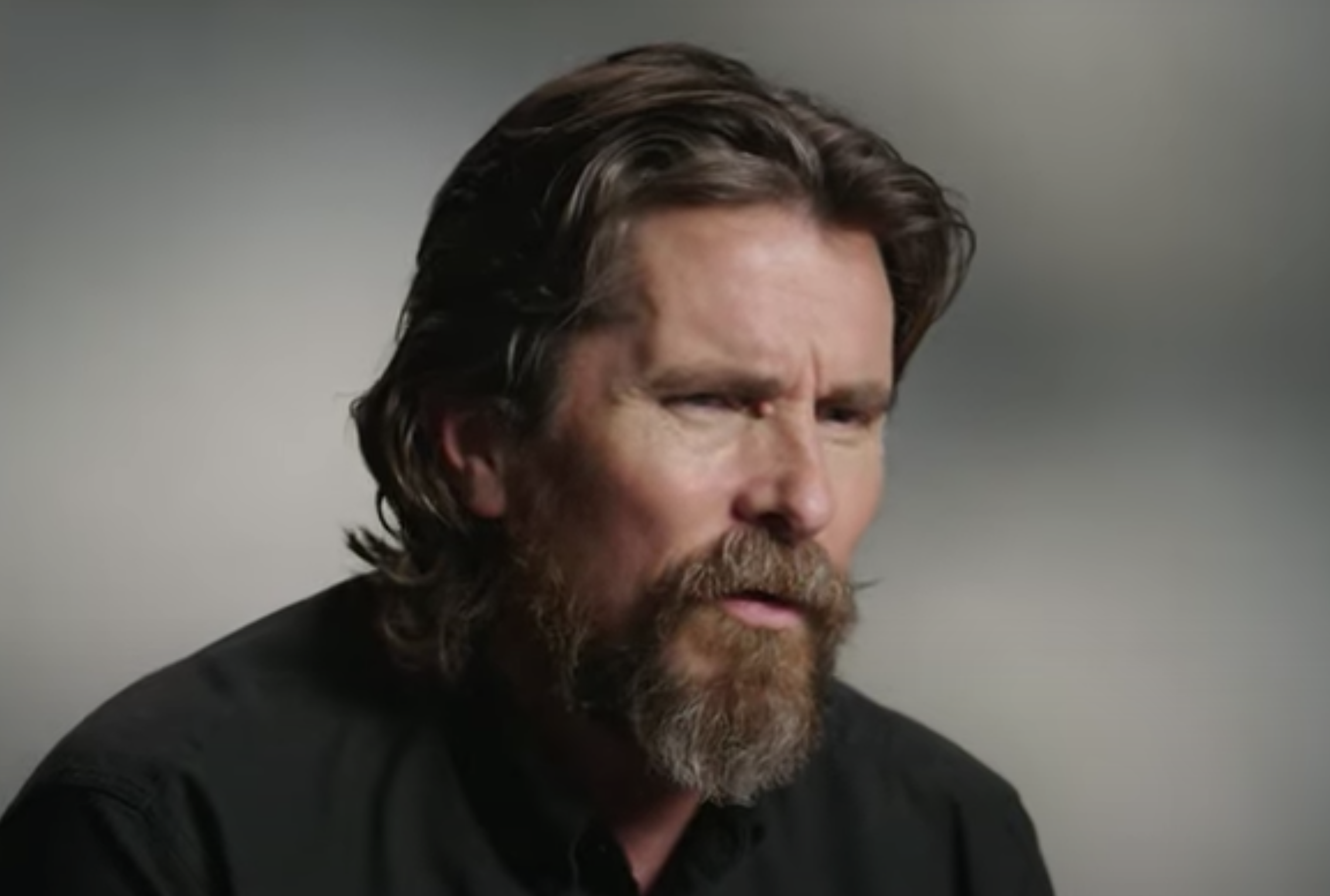
Christian Bale has been exceptional or certainly admired in several roles over the last 30 years. His finest performances, HE feels, are, in this order, the following: Dicky Eklund in The Fighter (’10), Patrick Bateman in American Psycho (’00), Dick Cheney in Vice (’18), and Bruce Wayne in his three Batman films (Batman Begins, The Dark Knight, The Dark Knight Rises).
But the Bale “performance” that made the strongest and most lasting impression, hands down, is “Bale Out: RevoLucian’s Christian Bale Remix!“, which popped in early ’09. A satirical dance remix of Bale’s Terminator Salvation rant (which happened for real in July 2008), it’s absolutely real, brilliant and unforgettable in a relentless sort of way. Every angry word is 110% genuine.
This is a distasteful subject, but I’ll just mention it and be done with it. I’ve ridden on underground subway systems all over the world — Paris, Boston, Berlin, Prague, Washington, D.C., Barcelona, London, Zurich, Rome, Munich, Frankfurt, Firenze — and New York’s subway system is the only one that has a serious problem with homeless urine stink. Okay, I might have encountered one or two faint whiffs in the Paris metro, but it’s not a regular thing there. You can, on the other hand, absolutely count on The Unpleasant while waiting for the IRT, IRT Lex, R or IND trains in Manhattan. Is it because homeless guys in Barcelona, London, Berlin and Prague are slightly more sanitary? Is alcoholism less of a problem over there? Do the overseas subway systems use more effective (i.e., more fragrant) disinfectant or employ more clean-up crews?
I’ve been saying for years (and there’s no question about this) New York City subways are the slowest, stinkiest and least reliable of all the major metro systems worldwide. Things have improved since the ’90s but the substandard service has been in place for decades.
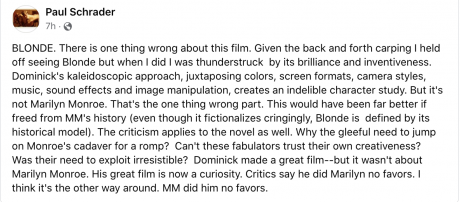
Okay, there’s a vague resemblance between Casper Phillipson, who plays JFK in Pablo Larrain‘s Jackie and Andrew Dominik‘s Blonde, and the Real McCoy. The nose, the jawline and the eyes, to some extent, but at the same time Phillipson’s eyes lack something important. In his off moments JFK’s eyes had a haunted, hangdog quality — a slightly gloomy and exhausted look that was captured by Time magazine illustrator Pietro Annigoni. There was a vibe about Kennedy in these moments that seemed to say “I’m probably not going to last into old age, and you know it as well as I.” No offense to Phillipson but this grave undertone vibe is missing in his features. Gotta have that flickering awareness of death hovering.
Any guy knows that if you put on a pair of tallish rubber wading boots, the color has to be olive drab or dark blue. Or black-and-yellow fireman boots. But what kind of clueless dork puts on a pair of white go-go boots a la Nancy Sinatra? That’s more than clueless — it’s borderline suicidal from an image standpoint. And worse when you throw in the pot belly. If I was DeSantis I would drop at least 15 or 20 pounds — he’s too chubby to be a Presidential candidate. And while I’m working on the gut I would wear a midriff girdle under my shirt. Orson Welles wore one while playing the fresh-out-of-college Charles Foster Kane.
As you begin to watch Park Chan-wook‘s Decision to Leave (MUBI, 10.14), there’s no denying that you’re being carried along by a masterful visual composer. Every shot is exquisite, a painting, an eye bath…and so perfectly balanced.
And during the first 30 to 40 minutes you can’t help saying to yourself “wow, this guy is really good” while at the same time hoping that it’ll amount to more than just a delicious film noir by way of a haunting mood trip.
And of course it doesn’t. As the first hour comes to an end it begins to hit you. This film is all visual swoon and superficial noir strokes, you realize — it’s not going to build or pivot or dovetail into anything. But it’ll look great every step of the way.
And then you look at your watch and go “oh Jesus Mary mother of God, there’s another 70 or 80 minutes to go!” And you realize that you’re stuck, and you descend into a feeling of being locked in an animal cage filled with straw. And you realize, of course, that the minutes are just going to drag on and on. You’d like to leave but you can’t because you’re watching a film by the great Park Chan-wook, and only a rank philistine would do such a thing.
I’m just saying that Decision to Leave is opening on a week from Friday, and that…oh, hell, do what you want. Some critics are nuts for this guy. But this film should ideally be called Decision to Avoid.
Posted from Cannes on 5.23: With all due respect for Park Chan-wook’s smoothly masterful filmmaking chops (no one has ever disputed this) and the unbridled passion that his cultish film critic fans have expressed time and again…
And with respect, also, for the time-worn film noir convention of the smart but doomed male protagonist (a big city homicide detective in this instance) falling head over heels for a Jane Greer-like femme fatale and a psychopathic wrong one from the get-go…
The labrynthian (read: convoluted) plotting of Park’s Decision To Leave, though initially intriguing, gradually swirls around the average-guy viewer (read: me) and instills a feeling of soporific resignation and “will Park just wrap this thing up and end it already?”
Jesus God in heaven, but what doth it profit an audience to endure this slow-drip, Gordian knot-like love story-slash-investigative puzzler (emphasis on the p word) if all that’s left at the end is “gee, what an expert directing display by an acknowledged grade-A filmmaker!”