Does “Crimes” Have A Pulse?

David Cronenberg‘s Crimes of the Future opened three days ago (6.3). I’m presuming that the reviews scared a lot of would-be viewers off — not the negative judgments, of which there are very few, but the descriptions of the surgical slicings and glurpy body parts, not to mention “ear man.” But some HE followers are bolder and more inquisitive, or so I tell myself. Please share if you went there.

Just to get things started, here are some excerpts from my 5.24 Cannes review:

1. As far as it goes, Crimes is a respectable, dialogue-driven, high-concept chamber piece. Baroque, perverse, concentrated.

2. Where does it stand on my Cronenberg preference list? Somewhere in the middle, just above Dead Ringers and Naked Lunch. My all-time favorite Cronenberg film is still The Dead Zone, followed by A History of Violence, Crash, The Fly and Scanners.

3. Crimes of the Future is basically a play . There’s never any doubt that you’re watching a thoughtful, rigorously sculpted effort by a grade-A auteur. It’s not elevated horror but a kind of perversely erotic body-probe mood piece.

4. Remove the physical-effects stuff — bizarre surgical slicings, erotic body penetration, superfluous internal organ removal — and the seaside, small-hamlet, sound-stage setting (it was shot in Athens), and you’re left with a presentation that could have been staged at Manhattan’s Cherry Lane theatre or…whatever, on Philco Playhouse back in the early to mid ’50s.
Read more

“Cheap Texas Broads” Meets Old-Man Feet

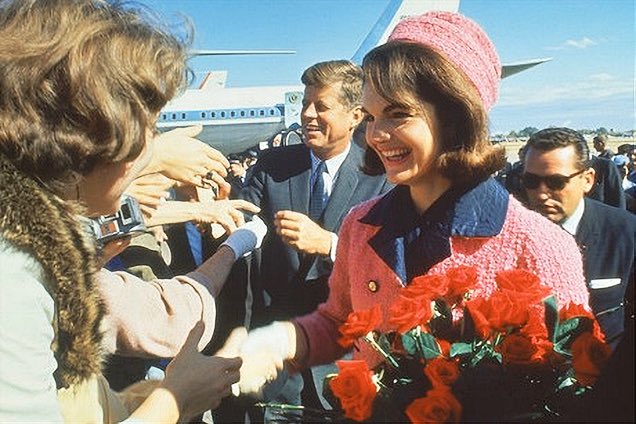
Originally posted from Hue (Vietnam) on 11.19.13: I was reminded of a famous JFK quote when I read Cathy Horyn’s 11.14.13 N.Y. Times piece about the legend and the whereabouts of Jackie Kennedy‘s pink suit (“a classic cardigan-style Chanel with navy lapels”) that she wore on 11.22.63.

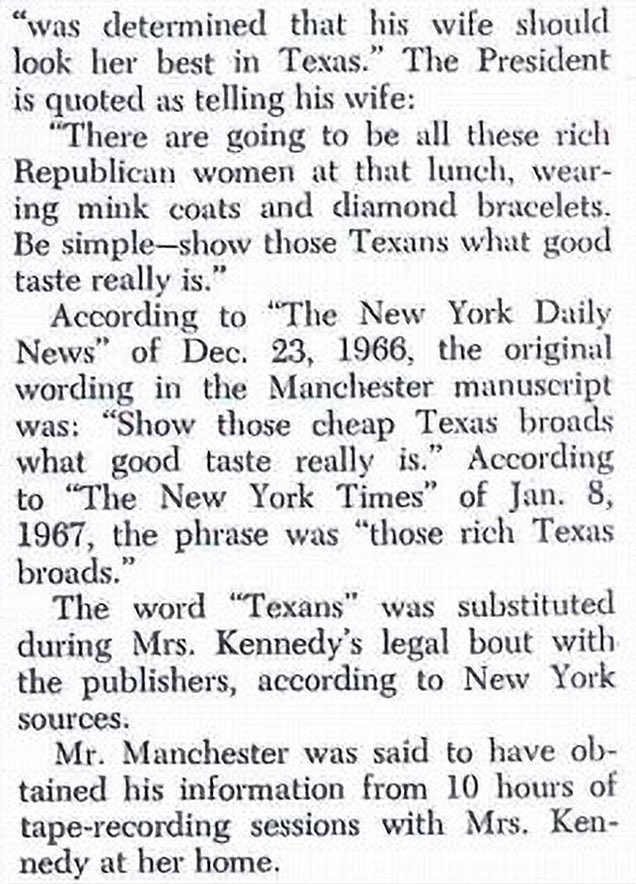
In an interview with Death of a President author William Manchester, Mrs. Kennedy recalled that her husband wanted her to make a stylistic statement during their Dallas visit. “There are going to be all these rich Republican women at [a lunch they were scheduled to attend], wearing mink coats and diamond bracelets,” JFK told her. “[So] be simple — show those cheap Texas broads what good taste really is.”

In a subsequent dispute with publishers of Manchester’s book, Mrs. Kennedy managed to dilute “cheap Texas broads” into “rich Texas broads” and then “those Texans.”

I’m mentioning the original quote because (a) it makes JFK seem more human and less iconic and (b) because I relate to withering aesthetic judgments. It reminded me that Kennedy was capable of remarking how gauche or clueless some people dressed. It suggests that had he survived into his 90s and found himself at my rooftop restaurant in Hue — I realize this sounds like a stretch but it isn’t really — he too would have been appalled at the sight of old-man feet inside rubber and leather sandals. Not to mention the shorts and the golf shirts. Maybe.

Glenn Kenny: “One hears a lot of dumb, gratuitous and outright asshole-ish ‘JFK, c’est moi’ statements over the course of a lifetime, but this one really has a certain je ne sais quoi.”

6.6.22 explanation: I posted this four days before the 50th anniversary of JFK’s murder, when historical perspective essays were flooding the internets. I was recoiling from the sight of sandaled old-man feet at this Hue hotel, and so my free-associating mind wondered “how would a 96 year-old JFK had reacted to such a sight?” I’m confident that he would’ve felt that even in Vietnam, ugly, unpedicured man toes should always be concealed.


Cruise’s 2nd Most Emotional Moment

“Guy gets on the MTA in LA…dies. Think anybody’ll notice?”

Tom Cruise‘s “hello, I’m looking for my wife” scene in Jerry Maguire still ranks first, but Vincent’s final line in Collateral [4:15 to 4:40] is first runner-up. In a way it’s almost more moving than the Maguire scene because you’re not expecting cynical, hard-case Vincent to emotionally reveal himself.

Cruise Has It All Except For Vulnerability

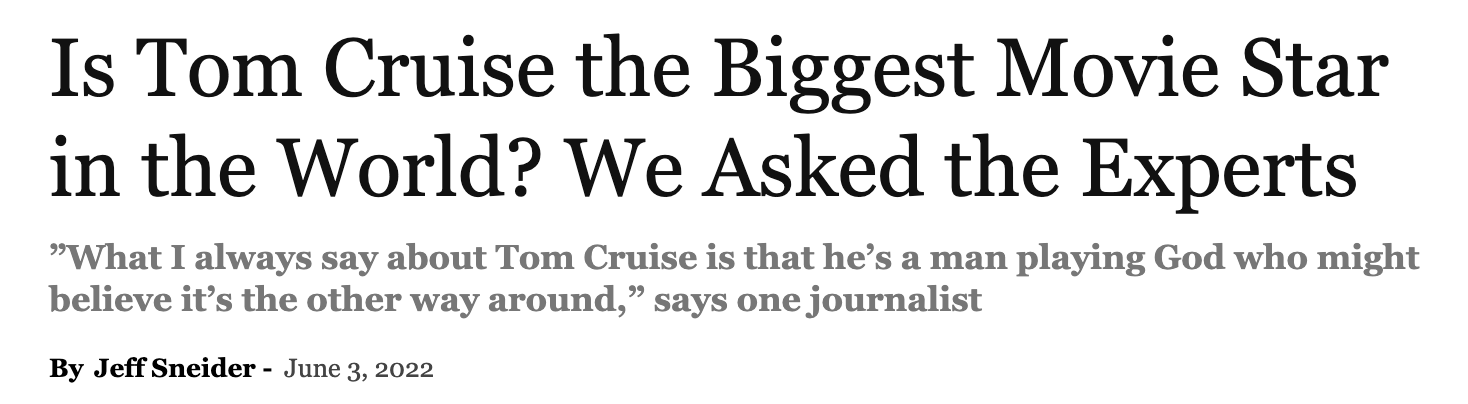
Late last week I was asked to tap out a response to Jeff Sneider‘s “Is Tom Cruise the Biggest Movie Star in the World?“, a 6.3 Los Angeles magazine piece. I was in the middle of my stuck-in-Toronto nightmare but I said “sure.” And then I forgot about it. Here’s what I would have written if Air Canada hadn’t made my life so briefly miserable:

Tom Cruise is the Last Big Movie Star, of course. But there’s still something mechanized and energizerbunny about the guy. We all know this.

“A real movie star doesn’t just sell tickets — he/she also reflects some rooted, grounded aspect of the culture on some level, or stands for the kind of person we are (or at least aspire to be) deep down. Everyone knew (or at least believed they knew) who the big stars were in the old days — Gary Cooper, Cary Grant, Robert Redford, Al Pacino, Marilyn Monroe, Audrey Hepburn, Meryl Streep, Clark Gable, William Holden, Humphrey Bogart, Katharine Hepburn, Marlon Brando.

“But nobody really knows who Tom Cruise is, not really. Back in the couch-jumping days there was a suspicion that he might have gone around the bend, that he’d become a Scientology fanatic. That notion has since drifted away.

“And yet he’s been selling the hell out of that guy he’s been playing all along, and he certainly deserves credit for keeping that act going and that engine running for nearly 40 years. And for the most part his movies have long stood for quality.

“Cruise has been a major brand and a highly influential audience motivator since Risky Business (’83) and right now he’s obviously riding high off the response to Top Gun: Maverick (currently $291 million domestic and Cruise’s highest-ever grosser).

“So good for him and more power, but he’s always seemed a little too guarded for my tastes. For what it’s worth I’d like to see him play more guys in the vein of Vincent, that gray-haired assassin in Collateral, and that cocaine cartel pilot in American Made.”

Roosters Are Laying Eggs Now…Right?

I’m planning to finally watch Matt Walsh‘s What Is A Woman? doc, which has been streaming since June 1st. I happen to feel more in synch with Walsh’s views about gender ideology and slightly less in favor of gender positivism, which has been flirting with gender wacko-ism. I wouldn’t characterize my views as dismissive or transphobic — I’m more of a trans-questioning type of guy.

I’m completely down with Bill Maher’s “Along For The Pride” rant that he delivered two weeks ago. I think that Charles Durning‘s farm dad in Tootsie (“Bulls are bulls and roosters don’t try to lay eggs”) was a sensible-sounding guy. I think that the transgender swimmer Lia Thomas competing against natural-born women is tremendously unfair. And I don’t see what’s so awful about Florida’s Parental Rights in Education Act (aka “Don’t Say Gay”), which prohibits classroom instruction on sexual orientation or gender identity from kindergarten to third grade….what’s wrong with postponing this shit until kids get a little older?

The rhetorical thrust of Walsh’s doc is obviously topical and seemingly sensible, and yet most the critics are ignoring it. That seems unfair and even punitive. I’m still succumbing to jetlag naps (I won’t be out of the woods for another two or three days), but I’ll give it a shot this afternoon.

Read more

Basement Tapes

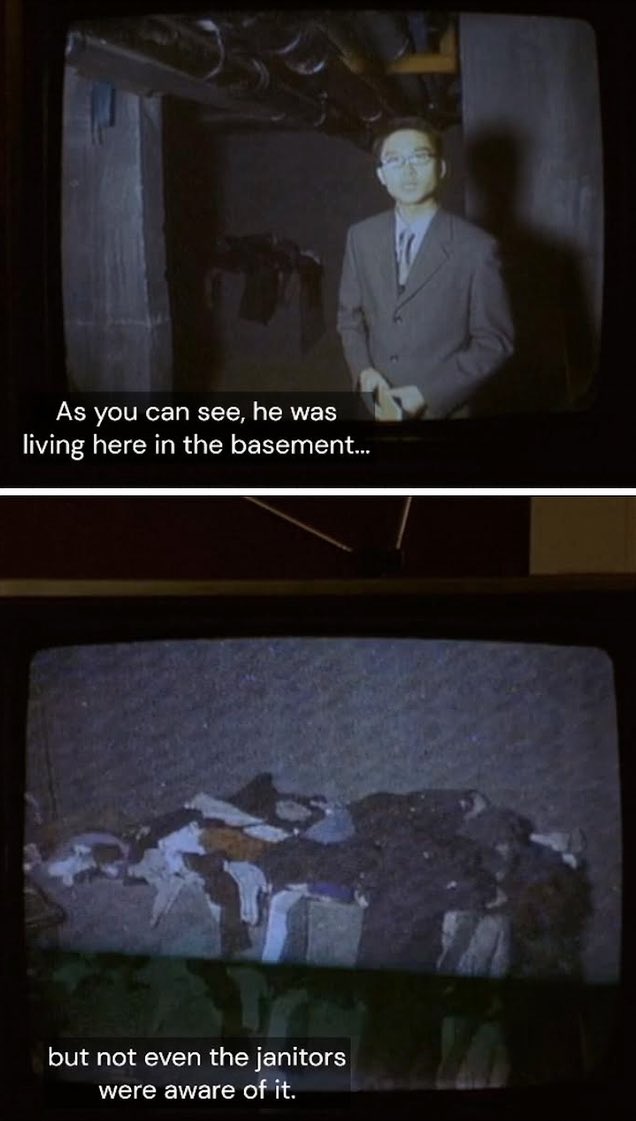
HE correspondent “Eddie Ginley” recently saw Bong Joon-ho‘s Barking Dogs Never Bite (’00), and was struck by the “guy living in a hidden basement area without anyone noticing” subplot that was re-used in Parasite (’19). Ginley says he “can’t believe no one has ever mentioned this.”

But all filmmakers recycle ideas from time to time, and sometimes remake whole movies only a few years later. Michael Mann‘s L.A. Takedown was recycled as Heat six years later. Sometimes ideas germinate for years. The “stabbing of Louis Bernard” scene in The Man Who Knew Too Much (’55) was first dreamt up by Alfred Hitchcock in 1938.

Why Malick’s Jesus Flick Is Still In Post

Seven or eight years ago the late James Horner recalled his frustrating attempts at composing the score for Terrence Malick The New World (’05). Writing the score wasn’t the problem, he said, but Malick’s salad-toss approach to editing. We’ve all read and heard eccentric Terry stories over the years, but if you’re wondering why Malick’s latest, The Way of the Wind, is still being edited two and two-thirds years after completing principal photography, Horner explains it all.

Way of the Wayward,” posted on 3.30.22: “Almost three years after starting principal photography in June 2019, Terrence Malick‘s The Way of the Wind is still shrouded in secrecy with no whispers, much less expectations, about any festival bookings this year.

“Definitely not Cannes, of course, and with the warm weather fast approaching you’d think the Venice/Telluride crowd would be hearing about possibly getting a peek at Malick’s film down the road. But no — ‘big circle of silence.’

“Malick tends to spend about two years in post-production on his films. Presuming that The Way of the Wind wrapped sometime in the early fall of ’19, the two years of post-production would have been completed last September or October, or five or six months ago.”

Try It On For Size,” posted on 11.20.20: “In June 2019 Terrence Malick began shooting The Last Planet, which is some kind of Jesus movie. The cast includes Géza Rohrig as Christ, Matthias Schoenaerts as Saint Peter, and Mark Rylance as four versions of Satan. It was announced today that the title has been changed to The Way of the Wind.

Read more

“The Witch” With Subtitles

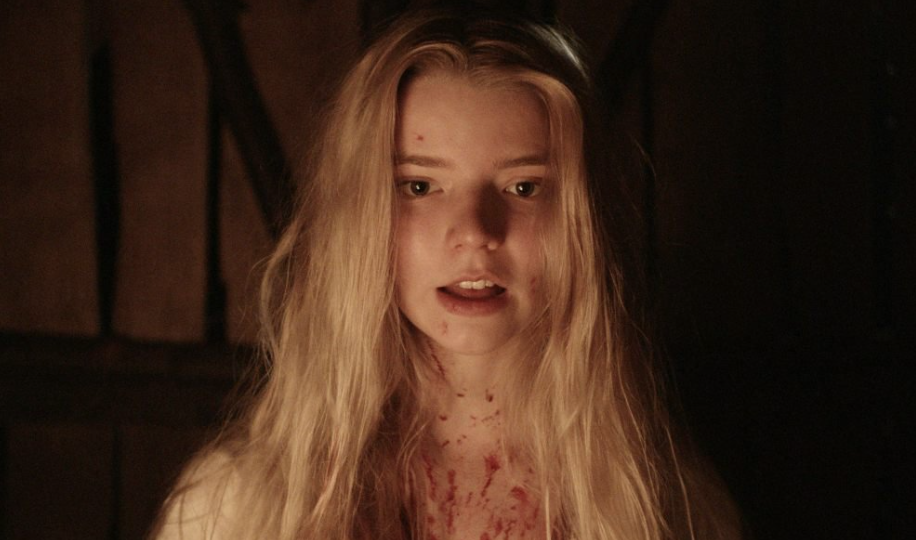
Having missed the Sundance ’15 debut of Robert Egger‘s The Witch, I didn’t see it until a year later. Boy, was I won over! For me, the film’s critical praise and box-office success ($40 million gross vs. $4 million budget) crystalized my understanding that elevated horror had become a thing — a respectable sub-genre as well as an assurance that not all horror films needed to be aimed at primitives.

A year earlier Jennifer Kent‘s The Babadook had defined the 21st Century template; in 2018 Kent’s The Nightingale and Ari Aster‘s Hereditary fortified things, followed in 2019 by Aster’s Midsommar.

I have this idea that elevated horror was launched by the German expressionists (Robert Wiene‘s The Cabinet of Dr. Caligari, F. W. Murnau‘s Nosferatu) in the early 20s. Was Val Lewton‘s Cat People the first American-made flick to suggest creeps rather than show them? The prize for the best E.H. flick of the ’60s was split between Jack Clayton‘s The Innocents (’61) and Robert Wise‘s The Haunting (’63). The most explosively popular E.H. of all time, of course, was William Friedkin‘s The Exorcist (’73).

Anyway, last night I re-watched The Witch, and this time with subtitles. From my original review: “I’m very much looking forward to the subtitle option when the Bluray comes out. Ralph Ineson, blessed with one of those magnificent deep voices with a timbre that can peel wallpaper, was the only one I fully understood on a line-for-line basis. To my ears everyone else spoke 17th-Century dithah-moundah-maaaysee-whatsah.”

Now that I’ve “read” Eggers’ script, so to speak, my respect for The Witch‘s period-authentic language is greater.

More review excerpts: “This little creeper (which was projected last night at a 1.66:1 aspect ratio!) is set on an isolated farm in 17th Century New England, when the lore of witches and sorcery was at an all-time high. I was seriously impressed by the historical authenticity and the complete submission to the superstitious mythology of evil in the early 1600s and the panicky mindset of those God-fearing Puritans who completely bought the notion that demonic evil was absolutely manifest and waiting in the thicket.

Read more

Every Five Years Or So

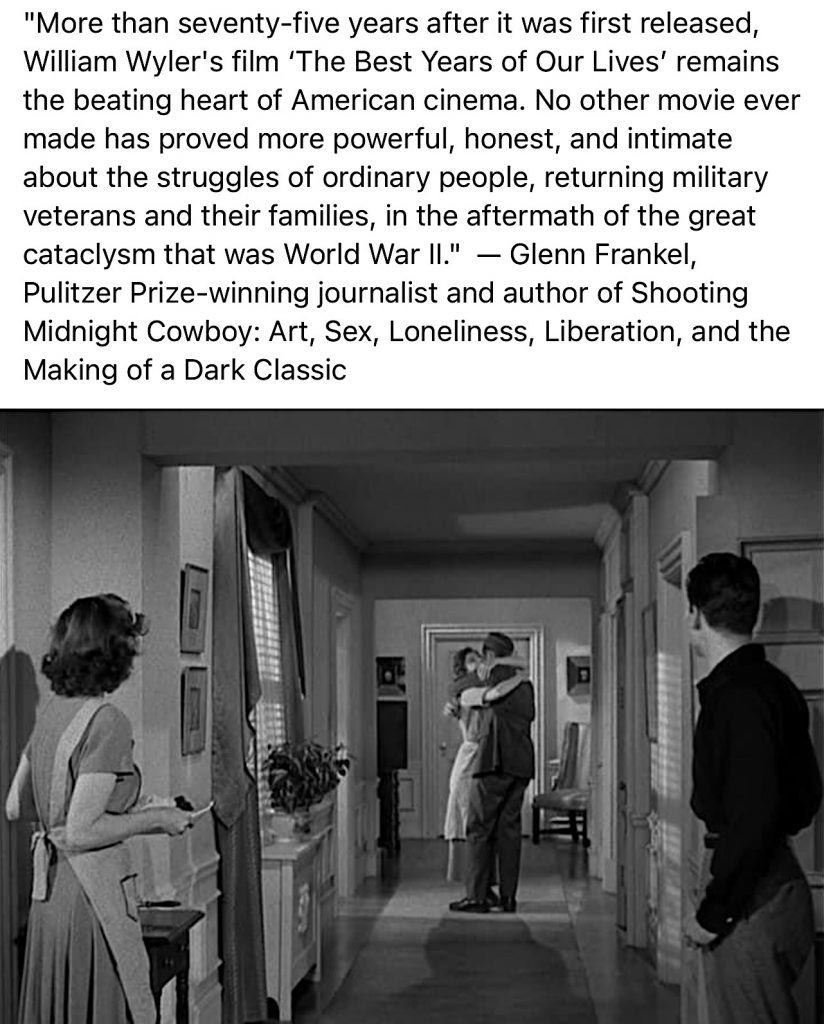
…I post a little tip-of-the-hat mention of William Wyler’s The Best Years of Our Lives (‘46). Because it’s a truly great film, because the last half-hour delivers one home-run scene after another, and because it feels good to at least consider that one Millennial or Zoomer who’s never seen it…that one Philistine might give it a first-time looksee and become a serious fan.

I’m especially fond of a letter-reading scene between Pat Derry (Roman Bohnen) and Hortense (Gladys George). George owns this scene — it’s all about the emotions that she tries to suppress as she listens to her alcoholic husband read a letter of commendation about his son, Fred (Dana Andrews).

Sober Guy Confronts Boozing Parents

I’m trusting a suspicion that Louis C.K.‘s Fourth of July, a seemingly smart dramedy about a recovering alcoholic musician (Joe List) confronting his dysfunctional, alcohol-embracing parents during a visit to their home, is a good film. I can just smell it. The usual suspect distributors, of course, are too terrified of angering Louis C.K.’s #MeToo detractors to even think about partnering with him, so the comedian-director and cowriter is distributing the film himself.

As a gesture of support for Louis C.K., List and the metaphor of transcending past mistakes, I’ve bought a ticket to see the film on June 30th at Manhattan’s Beacon Theatre.

“The Horse Solders” Has Style and Substance

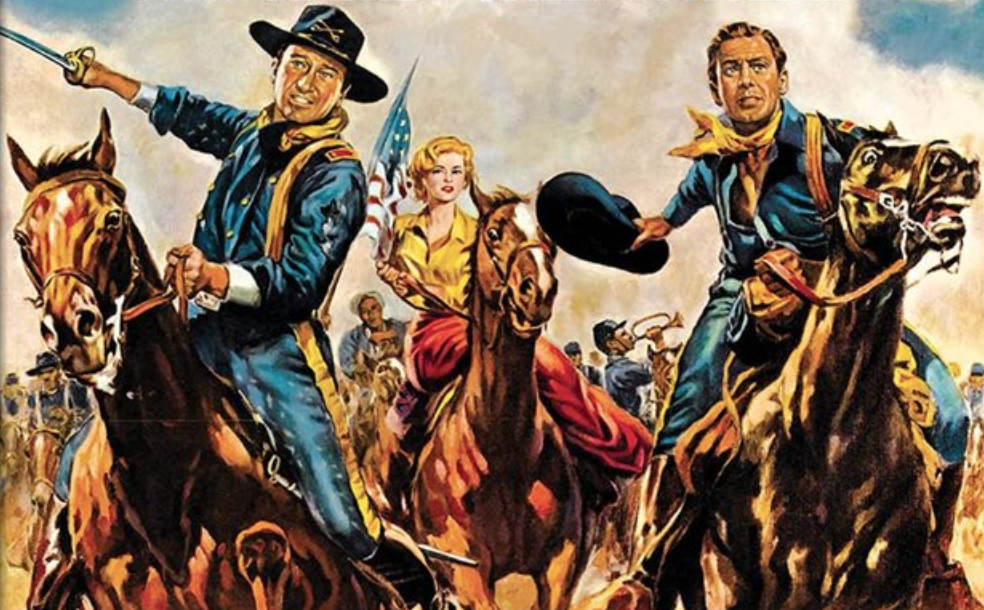
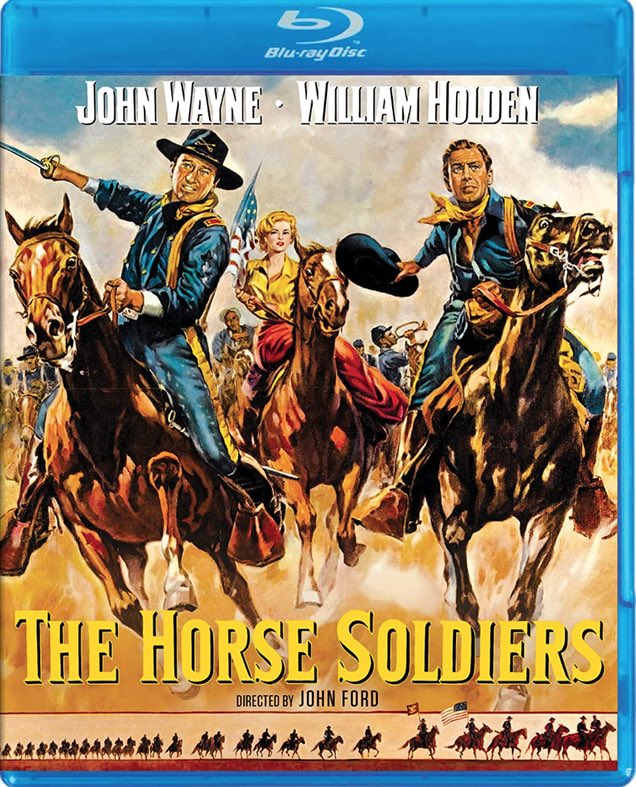
I’ve had it up to here with the standard narrative about The Horse Soldiers being one of John Ford‘s lesser efforts. I know this sounds like heresy, but it may be my favorite post-1945 Ford film. I know that She Wore A Yellow Ribbon and The Searchers and The Man Who Shot Liberty Valance are widely regarded as more substantial and therefore “better”, but I don’t like watching them as much as The Horse Soldiers, and anyone who doesn’t like that can shove it.

A Civil War drama based on Grierson’s Raid of 1863, The Horse Soldiers is steady, solid, midrange Ford — well-produced and well-acted with good character arcs and flavorful Southern atmosphere. Plus it gets extra bonus points for being set in the South (green trees, green grass, plantations, swamps, bridges, rivers) and not in godforsaken Monument Valley.

Handsomely shot by William H. Clothier in a 1.66 aspect ratio, its very easy to watch — every time I pop it in I feel comfortable and relaxed. Partly because it has a minimum of Ford-bullshit distractions. My only real problem is a scene in which rebel troops are heard signing a marching tune exactly like the Mitch Miller singers. I also don’t like a scene in which a furious John Wayne throws down eight or nine shots of whiskey in a row — enough to make an elephant pass out.

There’s a scene in which a boys’ military academy is asked to attack Wayne’s Union regiment — a scene in which a mother drags her 10-year-old son, Johnny, out of a line of marching troops, only to lose him when Johny climbs out of his second-floor bedroom window to rejoin his fellows. It reminds me of that moment when Claudette Colbert collapses in a grassy field as she watches Henry Fonda marching off to fight the French in Drums Along The Mohawk.

I also love that moment in Newton Station in which Wayne senses something wrong when costar William Holden, playing an antagonistic doctor-surgeon, tells him that perhaps a too easily captured Confederate colonel (Carleton Young), an old buddy, isn’t the submissive, easily captured type — “He’s West Point, tough as nails…the man I knew could lose both arms and still try to kick you to death.”

Kino Lorber’s new 4K version of this 1959 film (which lost money, by the way, partly due to exorbitant salaries and producer participation deals) streets on 6.14.22