Sonny Corleone Job Interview

Employment Counselor: Can I help you, sir?
Sonny Corleone: Yeah, I’m here for…I wanna job for the summer.
Employment Counselor: How old are you?
Sonny Corleone: Sixteen.
Employment Counselor: Do you have any work experience?
Sonny Corleone: I’ve done stuff for my family, but…uh, I wanna work somewhere else.
Employment Counselor: A family business?
Sonny Corleone: I worked for my father.
Employment Counselor: And what did you do for him?
Sonny Corleone: Aaahh…stuff. Boring stuff.
Employment Counselor: Okay, no problem. But before we get started, I’d like you to fill out this form. It’s about gender preference.
Sonny Corleone
: About what?
Employment Counselor: About your gender identity.
Sonny Corleone: My what?
Employment Counselor: It’s not a big deal. Just fill it out and we’ll go from there.
Sonny Corleone (readying the form): Fuck is this?
Employment Counselor: Just mark the appropriate term.
Sonny Corleone: This…WHAT THE FUCK?
Employment Counselor: It’s just a form. If you’re straight, just check cisgender.

Read more

HE Assessment for Ages

From “All Sizzle, No Steak” comment thread, posted this morning:

Yeah, that’s me — a Japanese soldier living in a jungle cave and refusing to give up the faith.

Within their own realm and their own conversations and celebrations, the promotional Oscar machine gang still delivers or represents a climactic “thing” — it’s just a much smaller and more secular thing, numbers-wise, than ever before in their over-90-year history.

The numbers are much smaller because over the last five or six years because the Oscar-focused community (filmmakers, producers, distributors) has more or less cut itself off from the middle-class mainstream by wokeing itself to death — by largely blowing off the realm of sensible middle-class dramas and comedies and knockout spectacles (which were semi-dependable brands throughout the 20th Century and during the aughts and mid-teens, until ‘16 or thereabouts) by turning films into vehicles intended to reflect progressive values and bring about social change.

Movies that try to touch people’s souls in a gripping, accessible, non-political way (films like Manchester by the Sea) are no longer happening, and films like SpiderMan: No Way Home are considered irrelevant. In their place the industry-reflecting Oscars have become a show about elite progressive values — #MeToo, LGBTQIA, multiculturalism, identity politics & the general worldview of Rosanna Arquette.

“The erratic pursuit of sweeping, penetrating, soul-touching cinema (a rare achievement but one that has occasionally manifested over the decades) has been more or less called off, it seems, because such films or aspirations, in the view of certain #MeToo and POC progressives, don’t serve the current woke-political narrative.” — from “Wolfe Reminds, History Repeats,” posted on 3.22.21.

When the sociopathic Donald Trump was elected and the deplorable Harvey Weinstein was gored by #MeToo, The NY Times and Ronan Farrow, the Oscar-aspiring community committed itself to an “older white guys and the movies they used to make are bad news” theology. They decided to redefine Hollywood product by way of inclusion, equity, more #MeToo, more strong women, a greater variety of ethnicities, more gay, more trans, etc.

And by apologizing for almost everything that Hollywood represented and/or tried to create from 1915 until 2015, pretty much. Pay a visit to the Academy Museum (i.e., “Woke House”) and tell me I’m wrong.

The problem with all that, numerically speaking, is that 60% of the population doesn’t necessarily hold with the idea of de-platforming middle-class, high-craft films produced by older white guys. You could argue, in fact, that a much-larger portion (80% or 85%?) of the movie-loving public is on the normcore side of the cultural divide. You could argue, in fact, that the wokester-progressive community represents a relatively narrow slice of the overall pie.

Last April’s Steven Soderbergh Oscar telecast from Union Station was essentially a declaration of large-scale ritual seppuku. The Soderbergh show basically said “these awards are about us…about our narrow little community of wealthy elites. Joe and Jane Popcorn can watch or not watch…we don’t really care one way or the other.”

All Sizzle, No Steak

From Richard Rushfield‘s latest The Ankler column, titled “How Low Will Oscars Go?” — posted this afternoon:

“This should be the year the chickens come home to the Oscars, not just to roost but to peck the foundation to collapse. “

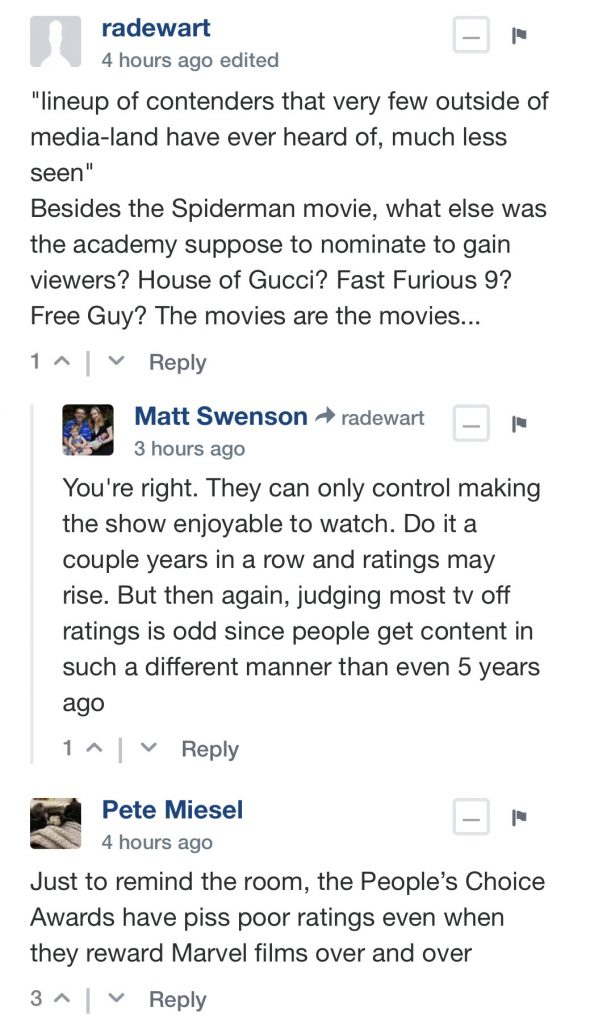
“All the self-absorbed trends the Academy has indulged over the past decade will be out in full bloom, starting with a lineup of contenders that very few outside of media-land have ever heard of, much less seen.

“Just to set the over/under: last year’s show was watched by 10.4 million people, down 56 percent from the previous year. There’s not much reason to suppose that trajectory has been abated. So if this year’s show loses 56 percent over the year before, that will put it at 4.5 million viewers.

“That seems slightly low to me and I’d have to take the over there. The Ankler prediction stands at 5.6 million.

“But in any event, anything in that neighborhood stands a good chance that not only won’t the Oscars be one of the highest-rated shows of the year, it might not even be the highest-rated show of the week.”

Full Blabbermouth Trailer

As noted several weeks ago, Matt Ross‘s Gaslit (STARZ, 4.24) is the story of the colorful Martha Mitchell, the wife of former Attorney General John Mitchell and a Southern belle blabbermouth who was told to shut up about what she suspected about Watergate and yet refused to zip it.

I’m presuming that the idea behind Gaslit is to celebrate Mitchell’s feisty, temperamental personality and independent streak. But I’m hoping that the film will also acknowledge that Mitchell didn’t play her cards all that well, and that she died destitute at a relatively young age (57). Sad but true.

The limited miniseries is based on Leon Neyfakh‘s “Slow Burn” documentary

Julia Roberts plays Martha, and a barely recognizable Sean Penn plays husband John. Costarring Dan Stevens, Betty Gilpin, Shea Whigham and Darby Camp.

From Martha Mitchell’s Wiki page: “Following the 6.17.72 Watergate break-in, Attorney General John Mitchell “enlisted security guard Steve King (a former FBI agent) to prevent his wife Martha from learning about the break-in or contacting reporters. Despite these efforts, the following Monday, Martha acquired a copy of the Los Angeles Times.

“Martha learned that James W. McCord Jr., the security director of the Committee to Re-elect The President and her daughter’s bodyguard and driver, was among those arrested. This detail conflicted with the White House’s official story that the break-in was unrelated to the CRP, and raised her suspicion.

“Martha unsuccessfully made attempts to contact her husband by phone, eventually telling one of his aides that her next call would be to the press.

“The following Thursday, on 6.22.72, Mitchell made a late-night phone call to Helen Thomas of the United Press, reportedly Mitchell’s favorite reporter. Mitchell informed Thomas of her intention to leave her husband until he resigned from CREEP. The phone call, however, abruptly ended. When Thomas called back, the hotel operator told her that Mitchell was ‘indisposed’ and would not be able to talk. Thomas then called John, who seemed unconcerned and said, ‘[Martha] gets a little upset about politics, but she loves me and I love her and that’s what counts.’

Read more

Bill and Marlee

Obituary protocol requires that when a person dies you can never give him/her the “Bob Clark treatment**.” 15 years ago I was slapped around for precisely this offense.

When William Hurt passed last Sunday (3.13) I had nothing but love and fond memories in my heart and my copy reflected that. But the feelings of Hurt’s former live-in lover, CODA costar Marlee Matlin, were presumably mixed, certainly to go by her memoir “I’ll Scream Later.”

Matlin wrote that Hurt was a bit of a brutalist. Emotional and physical abuse (i.e., bruises) and even an incident of domestic rape while Hurt was filming Broadcast News, happened between them, most of it generated by Hurt. Hurt and Matlin were both apparently guilty of “considerable” drug abuse.

I’m also presuming that some #MeToo brigade types (like The Daily Beast‘s Amy Zimmerman) are persuaded that Hurt-in-his-heyday was an abusive prick and could even be described as satanic.

Hurt and Matlin were lovers for roughly a three-year period — late ’85 (when filming began on Children of a Lesser God) to sometime in mid to late ’88. They lived together for two years. Born on 3.20.50, Hurt was 15 years older than Matlin, who was born on 8.24.65.

Wiki excerpt: “In 1986, after Matlin won the Academy Award for Best Actress for Children of a Lesser God, Hurt reportedly asked her to consider what it meant to win the Oscar after just one film, when others won only after many years of hard work.

“‘What makes you think you deserved it, Marlee?’, Hurt allegedly asked in the limo after the Oscar telecast. ‘There are hundreds of actors who have worked for years for the recognition you just got handed to you. Think about that.'”

That wasn’t a very nice thing to say in the wake of Marlin’s big win. Hurt’s point, I presume, was that she won more for social-political-cultural reasons (i.e., the novelty of her being a deaf actress) than for the skill and chops that went into her performance.

But all Oscar wins are about “the narrative”, of course, and especially about being across-the-board likable. It was nonetheless mean of Hurt to try and denigrate her achievement.

In response to Matlin’s accusations about Hurt, particular those that aired on CNN on 4.13.08, Hurt issued a statement: “My own recollection is that we both apologized and both did a great deal to heal our lives. Of course, I did and do apologize for any pain I caused. And I know we have both grown. I wish Marlee and her family nothing but good.”

Read more

Back to Baltimore (Simon, Cops, Drugs, Corruption, Newspaper Reporting)

Six episodes of that good David Simon Baltimore hardcore ghoulash that so many HE loyalists swore by in the form of The Wire. Plus come classic Serpico slash Prince of the City soul-searching action. Jon Bernthal (much slimmer), Treat Williams, Wunmi Mosaku, Jamie Hector, McKinley Belcher III, Darrell Britt-Gibson, Josh Charles, Dagmara Domińczyk, etc. Directed by King Richard‘s Reinaldo Marcus Green. Launches on 4.25.

Duelling Train Fights (2015 vs. 1963)

Daniel Craig‘s James Bond doesn’t really defeat Dave Bautista‘s Mr. Hinx — he gets some much-needed help from Léa Seydoux‘s pistol-packing Madeleine Swann, and then Hinx is accidentally yanked out of the train by a rope and some barrels.

Sean Connery gets some assistance from an exploding talcum-powder briefcase and a small knife, but otherwise decisively defeats Robert Shaw‘s “Red” Grant.

The From Russia With Love battle lasts 3 minutes and 40 seconds, and yet it seems shorter than Spectre’s train fight, which lasts roughly two minutes and 45 seconds.

Read more

No Sentimental Fable

The six-day Oscar voting period begins tomorrow (Thursday, 3.17) and ends the following Tuesday (3.22) at 5 p.m. This. Is. It. And here’s how the the Best Picture situation seems as we speak.

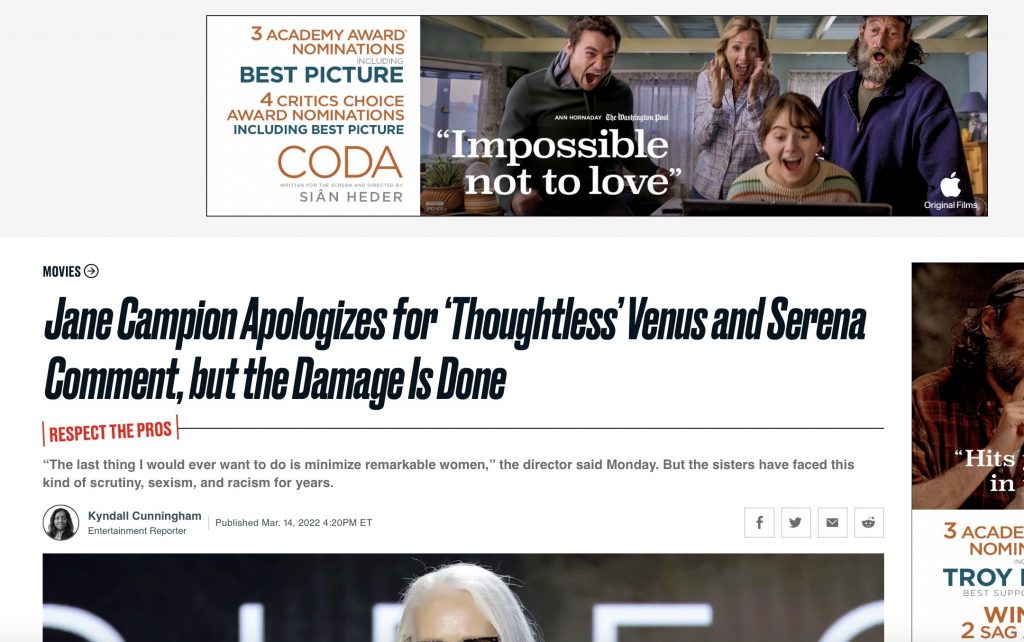
Jane Campion‘s The Power of the Dog hasn’t a prayer, of course, although her Best Director Oscar is assured. The top two contenders (i.e., the ones most likely to take the prize) are Reinaldo Marcus Green and Zach Baylin‘s King Richard and Sian Heder‘s CODA. So what will it be? The tennis movie or the singing-and-signing movie?

On 2.27.22 (two and a half weeks ago) the Best Picture Oscar odds shifted dramatically. The Screen Actors Guild handed its Best Ensemble Award (“Outstanding Performance by a Cast in a Motion Picture”) to CODA, and suddenly this low-budget, musically-driven family film had the heat. And yet, many reminded, CODA‘s lack of a Best Editing nomination suggested it may not win, as the correlation between Best Picture and Best Editing Oscars stretches back decades.

And then, six days after the SAG awards (3.5.22), King Richard‘s Pam Martin won the ACE Eddie Award for Best Edited Feature Film — Dramatic. Suddenly the narrative switched again — the Best Picture race was now a neck-and-neck between King Richard and CODA. Because of the merits, of course, but also because no one really likes The Power of the Dog. We know that.

It is noteworthy and coincidental that CODA and King Richard are about families engaged in tough struggles — the determined and pugnacious Richard Williams (Will Smith) pushing his athletically gifted daughters, Venus and Serena Williams (Saniyya Sidney, Demi Singleton), to succeed as professional tennis players, and CODA‘s Ruby Rossi (Emilia Jones) trying to overcome her own hang-ups and ambivalence in order to go her own way as a singer, the final goal being to gain admission to Boston’s Berklee School of Music.

Question: Which is the more fully engaged family film? Which is more realistic and less fanciful? Which is more reflective of the hard-nosed world the way it actually is than the way it seems by the terms and language of a sentimental fable

King Richard is no sentimental fable — it’s a family film that never quits, never fiddles around, never loses focus, doesn’t know from serendipity.

Read more

“Hair Styles”

90 minutes ago I was pedaling south on La Cienega (I have a nice bicycle) when I noticed a block-long line of mostly teenage girls. Okay, 20somethings.

I pulled over, walked up to a 50ish dude standing by one of the girls (a dad, I presumed) and said, “May I ask what this is?” He gestured to his daughter and she said “oh, it’s for hair styles.”

“Hair styles?” I said. “People are having their hair done?”

Hairy Styles,” she repeated, a little more clearly this time.

“Oh, Harry Styles…sure!” I quickly replied. “Dunkirk, dresses and pearl necklaces.”

It was the young girl’s fault. You don’t pronounce Styles’ first name so it rhymes with “hairy.” You pronounce it Hahrry. Like Harry Truman or Harry and the Hendersons or “a little touch of Harry in the night.” But she could have been thinking of Eugene O’Neill’s The Hairy Ape. Not that she was.

First Muslim Superhero!

I’m not questioning the Muslim identity thing, but her pipsqueak voice sounds so “Valley” — she has the vocal-fry speaking voice down cold. She could be any mousey, low-self-esteem teenager in any region of the country. Same manner, same vibe. In short, she’s done everything she can to blend in and assimilate with all the other vocal-fry girls.