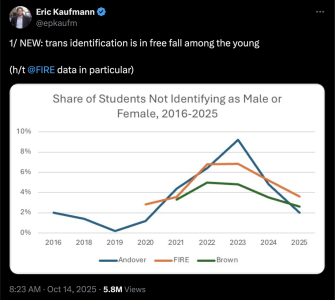
AI sez: A post on X (formerly Twitter) by researcher Eric Kaufmann on October 14, 2025, sparked the viral claim. Citing data from the Foundation for Individual Rights and Expression (FIRE), Kaufmann reported a recent and sharp decline in self-identified “trans and queer” youth between 2022 and 2025.
The unconfirmed data claims that the share of college students identifying as a gender other than male or female dropped from 6.8% in 2022 to 3.6% in 2025. This suggests that trans proponents may be feeling into the forest.
Critics point to the fact that this data has not been peer-reviewed or independently verified. It also relies on a single dataset that may not be representative of the entire population, and the nature of the specific survey questions has been questioned.
Value screened last weekend to an adoring crowd at the Hamptons Film Festival, and is currently press-screening in Manhattan prior to the early November debut, which is only 24 days off.
It’s a guaranteed Best Picture Oscar nominee; ditto Renate Reinsve and Skellan Skarsgard for Best Actress and Best Supporting Actor, respectively. We all understand that Hamnet is the Oscar frontrunner as we speak, but don’t sell Value short.
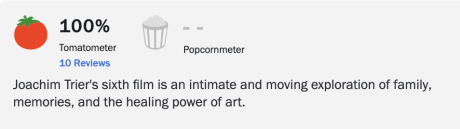
Posted on 5.21.25: I saw Joachim Trier’s SentimentalValue last night at 10:30 pm, exiting around 12:40 am. I was afraid it might not live up to expectations, but no worries — I began to feel not only stirred and satisfied but deeply moved and delighted by the half-hour mark, and then it just got better and better.
For my money this is surely the Palme d’Or winner. I wanted to see it again this morning at 8:30 am. Yes, it’s that good, that affecting, that headstrong and explorational. A 15-minute-long standing ovation at the Grand Lumiere, and all the snippy, snooty Cannes critics are jumping onboard.
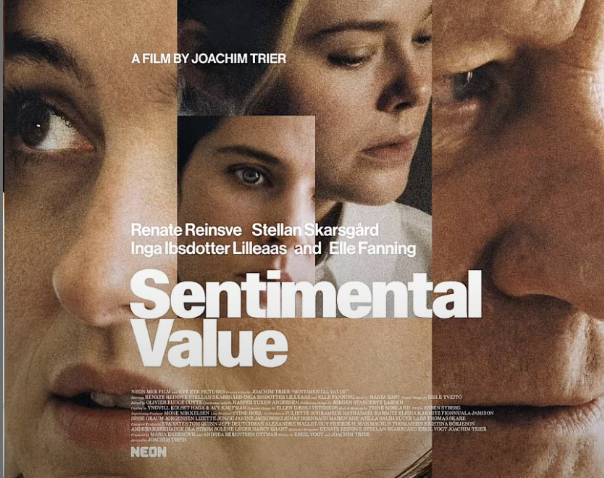
But what matters, finally, is what HE thinks and feel deep down, and that, basically, is “yes, yes…this is what excellent, emotionally riveting family dramas do…especially with brilliant actors like Renata Reinsve (truly amazing…she really kills) and Stellan Skarsgård, Inga Ibsdotter Lilleaas and Elle Fanning topping the ensemble cast.”
But I was really too whipped to tap anything out when I returned to the pad at 1:15 am. I managed a grand total of 4.5 hours of sleep, and am now at a Salles Bunuel screening of Eugene Jarecki‘s The Six Billion Dollar Man…beginning in a few.
Sentimental Value (why do I keep calling it Sentimental Gesture in my head?) is a complex, expertly jiggered, beautifully acted Ingmar Bergman-esque family drama that feels at times like Woody Allen‘s Hannah and Her Sisters but with less comic snap…it’s more of a fundamentally anxious, sad, sometimes very dark but humanist dramedy (a flicking comic edge, a Netflix putdown or two).
It’s a film that’s completely receptive and open to all the unsettled cross-current stuff that defines any shattered, high-achieving family, and this one in particular.
Emotional uncertainty and relationship upheavals are in plentiful supply.
Set in Oslo, it’s basically about an estranged relationship between Skarsgard’s Gustav Berg, a blunt-spoken, film-director father who hates watching plays, and his two adult daughters — Reinsve’s Nora Berg, a prominent stage and TV actress who’s a bundle of nerves, anxiety and looming depression, and Lilleaas’s Agnes, Nora’s younger sister who’s not in “the business.”
Gustav’s career has been slumping but now he’s returning to filmmaking with a purportedly excellent script that’s partly based on his mother’s life (although he denies this), and he wants Nora to star in it. She refuses over communication and trust issues, and so Gustav hires Fanning’s Rachel Kemp, a big-time American actress, to play Nora’s role.
I could sense right away that Kemp would eventually drop out and that Nora would overcome her anger and step into the role at the last minute. And I knew the film would explore every angle and crevasse before this happens.
‘ Value really digs down and goes to town within a super-attuned family dynamic…steadfast love, familial warmth, sudden tears, extra-marital intrigue, stage fright, film industry satire, thoughts of suicide…nothing in the way of soothing or settled-down comfort until the very end, and even then…but it’s wonderful.
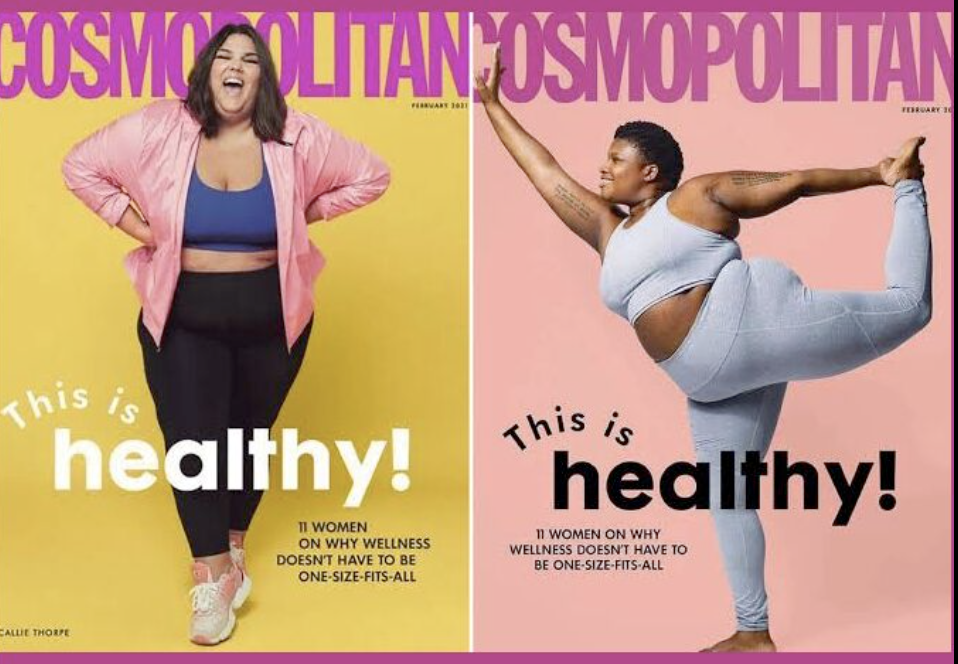
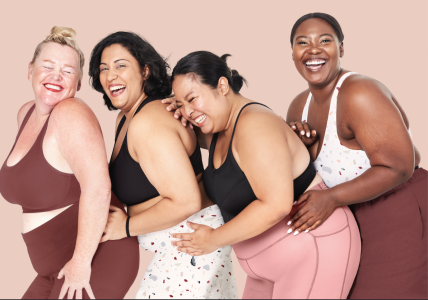
…when whalebods were seen as sexy, healthy, and life-affirming in the most wonderful way imaginable? Ozempic and other crash-diet drugs put an end to that, thank God, and now it’s even okay for a semblance of the male gaze to make a slight comeback. Because a vibe shift (lo and behold) has happened, and the once-bullying woke Stalinists have fled into the forest.
Triggered by a recent CNN article about the return of the male gaze, “After Party”‘s Emily Jashinsky and Spencer Klavan, Associate editor for Claremont Review of Books and Author of “Light of the Mind, Light of the World”, on a recent CNN article on the “male gaze” and how mainstream outlets frame timeless human desires as outdated or problematic, contrasting the body-positivity era of 2020 with today’s renewed focus on fitness.
The large-format, high-resolution VistaVision process only lasted from ’54 to ’61, but it certainly made films look extra-sharp and luscious during that brief heyday — The Ten Commandments, Richard III, Strategic Air Command, To Catch a Thief, The Searchers, The Man Who Knew Too Much, Loving You, Gunfight At The O.K. Coral, North by Northwest, One-Eyed Jacks, etc.
VistaVision generally made color features look like eye-popping, high-calorie desserts, and the black-and-white ones — The Desperate Hours, Fear Strikes Out, The Joker is Wild, Desire Under The Elms, The Tin Star — looked extra smooth and needle-sharp with wonderful deep blacks. Present-tense Bluray and 4K renderings of these films are always extra-pronounced…good enough to eat.
So why don’t the new VistaVision films — Paul Thomas AndersonOne Battle After Another and Brady Corbet‘s The Brutalist — look as good as the oldies? To me the newbies look okay but that’s all. The 35mm process via the Beaumont VistaVision camera or “Beaucam”, which Anderson and Corbet used, is roughly the same calibre as the VV cameras used in the ’50s, but neither OBAA or The Brutalist deliver that special VistaVision schwing. There isn’t a single moment in Anderson’s gritty-ass film that delivers any kind of super-pleasurable eye bath.
I’m presuming that Anderson wasn’t interested in giving his films a ’50s visual sheen and may have been looking to deliver that hand-held, you-are-there verite quality that Gillo Pontecorvo used for The Battle of Algiers, and that’s fine. But why shoot the fucking thing in VistaVision then? Because OBAA just looks like a normal, no-big-deal 35mm movie. It certainly doesn’t make your eyes go boiiiinng!
Nothing quite gets me off visually like a rich, luscious, black-and-white ’60s film. Particularly those wonderfully detailed flicks shot between the early to mid ’60s, when the competition from color TV was starting to breathe down everyone’s neck, which prompted certain dps to try harder or push it on some level. This Sporting Life, Sons and Lovers, Seven Days in May, The Train, The Spy Who Came In From The Cold, A Hard Day’s Night, etc.
But for some curious reason, Kenneth Higgins‘ monochrome capturing of John Schlesinger‘s Darling (’65) has never quite done it for me. Appreciation sans levitation.
The lighting in some portions seems unexceptional, the details and textures don’t quite pop, here and there it almost flirts with humdrum. It’s a wee bit underwhelming.
But next week I’ll be giving Darling another chance at Manhattan’s Film Forum, which is showing a newish 4K restoration.
Julie Christie is incandescent, of course (Darling launched her into the stratosphere), despite the fact that she’s playing a shallow, opportunistic, fairly loathsome person. Dirk Bogarde is wonderful, as usual.
Wiki excerpt: “In 1971, New York magazine wrote of mod fashion and its wearers: ‘This new, déclassé English girl was epitomized by Julie Christie in Darling — amoral, rootless, emotionally immature, and apparently irresistible.”
Most of yesterday afternoon was about hiking in Sullivan Canyon, a leafy, horse-trail community just west of Mandeville Canyon.
We defied the posted warnings and parked on Old Ranch Road, about 1/2 mile north of Sunset. We walked up a cloppy horse path to Sullivan Canyon trail, which goes on and on. By the time we were back to the junction of Sunset and Old Ranch we’d hiked five miles.
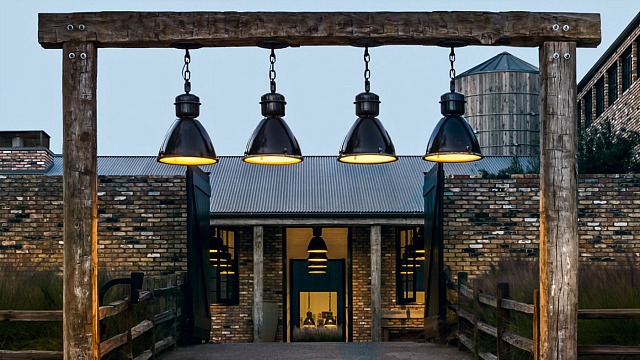
We only scoped out the exterior, of course. It’s magnificent and exacting, so beautifully textured and all of a piece in so many ways, but at the same time (here it comes) so immaculate that it feels more like the workspace of an enlightened, forward-thinking company (it reminded me a bit of J.J. Abrams‘ Bad Robot headquarters) than what most of us would call a “home.”
Homes need to feel imperfect and lived in and just a little bit ramshackle — a tad sloppy and messy with the scent of white clam sauce and sliced lemons, and maybe a hint of cat poop. A good home always has magazines and books and vinyl LPs all over the place, not to mention flatscreens and blankets draped over couches and at least three or four cats and dogs hanging around.
Keaton’s place might feel homier inside, but the exterior seems a bit too precise.
Oh, and there’s hardly any tree-shade in the front yard of Keaton’s place. Warren Beatty once said that great-looking hair constitutes 60% of a woman’s attractiveness; by the same token a great-looking home needs great trees (sycamores, jacaranda, lemon eucalyptus, pin oak) to drop a few thousand leaves and shade the place up.
6:15 pm update: I just ran into Warren Beatty and Annette Bening at Le Pain Quotidien on Melrose…honest! I told him I loved the quote about hair constituting 60% of a woman’s beauty or appeal, and he said, “I don’t think I ever said it.” Huh. “You read this somewhere?,” he asked. Yeah, I said. In an article about Diane Keaton or about her home, and just this morning. I definitely didn’t invent it, I emphasized, but I love the observation regardless.
Diane Keaton’s spacious, self-designed home, just around the corner from Old Ranch Road and exactingly designed like nothing you’ve ever seen.
…I could say with absolute authority that it smells or, you know, blows the proverbial big one. But I’ve refused to see it. Has anyone submitted? If so, may I ask why?
It was startling enough when the universally loved and seriously admired Robert Redford suddenly slipped beneath the waves on Tuesday, 9.16. But within a mere twinkling of time….three and a half weeks or 25 days later…the cosmic trap door suddenly gave way underneath Diane Keaton also and she, too, was gone like that.
A half-century ago Redford and Keaton, who probably met a few times but never worked together…in the mid ’70s they were as magnetic and glistening and era-defining as it got…both commandingly charismatic and wrapped up in the social-political-cultural current like few other Hollywood hyhenates.
Even the HE readers who hate my “hot peak period” obits have to admit Redford and Keaton were seriously peaking in ’75. Okay, Keaton’s Everest moment didn’t happen until Annie Hall popped on 4.20.77 but still…
Redford (born on 8.18.36) and Keaton (1.5.46) will receive extended tributes at the end of the Oscar death reel on Sunday, 3.15.26, but who will be given the very last spot?
“A slave stood behind the conqueror holding a golden crown, and whispering in his ear a warning: that all glory is fleeting.” — Francis Coppola by way of George C. Scott by way of George S. Patton.
Gutslammy, power-punchy, fleet-of-mind-and-foot and masterfully crafted as it is, Paul Thomas Anderson‘s One Battle After Another has been defeated in the ongoing online argument over the last two weeks or so, at least as far as the BestPicturecategory is concerned.
It has lost the verbal battle because everyone realizes it’s a vessel of extreme-left POC girlboss agitprop, and that the rave reviews are basically about fuck-yeah political agreement first and artistic-cinematic admiration second.
Plus it goes against the expanding realization that hard-left wokey wackos have all but destroyed the Democratic party’s profile among middle-of-the-road voters, and that it’s time to pull back on that shit right now and for the wokeys to flee into the forest and staythere.
We all know that Christian Toto made a fair point a couple of weeks ago when he claimed that if OBAA had been about rightwing activists engaged in shootings, robbings and hiding out under fake identities, it would have been totallyassassinated by the Rotten Tomatoes and Metacritic gang.
So Best Picture-wise it’s over, okay? Forget that category and move on.
PTA’s film will be nominated in eight or ten or even twelve categories, of course (Leonardo DiCaprio for Best Actor without question, Best Director, Cinematography, Best Adapted screenplay + Chase Infiniti‘s category-fraudulent, phoney-baloney Best Actress campaign will probably snag an actual nom), but a Best Picture win is simply not happening.
The top finalists are a pair of emotionally riveting, deeply penetrating family dramas — Chloe Zhao‘s Hamnet vs. Joachim Trier‘s Sentimental Value, which blew the roof off and triggered a standing ovation after a Hamptons Film Festival screening yesterday afternoon at Guild Hall. (Bill McCuddy was there — he saw it, heard it, felt it.)
Hamnet is favored to win, yes, but Value clearly has the stuff to aggressively compete and heel-nip like a sonuvabitch, and it seems to be gaining ground.
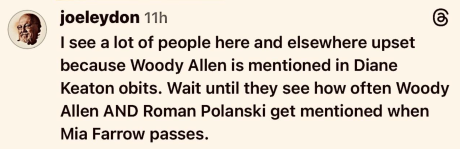
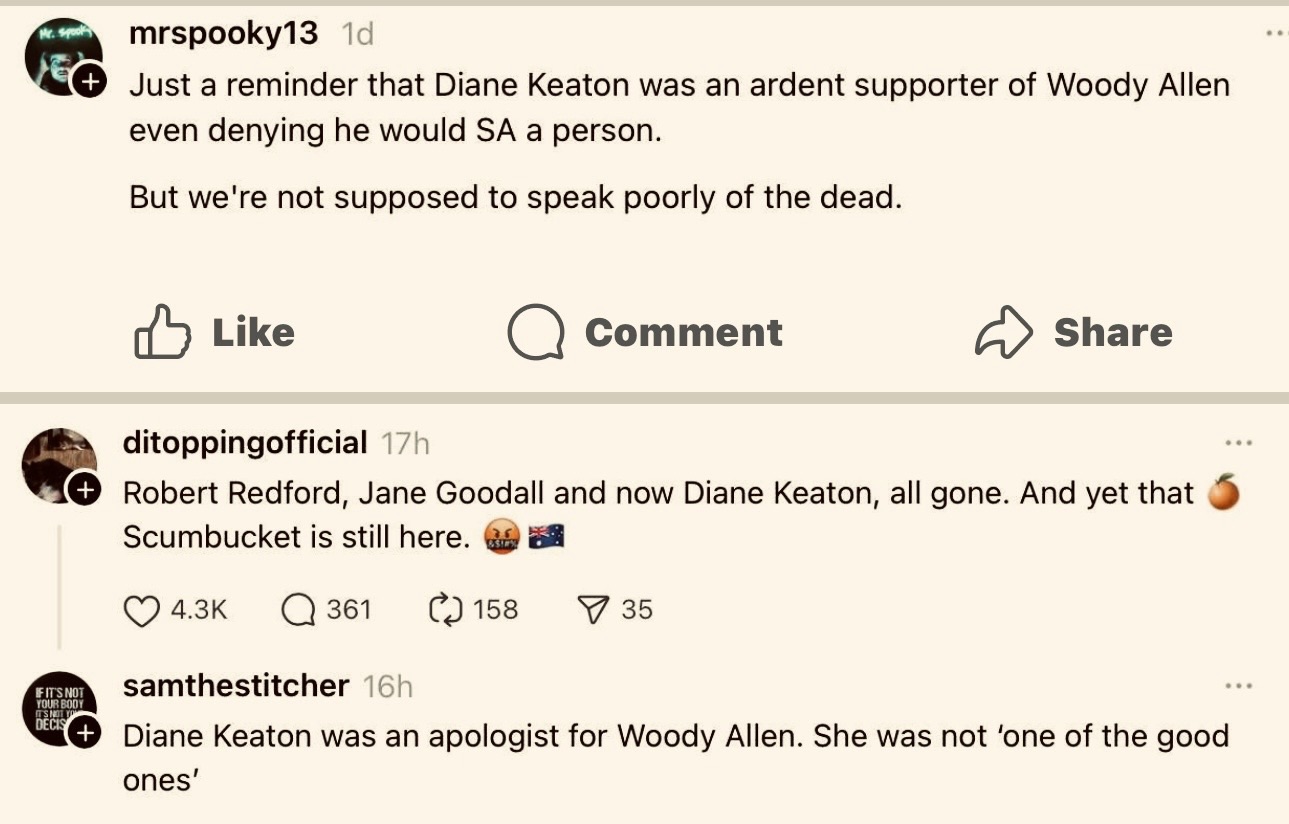
Joe Leydon is completely correct. When Mia Farrow passes, the expansively written obits and summing-up essays will have no choice but to conclude that, like all successful actresses, she was a very shrewd and calculating careerist who boosted her profile and cultural standing big-time by connecting with Woody Allen in the ’80s. And that she turned feral and ferocious in August ’92 over you-know-what and that Moses Farrow knows a thing or two about that (as do many others), and that she’s long praised and stood solidly behind her genius-level Rosemary’s Baby director, Roman Polanski, and admirably so.