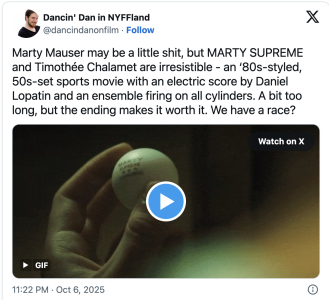
We’ve all become sick of needlessly long movies…films running between 130 and 150 minutes or longer for no apparent reason other than a lack of basic narrative discipline. But this doesn’t appear to be an issue in the case of Josh Safdie‘s Marty Supreme (A24, 12.25).
Responses to last night’s “secret” Supreme screening at the New York Film Festival have been pretty good. Some have expressed vague concerns over a 2 hour and 29 minute running time, but hell…that’s nothing. Especially if the film in question has the Safdie heebie jeebies.
Length, of course, has always been immaterial or irrelevant when it comes to quality — no bad film can be too short, no good film can be too long.
If you’re talking “long but good movie,” 165 to 180 is HE’s sweet spot. Long but a little lighter, tighter and trimmer…slightly less indulged.
HE’s favorite 165 to 180s: The Godfather (175), Heat (170), Patton (172), The Best Years of Our Lives (170), Saving Private Ryan (169), The Thin Red Line (170), Long Day’s Journey Into Night (174), The Young Lions (167), The Longest Day (178), Beau Is Afraid (179), Dogville (’03), The Great Escape (172), The Unbearable Lightness of Being (171), Braveheart (178).
I even have a certain elevated regard for marginally flawed films in this realm…King of Kings (168), In Harm’s Way (165), The Towering Inferno (165), The Good Shepherd (167), Alexander (175), etc.
Many three-hours-or-longer films reside on my all-time greatest roster — The Godfather Part II, Apocalypse Now, Lawrence of Arabia, The Wolf of Wall Street, Scarface, The Irishman, Barry Lyndon, Ben-Hur, Titanic, The Seven Samurai, Gone With The Wind, Spartacus, etc.
“Even if CBS staffers (rightly) see Bari Weiss‘s Free Press as opinionated, it might not see itself that way; indeed, the site claims simply to be covering the world the way it is, when mainstream newsrooms have abandoned that role. (Already, in the press release announcing her appointment, Weiss promised to make CBS News ‘the most trusted news organization of the 21st Century.’)
“This isn’t to say that everything is relative. But the truth rarely just reveals itself. The choices journalists make in seeking it inevitably inform the stories they tell.” — from Jon Allsop’s “What Will Bari Weiss Do to CBS News?” (New Yorker, 10.6.25).
“The media meltdown around Bari Weiss, who is basically a sensible centrist with zero allegiance with the wokeys, is no different than the leftwing mob that ran her out of The New York Times, except that now she has control over the newsroom and is (gasp) forcing the CBS newsroom to adhere to traditional journalistic standards.” — @mattray4876.
With Michael Mann‘s Heat 2 having finally settled upon an eager-beaver financier-distributor (United Artists) and ready to move next year with a budget of $170 million, HE has a comment or two.
With discussions about the 50-year-old Leonardo DiCaprio playing Chris Shiherlis, the role Val Kilmer played at age 35 in the 1995 original…I hate to say this because it sounds cruel, but isn’t Leo too old for this character?
Chris isn’t a strong supporting role in Heat 2, mind, and is pretty much the flat-out lead with Neil MacAuley, Robert De Niro‘s character from 30 years ago, appearing only in the first third.
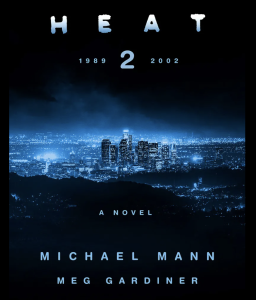
Mann and Meg Gardiner‘s Heat 2, a novel published in ’22, serves as both a prequel and a sequel to the original, and it goes like this:
(a) a 1989 Chicago-based saga featuring Vincent Hanna and the super-villainous, Anton Chigur-like Otis Wordell (some kind of Waingro-like figure, only worse), along with MacAuley (please don’t hire the beak-nosed Adam Driver to succeed Robert DeNiro or Al Pacino…please don’t do this to us!), Chris Shiherlis and Michael Cerrito involved in the usual thievery and violence, and topped off with a tragic finish…
(b) a 1995 section that covers Chris’s escape from Los Angeles after Heat‘s big failed bank robbery, and his relocating to Ciudad del Este in Paraguay where more heavy stuff happens, and…
(c) a 2002 chapter that dramatizes a collision between Hanna, Wordell and Shiherlis.
Shiherlis would obviously be six years younger than his Heat age in the ’89 prequel, or 29 years old. He would be 42 in the 2002 finale. I interviewed a 19-year-old Leo at The Grill in ’94, so it feels pretty weird to suggest that he’s now a bit too too old to portray a ’90s-era bank-robber. But time doesn’t fuck around and he would be a little too creased and leathery to play a 29-year-old.
Mann would have to digitally de-age DiCaprio for the ’89 and ’95 sections. The Leo who starred in The Wolf of Wall Street would have had no problems in this regard.
Heat 2 can’t be all tension and bullets and adversaries. It needs love and longing, and an element of trust and settled vibes…a Jon Voight-like figure who speaks softly and cautiously and has the angles mostly anticipated.
Friendo who’s read Mann and Gardiner’s Heat 2: “It’s a good book. The vibe feels similar to the original Heat. Otis Wordell is the most compelling figure….he’s like a demonic Anton Chighur, and his presence imparts a certain kind of No Country for Old Men vibe. A haunting figure. Seems unkillable. Rapes/tortures people.”
Sent this morning to the esteemed Gatecrashers crew (Sasha Stone, Jeff Sneider, William Mccuddy, Christian Toto, Chris Gore, Jordan Ruimy, Matthew Pejkovic, Kristi Coulter Bobhy Peru, Edward Douglas, John Nolte, Scott Kernen, The Cinescape, Scott Menzel, Knox Bronson, Bee Garner and two or three secret industry contributors):
Hail to all GateCrashers! A few significant films have yet to open or be widely screened, of course, but it’s time to begin the award season dance yet again.
You guys all know the drill. The forms and whatnot will be sent out soon. We should be up and rolling by…when? Mid-October? Let’s see how it develops.
In addition to the eternally wise and perceptive Kristi Coulter, I would personally love to add at least one more significant female movie lover. Suggestions?
Sasha and I are not exactly on the same page on a sidebar that I’m about to suggest, but we really need to add a ”pure cinema elevation” category.
Please submit the titles of at least five but no more than ten films that, by your sights and rights, qualify as the best films of 2025 so far. Sasha wants to wait on this until everything has been seen but I say “to hell with that”…send them along now. Forget which films the Academy and guild members and critics groups are likely to support and which distributors are likely to buy FYI ads on your site, and JUST GO WITH YOUR HEART.
Personal plea: Please do what you can to see Boorman and the Devil, which is EASILY one of the year’s best.
No more identity campaigns! And while we’re on this topic, death or at least significant award-season diminishment to Sinners, which would not even be jokingly discussed as an Oscar contender if it had been directed and written by Clem Kadiddlehopper.
And so the winner of the Samuel Z. Arkoff American International schlocko cunnilingus bloody Irish vampire Delta Blues / Robert Johnson drive-in popcorn award is (wait for it) (keep waiting) (here it comes) Sinners!
And the winner of the D.W. Griffith Birth of a Nation Inverse Award goes to One Battle After Another!
Yes, I’m kidding. Vote for whatever film or director of screenwriter or actor you think has the big heat.
Except deep down I’m NOT kidding. Identity campaigns are woke cancer. The great Steve McQueen is a major, world-class artist. Ryan Coogler isn’t even close to McQueen’s level…sorry.
Kidding, not kidding…who knows? Vote for whatever the fuck.
Last night I watched two episodes of Ryan Murphy‘s recently-popped Ed Gein miniseries…Monster: The Ed Gein Story (Netflix, 10.3). I flipped and zipped around here and there but mostly I stayed with #3 and #4.
It’s primarily a wildly imagined, “we’ll show anything we feel like showing and we don’t care” impressionist fantasia, and I felt honest respect for the loose-shoe scheme of it. It streams like a dream through Ed Gein’s twisted psychology and grotesque imagnings, and we’re shown very little (next to nothing) in the way of hard documented facts or realism.
Okay, it contains a few nods to reported fact and a few reenactments of certain incidents, but mostly the series is about Ian Brennan, the series’ showrunner and screenwriter, and director Max Winkler using the Gein history as a launchpad for a dive into Bunuelian impressionism by way of bland, middle-American, mid 20th Century horror.
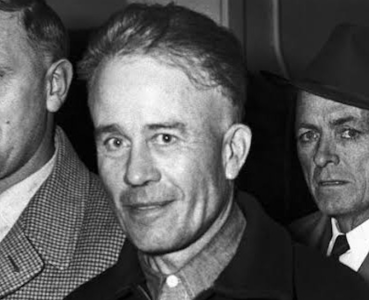
And guess what? Gein’s portrayer Charlie Hunnam, 45, is nearly a dead ringer for the Real McCoy. Except he performs every line with the same wimpy, fluttery, high-pitched voice.
The Gein miniseries (eight episodes) is a psychological dreamscape thing that ignores, flagrantly lies about or luridly exaggerates what is generally known about Gein — an older, plain-faced, mother-loathing Wisconsin farmer who never had sex in his life — and the gruesomely chilling horror films (Psycho, The Texas Chainsaw Massacre, The Silence of the Lambs) that he and his gruesome acts inspired.
The Psycho portions are basically one flagrant lie after another. The enactment of the Psycho shower murder scene (much bloodier and more bruisingly violent than Hitch’s original, and in COLOR yet!) and the audience reactions (throwing up, fainting, etc.) is all florid poppycock, but it’s imaginatively surreal at the same time. And I love the look of smug satisfaction on Hitch’s face when he sees how upset the theatre patrons have become.
I watched episodes #3 and #4 (“Babysitter” and “Green”), the former featuring the Psycho demimonde (Alfred Hitchcock, Robert Bloch, Alma Reville, Anthony Perkins, Tab Hunter) and the latter featuring Lesley Manville as Bernice Worden, a hardware store owner who was Gein’s final victim.
I wanted to watch the Manville chapter because I was told that this elderly British actress has shrieking doggy-style sex with Hunnam, except her cries and moans struck me as insincere and superficially performative, which I’m presuming was intentional.
For me the most horrifying element in the whole series are those frozen, snow-covered, eternally flat Wisconsin landscapes. (Gein and his horrible mother lived on a small farm in Plainfield, Wisconsin.)
Hunnam, Manville and Laurie Metcalf‘s mom aside, the performance standouts include Tom Hollander‘s Hitchcock, Ethan Sandler‘s Robert Bloch, Suzanna Son, Vicky Krieps, Olivia Williams (Alma Reville), Joey Pollari (Anthony Perkins), Jackie Kay (Tab Hunter), Addison Rae (pretty blonde who mysteriously disappeared) and Elliott Gould‘s Weegee.
Incidentally: Gein is a German name, of course. “EIN” is used in hundreds of German or German-Jewish names — Rheingold, Feinberg, Heinrich, Heinz (ketchup) — and it’s always pronounced like the words “eye”, “fly” or “rye” with an “n” attached. Obviously Gein should be pronounced the same as “Heinz” or the first syllables in “Rheingold”, “Feinberg” or “Heinrich.” And yet many nonsensically insist that Gein should be pronounced “GEEN” — wrong!
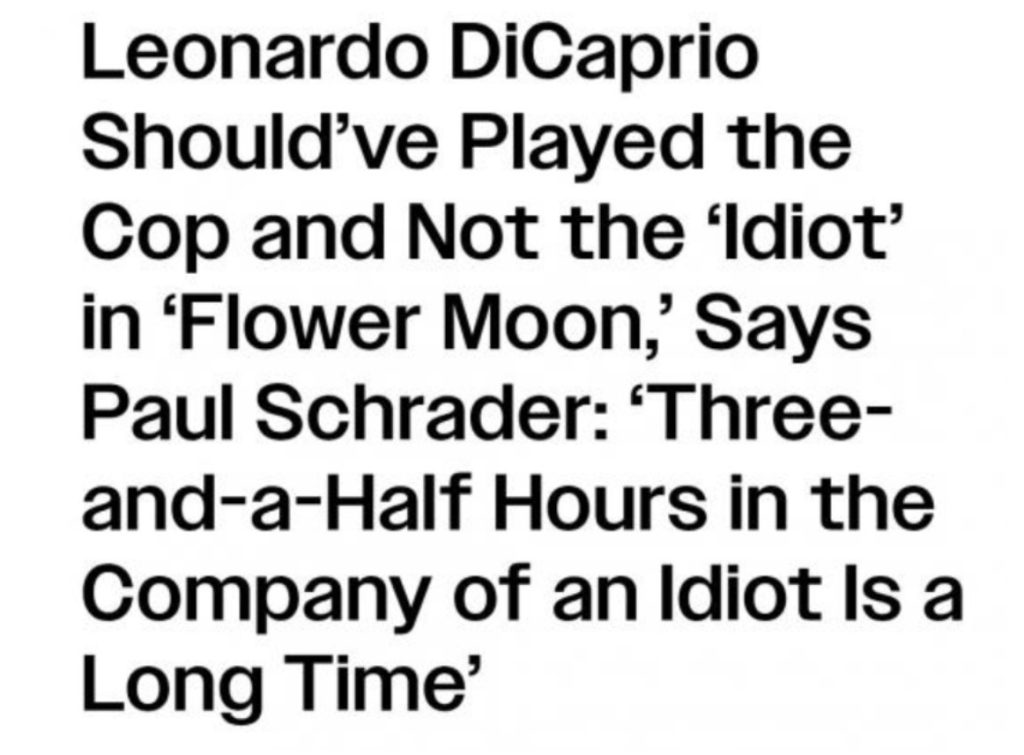
A fair and honest portrayal of Martin Scorsese’s life and career would acknowledge that KillersoftheFlowerMoon is arguablyhisworstfilm (yes, even worse than Hugo and Kundun) .
I’ve explained this numerous times, but this is because (a) KOTFM was driven by an all-but-total capitulation to glum woke theology, which meant that (b) Lily Gladstone’s Molly Burkhart had to be portrayed as not only gloriously imbued with God’s radiant and rhapsodic light but as a deeplyfascinatingcharacter (not).
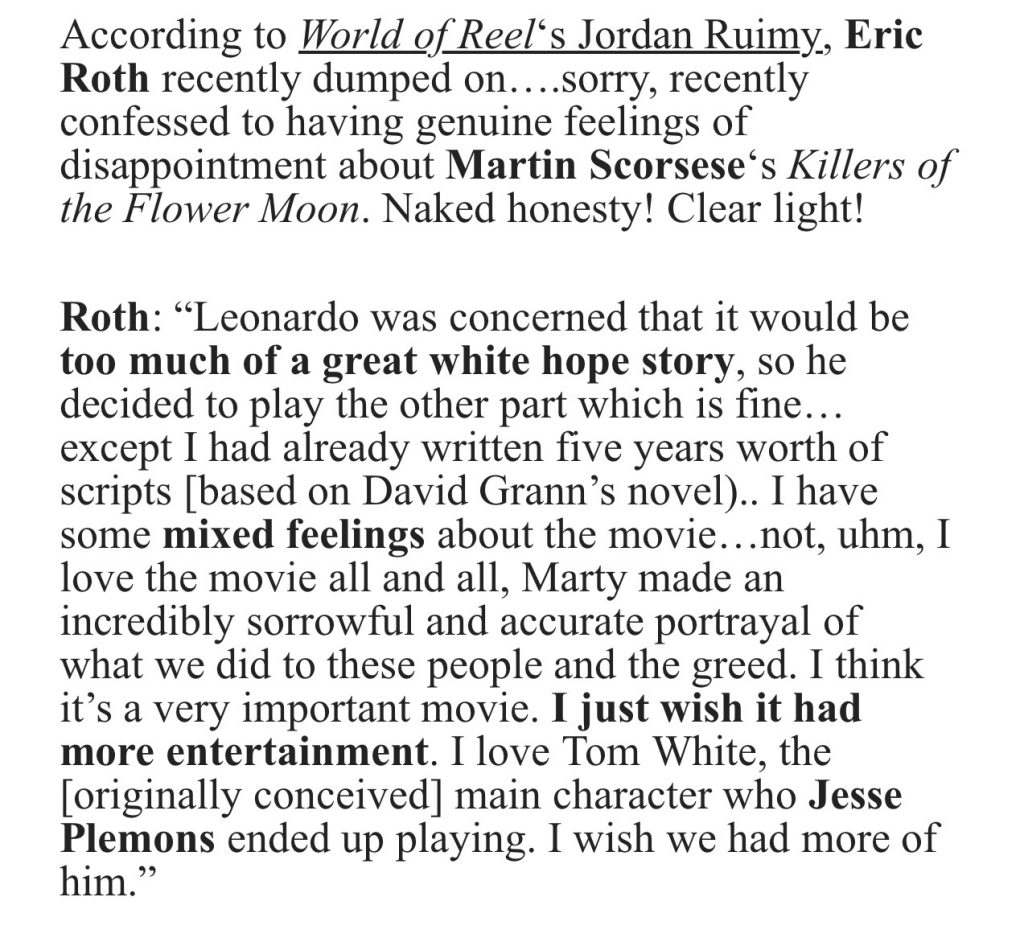
Scorsese had a greatEric Rothadaptation of David Grann’s 2017 novel to work with, but he and Leonardo DiCaprio were too afraid of offending the DEI fanatics by making Texas Ranger Tom White the central character.
KOTFM was therefore, Robbie Robertson’s haunting music aside, theleastScorsese–esquefilm to ever bear his name. It was about Marty dropping to his knees and showing obeisance to the early 2020s power of woke fanaticism.
Does Rebecca Miller’sMr.Scorsese (Apple TV+, 10.17) acknowledge this? I haven’t seen it, but it sure as hell sounds like she doesn’t.
Free Press honcho Bari Weiss became a “name” in 2020 after quitting the woked-up N.Y. Times — a rebellion against twitter totalitarianism & illiberal woke Stalinism. The wokester journos currently embedded within CBS News will soon become fully cognizant of their terrible folly. Another way of putting it is that some (all?) of them are dead meat.
A bulletin from Hamptons resident and HE friendo Bill McCuddy…
“After debuting at Telluride on 8.30, Ivy Meeropol‘s Ask E. Jean had a big hot-ticket screening at the Hamptons Film Festival on Saturday, 10.4.
Carroll to McCuddy: “This is a film about how to beat Donald Trump, and that’s basically what my director Ivy Meeropol has done…she reveals what it will take to stop what’s going on today.”
Will Carroll ever see a dime of the nearly $90 million smackers the President owes her? “Oh yeah…have you met Robbie Kaplan?” she asked, referring to her pitbull lawyer and one of the documentary’s headliners.
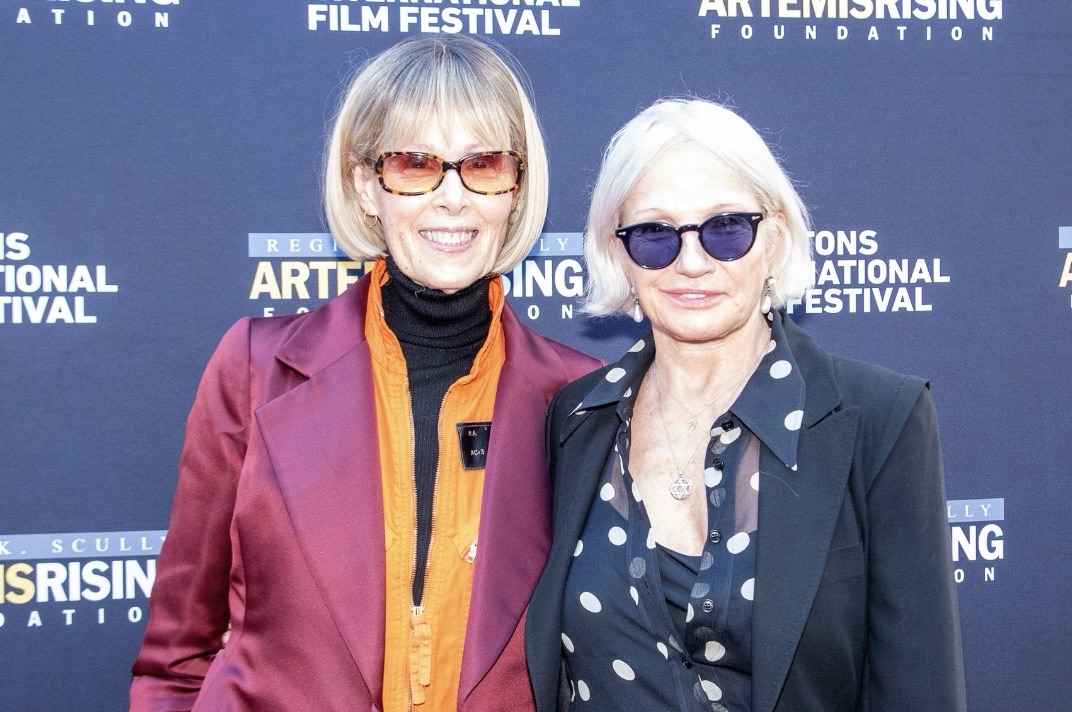
“FUCK, yeah,” chimed in pal Ellen Barkin, standing by Carroll’s side. “Look at her lawyer.”
Barkin’s not in the film — she was just there for support and said, jokingly, “I’m playing E. Jean in an afterschool special so I have to really embrace her.”
Barkin then got serious about the gravity of Carroll’s lawsuits, the admission that J.C. hasn’t had sex since the attack, and how the film has affected the women’s movement.
Barkin: “It’s only the most important thing that’s happened, for me, since civil rights. The 70’s riots. This comes next for me.”
A number of familiar scenes played well (i.e., Trump identifying Carroll as Marla Maples in a photo). It also reveals the two people E. Jean confided in after the attack — newscaster Carol Martin and ‘Preppy Handbook’ journalist Lisa Bernbach. Other talking heads in the 91-minute film include Bill Boggs, Geraldo Rivera, and the entire Carroll legal team.
Trump’s deposition, considered ‘fair use’ footage because it was part of the trial, was “ripped from YouTube” according to the director. When someone from the audience asked if the Trump appeals — he has one left, according to the film — will be settled while The Beast is still in office, Kaplan said “Yes, I believe so.”
McCuddy worked with the Elle magazine author during the time of the assault in the mid 90s. She and he were both picked by Roger Ailes to host television shows on the now defunct NBC channel “America’s Talking.” She had the advice show “Ask E. Jean” and McCuddy had the afternoon talk show right before hers called “Break A Leg.”
McCuddy: “Carroll and I have kept in touch with social media and via an off-Broadway show I did before COVID that she came to see. She gave me a big hug on the red carpet for the HFF premiere. Pic is still looking for a distributor and gets a second viewing on Sunday.”
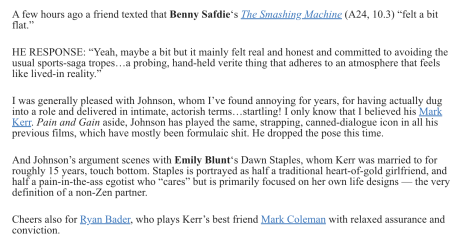
As I posted from Venice on 9.1, Benny Safdie‘s The Smashing Machine (A24) is a reasonably decent, at times almost refreshingly offbeat film because it doesn’t deliver the usual formulaic cowflop that Dwayne Johnson movies have been shoveling for too many years.
On top of which Johnson’s lead performance as Mark Kerr is earnest, dug-in, totally respectable.
So why did Smashing make only a lousy $6M this weekend? My guess is that Joe and Jane Popcorn took one quick look at Johnson’s black curly wig and said “nope, no way.” Just a hunch.
Yesterday I tried listening to portions of Taylor Swift‘s “The Life of a Showgirl“, and I’m very sorry but the music and her voice in particular just went “thud” all over again. I listened and nothing happened.
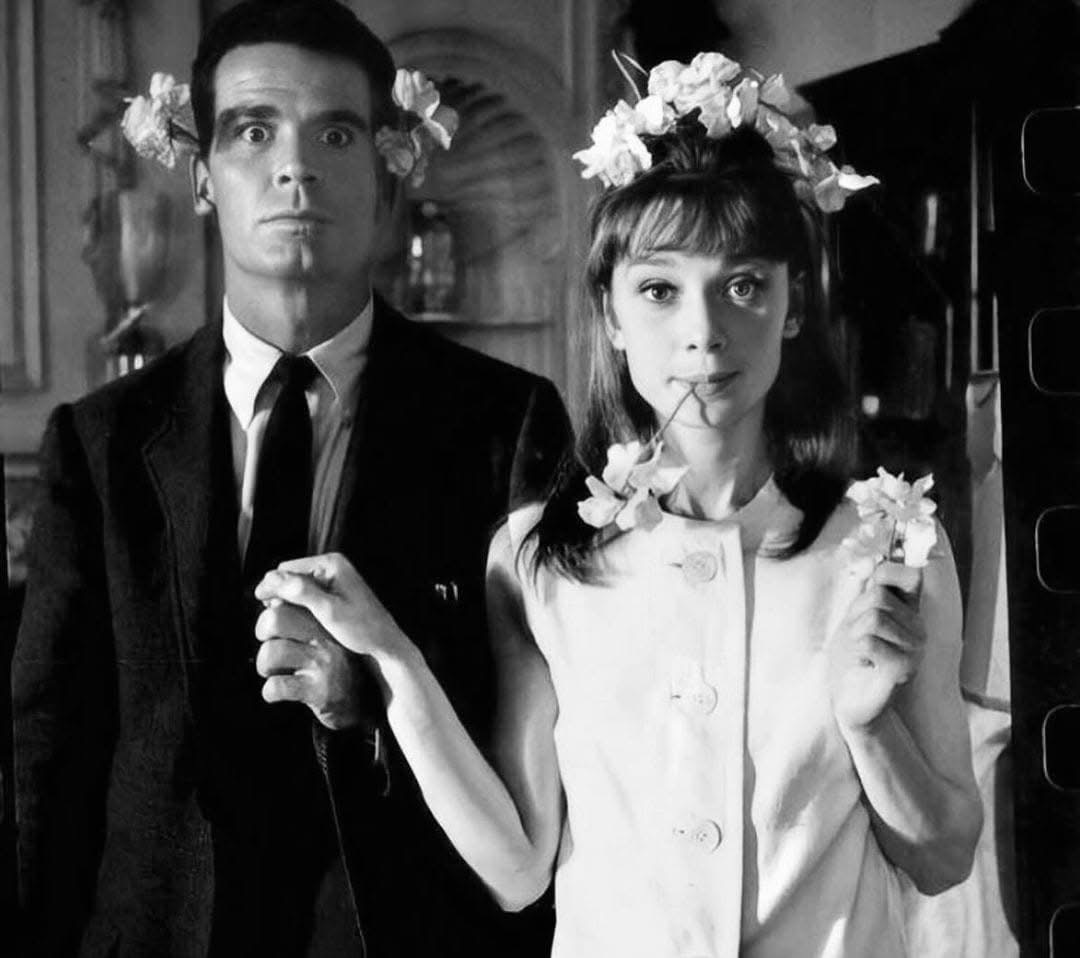
William Wyler‘s The Children’s Hour (’61) is a thoroughly suffocating drama and, for my money, a stone drag to sit through. Eeeeeekk!…lesbians! The alarmed expressions in the trailer alone are borderline comical.
It began life as a 1934 Hellman play about the hounding of two schoolteachers over rumors of a suspected gay relationship.
In 1936 Wyler sheepishly adapted a watered-down screen version of Hellman’s play (Hellman herself wrote the screenplay), having scrubbed it of lesbian allusions and re-titled it as These Three.
Even Wyler’s 1961 version, which finally allowed allusions to a lesbian relationship between the schoolteachers (Audrey Hepburn, Shirley MacLaine), unfolds in overly timid terms. Hellman “adapted” it, although screenplay credit went to John Michael Hayes.
James Garner and Joel MacCrea played the same role in the ’61 and ’34 versions, an alarmed doctor named Joe Cardin who basically wants to mate with Audrey Hepburn and Merle Oberon, respectively.
Yes, Virginia — even in 1961 the notion of a possibly gay relationship between two women was quite an alarming thing, strange as this may sound today. Wyler’s Kennedy-era film was derided as being overly skittish and chicken-hearted.
This was the same year, mind, as Basil Dearden‘s much braver Victim, a low-budget British drama about a blackmailer making life miserable for a seemingly straight-and-married barrister (Dirk Bogarde) over allegations of a male homosexual relationship from the barrister’s past.
Victim‘s Wiki page says it was filmed in only 10 days.
As far as I can recall there are only two films with a strong, recognizable musical theme or theme song…Elia Kazan‘s East of Eden (’55) and Robert Altman‘s The Long Goodbye (’73)…these two may be the only films in which the musical theme is sung or hummed by characters within the film itself.
Which means, obviously, that the theme was composed and performed before principal photography on these films began.
In Eden, Julie Harris hums Leonard Rosenman‘s main theme (which begins at the :40 mark in the below video), and in The Long Goodbye, a lounge singer croaks or croons John Williams and Johnny Mercer‘s “Long Goodbye” tune in the Hollywood bar in which Marlowe retrieves his messages.
There are probably other films that have operated this way, theme-song-wise — I just can’t remember them.