100% Martin Riggs: “Whaddaya wanna hear, man? Do ya wanna hear that sometimes I think about eatin’ a bullet? Hah? Well, I do. I even got a special one for the occasion with a hollow point…look. Make sure it blows the back of my goddam head off, do the job right.”
The following passage is 50% Riggs and 50% me (i.e., Jeffrey Wells) right now: “Every single day I wake up and I think of a reason not to do it, every single day. And you know why I don’t do it? It’s gonna make you laugh. You know why I don’t do it? The job. Doin’ the job. And that’s the reason.”
Every now and then Chris Gore seems to be on the verge of saying “yes, they’re a prison camp…of course they are!” But he always wusses out or, you know, holds back. Because he’s still invested in the things that moved him as a kid and a teenager. Which, I suppose, also describes me to some extent.
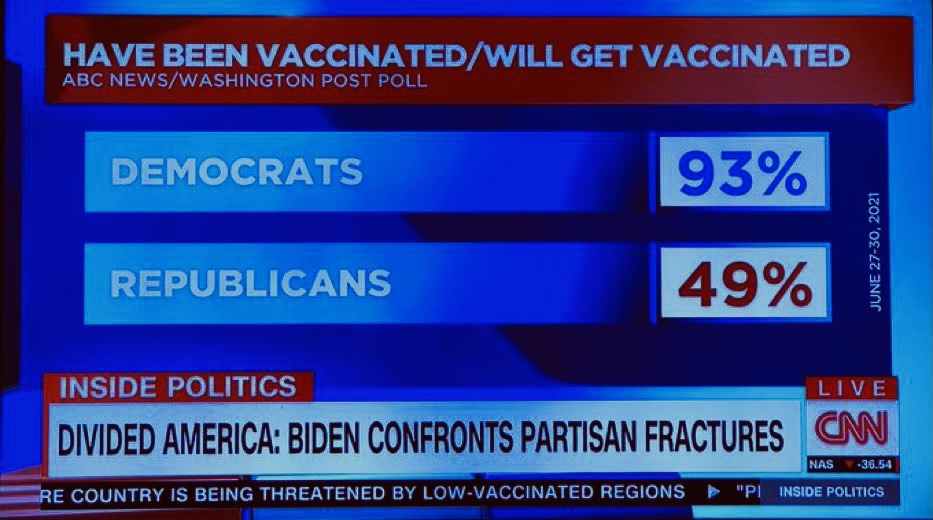
…that a fair-sized percentage of the Republicans refusing the vaccine will succumb to the Delta variant and perhaps…move on the next realm? C’mon, what’s so bad about that? They’re monsters, they’re lunatics, they’re prolonging the pandemic…fuck ’em if they can’t take a joke.
If you haven’t yet, please get vaccinated. It’s the best way to keep yourself and your loved ones safe from the dangerous new COVID-19 variants.
True story from a critic friend, edited by the author so as to obscure his/her identity:
I know it’s wrong to speak ill of the dead. But I so enjoy telling this story.
Let me start like this: Any job description in a help-wanted ad seeking to hire a critic should include these words: “Must be a bit of a dick.”
The ads never say that. But they should. Because, no matter how nicely you do it, some people don’t take criticism well. Inevitably, you will have to say something negative in a public forum about the creative expression of another human being. Whether you mean to be or not, they’ll think you’re a dick.
Here’s the thing: Sometimes, it’s really enjoyable to be as witty and as nasty as you can when you’re writing a review. Because you’re being a dick, which is, by definition, fun.
I knew early on that I had the ability to provoke and the willingness to do so (along with a shocking inability to foresee possible consequences of my
actions). I take a certain pride in a well-turned phrase and an irreverent sense of humor.
But while I’d experienced the immediate reactions of local artists — actors, directors, musicians — to my reviews in the early years of my career, I’d
rarely had the sense that, when I wrote a movie review or a review of a rock concert, the people I was writing about ever actually saw what I wrote.
Which brings me to my point about being a dick, and my Richard Donner story.
In 1994, during a moment when there was a microburst of interest in westerns because of the success of Unforgiven and Dances With Wolves, I’d been assigned one of those trend stories that editors love: the return of the Western. So I started making calls.
One of those went to a publicist at Warner Bros., which was a few months away from releasing Richard Donner’s remake of the 1950s TV hit, Maverick, starring Mel Gibson, Jodie Foster ands James Garner. Could I get a few minutes on the phone with Donner, I asked, to talk about westerns?
Donner was a director and producer of commercially successful middlebrow (or worse) films starting in the 1960s, including Superman with Christopher Reeve, The Goonies (most overrated kids film of all time), The Omen and the Lethal Weapon films, which, to my mind, had ruined action movies.
In those days before cell phones and e-mail, the reply came with surprising swiftness. I got a call back the same day from the Warners’ publicist, telling
me, no, Richard Donner would not speak to me about westerns — or anything else, apparently.
“Why not?” I asked.
“Did you write a review of his film Radio Flyer“, the publicist asked.
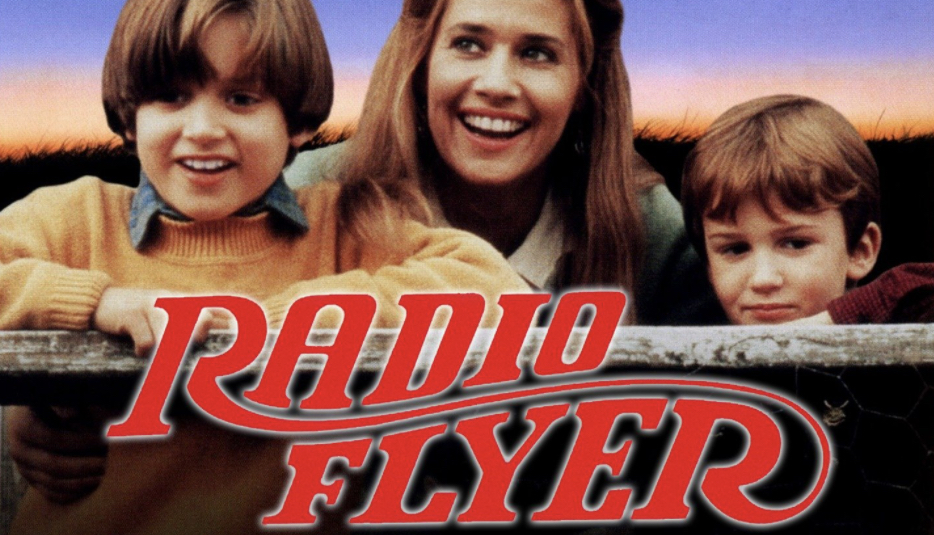
It had been two years, but I knew exactly what he was talking about: I believe I called it “a feel-good film about child abuse.”
“Yeah, well, that was apparently a very personal film for him, so he’s not going to talk to you,” the publicist said.
Until that point — 1994, in a career that started officially when I turned pro in 1973 — I had no sense of anyone reading my reviews other than the
people within the immediate circulation area of my newspaper. I forwarded them to the film publicists in New York, and knew they were syndicated.
But I simply didn’t imagine filmmakers themselves actually taking the time.
Now, however, I knew I had Richard Donner’s attention.
So when Maverick came out in 1994 and I reviewed it, I referred to him on first reference as “Richard Donner, who directed Radio Flyer, a feel-good film about child abuse.”
I’m sorry but I don’t wholly disagree with the sixth paragraph in a 7.5 USA Today op-ed piece. It pains me to acknowledge that it was written by Christopher F. Rufo, a conservative Millennial who’s buddied up with Tucker Carlson and the vile Mark Meadows. I hate Trump-allied righties for the most part, but the sixth paragraph has validity.
“‘Political correctness’ is a dated term and, more importantly, doesn’t apply anymore. It’s not that elites are enforcing a set of manners and cultural limits — they’re seeking to reengineer the foundation of human psychology and social institutions through the new politics of race. It’s much more invasive than mere ‘correctness,’ which is a mechanism of social control, but not the heart of what’s happening.
“The other frames are wrong, too: ‘cancel culture’ is a vacuous term and doesn’t translate into a political program; ‘woke’ is a good epithet, but it’s too broad, too terminal, too easily brushed aside. ‘Critical race theory’ is the perfect villain. Its connotations are all negative to most middle-class Americans, including racial minorities, who see the world as ‘creative’ rather than ‘critical,’ ‘individual’ rather than ‘racial,’ ‘practical’ rather than ‘theoretical.’
“Strung together, the phrase ‘critical race theory’ connotes hostile, academic, divisive, race-obsessed, poisonous, elitist, anti-American.And it’s not an externally applied pejorative. Instead, it’s the label the critical race theorists chose themselves.”
The nub of Rufo’s rebuttal begin at 6:45, and they partly stem from Anastasia Higginbotham‘s “Not My Idea: A Book About Whiteness“, the controversial children’s book.
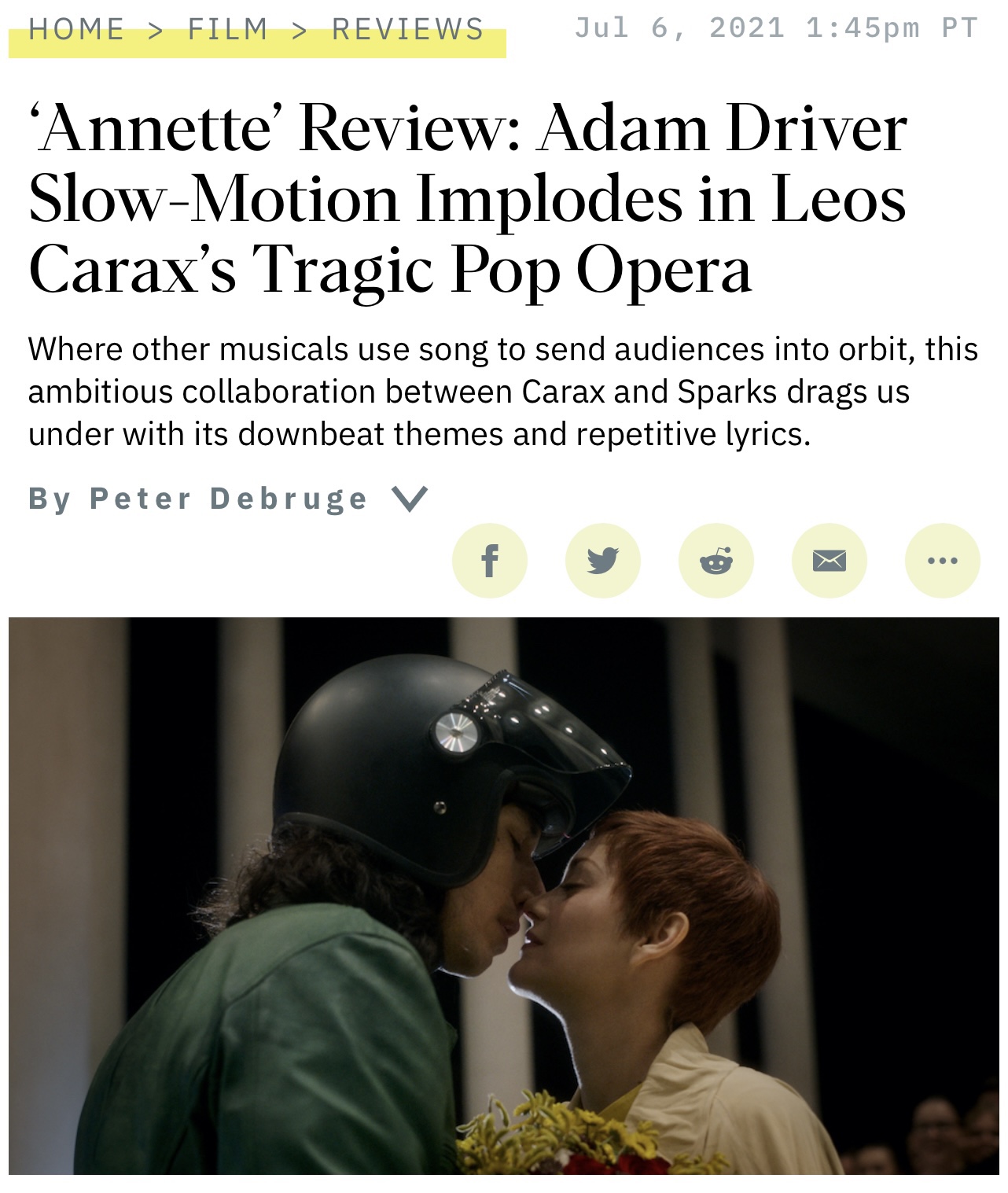
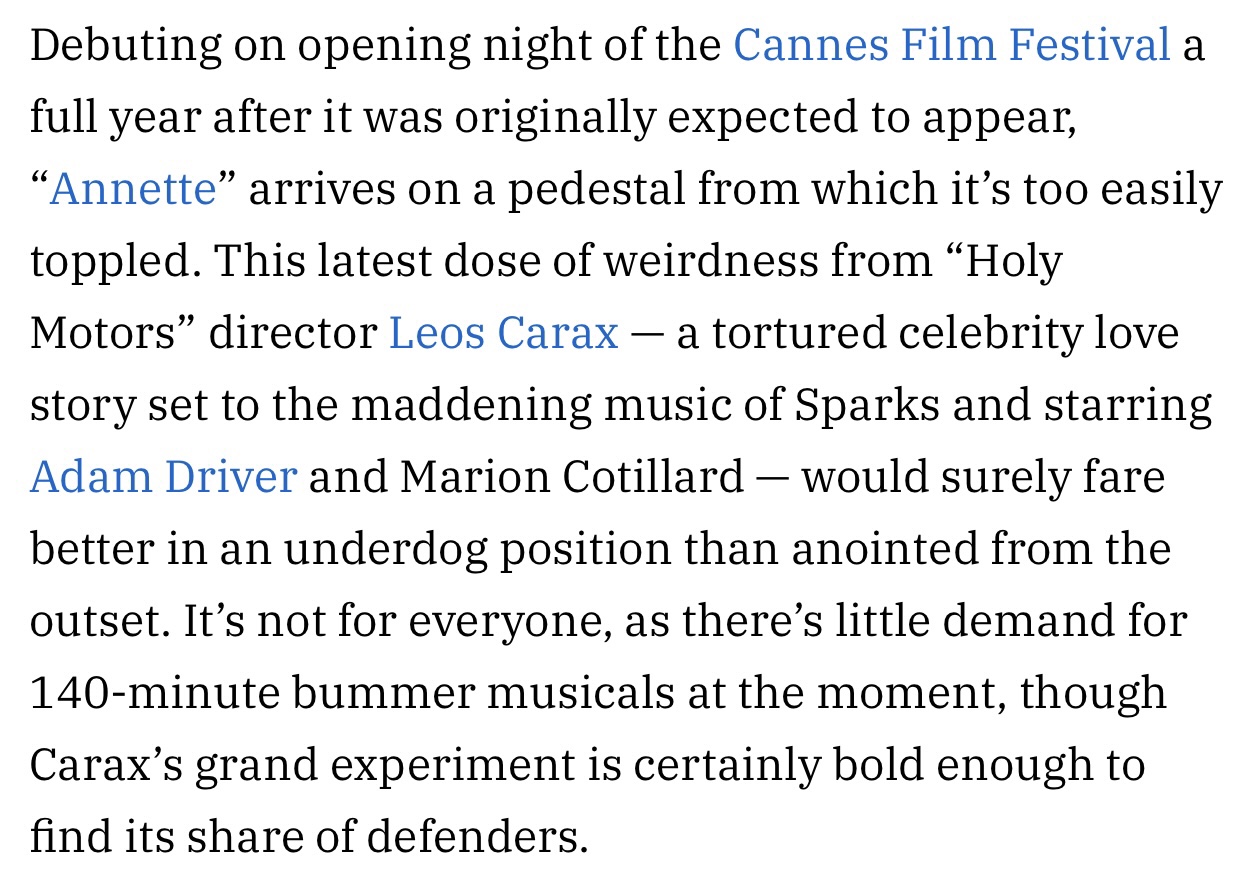
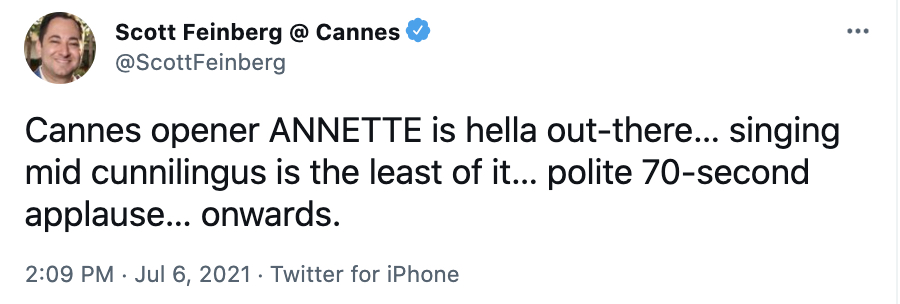
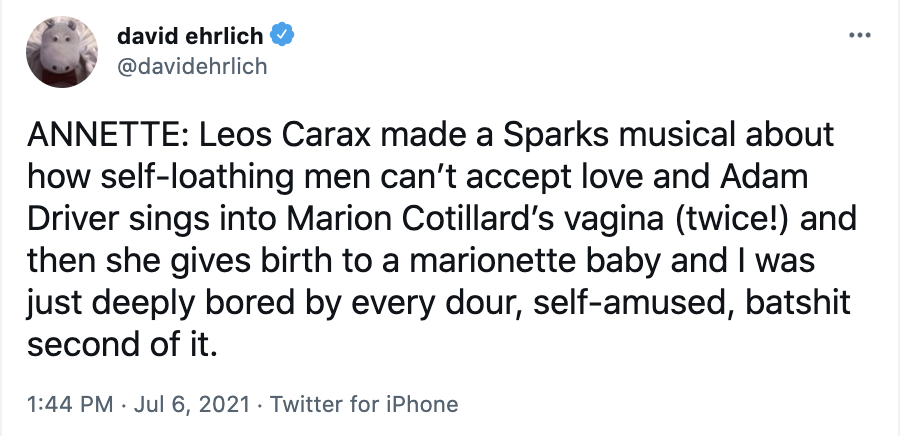
The word is out on Annette, and everyone has adjusted their expectations. Look at all those opening-nighters sitting standing right next to each other! Jodie Foster‘s fluent French is attractive.
Jodie Foster is intro’d at the Cannes opening ceremony, gets massive standing O, speaks fluently in French pic.twitter.com/Mq26NW5PKo
— Scott Feinberg @ Cannes (@ScottFeinberg) July 6, 2021
You’d think that movie distributors would want to mount garish billboards on the Carlton hotel’s facade, in keeping with decades upon decades of tradition. What is the Cannes Film Festival without vulgar signage along the Croisette? Except 2021 is a sleepy-ass year, and movie promos are few and far between.
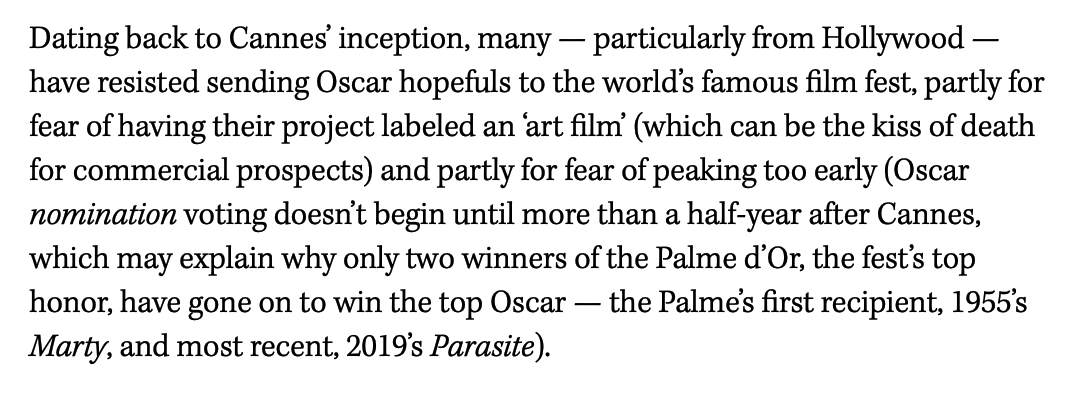
Wells to Feinberg: “You can’t just mention Palme d’Or winners Marty and Parasite in your opening paragraph and ignore No Country for Old Men, which launched in Cannes in May ‘07 and went on to win the Best Picture Oscar the following February or March. To hell with the Palme d’Or distinction — Cannes launched NCFOM and that’s what counts.
“In the 14 years since have award-season publicists and marketing strategists decided that Cannes is generally too risky (contrarian critics) and too early in the season, and that it isn’t worth the trouble and expense? Has a consensus emerged that award season launches at the major fall festivals make MUCH more sense? Yes.
“But you can’t ignore the No Country precedent. That was a very big deal at the time.”
Hugs and condolences for the family, friends, colleagues and fans of director Richard Donner, who was born on 4.24.30 and passed earlier today at age 91. Donner was no visionary auteur but an amiable, well-liked, good-guy journeyman — he behaved like a human being, always got the job done, kept his cool, smoked cigarettes, etc.
Hollywood Elsewhere is an unqualified fan of two things Donner directed — “Nightmare at 20,000 Feet,” the 1963 TwilightZone episode in which an airborne William Shatner grappled with the sight of a gremlin on the wing, and the original Lethal Weapon (’87), an anarchic, crazy-violent, occasionally funny cop thriller that helped launch a new idea in action films– i.e., the cop who was crazier than the criminals. (AngelHeart, which opened concurrent with LethalWeapon, advanced the same notion.)
Be honest — the first Lethal Weapon was the only decent one, and it represented the only time in Donner’s career when he was truly the king of the hill and totally on top of the zeitgiest curve.
I was mezzo mezzo on Superman — didn’t care for the scenes with fat, white-haired Marlon Brando, hated the Jeff East casting as young Chris Reeve, loathed the North Pole ice palace, etc. But I loved Gene Hackman and Ned Beatty‘s interplay (“Otisburg?”).
I’m sorry but I had problems with every other Donner-directed film — The Omen (silly, stupid, annoying), Superman II, The Toy, The Goonies, Ladyhawke, Scrooged, Lethal Weapon 2, Radio Flyer, Lethal Weapon 3, Maverick (a friend called it “a $75 milliondollarElvis Presleyfilm“), Assassins, Conspiracy Theory, Lethal Weapon 4, Tales from the Crypt: Ritual, Timeline, 16 Blocks.
Nobody cares about In The Heights any more, but if they did there’d be one more thing for wokesters to gripe about.
The last grenade thrown at Jon Chu and Lin-Manuel Miranda‘s musical (a mostly faithful adaptation of LMM’s 2005 stage musical) was the colorism thing — the film had ignored the presence of Afro-Latinos in Washington Heights and therefore was, after a fashion, guilty of a form of discrimination — i.e., colorism.
I never saw the stage play but a friend of Jordan Ruimy‘s did, and he reports that the film version “cut the plot line about Kevin Rosario, the Puerto Rican dad” — Jimmy Smits in the film — “not wanting his daughter Nina to date Benny” over an ethnic disparity issue. (In the film Nina and Benny are played by Leslie Grace and Corey Hawkins.)
A blunt way of explaining Kevin’s “ethnic disparity” problem is that he doesn’t want his daughter dating a guy who isn’t from their tribe and who doesn’t speak Spanish. A blunter way of putting it is that Kevin may have a problem with his daughter dating a black dude,.
“Nina and Benny spend the night together in Benny’s apartment as Kevin frantically searches for her all night; Benny worries about what Kevin will say about their relationship but is happy to finally be with her (‘Sunrise’). Nina eventually returns home to find her parents worried sick about her, and Kevin grows furious when he learns she was with Benny, disapproving of their relationship due to Benny not being Latino.”
A 6.10.21 Elle piece by Madison Feller discussed several differences between the stage and film versions. Feller didn’t mention Kevin’s problem with Benny in the stage version.
One of my all-time favorite jobs was working as a celebrity-spotter at Cannon Film premieres and after-parties. I had this responsibility was in late ’86 and ’87. I would rank it right below driving for Checker Cab in Boston. It was so easy and so satisfying. All I had to was stand at the door of film premieres and after-parties and make sure that no one of any importance was turned away.
No system is perfect, and every now and then a celebrity will show up uninvited or without a ticket, or with an entourage that he/she hadn’t mentioned when rsvping. I was there to make sure no famous or semi-famous person would ever receive a hard time.
When I was spotting I felt right in my element. I knew exactly how to play it. For I recognized everyone, every old-time actor whose time had passed, every supporting actor who wasn’t working much any more, every well-connected friend, every fringe player, every European actor who most Americans might not recognize, etc. And they all loved me for waving them through, and for knowing their names and their credits.
Remember actress Helena Kallianiotes (Five Easy Pieces, Kansas City Bomber), the vaguely butchy, Greek-born friend of Jack Nicholson‘s? In the mid to late ’80s she ran Helena’s, a super-exclusive celebrity supper club in the Silver Lake area. In October ’87 Helena attended the Barfly premiere with a friend, and for a few seconds the Cannon door girls were giving her shit. I swooped in like Prince Valiant. “It’s okay, she’s cool,” I told the girls. “Hi, Helena…come on in.”