One More “Risky” Thing

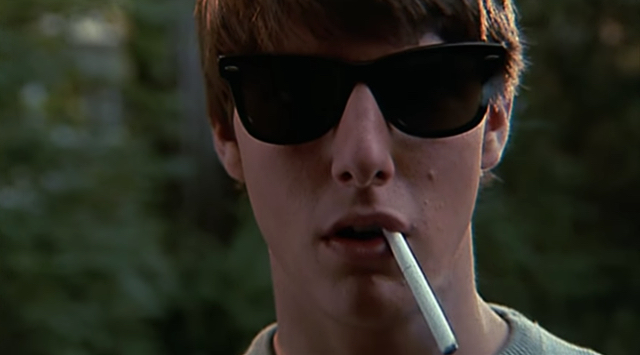
This frame capture explains all you need to know about how good Risky Business is, and how exceptional director Paul Brickman was.

19 out of 20 directors would have directed this scene like John Badham, the rote or good-enough way, and we would’ve simply been told/shown that some neighborhood kids are listening to a front-yard dispute between Joel Goodson (Tom Cruise), Guido the killer pimp (Joe Pantoliano) and a couple of tart-tongued prostitutes (Rebecca De Mornay, Shera Danese)…hah-hah! The kids would have just stood there, and maybe reacted in some kind of “holy shit, this is unusual!” way.

But Brickman told them to look studious and absorbed and perhaps even a little bored. And so the boy on the left is leaning against his bike, starting to tire from the effort of wondering who’s the more promising pimp, Joel or Guido? And the two little girls are watching with arms folded. This is the difference between average and brilliant filmmaking.

Liz Who?

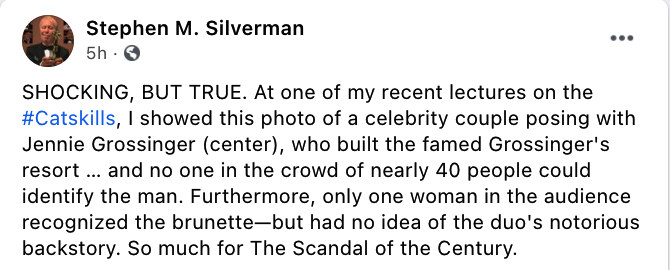
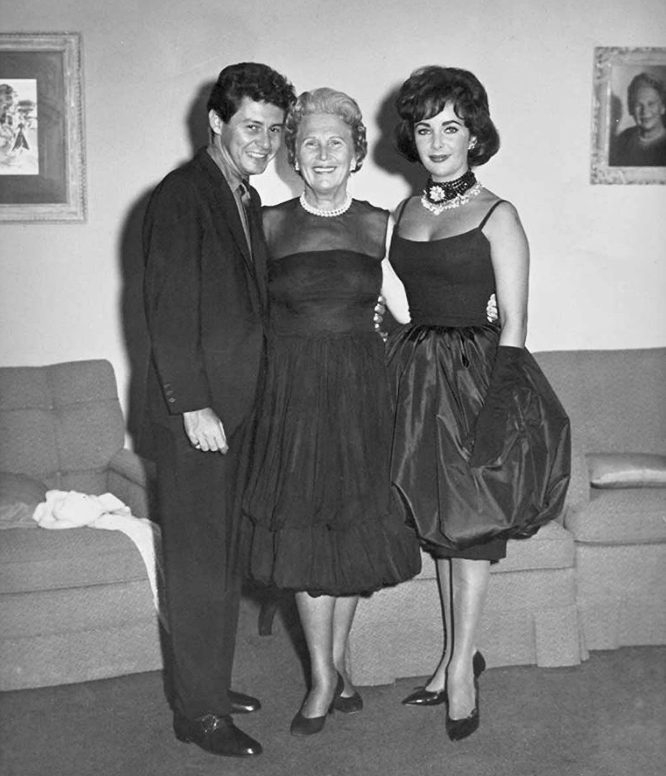
To be fair to the “nearly 40” students who hadn’t a clue, Elizabeth Taylor‘s career peaked between 1950 and ’51 (Father of the Bride, A Place in the Sun) and ’63 (Cleopatra). She’s remembered by older film buffs and the gay community, of course, but Joe and Jane Popcorn checked out at least a half-century ago, if not earlier.

Read more

Turning Wheel

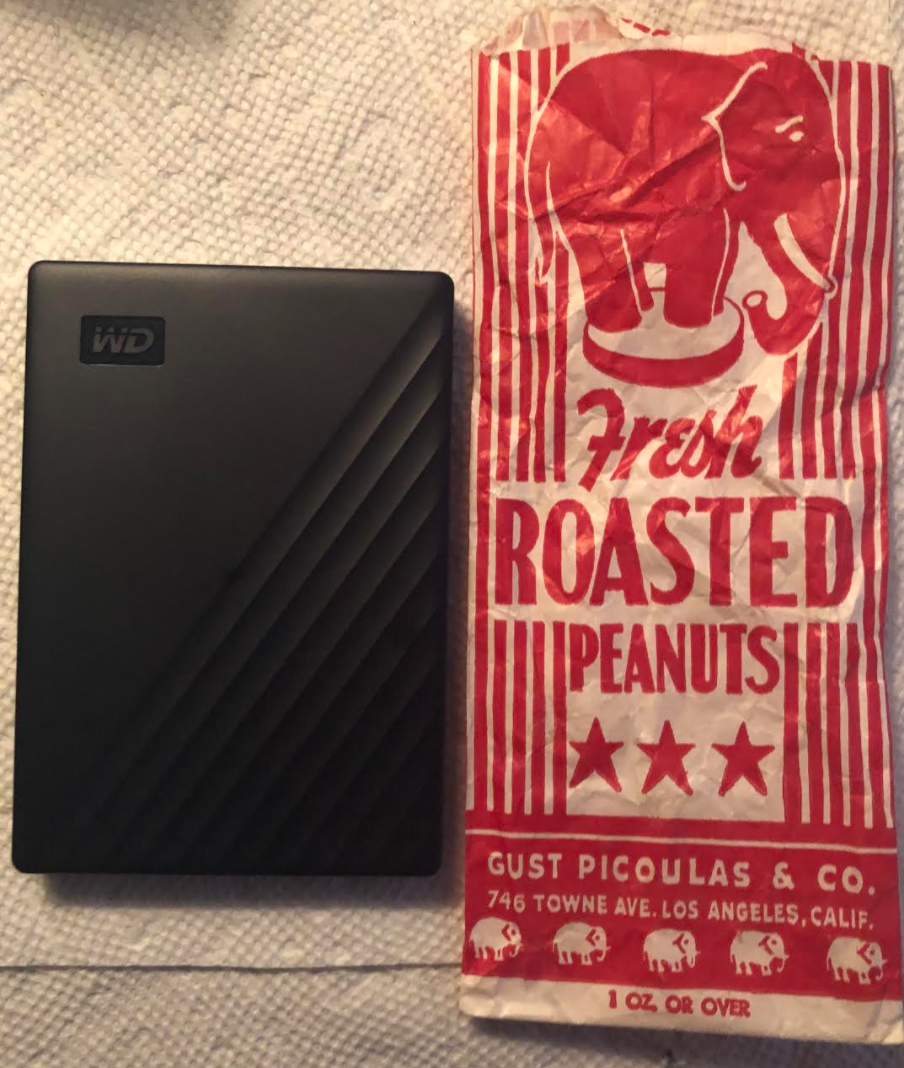
Apple’s Big Sur operating system came out six months ago, but I only got around to installing it on my 15″ Macbook Pro (500G storage, 8GB memory) two or three days ago. Except the installation stalled or got gummed up, so I had to run down to Best Buy for a 2 terabyte Western Digital external hard drive. I loaded the entire contents of the Mac onto the WD, wiped the Mac clean and re-installed everything — now it’s all good.

I haven’t owned an external hard drive since ’08. It only held 500G, weighed a couple of pounds and needed a wall plug-in for power. The WD is (a) powered by the laptop, (b) only a little bit bigger than a playing card and (c) barely weighs anything.

Another “Midnight Cowboy” Doc?

Earlier today Variety‘s Brent Lang announced a new documentary about the making of Midnight Cowboy, based on Glenn Frankel’s “Shooting Midnight Cowboy: Art, Sex, Loneliness, Liberation and the Making of a Dark Classic.”

The rights were acquired by Nancy Buirski (The Rape of Recy Taylor, The Loving Story) through her documentary production company, Augusta Films. Buirski will direct.

May I ask a question? Why another doc about the making of this 1969 classic? There are at least two or three docs on YouTube that cover it pretty well. (Not to mention a couple of visual essays on the Criterion Bluray.) It’s not going to hurt to watch Buirski’s film, but I’d rather see a making-of doc about something less well-worn.

Oh, and please remember not to buy the Criterion Cowboy — it’s a flat-out desecration.

Read more

STFU…Please

Nearly two years will have have elapsed between the start of principal photography on John Krasinksi‘s A Quiet Place Part II, which began shooting in June 2019, and the 5.28.21 opening. I was a fan of the original A Quiet Place, which opened on 4.6.18 — roughly a year before the pandemic began.

I really don’t like that gurgly-gurgly monster sound at the end of this trailer. It sounds too much like the gurgly-gurgly that I heard in 2011’s Cowboys and Aliens.

Eureka — A Quiet Place Metaphor“, posted on 2.20.20:

The only thing that didn’t quite work about John Krasinki‘s A Quiet Place (’18) is that I could never detect a social metaphor. The horror, it seemed, was totally situational in a random-ass way. Don’t make a sound or the big brown alien monsters will rush in and murder you whambam. Okay, fine, but what’s the real-life echo?

Howard Hawks and Christian Nyby‘s The Thing was about early ’50s paranoia over invaders from the sky, be they Russians or flying saucers. Don Siegel‘s Invasion of the Body Snatchers was about submitting to the blandness of the Eisenhower years…the mid ’50s conformity of the suburbs. George Romero‘s Night of the Living Dead was about a sick society grappling with evil histories and buried behaviors — dead bodies walking the earth in order to wreak vengeance. Rosemary’s Baby was…I’m not sure but it had something to do with that 4.8.66 Time magazine cover that asked “Is God Dead?” Jennifer Kent‘s The Babadook was some kind of metaphor about car crashes and dead husbands and the terror of facing parenthood alone.

But what was A Quiet Place about?

Read more

What’s The Black Superman Backstory?

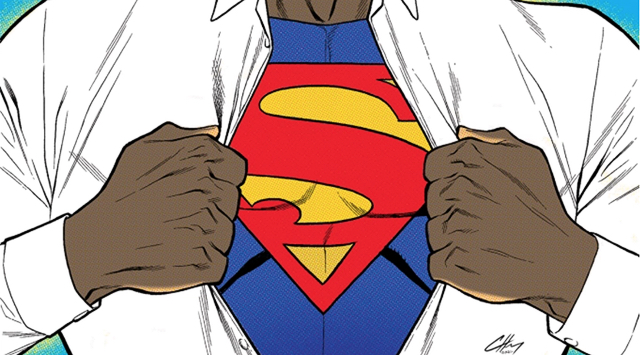
I wasn’t paying attention when it was reported on 2.26.21 that Warner Bros. and DC had hired Ta-Nehisi Coates to write the screenplay for a Black Superman flick to be produced by J.J. Abrams.

Earlier today THR‘s Tatiana Siegel and Borys Kit reported that everyone is committed to hiring a Black director…natch.

The idea, of course, is to fill the mythical-superhero void left by the passing of Black Panther star Chadwick Boseman. But Coates still has to come up with some kind of semi-plausible plot that will link up with the traditional Superman saga…right? The classic Superman tale and D.C. legacy would have to be incorporated to some extent.

Assumption #1: If Black Superman will possess the same kind of superpowers that all the previous Supermans had going back to Kirk Alyn and George Reeves, he has to be from a Krypton-like planet…right? Or from Krypton itself. If the latter, Black Superman would have to be yet another survivor who escaped the planet before it self-destructed. Coates would have to explain that Krypton was always a biracial society, etc.

HE idea: The obvious strategy (one that would totally ring Quentin Tarantino‘s bell) would be to follow the Wonder Woman time-travel template and set Black Superman somewhere in the pre-Civil War Antebellum South. Have an infant Black Superman arrive on planet earth in the year 1852, encased in a special vacuum-sealed, oxygen-supplied cylinder that slides into a cotton plantation somewhere in the heart of the Confederacy. Or in 1862 with the war going on. Or he arrives as a 20something with his powers fully developed. Either way the story writes itself.

Hollywood Reporter illustration by Clayton Henry.

Fleeting Glimpse

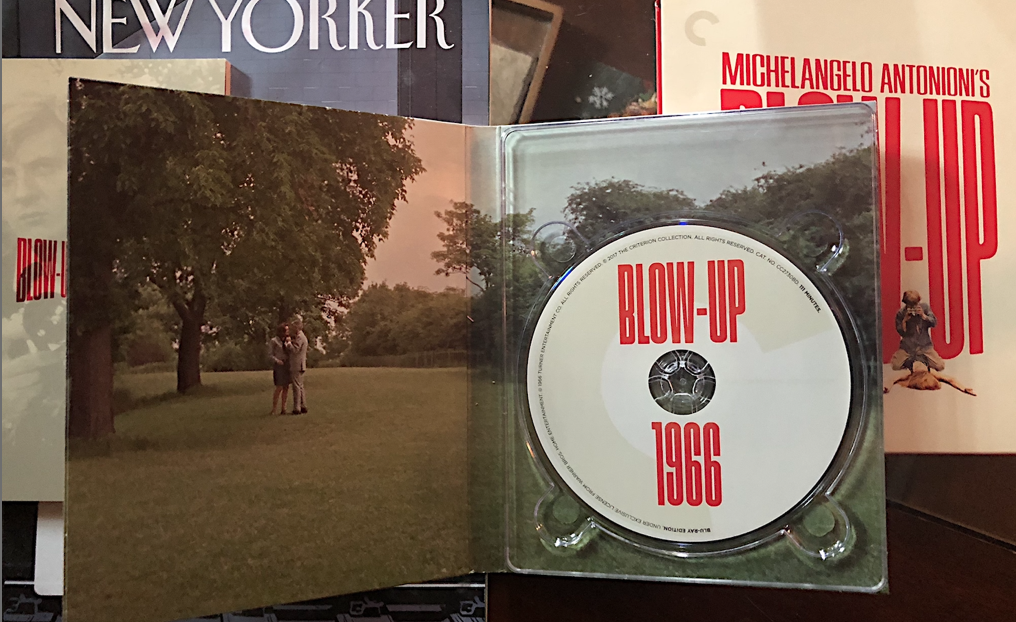
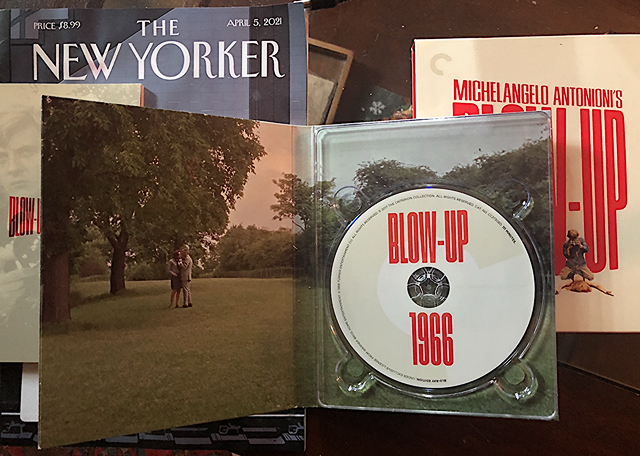
In basic plot-strategy terms, Michelangelo Antonioni‘s Blow-Up (’66) kicks off in a London public park (Maryon Park in Charlton) when a youngish fashion photographer (David Hemmings) happens to take several snaps of an amorous May-December couple (Vanessa Redgrave, Ronan O’Casey).

As he develops the photos in his dark room later that day he realizes that the images show a murder in progress — one of the blow-ups reveals an assassin holding a pistol, and another a fuzzy image of the dead O’Casey lying on the grass.

Blow-Up isn’t a thriller, of course — it’s a meditation about reality vs. perception vs. artistic fancy as well as a brilliant capturing of 1966 avant-garde London, so the focus is about much more than just the ins and outs of a murder. But Hemmings encountering Redgrave-O’Casey is the inciting incident, and I’ve always adored the first glimpse of that swoony couple in a lazy-day mood.

Any other director would have called special attention to Redgrave-O’Casey…capturing them with a steady centered shot, perhaps starting from a distance and then cutting to an MCU, in effect telling the audience “you’ll want to pay attention to these people…something is about to happen.”

Instead Antonioni and dp Carlo Di Palma show Hemmings scampering around the grass while shooting some pigeons, and then the camera pans up and to the left, and as it’s moving north it catches the briefest glimpse — exactly one second’s worth — of the couple. (Go to the :31 mark.) The first-time viewer doesn’t even notice them, much less consider that they might be key players.

This is one of the 40 or 50 things that I dearly love about this film, and why I own the Criterion Bluray version. The first thing that grabbed me way back was the sound of wind rustling the park bushes and tree branches as Hemmings snaps away. So much going on and not a line of dialogue or a note of music…just the breezes.

Read more

Voice Is Too Mannish

I’m sorry but I kind of expected Caitlin Jenner to sound more like…I don’t know, more like Anne Bancroft or Rosalind Russell or Joan Crawford. Somewhere in that realm. I’m not saying there’s anything “wrong” with sounding like a dude, but it goes against the rest of what she’s putting out.

Jenner: “Here’s my crazy thinking. We are now spending billions of dollars on this high-speed rail, okay, and they talk about it all the time, between LA and San Francisco. And I’m going, ‘Why are we doing that? I can get on a plane at LAX, and I’ll be in San Francisco in 50 minutes. Why do we need high-speed rail?'”

Four Daggers

Blunt critiques hurt when you’re young, and they tend to stay with you for years or even decades. By the same token kind or admiring or supportive remarks directed at a ten-year-old or a kid in his mid teens or even a twentysomething probably stick to the ribs also. Then again I didn’t get too many of those. I mainly recall four moments in my teens (actually three — the first happened when I was 10 or 11) when somebody said something cruel or dismissive, and how they really stung.

Stab #1: I was Halloweening in my neighborhood, and was actually too old for it (10 or 11, like I said) but I had a sweet tooth. I had grown a lot recently — 5’9″ or thereabouts. Awkward spurt. And I had some kind of grotesque mask on. And the father at one of the homes answered the door and said, “I bet that’s Jeff Wells behind that mask…I can tell because of the big feet. Jeez, look at those shovels.” So I was a freak of some kind. That was the moment in my life when I resolved to wear only slender Italian shoes. Because they don’t make your feet look any bigger than they are. (And mine aren’t that large — I’m a size 12 and 1/2.)

Stab #2: I was 14 or 15 and hanging with a bunch of junior high school guys in a friend’s home, and at one point or another I smiled a little awkwardly and a guy sitting nearby cast a glance and jokingly said “handsome.” As in “not handsome.” As in homely or doofusy. I remember the feeling in my chest when he said that, and how it took me years to recover from an idea that I was second- or third-tier in the looks department. I gradually got past that, but not until my mid 20s.

Stab #3: I was sitting at a metal dining table in a backyard patio with good friend Jack (it was his father’s home, a big brick mansion on a hilltop) and Bill. And then Jack’s dentist father came out and sat down with us. The discussion turned to high school and grades and colleges and whatnot (we were juniors), and Jack’s dad was the blunt type…”you don’t have to like it but I’m telling you how it is” or “if you don’t wake up and get your shit together you’re gonna be in trouble.” Then the subject turned to character, and Jack’s dad dismissed us all with one fell swoop. He looked at Jack and said “you’re a washout”, and then pointed at me — “And you’re a washout” — and then said the same thing to Bill. And that no-holds-barred verdict stayed with me for a good decade or so. I already had the son-of-an-alcoholic, low-self-esteem thing going on, and so the washout label fit right in.

Stab #4: I was in the earnestly shabby office of a fledgling weekly newspaper, and I had submitted a clumsily written piece about John Lennon (I forget the angle) and the quality of various articles were being assessed, and somebody mentioned the Lennon piece and one of the editors — glasses, frizzy-haired, flinty manner — said what he thought without knowing that the author was sitting right next to him. “Oh, it’s terrible,” he said. “It’s all over the place…it’s just crap.” Talk about the sensation of a knife right through your lungs. It hurt so much I stopped thinking about writing. Anything to avoid that awful feeling again. But the memory of that stabbing prompted me to try harder when I started writing about movies in the mid ’70s, and I eventually got the hang of it by ’80 or so. At least to the point that I could write decently.

That which does not kill you [usually] makes you stronger.

Beautiful Day

Every now and then the sun is out, the sky is bright blue and the warmish air smells fresh and relatively clean. (By Los Angeles standards.) And the whole outdoor realm just feels…perfect. And I’m one of those many millions who, when such a day is upon us, too often doesn’t stop and smell the roses. But I did today.

For about 15 seconds. Okay, ten. Right before I entered the West Hollywood Library for the first time in over 14 months, and it was wonderful…wonderful to offer my card, talk quietly to the clerks, plug in at a work table and just settle in. Library writing tends to focus me a bit more; too many distractions at home (food, cats, TV, vacuum cleaner, bathroom mirror).

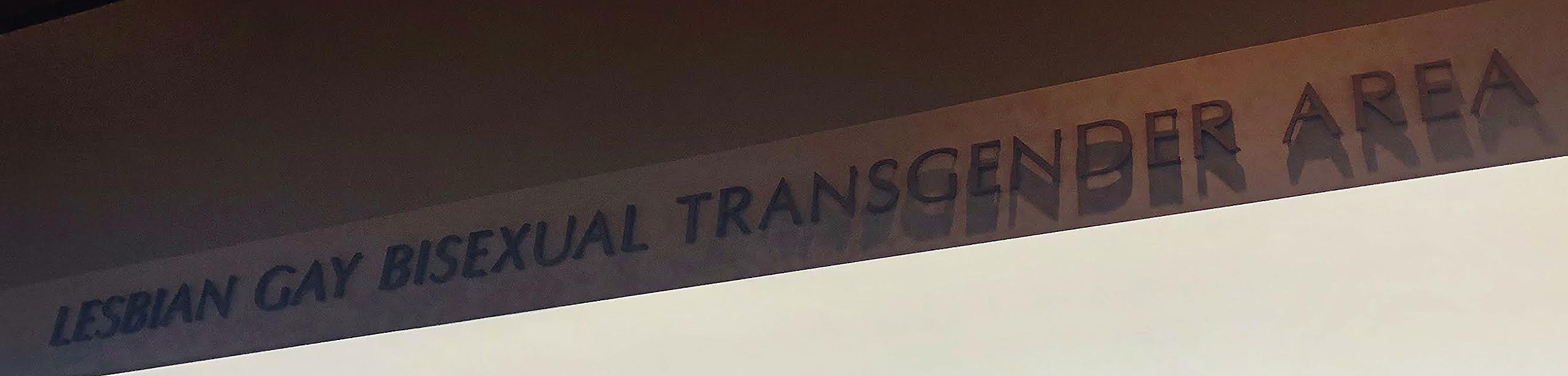
I chose a table away from the main desk, back in the rear section. It took me 15 or 20 minutes to notice I was in an area that was specially reserved for LGBT visitors. (“Lesbian Gay Bisexual Transgender Area.”) I suddenly felt like an interloper. A youngish, dark-haired woman was sitting at the other end of the table; had she noticed that I don’t look particularly gay and that I might want to think about sitting elsewhere, just to be on the polite side? She probably didn’t care.

I was also kinda wondering what the reaction might be if the WeHo library had decided that another section of the library was to be officially designated or set aside as an area where straights and cisgenders were encouraged to congregate.


View from north-facing window of WeHo Library — Wednesday, 5.5.21, 2:15 pm.