Forgot To Mention This

Last weekend I posted a pick-up piece that was based upon a 4.23 piece by Vulcan Reporter containing what I’m told was mistaken reporting.

The article ended with the following: “While Warner Bros is not abandoning home video media completely, the amount of Warner Bros films and shows that will be getting physical media releases will be going down as the idea is to develop more interest in HBO Max.”

A knowledgable source says that the story was based upon “an improper or misunderstood comment from Jerry Beck to someone who had left their fact checker in their sock drawer.

“No one from Warner Archive said anything. [Beck] knew some release info that was not to be discussed, and mentioned it in an interview. That info was taken totally out of context, and then put in an article by a journalist without a clue.

“The studio isn’t the problem. The pick-up piece you ran on 4.24 was neither true nor accurate.”

Read more

Zinnemann’s Unheralded “Hang” Film

If you have a liking for “hang-out” films, consider a view that Fred Zinnemann‘s The Sundowners (’60), which isn’t even available via HD streaming, is one of the better ones.

Nicely shot by Jack Hildyard (The Bridge on the River Kwai) and running 141 minutes, it’s about a family of itinerant Australian sheep drovers (Robert Mitchum, Deborah Kerr, Peter Ustinov, Michael Anderson, Jr.) driving a large herd to market.

It’s a hang-out film because it’s leisurely, laid-back and pretty much plotless — it just ambles along from one episode to another. Okay, there’s a third-act focus on possibly buying a home and settling down, but there’s never much urgency about this.

In hang-out films dramatic conflicts, second-act pivots and third-act crescendos barely poke through and are otherwise subordinate to the ebb and flow of relationships between the main characters. A focus on mood, flavor, attitude and atmosphere (be it laid-back or existential).

In the latter sense you could almost call Michelangelo Antonioni‘s L’Avventura (’60), L’Eclisse (’62) and La Notte (’63) hang-out films.

One of my personal faves is Jim Jarmusch‘s Only Lovers Left Alive — actually half of a hang-out film and half of a “distressed bohemian” interior-design trip.

In 2014 Quentin Tarantino was quoted saying that Howard HawksRio Bravo (’59) was his favorite hang-out movie.

Five years later his own Once Upon A Time in Hollywood mirrored Rio Bravo‘s aesthetic.

Read more

“Canterbury Glass” Metaphor

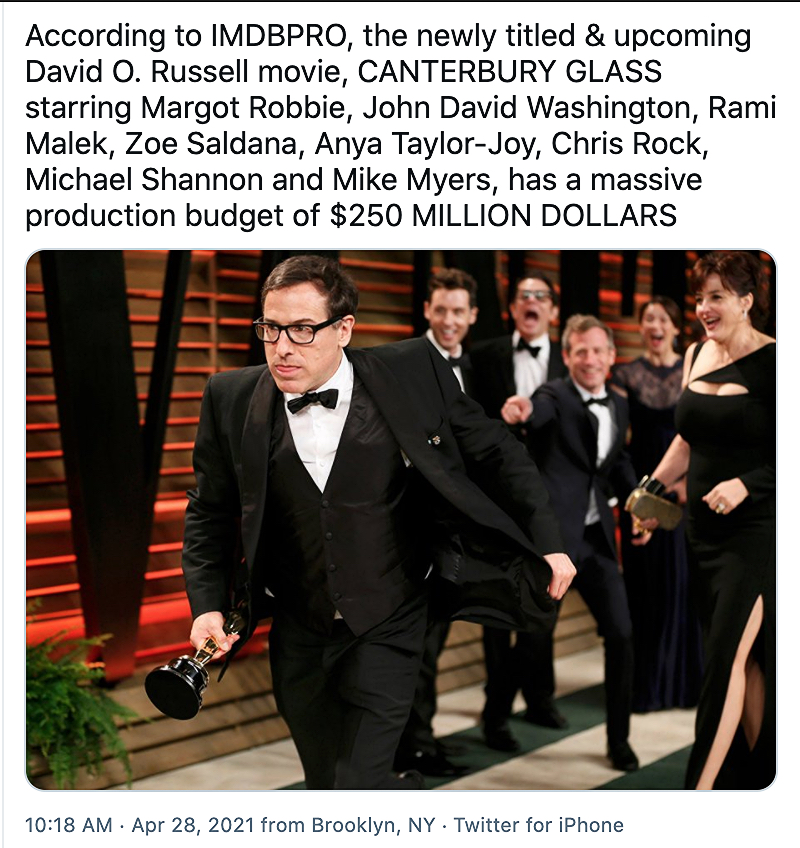
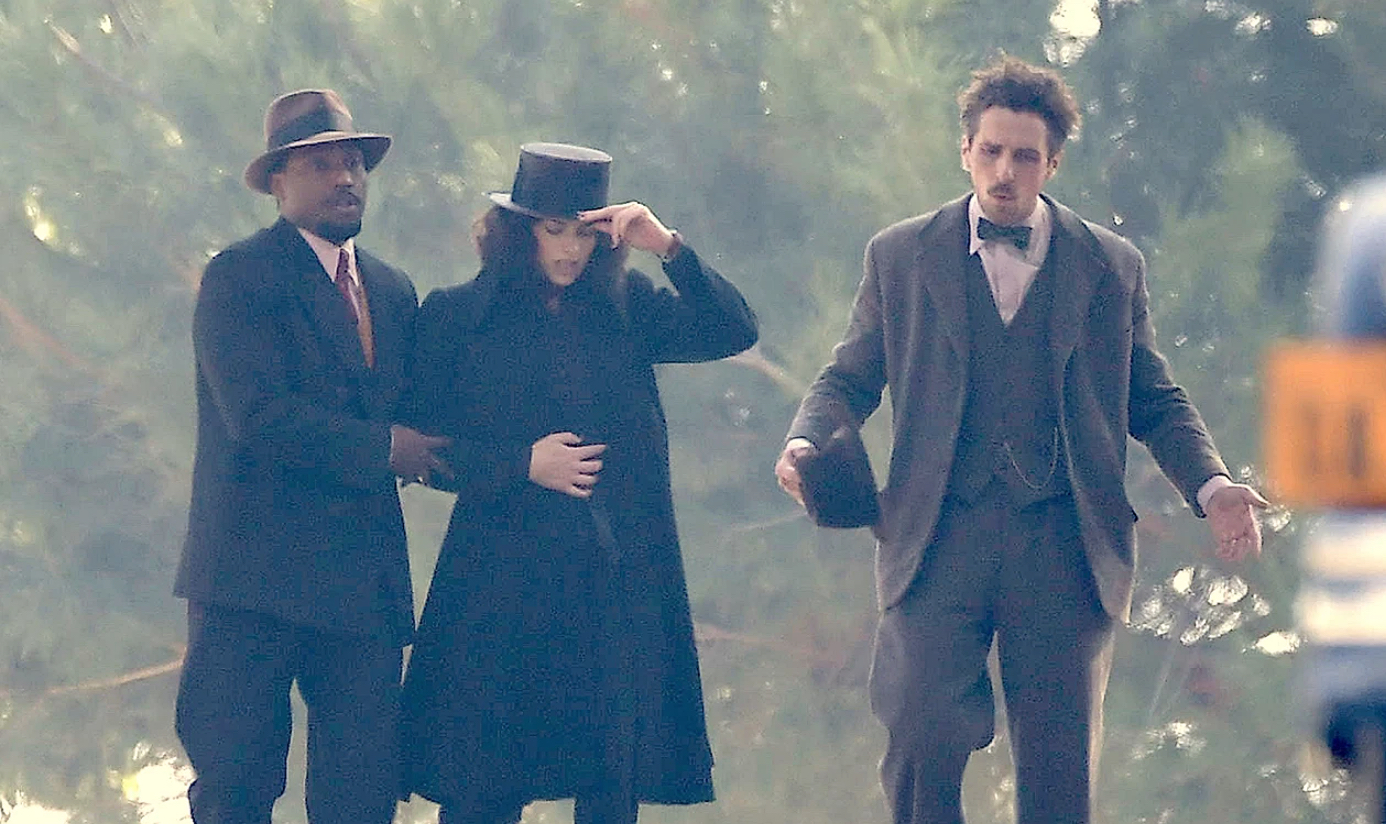
The 1930s-era film that David O. Russell has been shooting since early this year and which stars Christian Bale, Margot Robbie and John David Washington (and costars Rami Malek, Zoe Saldana, Robert De Niro, Mike Myers, Timothy Olyphant, Michael Shannon, Chris Rock, Anya Taylor-Joy. Andrea Riseborough, Matthias Schoenaerts and Alessandro Nivola) allegedly has a firm title — Canterbury Glass.

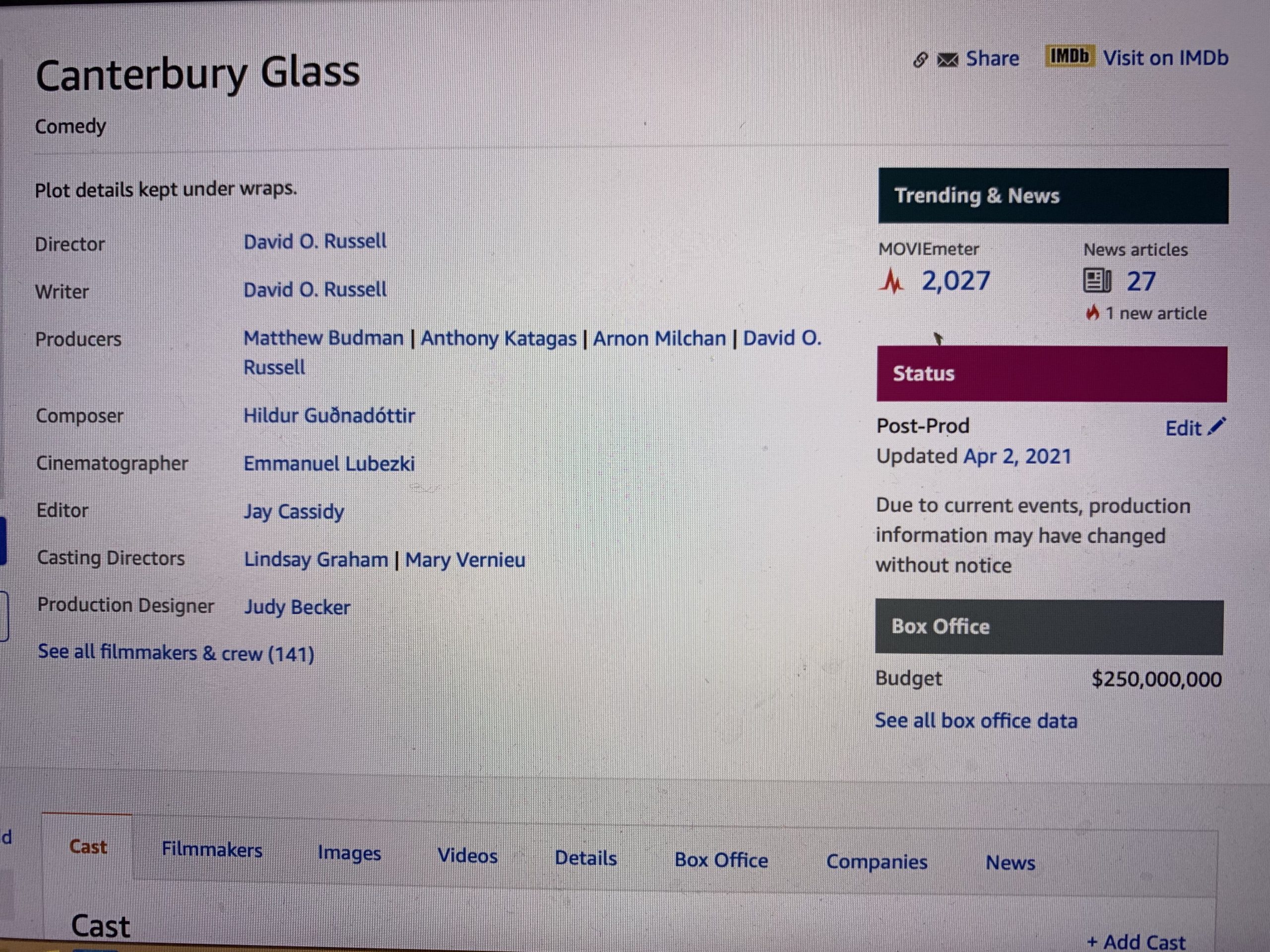
I don’t believe it — a $250 million period ensemble piece (“a doctor and a lawyer form an unlikely partnership”) with a title that sounds like a high-toned PBS historical drama or documentary?

In their man-on-the-street geography quiz interviews Jay Leno and Jimmy Kimmel have shown that average Millennials and Zoomers are cretins when it comes to identifying continents and countries, much less regions and cities, and that maybe 1 out 500 might know that the title refers to the medieval stained glass windows (between 800 and 900 years old) in Canterbury Cathedral, and that the allusion is to something aged, fragile and extremely valuable.

With a notoriously uneducated and incurious populace, presenting a super-expensive caper film titled Canterbury Glass is like saying “we know you guys don’t know or care what the title means and we don’t care if you do or don’t…we’re calling it this in order to goad and confound you, and to make sure you understand that the people who made this film live in their own aesthetic and cultural membrane, and that they’d rather please themselves than reach out to you with a title that adds up in a way you might understand or relate to.”

IMDB Pro page capture:

Ferguson on “Kane”

In May 1941, the great Otis Ferguson was half-and-half on Citizen Kane — down on his knees for the genius-level landmark stuff (especially Gregg Toland‘s cinematography) but irked by “talk and more talk,’ or what he regarded as such.

Ferguson excerpt: “I believe we can look at the picture, and of course have been told to wait for that. The picture. The new art. The camera unbound. The picture is very exciting to anyone who gets excited about how things can be done in the movies; and the many places where it takes off like the Wright brothers should be credited to Welles first and his cameraman second (Herman J. Mankiewicz as writing collaborator should come in too).

“The Kubla Khan setting, the electioneering stage, the end of the rough-cut in the Marsh of Thyme projection room, the kid outside the window in the legacy scene, the opera stage, the dramatics of the review copy on opening night…the whole idea of a man in these attitudes must be credited to Welles himself.

“And in these things there is no doubt the picture is dramatic. But what goes on between the dramatic high points, the story? No. What goes on is talk and more talk. And while the stage may stand for this, the movies don’t. And where a cameraman like Gregg Toland can be every sort of help to a director, in showing him what will pick up, in getting this effect or that, in achieving some lifting trick the guy has thought up, the cameraman still can’t teach him how shoot and cut a picture, even if he knows how himself. It is a thing that takes years and practice to learn.

“And its main problem always is story, story, story — or, How can we do it to them so they don’t know beforehand that it’s being done? Low-key photography won’t help, except in the case of critics. Crane shots and pan shots, funny angles like showing the guy as though you were lying down at his feet, or moving in over him on the wings of an angel, won’t help. Partial lighting won’t help, or even blacking out a face or figure won’t help, though it may keep people puzzled. Tricks and symbols never really [amount] to much.

Read more

Woody’s Glorious “Shane” Moment

A reposting of a 7.30.18 recollection of HE’s “Great Woody Allen Comes To The Rescue of Shane” episode, which happened in early to mid April of 2013:

Five and one-third years ago Woody Allen saved George StevensShane from an aspect-ratio slicing that would have rocked the classic cinema universe and resulted in a great hue and cry from the Movie Godz. When all is said and done and the Chalamets of the world have all been put to bed, this is one of the events that will burnish and solidify Allen’s legacy.

On 3.16.13 I revealed that George Stevens, Jr. and Warner Home Entertaiment restoration guy Ned Price were intending to release a Bluray of the classic 1953 western using a 1.66:1 aspect ratio, which would have cleavered the tops and bottoms of the original 1.37 photography by dp Loyal Griggs. I howled and screamed in my usual way, but nothing seemed to change until Allen, the only top-dog, world-class director to step into this fray, shared his opinion on 4.4.13.

On 3.29 I appealed for help from Martin Scorsese in an open letter. On 4.4 I posted the Allen letter. 13 days later Joseph McBride’s letter to Stevens, Jr., deploring WHE’s intention to present the film within a 1.66 a.r., was posted.

Later that day Price threw in the towel and announced that WHE’s Shane Bluray would be released in the original 1.37 aspect ratio. I’ve long believed that Allen’s opinion was the crucial factor in rectifying this situation.

Read more

What If I Just Re-Watch “Perfect”?

…and take a nice friendly pass on Physical, a half-hour Apple series set to debut on 6.18? It’s apparently just another self-empowerment saga aimed at women of a certain age, set in the ’80s and starring Rose Byrne, etc.

I’m only saying that the trailer for Perfect (’85) persuades that despite being one of James Bridges‘ lesser efforts, it’s clearly a smarter, sharper, more handsomely produced A-level film than Physical ever dreamt of being. Obviously — you can tell immediately.

(A year earlier Bridges’ Mike’s Murder, a Los Angeles-based love story-slash-drug murder film with a lead performance from Debra Winger that becomes more poignant every time I re-watch it, received a bungled, half-hearted release from Warner Bros.)

I saw Perfect once 36 years ago, and I don’t recall anyone gasping or doing handstands or backflips. I shrugged it off, never gave it a second think. But I’d much rather sit through it again than watch Byrne reinvent herself as a celebrity gymnast while working out to “Video Killed The Radio Star.”

Read more

Breaks My Heart Into Pieces

…that the odds of this kind of emotionally galvanizing moment at the Oscars are not only dropping by the day but (be honest) will probably happen more and more infrequently if at all, in part because the ranks of charismatic home-run “brand” hitters like Jack Nicholson are thinning out. Will you listen to that crowd and feel those vibes? Will you consider that skipping across the stage? It didn’t seem like some stupendous emotional moment when it happened 23 years ago, but post-Soderbergh death knell it sure feels like one now.

Rip Me Off At The Ball Game

I haven’t been to a Dodgers game since the late ’90s. I was thinking last weekend about going again. (Tatiana’s never seen a baseball game.) Maybe the Dodgers vs. the Mariners on Tuesday, 5.11. But I can’t do the nosebleed section. I don’t have to sit along the baselines or behind home plate, but I have to be able to smell the grass and the dirt…aromas (including the hot dogs and those big plastic cups of beer) are everything to me.

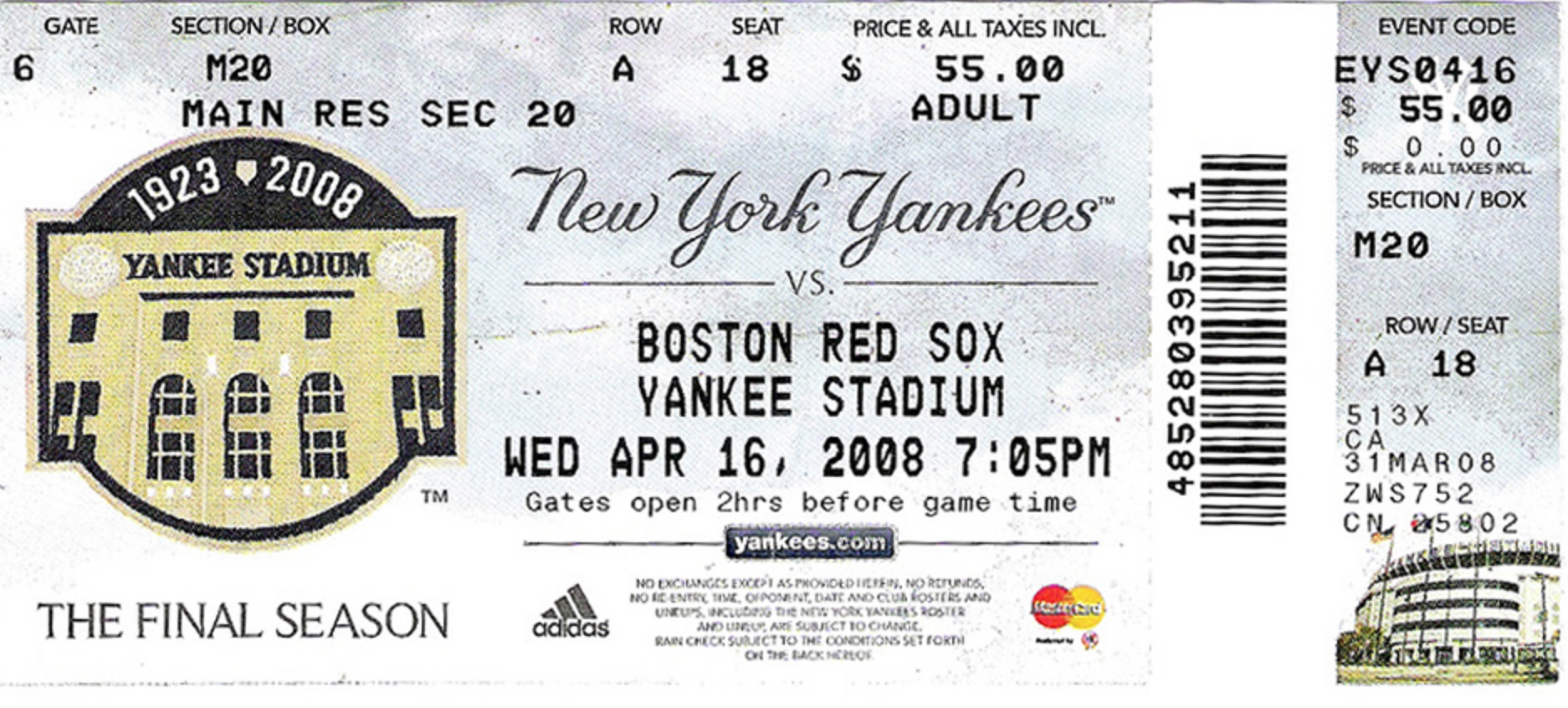
So I checked with seatgeek.com and Jumpin’ Jeezus! $197 to $232 each or $400 to $460 a pair! These are Covid prices — the teams have to charge more, I’m told, because fewer seats are being sold due to safe spacing — but still.

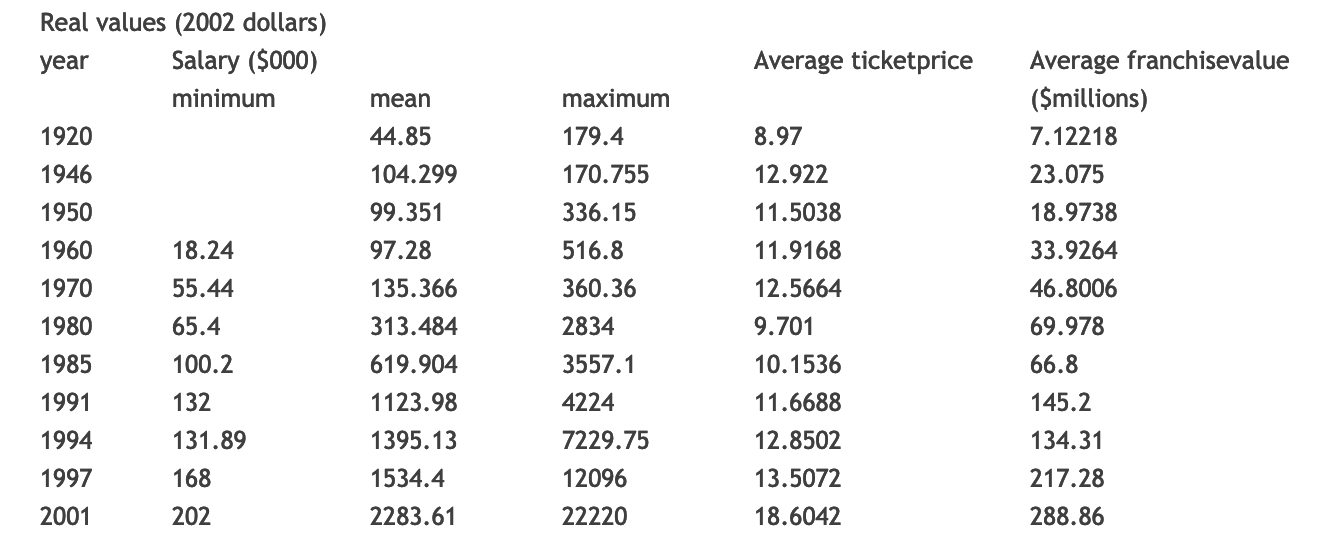
A 2002 ticket-price graph (converted to ’02 dollars) says that the average 1920 ballgame ticket cost around $9 (in ’02 dollars). By 1950 the average price was $11.50 (again, in ’02 dollars). In 1985 the average price was $10.15. In 2001 the average ducat cost $18.60.

In May 2016 I bought three tickets to a Mets-Giants game for $230 (Jett, Cait and myself). The weather was so horrific we didn’t go.

I asked Jett what he’s recently paid for a New York-area game. “I pay like $150 for really shitty NY Giants tickets,” he replied. “It varies from game to game, section to section. It costs $38 for nosebleeds to see the Reds @ the Dodgers.”

Raw Deal

I’m sorry but Oslo (HBO, 5.29), J. T. Rogers and Bartlett Sher‘s film (originally a 2016 play) about the backchannel process that led to the Oslo Peace Accords of ’93 and ’95 strikes me as Israeli propaganda, or not much more than that.

However welcome and applauded they may have been 26 and 28 years ago, the Oslo Accords were an incremental step in a long process that has steadily been about Palestinian disenfranchisement, oppression, humiliation and generally getting the shit end of the stick.

The Oslo Accords ratified a peace agreement between Israelis and Palestinians, founded upon recognition by the Palestine Liberation Organization of the State of Israel (as in “the right to exist”) and a recognition by Israel of the PLO as the representative of the Palestinian people (“self-rule”) and as a partner in negotiations, etc.

The Oslo process was significant in its day, but since then there has been a steady encroachment and usurpation of Palestinian West Bank territory by Israeli settlers and the Israeli military, and the Palestinian pie slices have gotten thinner and thinner.

In 1975 U.N. resolution 3379 declared that Zionism was “a form of racism,” and even though 3379 was renounced in ’91, the ’75 resolution stands as a historical statement of widely-shared opinion.

Today Israel controls well over 60% of the West Bank, and Palestinian economic development has been stymied and/or obstructed. Please watch “Israeli settlements, explained | Settlements Part I,” a 2016 Vox report.

There Must Be A Reason…

I’ve just watched these two scenes from Brian DePalma‘s Carlito’s Way (’93), and they seemed fresh as a daisy. Here’s the reason: I have excellent recall of the films I like and therefore want to recall. I’ve therefore remembered almost nothing about Carlito’s Way. I didn’t hate it, mind — I was “meh.”

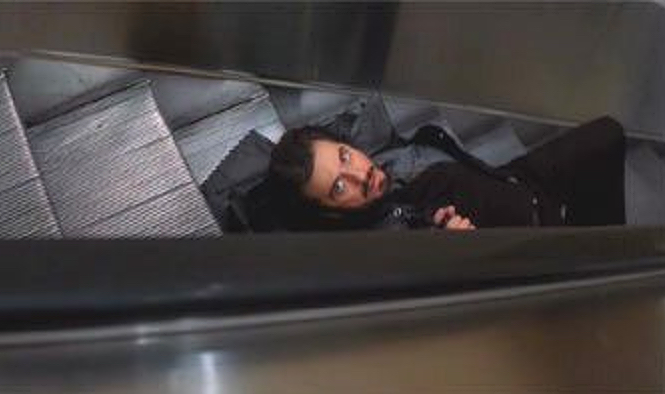
I’ve seen it exactly once, and I remember two things about it — (a) Sean Penn‘s light brown frizzy Jewfro (i.e., Alan Dershowitz) and (b) Al Pacino hiding from the bad guys on an going-down escalator by lying down on a going-up parallel escalator.

From “De Palma Getting Gold-Watch Treatment,” posted on 9.10.15: “DePalma was a truly exciting, must-watch director from the late ’60s to mid ’70s (Greetings to The Phantom of the Paradise to Carrie), and an exasperating, occasionally intriguing director from the late ’70s to mid ’90s (Dressed To Kill, Scarface, The Untouchables, Carlito’s Way, Mission: Impossible, Snake Eyes).

“De Palma is one of the most committed and relentless enemies of logic of all time. For a great director he has an astonishing allegiance to nonsensical plotting and dialogue that would choke a horse. I tried to re-watch Blow Out last year — I couldn’t stand it, turned it off. The Fury drove me crazy when I first saw it, although I love the ending. I found much of Dressed To Kill bothersome when it first came out 35 years ago, and to be honest I haven’t watched it since.”

There’s No Beating It

I have to be myself — the sum total of genes and upbringing and opportunities missed and seized, the small percentage of movies I’ve seen (hundreds as opposed to thousands) that are truly bracing or soul-soothing or a combination of both, fortunate good health (genes again), a flood of cultural and political (not to mention sensual, sexual, musical and spiritual) influences, a life of dreams and longings and drudgery and occasional adventure, decades of struggle and hand-to-mouth survival, the “stink of L.A. in your bones” (Charles Bukowski line) and the aromas of Paris, Hanoi, London, exurban Fairfield County, Prague and Savannah, endless car tune-ups and repairs and public transportations, mostly hard work and little slivers of leisure, the stink and horror of Twitter, ups and downs, Italian fashion and European restaurant solace, highs and lows and earphones…it is what it fucking is. A poor thing perhaps, but mine own.

So if the HE package doesn’t rock the rafters of this or that movie-savoring clique or tribe or realm with certain specific agendas and world-views, there’s probably not much I can do about it.