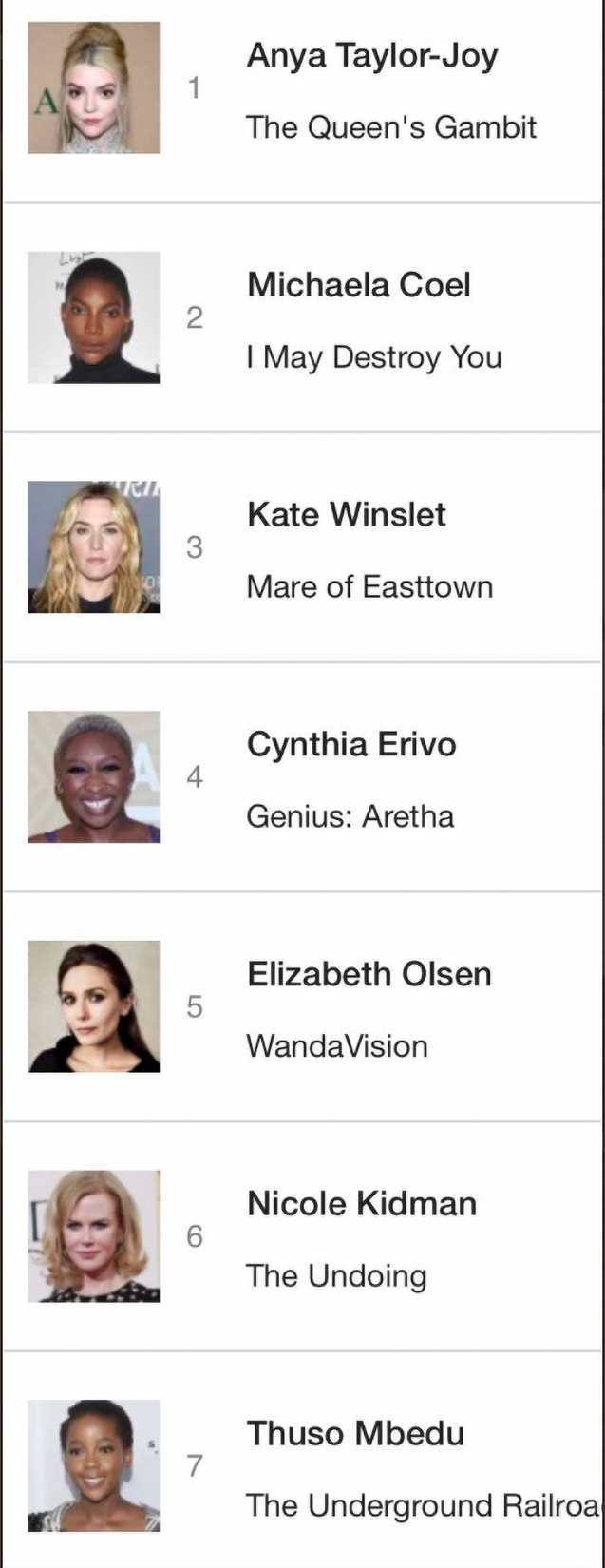
Definitely The Queen’s GambitAnya Taylor Joy and Mare of Easttown‘s Kate Winslet. WandaVision‘s Elizabeth Olsen will also be nominated, I expect, but she won’t beat Joy/Winslet. I never watched Cynthia Erivo‘s Aretha (Genius), partly because I have this idea in my head that Jennifer Hudson‘s Respect will be more definitive, Aretha biopic-wise. I haven’t yet watched The Underground Railroad (I’m told it’s a chore) or I May Destroy You so I have no opinion about Thuso Mbedu or Michaela Coel. For what it’s worth I agree with the below-stated opinion of Daniel Fienberg.
Angie Dickinson: Who knows more about movie cameras? You or me? Dean Martin: Maybe you. Angie: Ever directed anything? Dean: Nope. Angie: How do you adjust the focus? Dean: Beats me. Angie: Is it this little wheel doo-dad? Dean: Hey, how come you’re dressed like Cyd Charisse in a Fred Astaire movie? Angie: Gee, Dean, I dunno.
Dean: Because ya got great gams? Angie: Howard told me to wear tights. Dean: Can you dance? Angie: Not like Cyd Charisse. Dean: So what’s this movie about anyway? Besides me playin’ a drunk and Duke and I facin’ down the bad guys every so often? And singin’ a couple of songs with Ricky Nelson? Angie: It’s Howard’s answer to High Noon. Dean: He told me it’s a hang-out movie. Angie: Yeah? Dean: Yeah. Angie: What’s a hang-out movie? Dean: One that kinda ambles along.
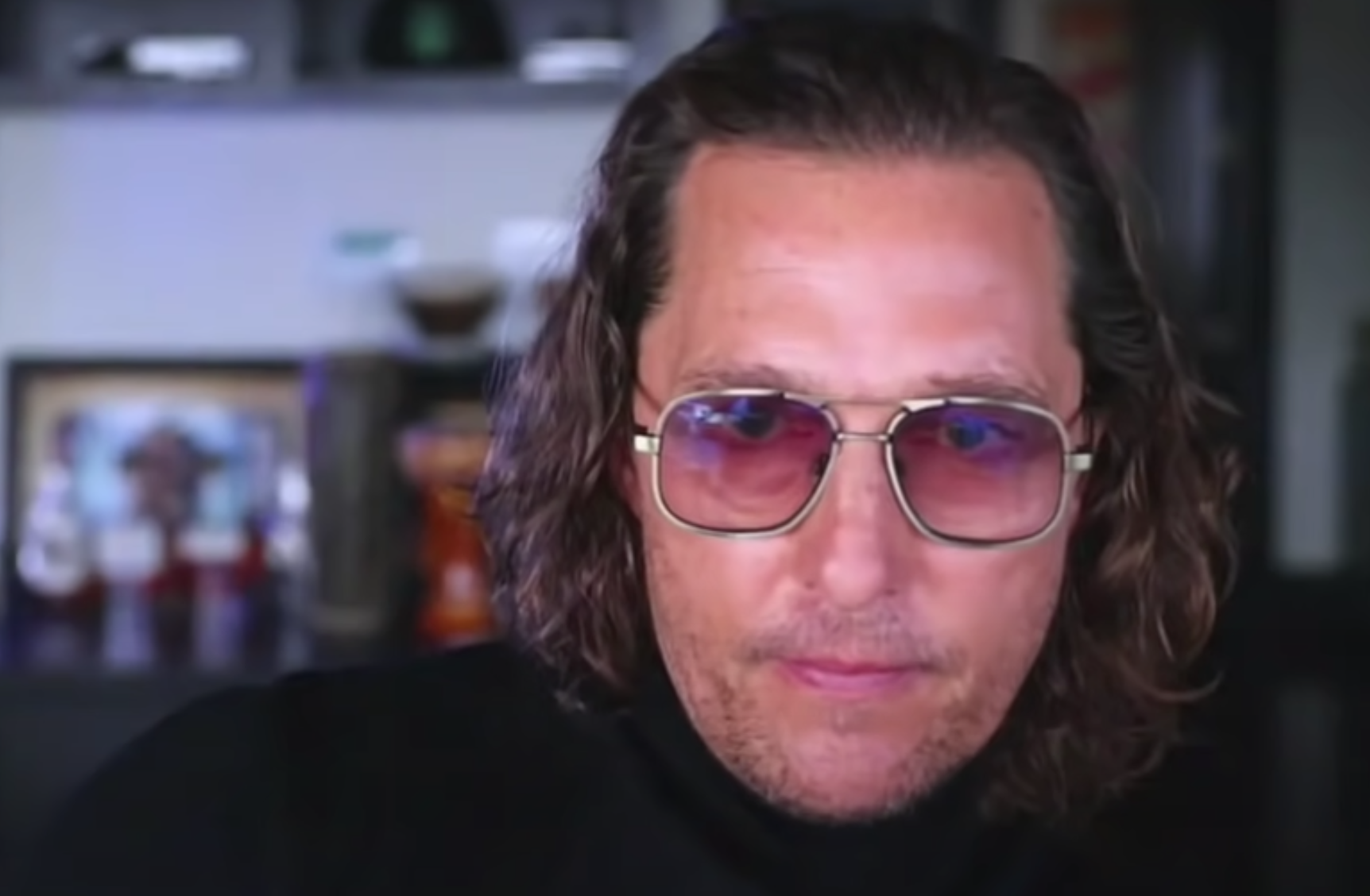
In a N.Y. Times op-ed titled “Could Matthew McConaughey Be All Right, All Right, All Right for Texas?” (5.9.21), Texas Monthly executive editor Mimi Swartz asks “would Mr. McConaughey run [for governor] as a Democrat or a Republican? That’s as much a mystery as the meaning of his soliloquy at the end of True Detective.”
The basic impression is that McConaughey is a kind of “philosopher king” type, which may or may not add up tactically if he runs for Texas governor. The best way to get a line on MM’s thinking, apparently, is to read his self-penned “Greenlights,” a book of practical thoughts and philosophical guidance which published last November.
Key McConaughey quote: “Knowin the truth, seein the truth and tellin the truth are all different experiences.” No apostrophes?
Swartz ends the piece with “may the best man win, man.” Translation: McConaughey is too vague and flaky-sounding to cut the political mustard.
NBC Universal has joined the “zero tolerance for the untrustworthy HFPA” cabal by announcing that it won’t air the 2022 Golden Globes awards. They’ve joined fellow renouncers Tom Cruise, Scarlett Johansson, Mark Ruffalo, Netflix and Amazon…they’ve all voiced their displeasure with the HFPA’s not-good-enough reforms.
The complaint is that the HFPA doesn’t really seem to mean it and/or hasn’t gone far enough in cleaning up their act. Giving their 2021 Best Director award to Chloe Zhao and their Best Actor and Best Actress awards to Chadwick Boseman and Andra Day were insincere gestures, the thinking seems to be. At this point the specifics don’t seem to matter. One way or another the HFPA seems to be more or less fucked. At least for now.
Nobody loved the HFPA dilletantes before — they were “tolerated” in a shoulder-shrugging, eye-rolling sense of that term, and now distributors and talent are saying “okay, fuck these guys…even with the announced reforms they aren’t woke enough, not by 2021 standards, and now, trust us, they’re about to understand the cost of their terrible folly.”
So if the Golden Globes are wiped out who takes their place as an Academy-reflecting body that hands out pre-Oscar awards and gets the buzz rolling? The Critics Choice Awards, right? I’ll bet those guys are gloating as we speak.
Not to defend the blithe, lackadaiscal HFPA, but we’re living through punitive, tumultuous times — a climate of institutional fear and intimidation — “think right, run your organization right and say the right things or your ass is grass, pal.”
Is the HFPA a secret stealth branch of former Ku Klux Klan members or something? Some of the HFPA-ers are known to be less than ardent in their support of wokester reforms, but mainly they’re just a group of gravy-train hustlers and opportunists. Nobody in the Hollywood promo machine had any serious problems with them before. Everyone played along. But now, out of the blue, Hollywood’s “woke” Twitter mob has given them the heave-ho. It’s an avalanche effect.
Nobody wants to be on the “wrong” side of this — if you’re not with the mob you’re suspected of being in league with suspected racists, or certainly people who don’t “get it.” You have to condemn without ambiguity these days. You have to come down hard. This is roughly analogous to what everyone did to stay safe in early ’50s Hollywood — they had to distance themselves from the accused, name names and declare loyalty to the established order.
Do Joe and Jane Popcorn care if the HFPA reforms are sweeping enough? Will they care if and when the GG awards don’t happen early next year?
NBCUniversal statement: “We continue to believe that the HFPA is committed to meaningful reform. However, change of this magnitude takes time and work, and we feel strongly that the HFPA needs time to do it right. As such, NBC will not air the 2022 Golden Globes. Assuming the organization executes on its plan, we are hopeful we will be in a position to air the show in January 2023.”
I began by dismissingMare of Eastwood on the mere basis of atmospheric gloom and wretched characters with all kinds of downmarket maladies and addictions. But episode #2 put the hook in and I’ve been on board ever since.
As mentioned earlier I’ve managed to put aside my issues with Kate Winslet (cravenly apologizing for working with Roman Polanski and Woody Allen in order to curry favor with #MeToo Academy types and possibly land a Best Actress nomination for Ammonite) and have even become accustomed to the Easttown demimonde and their endless summonings of moods and vibes most of us would rather not absorb.
Winslet’s “Mare” is a good generational match for Guy Pearce‘s Richard Ryan, who’s been romantically appealing from the start, but it makes no sense at all for Evan Peter‘s Detective Zabel, her investigating partner, to have a competing interest — at 34 he’s way too young for the 45-year-old Winslet, and he seems like a fool to be saying stuff like “I’m only interested if you’re interested” and “Mare, all my cards are on the table.” Dude, you can do better.
James McCardle has a face I’d love to punch repeatedly, and his Deacon Mark Burton is obviously a dangerous sicko. I decided last night that I won’t be happy until a mob gangs up on his ass and maybe throws him off a bridge.
I’m told that episode #5 (“Illusions,” 5.16) is the best yet.
Earlier today I was hit with another “I can’t even” from another HE reader with the same old “why can’t you just focus on movie dreams and echo-fantasies while putting real-world unpleasantries aside?” I’ve lost count but let’s imagine this is the 47th such reply…
As a film obsessive since age 4 or 5, HE has labored to engage with everything worthy or even half-diverting in the movie kingdom (except for Marvel/D.C. and low-rent horror). I’ve been doing so 24/7 for 17 years straight (and 23 years if you count the Mr. Showbiz & Reel.com columns). There isn’t a single particle of “Hollywood fantasy meets metaphorical transportation” that I haven’t personally swooned over or attempted to grapple with…many decades under the influence.
Then again you’ve presumably noticed that the double-ass whammy of the pandemic + the white-liberal Robin D’Angelo virus are major political & psychological currents in the film industry right now, and that THINGS HAVE CHANGED in a way that begs comparison with what Paris suffered through in the early-to-mid 1790s.
Did you watch the Soderbergh Oscars by any chance? If you were a resident of Prague in late August ‘68, you’d be saying “God, enough with the focus on Soviet tanks already!” As an HE friendo remarked a while back, the building is on fire and you’re thinking it’s just a warm day.
There’s no separating the spaghetti from the sauce.
…it would sorta kinda look like this. I don’t know what to say or think. All I can do for now is (a) gulp and (b) go “hmmm, maybe but I dunno.” It’s certainly simpler and cleaner, but right now I live in my own home, dammit — a place with a certain weather-worn history, a certain personality and attitude…a brand and a tradition that’s been around for 17 proud years.
My honest reaction is that HE Substack…a place I’m thinking of moving into…looks and feels like a modest, freshly-painted condo unit in a large sprawling complex, but at least it has a soft-drink machine off the main lobby, a large basement room for washing and drying, and of course underground parking.
I’m not saying it isn’t the right way to go (maybe it is), but right now I’m in shock. 17 years of blood, sweat and tears, and this is what it’s come to…a condo unit.
Writing is never easy — demanding, tiring, draining. Sometimes the spirit is upon me, and other times not. But it’s nowhere near as difficult as it was during the old Olivetti manual and IBM Selectric days of the ’70s and early-to-mid ’80s. Back then I would tell friends “I despise the process, but I love having written.” In my early Manhattan days (late ’70s) writing was like pushing a loaded wheelbarrow uphill, over gravel. I would spend way too many hours composing a 400-word film review, partly because it’s more difficult to write shorter than longer.
In Julia Lilian Hellman (Jane Fonda) threw her typewriter out the window. I got so crazy one night in my Bank Street apartment that I smashed a glass jar of peanut butter against the kitchen wall and cut my palm open. I damaged some nerves, but they gradually regenerated,
You could argue that this standoff scene between Eddie Albert and Charles Grodin in Elaine May’s The Heartbreak Kid (’72) is Albert’s career-best moment. He’s playing an utterly humorless Midwestern banker who smells deceit and calls it out …and it’s beautiful.
Surely there are other noteworthy scenes in which an older, wiser, sharper character (man or woman) tells a young hustler (either gender) to cut the crap.
Written by Neil Simon: “I see through you. You don’t think I see through you? You could wear two wool sweaters and a raccoon coat, I’d still see through you. ‘There’s no deceit in the cauliflower’? Where do you get ideas like that? Do they just…do they just come out of that New York head of yours?”
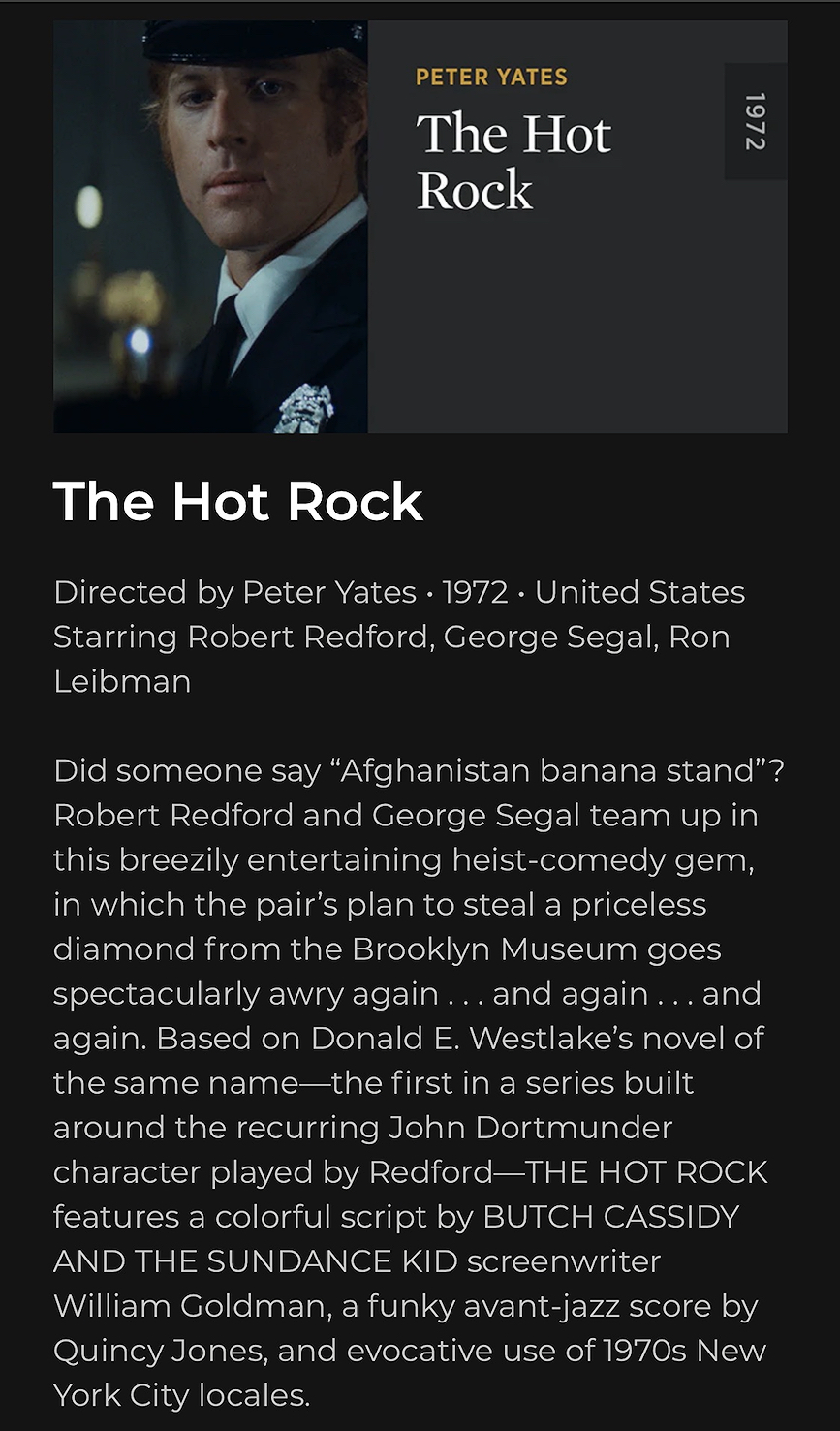
During the last 20 or 25 minutes of Peter Yates‘ The Hot Rock (’71), professional thief John Dortmunder (Robert Redford) arranges for a deep-voiced hypnotist named Miasmo (Lynne Gordon) to put an unsuspecting safe-deposit-box teller into a kind of waiting trance state.
The trigger term that will make the teller obey any command is “Afghanistan bananistan”, a deliberately silly invention (presumably dreamt up by screenwriter William Goldman)…a noun-switch takeover in the same vein as “Oscar schmoscar”…obviously.
It goes without saying that there’s no reason on earth for Miasmo to have invented a similar-sounding term, “Afghanistan banana stand.” Why would she do that? Even with a silly attitude what do bananas have do with Afghanistan? Has anyone ever heard of a Kabul fruit seller restricting his goods to just bananas? It’s lame — a needlessly literal term when the much simpler “Afghanistan bananistan” will suffice.
And yet the Hot Rock Wikipedia page nonsensically claims that Miasmo says “Afghanistan banana stand”, and now a copy writer for the Criterion Channel has parroted this interpretation. Can we please nip this one in the bud? “Bananistan” is standard form — “banana stand” is ridiculous.
The wise and sensible John McWhorter feels condescended to, he said on Real Time with Bill Maher two nights ago. Robin DiAngelo‘s “White Fragility“, he complained, basically says that Black people are “hothouse flowers” and “everybody has to tiptoe around us…we’re always crying and always angry and just so very, very delicate. I don’t feel like that person. It should be used to keep the table from wobbling…that is the only use for that book.”
DiAngelo, he observed, “does not see fit to address why all of this agonizing soul-searching [for residual racism by white people] is necessary to forging change in society. One might ask just how a people can be poised for making change when they have been taught that pretty much anything they say or think is racist and thus antithetical to the good.”