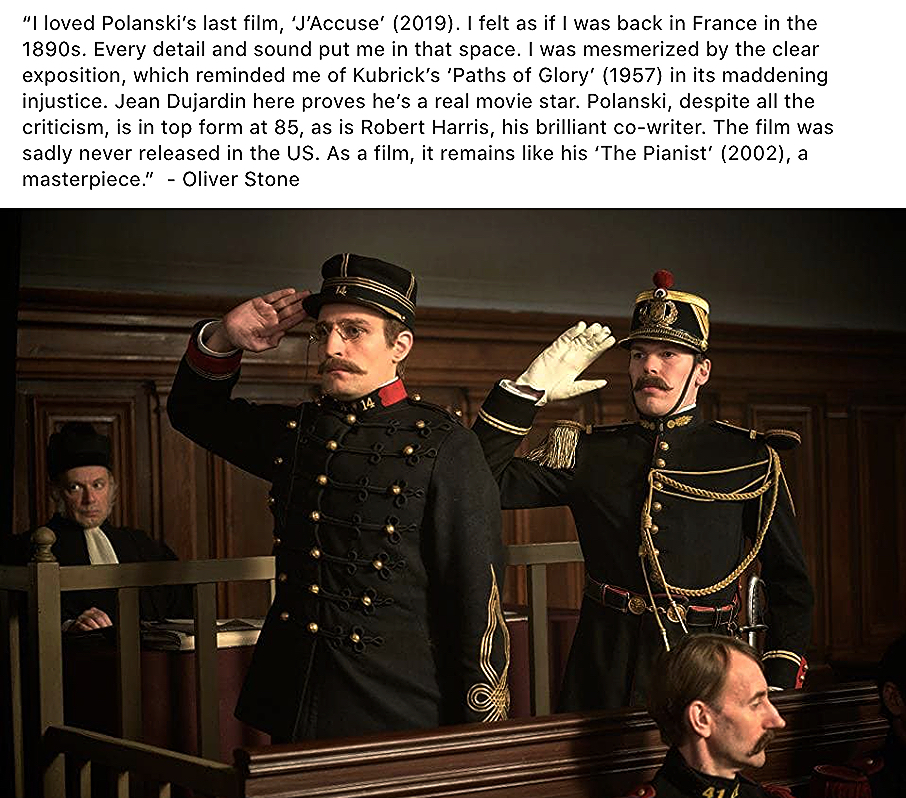
It’s been 13 months since I first saw Roman Polanski’s drop-dead masterpiece, and almost 20 months since it opened at the 2019 Venice Film Festival. To the best of my knowledge English subtitles were never available on the Gaumont Bluray, and English-speaking audiences still aren’t allowed to stream it with same because distributors are still fearful of potential #MeToo pushback. (And yet a December 2019 trailer has English subs!)
The path out of this situation is not difficult: The unfortunate history of a flawed artist is one thing, but the art itself is another. Suppressing public access to high-quality art is, to put it mildly, odious — a truly bad look.
From my 3.25.20 review: “J’Accuse has been crafted with absolute surgical genius…a lucid and exacting and spot-on retelling of an infamous episode…a sublime atmospheric and textural recapturing of 1890s ‘belle epoque’ Paris, and such a meticulous, hugely engrossing reconstruction of the Dreyfus affair…a tale told lucidly…a clue-by-clue, layer-by-layer thing.
“You know what J’Accuse is? A bedtime comfort flick — comforting because it’s so damned good.
“It’s my idea of a perfect film in every respect — Polanski and Robert Harris‘s brilliant screenplay, the ace-level production design by Jean Rabasse and art direction by Dominique Moisan, Pawel Edelman‘s naturally lighted cinematography, Alexandre Desplat‘s music…every single element is aces.
After the first elephant drops to the ground, shot by Wayne but alive and groaning, somebody in La Pierre’s party chuckles. Alas, Wayne can’t shoot. It takes three or four more shots to finish the deed. Wayne exhales, grins, accepts congratulations.
Excerpt: “After guides tracked down an elephant for her, Susan killed it, cut off its tail, and held it in the air. ‘Victory!’ she shouted, laughing. ‘That’s my elephant tail. Way cool.'”
From a wise and well-written Spectator piece by former Universal senior production and development vp Barry Isaacson, posted six and a half years ago:
“There have always been bullies in Hollywood; it’s institutionalized, like a form of hazing, but the key difference between the film business and the Marine Corps is that bullying in Hollywood is not meant to inculcate esprit de corps; its purpose, for the bully anyway, is to provide confirmation that the hierarchy is working in his favor.”
HE interjection: This is what I’ve been trying to remind Millennial and Zoomers about recently — that Scott Rudin‘s boss-from-hell personality is an historical archetype that is built into the system. Some responses have been “you’re trying to excuse or rationalize!” No — I’m just saying that a certain kind of tough producer brutality has been normalized over the decades.
Back to Isaacson: I was one of the last generation of studio executives at Universal that reported to the old mogul, Lew Wasserman. Wasserman was a physically imposing screamer who had parlayed with gangsters, bootleggers and union enforcers as a supplier of dance bands to illicit nightclubs during Prohibition, so he could terrorize white-collar employees without breaking a sweat.
“This was particularly useful to him one sweltering afternoon in the Valley, when the air conditioning had failed inside the office building known without much affection as The Black Tower. Wasserman lined up several executives in front of his desk and screamed at them for half an hour. He threw pencils at them. He took off his Rolex and shied it at the head of some fellow in distribution. One man, melting in his suit and tie like the others, fainted and collapsed in a heap on the floor. Wasserman continued screaming for another ten minutes. He was known — again without much affection — as ‘Old Yeller’.
“In the 90s the culture changed. Ancient, heterosexual, tough-as-teak depression-era Jewish alpha males like Lew Wasserman became elder statesman and Hollywood became, a little self-consciously at first, almost literary. A new breed of bully emerged; college educated, middle-class by birth, often gay, or female.
“The nastiest bully I ever encountered was a woman who fancied herself a producer because for about five minutes she was married to a Hollywood VIP. Power in Hollywood is often defined as being the prerogative of those who can say yes, but a middle-level studio executive only has the power to say no, which I had to do to this bully every Monday morning for a year, after the scripts she submitted to me the previous Friday had been laughed out of the executive conference room that morning.
“Upon hearing ‘no’, she screamed, she threatened, she even tried a skeevy form of bullying flirtatiousness — all to no avail. So she called my bosses and whined about me. One Monday lunchtime, after licking my wounds, I was waiting for a table at The Grill in Beverly Hills, a restaurant very popular with the industry expense-account crowd. Noticing my tormentor standing in front of me, my stomach lurched, as it did whenever I had to talk to her, meet with her or think about her. Luckily she was too annoyed not to have been seated right away to notice me, or Kevin Costner — at that moment indisputably the biggest movie star in the world — who was waiting quietly for his table ahead of her in the line. Seconds later, she stalked over to the maitre d’ and yelled ‘Do you know who I am?’
“There have always been bullies in Hollywood. And there is Scott Rudin.
Rose McGowan: “I do believe that Democrats, most especially, are in a deep cult…[a situation in which] you’re serving a master who might not be serving you…I always say ‘I come in peace’…I am not here to make people feel bad about their political choices, but I am here to say that you might be in a cult too, [especially] if you don’t know the signs,” blah blah.
Wait…is McGowan suggesting that mainstream establishment Democrats are members of a cult, or is she talking about the lunatic wokester fringe?
More to the point, why is she saying this on Fox, of all Godforsaken places?
…to pay attention, but in this devastated, post-Soderbergh Oscar Trauma environment this hit the sweet spot. The OwlKitty thing (a brand) is about parody + a tech demonstration, but seriously — how much more ludicrous is it compared to the actual Godzilla vs. Kong? Plus I feel a greater emotional investment in OwlKitty.
“Meritocracy, gone. Virtue signalling and ‘look at me’ has replaced it. If there ever was a competition about what were the best movies of the year…that’s long gone.
“To give you an idea of how [much] we have changed as a culture, ten years ago the Best Picture [winner] was The King’s Speech, about King George getting over his stutter and going on to give speeches on the radio during World War II. Ten years before that it was Gladiator and Russell Crowe getting [awarded] for Best Actor. And 30 years ago Joe Pesci was getting [an Oscar] for his work in Goodfellas.
“Will anyone remember anything about the movies that won last night, like everyone remembers those three earlier films? Of course not.” — Sky News host Paul Murray.
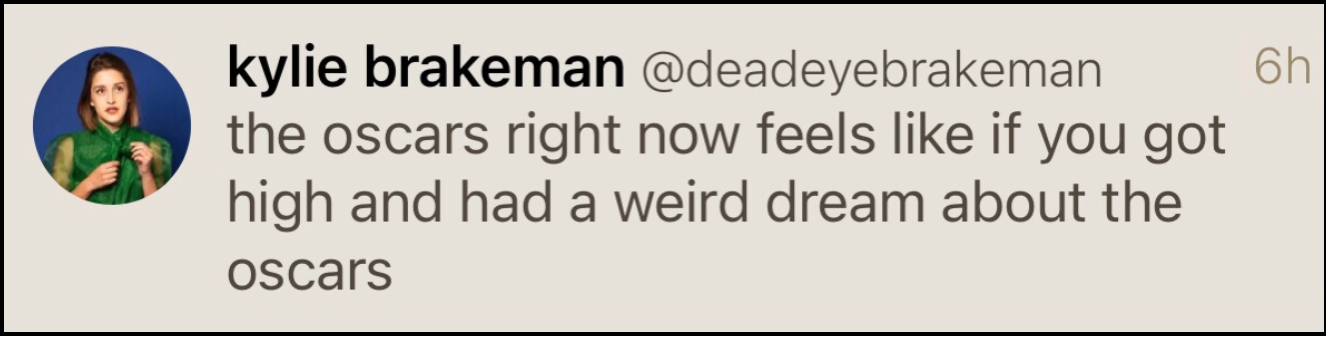
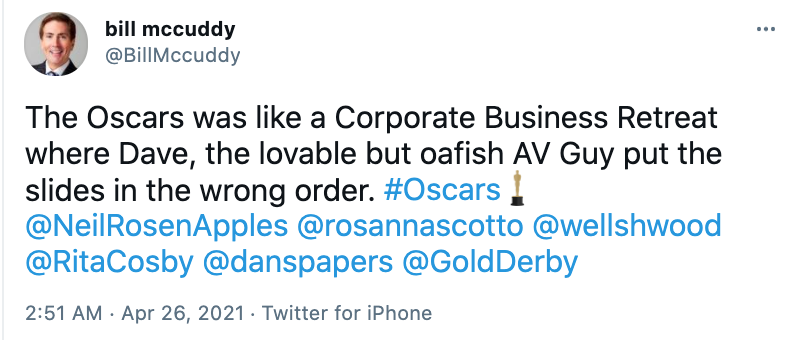
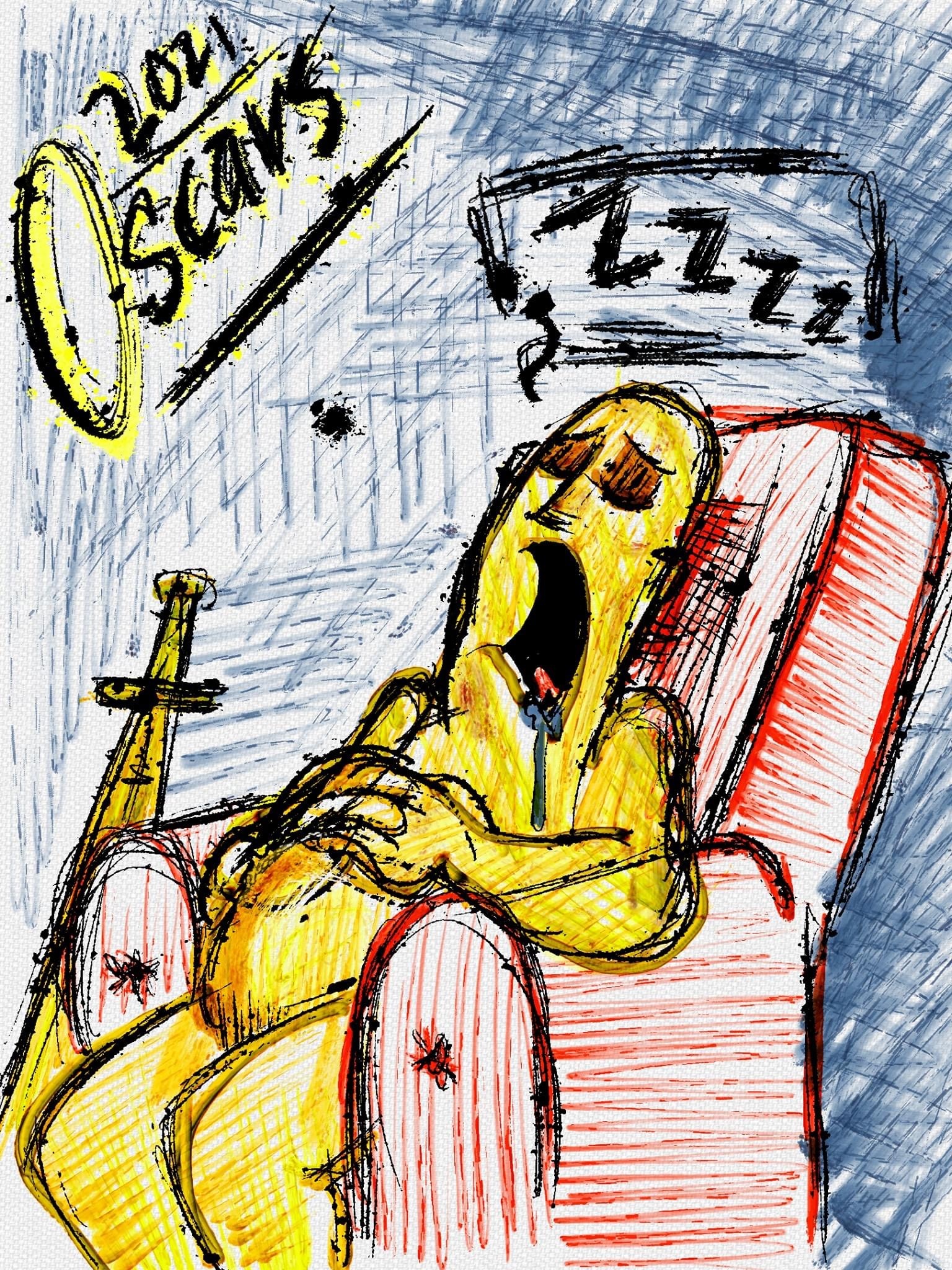
Does the Academy of Motion Picture Arts & Sciences realize what happened last night? Millions upon millions who’d been at least mildly or half-heartedly interested in the Oscar tradition decided “naah, to hell with it.” They became in effect Bob Strauss, and from the AMPAS perspective that’s a knife in the ribs. Culturally the Oscars used to be in the same realm as the World Series or the Super Bowl. Once again we’ve been reminded that the candle is flickering, and that all it will take to finish them off…I don’t want to think about it.
There’s really no choice any more. The Best Achievement in Popular Film Oscar idea, killed in its infancy by the snooties, doesn’t need to be revived — it needs to be implemented. Really. Another Steven Soderbergh-styled Oscar telecast in ’22 and it’s over. Hell, the brand is on life-support now.
Once again: On 9.10.18 Bloomberg’s Virginia Postrel posted a solution to the Best Picture Oscar problem. Her idea was simply that there are two film industries — one for ticket buyers who tend to prefer mass appeal or FX-driven popcorn flicks, and another for Academy members who prefer to honor movies that are actually good in some kind of profound, refined or zeitgeist-reflecting way.
It’s been understood for years that the vast majority of moviegoers are agnostic regarding the faith of cinema. What faith, you ask? Good point. Postrel’s article isn’t even three years old, and the pandemic has made it seem like an idea from another era. But embracing the Popcorn Oscars (maybe even encompassing the top five categories) would at least represent an attempt to face reality.
The short-lived Best Achievement in Popular Film Oscar idea died three years ago because (a) it was too vaguely defined and (b) it would have essentially denigrated the potential contenders in this category by categorizing them as popular but a bit slovenly — i.e., lower on the cultural totem pole than bona fide nominees.
Postrel’s idea was to not cast indirect shade upon mass-appeal films but simply create two Best Picture categories based on admissions — (1) a Spirit Awards-type Best Picture Oscar for films that have sold less than 10 million tickets and are favored by the wokesters, and (2) a mainstream Best Picture Oscar for films that have sold more than 10 million tickets.
Simple, no shade, and obviously reflective of how the the movie-watching world (or what’s left of it in theatrical terms) is defined these days.
Concurrently there is such a thing as applications of high craft in the making of popular films, and it wouldn’t devalue the smaller good films if the Academy were to acknowledge and celebrate this.
There’s really no choice any more. It’s the admissions, stupid. (Remember admissions?)
Last night’s Oscar telecast was watched by a lousy 9.85 million, with a piss-poor rating of 1.9 among the 18-49 demographic. This amounts to a drop of about 58% from last year’s numbers.
People didn’t want to watch because they didn’t care about the nominated movies, but mainly because it’s become an article of faith that Hollywood and a certain liberal strata in the big cities live on one planet, and the rest of the country lives on another.
The Hollywood community has more or less woked itself into a corner and nothing, trust me, will ever be “done” about this.
Hollywood elite to Average Joes in flyover regions: “Either you guys catch up with our enlightened progressive attitudes and accept that the Oscars are now the Sundance Spirit awards, or you don’t. Either way we’re on a crusade to correct too many decades of harmful or suppressive Hollywood behavior and to change an atmosphere defined for too long by a general lack of interest in socially meaningful films that will help to raise consciousness and lead to a better world.
“If Joe and Jane Popcorn aren’t on board with this, and if all they want is delight and diversion and quality-level escapism and maybe some poignant emotional stuff on the side, fine. But don’t expect us to necessarily supply that. We might make an audience-pleaser or to, but we’re not about that.”
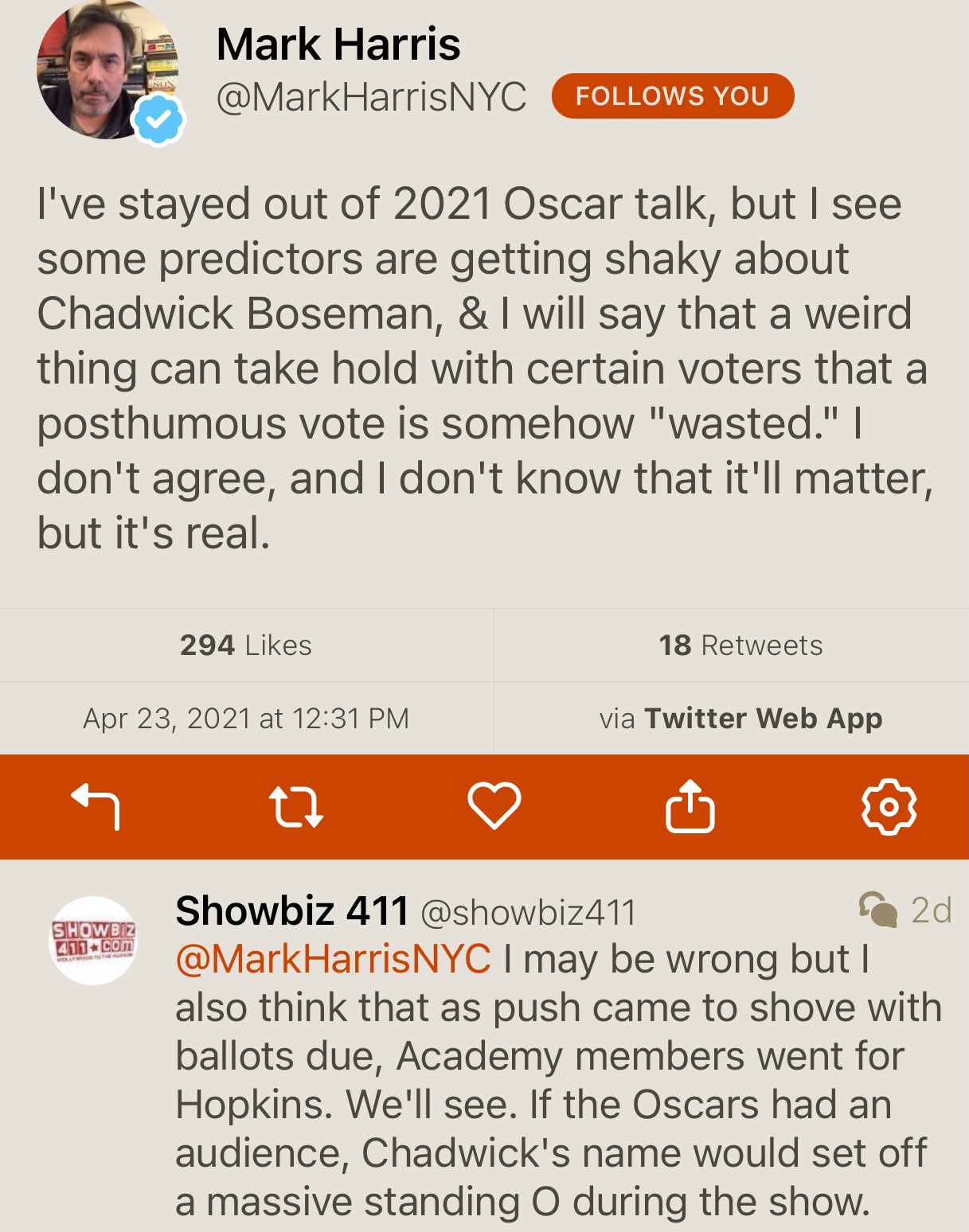
HE to Anthony Hopkins: Variety wokesters (Elizabeth Wagmeister, Clayton Davis, Angelique Jackson, Jenelle Riley) have made it clear they really wanted to experience the “Chadwick Boseman takes Best Actor Oscar” moment last night, and are quite disappointed that it didn’t happen.
So is there any way you could adopt a noblesse oblige attitude and (a) offer an apology for winning the Oscar or (b) say how sorry you are that your win robbed Boseman fans of a great emotional moment…something along these lines? Or maybe give the Oscar back to the Academy and insist that it go to Boseman’s family instead, because in this of all years no white actor wants to violate the wokester narrative that so many were counting on?
Wagmeister: “The major upset at the end was completely avoidable…the late Chadwick Boseman was the front-runner to win an Oscar for his role in Ma Rainey’s Black Bottom. [But] he lost to Anthony Hopkins, but what made the moment more shocking was that the [the] Best Picture [Oscar winner] had already been announced.”
Davis: “I don’t know whose idea it was [to announce Best Actor winner at the very end] but it was the most bizarre thing I had ever seen happen.”
Wagmeister: “From a television perspective it was kinda…I don’t even wanna say ‘good TV’ because I know that we’re all not happy about what happened.”
Jackson: “We were all hoping for something that was gonna shake things up, but I don’t think that [the Hopkins win] was in any way what the Oscar producers intended. There was a lot of hope that we were going to end with this very emotional, heartfelt moment…all these things were pointing toward a great, great emotional catharsis. Instead we had this real kind of catastrophic surprise.”
Wagmeister: “But of course, this is not Anthony Hopkins’ fault…”
Last night’s Glenn Close + Li’l Rel routine might’ve worked better if Glenn’s knowledge about “Da Butt” (a 1988 EU song heard in Spike Lee‘s School Daze) wasn’t so extensive and encyclopedic, and if she pretended to be an older white woman who knew one or two things but not everything, and then broke her moves out.
The following is a rough blend of a riff I wrote this morning along with friendo reactions…it’s a bit of a bumpy ride:
Friendo #3: “Here’s the one thing I’d add, and I think it’s crucial. It’s not going to be like this, year in and year out. We’ll have some of that vibe, but this is a fad, a fetish, a current obsession of WWS (woke white supremacy). It’s really a pure expression of white supremacy. That’s one of the reasons it’s so fucking embarrassing. Last night wasn’t just jaw-dropping — it was high camp. ”
Friendo#1: “The awards attendees reflected the huge number of POC nominations, voted upon by the increasingly diverse membership.
“Even so, the event did seem more like the BET awards. And three Black visitors watching in my home were embarrassed by the over-wokeness of the whole enterprise. ‘Trying way too hard’ was the judgement.
“In short, the white woke Academy is still over-compensating for its recent #OscarsSoWhite past.
“Plus there was no FUN…no entertainment, no clips. The nominees looked like wax figures as they were introduced.”
THR‘s Scott Feinberg: “The Oscar telecast producers also leaned into diversity in their selection of presenters, which is admirable, although one can’t help but wonder what middle-America made of the fact that only four of the 18 presenters — Bryan Cranston, Brad Pitt, Harrison Ford and Joaquin Phoenix — were white males.”
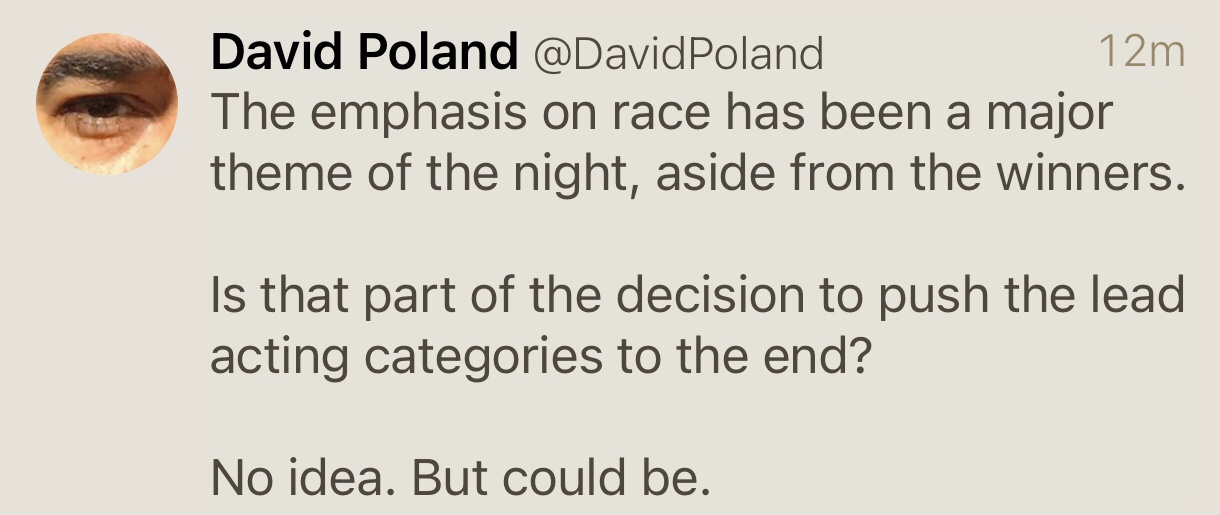
HE: I’m hesitating to share an impression that millions probably had last night. I’m even hesitating to mention it to you guys. The impression (I’m emphasizing the “i” word as opposed to something more specific) is that the Oscars had suddenly become much more diverse, dominantly so, and that the lethal nightmare of police bullets was hovering or massing just outside Union Station.
It wasn’t all that, of course, with a healthy but modest amount of palefaces (Glenn Close, Laura Dern, Reese Witherspoon, Harrison Ford, Brad Pitt, Carey Mulligan) sprinkled into the smallish, Greek amphitheater dinner cafe. But still…
The fact is that for the last 90 years (or since the telecast began appearing on home screens in the early ‘50s) the Oscars have largely reflected an industry that has…well, actually not mirrored but under-represented the racial makeup and character of this country — currently around 61% Anglo, 13% to 14% African American, 18% Latino, 5% or 6% Asian percentage and a smattering of other tribes. The truth of the makeup of the film industry was probably honestly reflected in the mostly-white complexions of those who attended in decades past…
But all in a flash, Americans who watched last night were suddenly contemplating a new mandated reality, and in strikingly visual terms — an African American Oscar community that was happy to be there and to celebrate diversity and achievement but was also grieving over the deaths of so many African Americans by hair-trigger cops.
For those relatively few Americans who watched the show it almost certainly came as a bit of a shock…trust me, for those accustomed to the notion of the 61-39 split and those who live in the suburbs and rural areas where the Anglo percentage is almost certainly higher, and even to those who reside in mostly white and largely gay West Hollywood…
And especially for movie mavens who’ve been watching since the JFK, LBJ and Nixon eras, the visuals in last night’s show said “roll with it, America…this is the progressive vision of 2021 America…of diverse, progressive, inclusive Hollywood and the America it believes in…a culture that is now (to go by visual impressions) half Black — not 13% or 14% African American but seemingly or possibly 50%…a culture in which progressives have decided that the experience of African Americans has been under-represented and under-respected for too long, and that for the best of reasons it’s time to (am I allowed to think this?) over-represent the POC experience (not to mention the #MeToo perspective and the LGBTQ current), in part due to a general urban-liberal consensus that hinterland white folks and especially older alpha white males are bringers and enforcers of evil (racism, murdering cops, Trump supporters, Proud Boys, Oath Keepers, Fox News watchers, U.S. Capitol occupiers, mask refusers, Republican-controlled legislatures that are now conniving to suppress voters of color by passing new-styled Jim Crow laws) and that the stain and toxicity of white privilege has to be trimmed, Twitter-whipped, schooled, diminished, Critical Race Theory’ed and Robin D’Angelo’ed in order to make the US of A into a more just, compassionate, fair-minded society.
All of this came WHOMPING out of TV screens last night, and on top of (a) the decision to emphasize origin stories and warnings of police shootings in the acceptance speeches, (b) the absence of film clips, (c) no red carpet gowns, (d) no sassy humor, (e) no singing or dancing as well as Chloe Zhao wearing Chinese pigtails and white sneakers and the whole odd feeling of alternate Union Station rules and regulations, including Frances McDormand’s vaguely surreal wolf howl…
It was a strange, at times sodden or sad, and even a mildly alienating night of 170 stars or more precisely attendees…I hate to even think this but I fear that if I, an eccentric if reasonable left-center WeHo fellow, felt a teeny bit jarred by the import of last night’s show then many millions of older Joe and Jane Bumblefucks out there also felt a tiny bit “whoa!”-ed out by the Soderbergh Oscars, then I fear that the midterm elections of 2022 will be affected by this impression. I hate to say it, but I fear it.
Friendo #3: “All true, and all brilliantly stated on your part. And, of course, no one else would say it so honestly. Everyone in America saw it the way you described it. Period.
“Yes, McDormand and Hopkins won the top two acting awards, but were the votes that supported them a reflection of the idea that the industry is ‘ambivalent’ about diversity? Or were they a reflection of the fact that their competitors simply didn’t deserve to win?
“Anthony Hopkins in The Father gives a much greater performance than Chadwick Boseman in Ma Rainey.” Frances McDormand in Nomadland gives a performance that’s vastly more accomplished than Viola Davis‘s [huffing and puffing] in Ma Rainey.”
HE: “Except that Frances McDormand wasn’t the best — Day was. So it’s never really about that. It never really has been. It’s about what makes you feel good by voting for this or that nominee. Plus this was the first time since the mid ’90s that the winners of the Globe and SAG didn’t take the Oscar. So you see something was radically different. What’s funny sort of is that the Globe voters were being chased around and called racists and yet their wins were more inclusive — Andra Day (who deserved to win) and Boseman. Tough call with Hopkins, who was very, very good.
Friendo #3: “Yeah, but newcomers like Andra Day never win, and Frances McDormand was much, much better than Viola Davis.”
Jordan Ruimy: “The Oscars overdid the inclusivity portion of the ceremony. My semi-woke sister was complaining to me via text last night about how they were shoving a message down our throats.”