Jolie’s Cambodian Pic Doesn’t Make Foreign Finals

Hollywood Elsewhere’s favorite 2017 foreign-language pic, Andrej Zvyagintsev‘s Loveless, is among the nine just-announced finalists for the Best Foreign Language Feature Oscar.

Two contenders that I didn’t care for — Angelina Jolie‘s First They Killed My Father (Cambodia) and Robin Campillo‘s BPM: Beats Per Minute (France) — didn’t make the cut. (Here are my negative responses to the Jolie and the Campillo.)

The other eight nominees: Sebastian Lelio‘s A Fantastic Woman (Chile); Fatih Akin‘s In The Fade (Germany — my positive review); Ildiko Enyedi‘s On Body and Soul (Hungary); Samuel Maoz‘s Foxtrot (Israel); Ziad Doueiri‘s The Insult (Lebanon); Alain GomisFelicite (Senegal); John Trengove‘s The Wound (South Africa); and Ruben Ostlund‘s The Square (Sweden — here’s a chat I did with Ostlund).


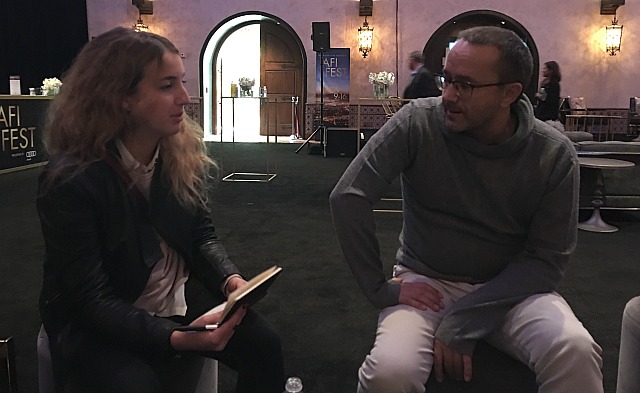
Loveless director Andrey Zvyagintsev during Hollywood Roosevelt chat during AFI Fest; pull quotes from Loveless one-sheet.

Read more

All In The Family

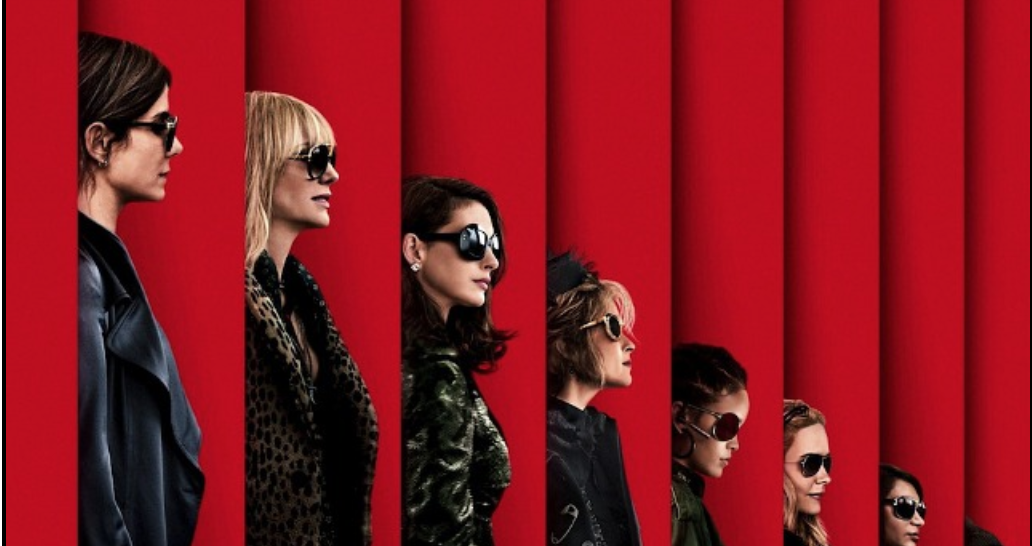
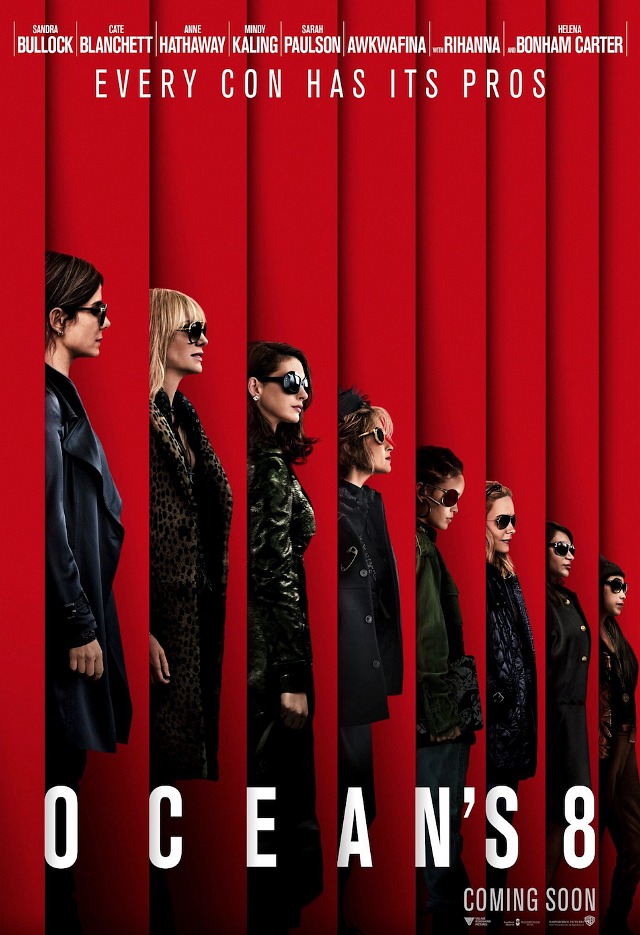
I’ve disliked the idea of Gary Ross‘s Ocean’s 8 (Warner Bros., 6.8.18) from the get-go, and I mean intensely. George Clooney‘s Danny Ocean has an “estranged” sister named Debbie (Sandra Bullock) and so, being competitive and all, she’s decided to mastermind her own audacious heist, only this time with the assistance of seven lady thieves (Cate Blanchett, Helena Bonham Carter, Anne Hathaway, Rihanna, Mindy Kaling, Sarah Paulson, Awkwafina) with the usual eccentric character traits. The plan is to rip off something of value (presumably not cash) from Debbie’s ex-boyfriend (Damian Lewis) on the night of Manhattan’s annual Met Gala. Original Ocean’s trilogy costars Matt Damon and Carl Reiner perform cameos but not Clooney. The idiotic brother-sister thing is like Steven Soderbergh deciding to make Clooney’s character the son of Frank Sinatra‘s Danny Ocean, Sr., who masterminded the 1960 Las Vegas casino heist. Something about the poster…hell, the whole enterprise is whispering “caveat emptor.”

Who Composed This Scene?

Director Richard Thorpe is primarily known as “the guy who didn’t get it.” Reason #1 was because Thorpe was fired off The Wizard of Oz after two weeks of shooting, one reason being dissatisfaction over his decision to dress Judy Garland in a glossy blonde wig, which made “Dorothy Gale” look inappropriately older and even sexy. Reason #2 was Thorpe’s direction of this scene from Jailhouse Rock. For some odd reason Thorpe decided to allow a homely guy (heavy horn-rimmed glasses, Brylcream hair) stand next to Judy Tyler as Elvis Presley sang “Treat Me Nice”. Look at him clapping along. What was Thorpe thinking? Directing is about visual composition as well as guiding actors, and Thorpe nearly destroyed this scene by allowing “four eyes” to seriously distract.

The Rock In ’20, Not ’24

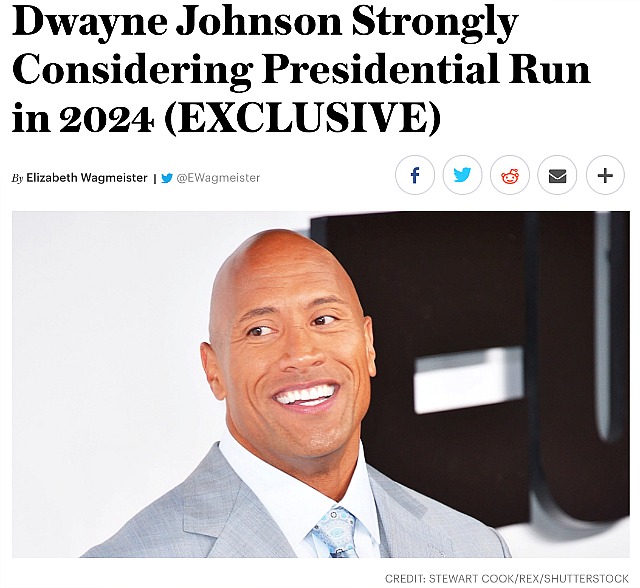
In a just-posted Variety interview with Elizabeth Wagmeister, Dwayne “The Rock” Johnson says he’s seriously considering running for U.S. President. Before this interview Johnson has only admitted to flirting with the possibility — now he’s getting specific.

Not against Trump in 2020, of course — that would require serious courage, which Johnson apparently doesn’t have — but in 2024 when the electoral playing field will be relatively free and clear. If you ask me Johnson has revealed himself here as a political showboater — an ostensible good guy who wants to help but not if it requires growing a pair. He sounds, in fact, like an opportunistic coward.

Johnson totally contradicts himself in the interview, talking about his own Hollywood power, self-interest and movie-starring being more important for now than trying to change things in Washington, at least in a 2020 sense.

“I care deeply about our country, and I care deeply about our people,” Johnson says. “Decency matters and being a decent human being matters, and character matters, and leadership matters.”

And yet Johnson tells Wagmeister that a 2024 run “would be the realistic consideration” because he has more movies and more millions to make before he tries to restore big-government decency and character.

“Realistically, as we go into 2018, when you look at my slate as we’re developing and shooting into 2019 and 2020,” Johnson says, “[and] the slate goes deep into 2021, so it feels like the realistic consideration would be 2024.”

Jumping into the ’24 campaign would require speaking and fundraising commitments starting in early ’23, at which point Johnson would be 50 to 51 years old. He was born in May 1972.

I’m not misinterpreting or misquoting in the slightest way here. Johnson really has told Wagmeister that while he has serious arguments with Trump and that he’s giving serious thought to running because he cares about the U.S. and wants to restore a climate of decency and character, he can’t see running in ’20 because of existing commitments to make and produce a few more films.

On top of which Johnson expresses himself like a fence-straddling candy ass, saying stuff like “the best thing I can do is continuing to listen and learn as much as I can” and “watch our presidency and…how every new development is handled.” He says that he’s “hopeful that our leaders exhibit poise, perspective and the ability to bring our country together during these tough times — which I don’t feel our presidency is currently doing — so that’s where I’m at.”

What kind of Pollyanna bullshit is that, Dwayne? You’re “watching” and “listening” and still trying to decide if Trump is an authoritarian jackass and orangutan who cares only about attracting media attention and fortifying his own business empire? You’re not sure about who and what Trump is?

Read more

Net Neutrality Is Over, A Memory

A couple of hours ago the Federal Communications Commission voted 3-2 to kill net neutrality. Yes, this has actually happened. The internet was more or less a level-playing field in the ’90s and during the Dubya and Obama administrations. That’s over now — it’s no longer considered a utility like water or electricity, the big guys are running the shots, and bit by bit consumers are going to have to adapt to increasing effects of corporate authoritarianism.

It won’t happen overnight, but things are gradually going to become more and more benignly Orwellian and less open-rangey. The Obama-era regulations that prohibited broadband providers from blocking websites or offering preferential treatment to bucks-up interests are history. The rules that until today stood against the all-but-complete corporate takeover of online content and to some extent discourse have been tossed.

In a 11.29.17 N.Y. Times piece, columnist Farhad Manjoo wrote that “when the rules go, the internet will still work, but it will look like and feel like something else altogether — a network in which business development deals, rather than innovation, determine what you experience, a network that feels much more like cable TV than the technological Wild West that gave you Napster and Netflix.”

FCC chairman and Trump lackey Ajit Pai said killing net neutrality “would gradually help consumers because broadband providers like AT&T and Comcast could offer people a wider variety of service options,” according to a 12.14 N.Y. Times piece by Cecilia Kang. “We are helping consumers and promoting competition,” Pai said in a speech before the vote. “Broadband providers will have more incentive to build networks, especially to underserved areas.”

Killing net neutrality is essentially about allowing corporate forces to make more money and, if they choose, to selectively discourage or suppress certain forms of content or discourse. This is a huge, huge deal, and most U.S. citizens are still saying, “Uhm, what exactly does net neutrality mean again?”

Soylent Cinema

Dominic Eardley: “So with the Disney swallowing of Fox, I guess we’re all in store for even more bland industrial hamburger patties posing as cinema?” HE: “Yup. Andre Malraux, ‘Man’s Fate.'”

For Jedi First Responders

It’s certainly not a burn. Not by my yardstick. Not if you accept and understand that a 40 year-old franchise can’t really go home again. Engages, strives, tries like hell. Draws a bead, hits the mark often enough. Aimed at families, sure, but in a way that doesn’t strenuously alienate. A diligent, crafty, resourceful attempt to wow fanboy dads who were 13 when The Empire Strikes Back opened in ‘80. Sticks to formula expectations as far as it can without seeming overly desperate. Plays the game like a spirited opportunist. A visual tribute to Empire‘s noirish lighting scheme. Perhaps a tad too jokey here and there. Tries your patience to a certain extent, okay, but whaddaya expect? A well-worn franchise is being re-milked, re-baked, re-fried, re-seasoned and vigorously stirred in order to turn a profit. A good looking-to-future-generations ending. Rian Johnson is an honorable tactician, an architect with a plan, an above-average engineer, a good fellow.