Fighting torture porn

“I waged a campaign this year against horribly violent horror movies and especially torture porn,” Nikki Finke has told an Elle magazine interviewer in a piece called “The Good, The Bad and the Ugly.” And this campaign, she believes, was influential to some degree.

“I really shamed the Hollywood execs making money on these movies. I do believe that no Hollywood player should earn a dime from a film he’s ashamed to show in his own home. Then other journalists started doing the story. I’m not saying I’m solely responsible, but it’s been gratifying to see that those movies have gone from doing very well at the box office to doing almost no business.”

Is that how it went down, or did torture porn sputter out of its own accord?

Bana’s villiany signals a turn

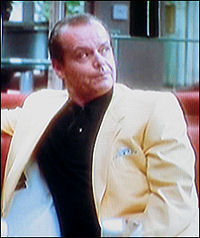
I have this rough theory that leading men who’ve established themselves as appealing good guys and/or made it as movie stars shouldn’t play villains until they’re at least 45 or 50 (a la Jack Nicholson in The Shining and Batman, Harrison Ford in What Lies Beneath and Willem Dafoe in Speed 2: Cruise Control), and that an even better time to get into bad-guy roles is when your career is on the way down, or at least when it’s starting to lose altitude.


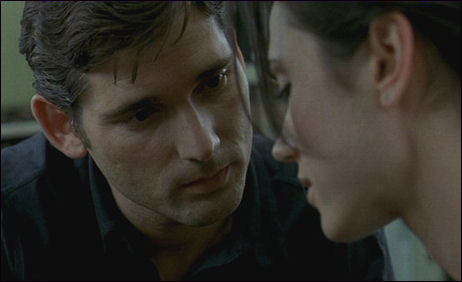
Eric Bana in Hulk

There are exceptions to every hard and fast rule, of course, so I’m not saying others haven’t played baddies (not flawed protagonists, but deep-dyed villains) at earlier ages and reverted right back to hero roles, but it’s relatively rare.

You can break into the big time playing a sexy, charismatic villain, of course — James Cagney and Humphrey Bogart did this, of course, and George Clooney began this way in From Dusk to Dawn — and then switch over to good-guy roles. But when a relatively young actor accepts a villain role after starring in only five or six features, the industry regards this as a kind of message. “I may not be a bona fide movie star after all,” it says, “and I may even be a character actor, or at least I’m willing to think of myself that way. The important thing is to act, to work…that’s what I care about. And if that means playing bad guys, cool.”

This is my reaction to Taiiana Siegel‘s Variety story about Eric Bana having signed on to play a vlilain called “Nero” in J.J. AbramsStar Trek or Paramount. I really liked Bana in Lucky You and consider his performance in Chopper an absolute classic. I believe that he took a hit, however, from the triple-whammy of Troy (playing a character whose indecisiveness with his randy brother Paris helped bring about the Trojan War), Hulk (obvious reasons) and Munich (that bizarre sex scene at the end), and he never quite recovered, especially if you throw in the financial failure of Lucky You.

I’m trying to be dispassionate and just pass along what I got from Siegel’s story without dumping on Bana, whom I genuinely like. Is there a message in this or not?

Theron spoiler confirmed

Charlize Theron‘s “sexiest woman of the year” designation by Esquire was spoiled by yours truly on 9.2 (and with great delight since I despise the long tease that leads up to the final reveal), and has now been announced in a press release and tapped out for the 10.11 issue of the Hollywood Reporter.

Revival of ’70s films

“Cue the wah-wah pedal and widen those lapels,” writes Washington Post columnist Ann Hornaday, because “the ’70s are back, at least at the movies.” She mainly talks about Tony Gilroy‘s Michael Clayton, which has a kind ’70s Gordon Willis-y vibe, and also lists The Brave One (Jodie Foster channeling Charles Bronson), In The Valley of Elah (with its echoes of Coming Home and The Deer Hunter), and director James Gray including a French Connection-like car chase in We Own the Night. But she omits the biggest and best ’70s movie of the season — Ridley Scott‘s American Gangster.

“Il Grido” at New Beverly

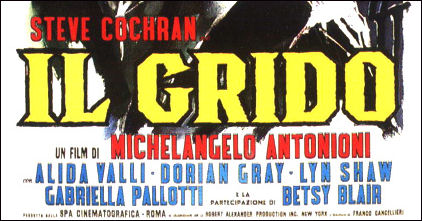
In the 1950s, Michelangelo Antonioni began to make features in the ’50s “that considered film’s capacity for visualizing interior states of mind,” writes L.A. Weekly contributor Robert Koehler about Il grido, which screens tonight and tomorrow at L.A.’s New Beverly cinema.

“As a tale of factory worker Aldo (American actor Steve Cochran), who has a breakup with his longtime lover Irma (Alida Valli) and leaves home with his young daughter to get a new grasp on life, the film cunningly borrows many neorealist tropes and then rattles them until they splinter.

“Viewers may at first think they’ve stumbled into a Vittorio De Sica movie involving struggling laborers and their cute kids, but the odyssey here proceeds not toward a final enlightenment or insight, but outward through vast, limitless landscapes that Antonioni brilliantly conceives as physical correlatives for Cochran’s state of mind.”

Scott on “Control”

“You don’t have to know anything about Joy Division to grasp the mysterious sorrow at the heart” of Anton Corbijn’s Control, writes N.Y. Times critic A.O. Scott. “No doubt aware of what this movie will mean to devotees of post-punk melancholy, [Corbijn] sticks to the human dimensions of the narrative rather than turning out yet another show business fable. Where it might have been literal-minded and sentimental, Control is instead enigmatic and moving, much in the manner of Joy Division’s best songs.”

Scott declares that Sam Riley, the “hollow-eyed and gentle-looking” portrayer of the late Joy Division singer Ian Curtis, “is crucial to the film’s effectiveness. Since Curtis is known more by his deep, plangent voice than by his face or his physical presence, Riley does not labor under the burden of mimicry. His performance is quiet, charismatic and a little opaque, in keeping with the movie’s careful, detached approach to its subject.”

More “Jesse James” ambushes

I’ve been sent two more reports of Jesse James dissing by Warner Bros. distribution execs — one from Las Vegas Review Journal critic Carol Cling, another from Salt Lake Tribune critic Sean Means.

Cling says she received an e-mail from Phoenix-based Allied Advertising (which handles screenings etc. for the Las Vegas market) two days ago, saying he/she had just heard that The Assassination of Jesse James by the Coward Robert Ford “will be opening this Friday! If possible, I would like to set a press screening, but I think it may be too late…let me know if there’s still time.”

Cling’s account of what happened after this is confusing (to me anyway), but the bottom line is that she couldn’t work in the James screening or a review of Andrew Dominik‘s film by her Tuesday deadline.

“Now I’ll have to check out Jesse James on my own time,” she says. “Not that I mind, but this is exactly the kind of movie that needs critical support, and the studio seems to be doing everything they can to subvert that.”

Means wrote today that The Assassination of Jesse James “is getting good reviews, scoring a 73 percent on Rotten Tomatoes and an A in Entertainment Weekly. It’s got Brad Pitt in it, for heaven’s sake…so why is Warner Bros. giving it the shaft?

“The movie, is slated to open this Friday in more cities, including in the Salt Lake City area. That was news to Salt Lake critics, who were informed Monday morning by Warner Bros.’ regional representatives in Denver. Those reps, God bless ’em, have scrambled to set up a press screening so the Salt Lake critics could see and review the film.

“Alas, their efforts seemingly have been sabotaged by the studio, which can’t seem to find a print available for a pre-screening. At the moment, there’s hope for a Thursday late-morning screening — almost too late for most papers’ deadlines — but nothing confirmed.”

Plus the Newark Star Ledger‘s Stephen Whitty has linked today to the mishegoss and threw in some comments.

“Walk Hard” David Carr piece

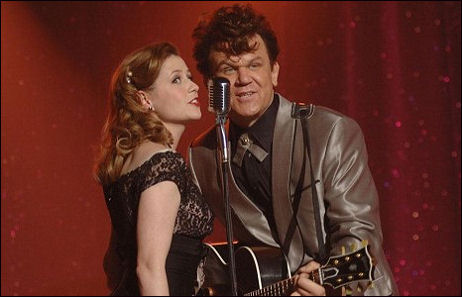
In a piece that reviews all the recent pop-music docs, dramas and biopics, N.Y. Times columnist David Carr mentions Walk Hard: The Dewey Cox Story (Sony, 12.21), the mock biopic in which John C. Reilly plays a Johnny Cash-like musician.

Carr says that “one of the surest signs that a trend is under way is that it has become worthy of parody,” and this Judd Apatow-produced, Jake Kasdan-directed satire “riffs through many of the genre’s tendencies.”

The article makes it clear that Carr has been shown a Walk Hard clip and heard a few songs from the film. (Probably the same clip and song selection being shown to L.A. journos tomorrow.) Apatow tells Carr in a phoner that music biopics are all cut from the same cloth.

“A small-town person grows up amidst a tragedy in his family, becomes a star, cheats on his first wife, goes into rehab, falls in love, cheats on his second wife, then sobers up again, experiences a final triumph and passes away peacefully or dies horribly,” Apatow said. “We all know these stories from VH1’s ‘Behind the Music,’ and even though we know what to expect, we still love watching them.”

We do, huh?

Reactions to “James” distribution

The reactions to yesterday’s report from Pheonix writer/critic Henry Cabot Beck that Pheonix critics are being denied a chance to see The Assassination of Jesse James by the Coward Robert Ford indicate that local Warner Bros. distributors are giving Andrew Dominik‘s film the bum’s rush in fairly uniform fashion around the country. As Arizona Daily Star critic Phil Villarreal remarks, “It’s the Assassination of Jesse James by the Cowards at Warner Bros.”

The Oregonian‘s Shawn Levy has written about not getting a chance to review it in time. Villarreal and Houston-based critic-blogger Joe Leydon have also reported that Warner Bros. reps are either not screening it or screening it late. The whole James effort is clearly half-hearted. One reader claimed “they’ve yet to even announce a release date for Montreal, and we’re one of the Top 10 markets in North America!”

I wrote Warner Bros. reps this morning about speaking with WB distribution president Dan Fellman about these numerous complaints.

As Levy wrote, “I can only respond with scorn to the spectacle of Warner Bros. treating their film with such dismissiveness and disdain. This was a film that received lots of publicity before its release and had a $30 million production budget (plus prints and ads — which, let’s face it, don’t cost as much when you dump the movie like this) . The reviews have been favorable from both critics and audiences. IT’S GOT BRAD PITT IN IT, for pity’s sake. Yet Warner Bros. sneaks it into Portland. With this butterfingered, half-hearted, dead-brained stealth release, they’re making their film impossible for audiences to find.”

Villarreal said that “the same situation has happened in Tucson, where I’m the morning paper’s critic. I was asked yesterday afternoon if I was interested in seeing the film on short notice, said yes, then heard nothing back.”

Robinov responds to Finke’s report

Having no doubt heard from numerous irate female producers and representatives of various big-name actresses over Nikki Finke‘s 10.5 report that Warner Bros. is “no longer doing movies with women in the lead,” production president Jeff Robinov has told Variety‘s Anne Thompson that he’s not only “moving forward with several movies with women in the lead,” but is also “offended by rumors of his cinematic misogyny.”
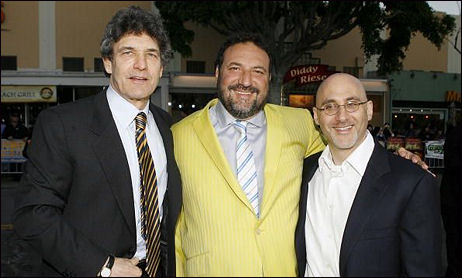

Warner Bros. honcho Alan Horn, producer Joel Silver, production prexy Jeff Robinov

Thompson’s story, which went up last night at 7:30 pm, didn’t mention Finke or her column, alluding instead to “recent reports in the blogosphere.” In fact there was one report (Finke’s) and some reaction pieces.

In fact, what Robinov has told Thompson doesn’t specifically dispute what Finke reported, which I took to mean that Warner Bros. is now thinking twice about greenlighting movies in which women are the absolute stand-alone leads, particularly films in the action realm. The various projects Robinov mentioned to Thompson all have strong parts for women, but none that fit this precise definition. (Robinov saying that he’s “still seeking the right script and star for a Wonder Woman feature, which has been in development for a decade” is well and good, but earnest intentions and $1.50 will get you a bus ticket.)

My riff last Sunday voiced a suspicion that Robinov probably didn’t say what the sometimes strident and simplistic Finke reported, speculating that “Finke’s interpretation of what Robinov actually said (or may have said) probably misses certain shadings and qualifications.”

I doubt that Finke made up Robinov’s alleged statement or sentiment out of whole cloth. He probably expressed disappointment about the revenues brought in by three recent WB female actioners — The Brave One, The Invasion and The Reaping — and perhaps voiced some offhanded remark to an agent or a producer about femme-topped action films that he’s since come to regret.

Robinov made a strong case in Thompson’s piece about making (or intending to make) movies with strong female roles, but he didn’t name any current or hoped-for projects in which women are the clear and unchallenged lead (as, say, Jodie Foster is in The Brave One), and certainly none in the action genre, which is generally thought to be a male-driven thing both in front of and behind the camera, and in terms of moviegoers.

Robinov reminded Thompson about the Wonder Woman character being a prominent player in The Justice League and that Silk Spectre “leads” in Alan Moore‘s Watchmen. He also mentioned female co-stars in the upcoming Speed Racer and Get Smart.

Robinov said Warner Bros. is definitely still making chick flicks and hetero romantic comedies. He mentioned a Sisterhood of the Traveling Pants sequel, an adaptation of the Nicholas Sparks novel Nights in Rodanthe with Diane Lane and Richard Gere, a fish-out-of-water comedy about female students called Spring Breakdown, and a romantic comedy called Fool’s Gold with Kate Hudson and Matthew McConaughey.

Robinov also said he would “happily” make Nikki Caro and Charlize Theron‘s North Country again (even though it bombed), and that he wanted to produce Peter Jackson‘s The Lovely Bones, which is about a young girl, and the Sex in the City movie.

I said last Sunday that “sweeping statements of any kind are unwise” and that “they usually make the speaker sound stupid or short-sighted.” MCN’s David Poland was quoted by Showbuzz, a CBS News website, as saying that what Robinov “may have said out loud to an agent was probably indiscreet and stupid” and that “you probably shouldn’t cut yourself off from any genre or niche and say we’re not doing that anymore.”

Read more

Depalma, “Redacted” legal issue with Magnolia

Yesterday Brian DePalma and Magnolia’s Eammon Bowles debated the issue of certain grisly photographs of Iraq casualties having been removed from the end of DePalma’s Redacted due to concerns about legal vulnerability. The discussion happened at a N.Y. Film Festival press conference held yesterday afternoon. Movie City Indie’s Ray Pride has posted good information about this, including a statement from Bowles.