“Dan in Real Life”

Variety‘s Joe Leydon is calling Peter HedgesDan in Real Life, which had a nationwide sneak preview last night, “gracefully understated and thoroughly engaging…a pleasant surprise.”

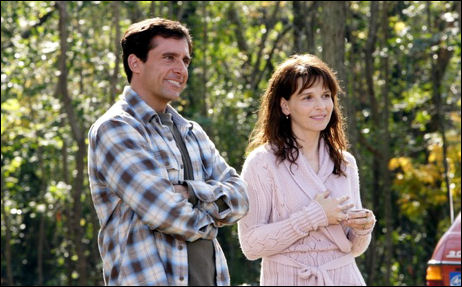
With Steve Carell and Juliette Binoche playing 40ish types who who fall inconveniently in love, pic “deftly interlaces heart and humor in a witty, warm and well-observed comedy about the unexpected and inconvenient blooming of romance at the weekend gathering of an extended family.

The film “more than fulfills the promise evidenced in Hedges’ Pieces of April. From a B.O. perspective, his follow-up has the potential to delight a demographically diverse audience, and generate enough favorable word of mouth to register as one of the fall’s true sleepers.

“It’s intended as high praise to note that, in sharp contrast to most other recent American-made laffers, there’s a decidedly European air to Hedges’ effort. Indeed, it’s not at all difficult to imagine, say, Daniel Auteuil in the lead role winningly played here by Carell.”

Hippie films

Last month British director Beeban Kidron (Bridget Jones: The Edge of Reason) began shooting Hippie Hippie Shake, about the adventures of Richard Neville, the publisher/editor of a famed counter-culture magazine called Oz that caught the airy-fairy mood and merriment of late ’60s London. (It actually published from ’67 to ’73.) Universal will probably open it sometime in the fall of ’08.


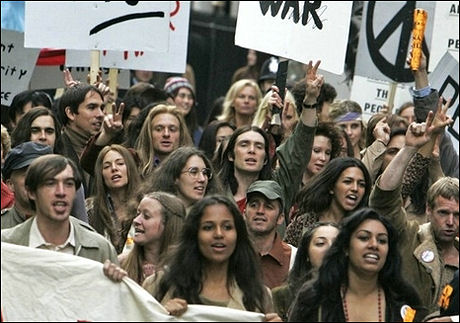
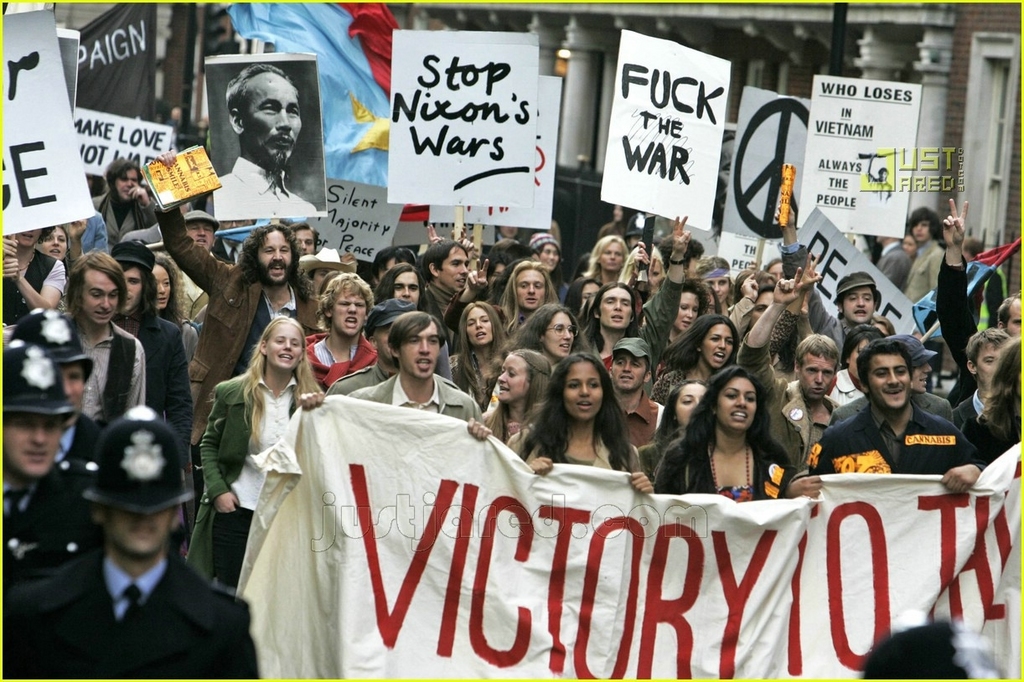
Sienna Miller, Cillian Murphy among anti-war protestors in Beeban Kidron’s Hippie Hippie Shake

Written by Lee Hall and William Nicholson and based on Neville’s same-titled 1996 memoir, the film will focus on (a) the magazine’s general ups and downs, (b) an obscenity trail that resulted from Neville (Cillian Murphy) and colleagues distributing a certain sexually explicit issue, and (c) the relationship between Neville and girlfriend Louise Ferrier (Sienna Murphy).

I’d love to see this Tim Bevan-Eric Fellner production do it right, but haven’t hippie films always been a problem? Isn’t there some kind of curse upon any film trying to reenact or reconstitute that old love beads-slash-Bhagavad Gita-slash- Moody Blues vibe? Isn’t there something immensely difficult if not impossible in trying to make that incense-and-peppermints chemistry seem palatable by the standards of 21st Century culture?

Julie Taymor‘s Across the Universe, Robert ZemeckisForrest Gump, Oliver Stone‘s The Doors…what other films over the last 15 or 20 years have gone back there? Has any ’60s-era film felt half as authentic as Control does in its recreation of early to late ’70s England?

The potential for hippie-film awfulness is huge. I guess I’m thinking of stinkers like Ernest Thompson‘s 1969 and Rob Cohen‘s A Small Circle fo Friends, and Larry Kasdan‘s decision to chop off the flashback sequence in The Big Chill because (according to legend) everyone looked vaguely silly in their hippie haircuts and tie-dyed T-shirts.


Miller during Hippie Hippie Shake shooting last month

The most in-the-pocket depiction of ’60s vibes and attitudes came from five films — Blow Up, Easy Rider, M.A.S.H. (set in early 1952 Korea but totally informed by Los Angeles hipster attitudes of 15 years hence), Who’ll Stop The Rain? and Platoon.

Note: In the above protest-march photo, three darker-skinned women of an apparent Middle Eastern heritage are visible. This in itself makes Kidron’s film seem slightly inauthentic. People of Middle Eastern ancestry (Indian, Pakistani, Iranian) are quite numerous in greater London today, but their numbers were smaller in the late ’60s plus the strictness of their family and neighborhood culture has always discouraged outside fraternization and cross-fertilization, particularly with those of an anti-traditional counter-culture bent, and particularly among women.

Lim on Lumet

“Most directors do not go on to make one of their best films after receiving their lifetime achievement Oscars,” Dennis Lim‘s 10.21 N.Y. Times piece begins. “But then, most directors do not have the near-legendary stamina and efficiency of Sidney Lumet, who accepted his honorary Academy Award two years ago, turned 83 in June and now has made 44 features in 50 years. His latest, a bracingly bleak crime melodrama called Before the Devil Knows You’re Dead (opening Friday in NY and LA), has been upstaging filmmakers less than half his age on the festival circuit this fall.”

Time does McCarthy, the Coens

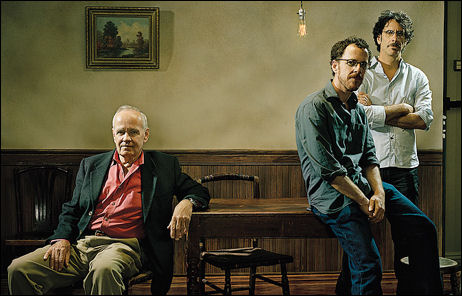
Time‘s Lev Grossman orchestrated and presumably edited a q & a discussion between Cormac McCarthy, author of the novel of No Country for Old Men, and director-writers Joel and Ethan Coen, who made the immaculate film version, but he wasn’t allowed to participate verbally. Because McCarthy is extremely press shy, Grossman had to sit on the couch and just listen.

What resulted is an okay thing, but it might have been better with a pushy journalist asking intrusive questions from time to time. An extra pair of editor eyes would have helped as far as the photo caption is concerned. On Sunday afternoon, it identified the filmmakers as Joel and Ethan “Cohen.”

In the same issue, Richard Corliss reviews the 11.9 Miramax release and says “it’s a shame” it doesn’t open until after Halloween “since it has a villain crazier, scarier and more implacable than any horror ghoul.

“As incarnated by the great Javier Bardem, Anton Chigurh is a killer from hell who likes to play mind games with his victims before he makes them play dead. How could an ordinary fellow like Llewelyn Moss (Josh Brolin) hope to elude this monster, when Moss has $2 million that Chigurh plans to get back without saying please?

“Even when Joel and Ethan Coen are writing originals, their movies often have the texture and density of novels. For their first official adaptation from a prime American author, they have stayed remarkably faithful to the Cormac McCarthy story, including a detour at the end that will baffle some viewers.

“But the rest is tough, tangy and thrilling — perfect scenes of rising tension, wily escapes, fatal face-offs. There’s one moment (it’s just a phone ringing downstairs) that will churn your blood and turn it cold, and plenty other frissons that could make this the biggest hit of the Coens’ sly career.”

McCarthy on “Gangster”

I respectfully disagree with Todd McCarthy‘s half-positive, half-dismissive Variety review of Ridley Scott‘s American Gangster, and his view in particular that “maximizing a gritty big-city story requires a credibility composed of thousands of small details, and this is one area where a citizen-of-the-world director like Scott can’t excel.”


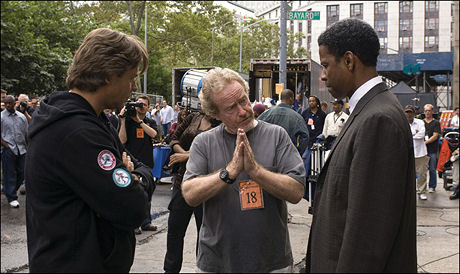
(l. to r.) Russell Crowe, Ridley Scott, Denzel Washington during the making of American Gangster

The situation, he says, is “akin to asking [Sidney] Lumet or [Martin] Scorsese to make a definitive film about crime in ’70s Newcastle — they could do a respectable, even exciting job of it, but it probably wouldn’t ring deeply true.”

But it does ring true. For me, anyway. Brits are famous for delivering American-set crime dramas with great chops and authenticity (as Karel Reisz managed with Who’ll Stop the Rain and John Boorman did with Point Blank), and this is one of those cases. I believed every New York second of American Gangster. For my money, Scott has not only skillfully channelled Lumet and Scorsese but the entire hallowed universe of ’70s urban filmmaking.

American Gangster wants to be a great epic crime saga so badly you can feel it,” McCarthy says. “The true story at its core — of the rise, fall and redemption of a ’70s-era Harlem drug lord — is so terrific, it’s amazing it wasn’t put onscreen long ago, and it would be difficult today to find two better actors to pit against one another, as hoodlum and cop, respectively, than Denzel Washington and Russell Crowe.

“With so many elements going for it, this big, fat Universal release is absorbing, exciting at times and undeniably entertaining, and is poised to be a major commercial hit. But great it’s not.

“Memories of numerous classics hang over this film like banners commemorating past championship teams — The Godfather, Serpico, Prince of the City,, Scarface and Goodfellas, among other modern-era crime-pic landmarks. Like most of those, this is a quintessential New York story, one you feel could have been the basis for a Sidney Lumet masterpiece.

“But while American Gangster is made with consummate professionalism on every level, it just doesn’t quite feel like the real deal; it delivers, but doesn’t soar.”

Softball Seinfeld profile

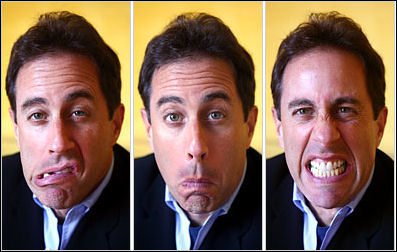
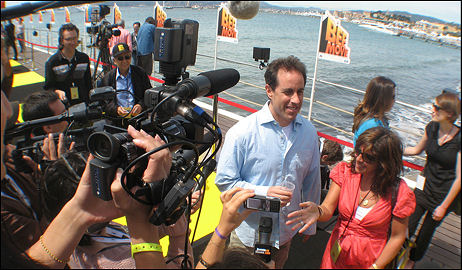
Jerry Seinfeld‘s Bee Movie opens a week from Friday (11.2) and nobody’s seen or said a thing about it. Except for what was said and shown at the big Cannes Film Festival promotion five and a half months ago. The first screenings aren’t happening until Tuesday, 10.30 and Wednesday, 10.31. The only thing to go on today is a softball Seinfeld profile by N.Y. Times guy David Itzkoff.

The best part of the piece explains how Seinfeld “can be affable with fans, but he doesn’t hide a certain earned arrogance. When one stunned onlooker [at a restaurant] asked for his autograph, Seinfeld said, ‘Sure’…then kept walking straight to his table.”

“While attending the United States Open tennis tournament, Seinfeld recalled, he was approached by a well-attired fan who handed him a business card and invited Seinfeld to visit his brokerage house. Both men became noticeably perplexed when the offer was declined. ‘I said, we don’t know each other. You’re a total stranger,’ Seinfeld recounted. ‘He says, but we really like you. I said, thank you so much, but this is as far as we go.'”

“Seinfeld adds: ‘This is a sophisticated guy that doesn’t understand the TV only works one way.'”

Bee Movie is about Barry B. Benson (Seinfeld), a bee who’s not happy with the idea of just making honey for the rest of his life. One day he gets to leave the hive on a honeysuckle mission in Manhattan’s Central Park, and eventually runs into humans who try to swat him to death.

Barry is nearly all in at one point when he’s saved by Vanessa (Renee Zellweger), with whom he promptly falls in love. (Kind of a King Kong-Ann Darrell romance in reverse.) Then he decides to talk to her. In English, that is. Then he learns about the human honey business, and decides that humans are ripping off the bees in order to do so, and so files a lawsuit to try and prevent this.

As I wrote last May, “I like ‘silly’ if the movie really goes for it whole-hog.”

Ryan Gosling problem

I stood below the Sunset 5 marquee yesterday evening just before 9 pm, trying to talk myself into seeing Lars and the Real Girl. And once again, for the seventh or eighth time, I said “naaah, later.” A movie journalist repeatedly missing showings of a respected, well-reviewed film like Lars is obviously derelict, but the truth is that I’ve been avoiding it because of my Ryan Gosling problem, which is hard to describe.
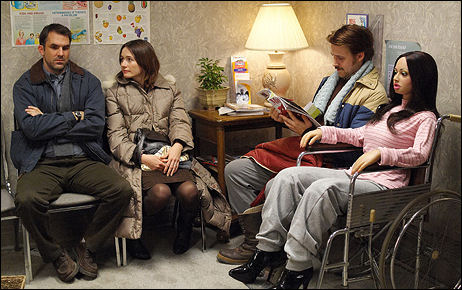

Paul Schneider, Emily Mortimer, Ryan Gosling in Lars and the Real Girl

I agree that he’s one of our very best actors of any age — some have called him the new Brando — and yet there’s something about Gosling’s look and manner that has always seemed a bit odd in a visitor-from-another-planet sort of way. To me, he’s always seemed distant and self-regarding. There’s no doubting that every performance he gives is some kind of brilliant, but in my delusional-fan way of absorbing things I’ve never wanted to hang out with the guy. It’s not that I find him dislikable as much as lacking a certain chemical component that I would want in my life.

This is compounded by Gosling having put on weight, grown a blue-collar mous- tache and worn flannel shirts — three style choices I have always had major problems with — for his part in Lars and the Real Girl. It’s obviously a neurotic affliction, but I can’t stand to look at, much less wear, flannel shirts. Strange as this sounds, if I see some some dumpy guy in a bar wearing a flannel shirt I will either go to the other side of the room or leave altogether. Especially if he’s wearing a moustache.

These reactions are aggravated when the wearer is also going with the whole unshaven, slightly greasy-looking rural or suburban working-guy fashion trip, lace-up work boots and all. I know about that mode of appearance — I’ve known dozens of guys who look and dress and live like this — and I want as little to do with it as possible when I go to movies. That may not sound “fair” but that’s how it is.

Plus the idea of a doofus who carries a love doll around is repellent to me. Why should I invest two hours of my time in a guy whose emotional state is this far off the planet?

I realize that it doesn’t get any shallower than when you process a film according to obvious subject matter. I rail against people refusing to see films because of some gut disinterest in subject matter, and here I am doing this very thing. I have no excuse, no defense. I will somehow make myself see Lars and the Real Girl soon, but I may as well be honest and admit that it’s been a real struggle.

“Don’t feel too badly about missing Lars and the Real Girl,” a big-city critic writes. “I found it frankly disgusting, and I don’t think of myself as a prude or conservative. I wonder about what’s missing in the lives of critics who see this film as some kind of affirmation of life.

“It’s about a grown man having a romantic relationship with a plastic doll. He’s a very sick individual, yet the movie wants us to think he can be cured if everybody just tolerates his quirk until he sorts things out.

“No way would an entire town put up with this nonsense. If this were the real world, Lars would be committed pronto, or run out on a rail before Aunt Bea had time to bake a batch of brownies.”

Hillary’s Bargain

“In her acid flashback of a new book, ‘For Love of Politics,’ Sally Bedell Smith describes how First Lady Hillary routinely unmanned Bill and his aides, and engaged in sharp spurts of temper that sparked his temper.

“‘Hillary’s anger was bound up in the intricacies of her marital bargain, which engendered rivalry and resentment along with mutual dependence,’ Ms. Smith writes. Political power was her reward for his marital infidelity.

“When Bill explains why Hillary should be president, his subtext is clear: We owe it to her for all she put up with from me.” — from today’s (10.21) < strong>Maureen Dowd/N.Y. Times column, titled “Cougars, Archers, Snipers.”

Cotillard re-launches Piaf campaign

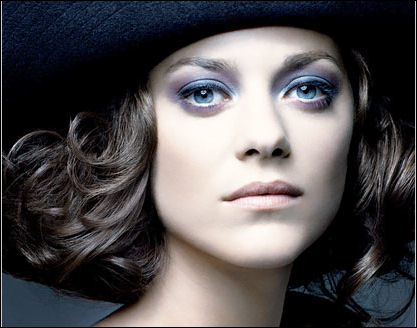
La Vie en Rose director-writer Olivier Dahan “wrote the script with me in mind. I never knew why, but then he told journalists, ‘There was something about Marion’s eyes.’ He saw some tragedy in my eyes, something terribly sad that reminded him of [Edith] Piaf.


La Vie en Rose star Marion Cotillard

“And I have to say, I did feel close to her. As an actress, I could understand her behavior. That made me less afraid of playing an icon that so many people love.

“In the end, a role this huge is like the biggest present. So your initial fear becomes a fake fear — just a manifestation of your ego. I didn’t want to waste my time asking myself, Will I be good or not good? I realized I just had to have less ego and do more work.” — Marion Cotillard speaking to N.Y. Times questioner Lynn Hirschberg in today’s (10.21) N.Y. Times (a.k.a. “T”) magazine.

The idea in speaking to Hirschberg (and in posing in an assortment of high-style dresses that accompany the q & a) is to re-launch Cotillard’s Best Actress campaign, which began for many journalists like myself six months ago with early screenings, a 4.17 Los Angeles press junket and an appearance by Cotillard and Dahan at the City of Light/City of Angels Film Festival at the DGA theatre.

La Vie en Rose, I wrote on 4.18, “is essential viewing for one reason and one reason only — Cotillard’s bracingly vivid, wholly convincing, almost mind-blowingly hardcore performance as Piaf.


At L.A.’s City of Light/City of Angels Film Festival last April

“Cotillard so physically resembles the diminutive Piaf — a frail, sparrow-like woman who stood only 4 foot seven inches — and so burrows inside this legendary singer’s aura of hurt in nearly every stage of her life that she blows you away in almost every scene. I’m making it sound like an overbearing performance but it’s not, trust me.

Matthew Smith‘s prosthetic makeup is certainly part of the effect, but Cotillard’s performance would be nothing without her capturing Piaf’s spiritual essence (or at least, what I’ve always believed that spiritual essence amounted to) . The result is one of those amazing-transformation, De Niro-as-Jake La Motta performances that automatically gets Oscar attention. 2007 isn’t quite one-third gone, but there’s no way in hell Cotillard won’t be Best Actress-nominated.

“It’s not in the least bit significant that Cotillard is 5′ 6 and 1/2 inches, or nearly a full foot taller than Piaf, since almost no one watching this film is likely to know this or be aware of any height discrepancy anyway. But it is significant that everything she says and does as Piaf is a complete immersion, an exceptional revisiting…an absolute knockout.”

Vicky Christina Barcelona

This 10.19 Hollywood Reporter story about the title of Woody Allen‘s next film is, I’m sure, a mistake. Allen would never call anything Vicky Cristina Barcelona. Even for a film that described as a “love letter to Barcelona,” it’s just too awful sounding. Scarlett Johansson, Penelope Cruz and Javier Bardem costar.

Inglorious Bastards?

Is Toronto Star critic Peter Howell really sure that Quentin Tarantino is actually going to make Inglorious Bastards, a Dirty Dozen-ish World War II flick with Tim Roth and Michael Madsen, much less deliver it sometime in ’08? He’s been talking about making this film for years and years.

What he seems to do, mainly, is talk about (a) what he’s going to do, (b) what he’s done, or (c) what other filmmakers have done. I realize that every three or four years he gets around to making a film, but I don’t trust Tarantino to deliver a movie on any kind of set schedule at all. That said, it would be great to see Inglorious Bastards sometime in ’09 or ’10, which is probably when Tarantino will get around to it.

Anderson’s “Weekend” remake

Dreams never seem as profound the next morning as they do when they’re running the show in your sleep, but I had a lulu of a dream last night that, if listened to and boldly acted upon, might lead to the resurrection of Wes Anderson‘s career with a single mad sweep of the brush and a sudden screech of tires.


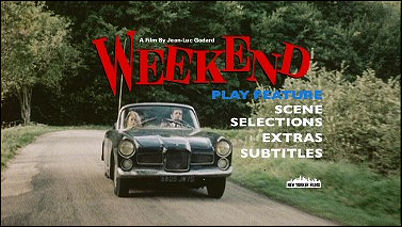
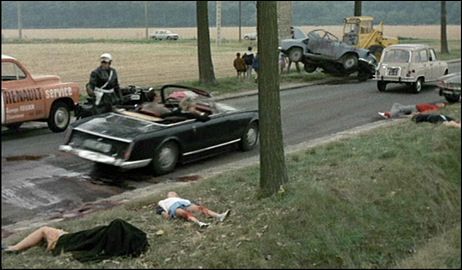
DVD frame-capture from Jean-Luc Godard’s Weekend

What Anderson needs to do more than anything else right now is to blow up “Andersonville,” that specially styled, ultra-hermetic world that his films and characters reside in. Being Wes, he naturally needs to do it with style. And the best way to do this, I’m convinced, is to make an arty black comedy about the world coming to an end on the rural two-lane blacktops, highways and freeways of America. Anderson, in short, needs to reimagine and then remake Jean-Luc Godard‘s Weekend.

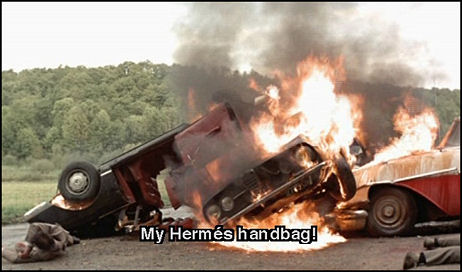
The original 1967 film, an allegory about the breakdown of civilization illustrated by traffic jams, random violence and bloody car crashes, is regarded by some as Godard’s finest.

I saw shots from Anderson’s Weekend in the dream, and that carefully choreo- graphed, super-manicured visual quality he brings to each and every scene in his films would, I believe, work perfectly with a vision of death, anarchy and twisted metal on the road. The film was fully completed in the dream (I saw it in a small red screening room in Paris, sitting in a large velvet armchair), and it was great viewing.

As I watched Anderson’s camera track along the highway and gaze at the flaming SUVs and scooters and bodies of Bill Murray, Natalie Portman, Anjelica Huston and Jason Schwartzman lying every which way I knew I was seeing a kind of genius. I was awestruck. Only a madman would have made such a film in the wake of The Darjeeling Limited, and I was filled with respect for Anderson’s artistic courage.

I’m not saying Anderson’s Weekend would be commercial or even critically hailed. But after making such a film, Anderson would be free. He would no longer be the guy with the Dalmatian mice and the pet cobras and the velvet curtains and the characters lugging around specially-designed suitcases with all the Kinks and Rolling Stones and Nico songs on the soundtrack.

It is widely agreed by movie cognescenti that Anderson has allowed his films to be consumed by a deadpan mannerist attitude along with a certain style-and-design mania, which Esquire‘s David Walters believes has devolved from a signature into “schtick.” By making movies about “world-weary fellows” with money “who hurl non-sequiturs and charm with endearing peccadilloes and aberrant behavior” in a world-apart realm, he has painted himself into a corner.

Only a radical new turn can free Wes from his effete parlor passions. If not a Weekend remake then something equally nutso. He has to say to his audience (and himself), “To hell with this world I’ve made for myself. I am no longer the maestro of that tweedle-dee symphony. I am a new man on an untravelled path.”