Minor Cannes Advantage

The only tactical advantage to seeing Indiana Jones and the Kingdom of the Crystal Skull in Cannes on 5.18 is that critics there will have a jump on those seeing it stateside by perhaps as little as seven or eight hours.

The Cannes press screening will happen at 8:30 am with reviews going up an hour or so after it ends at 10:35 am — make that 11:30 am to 12 noon, Cote d’Azur time. That’s 6:30 am to 7 am New York time, and 3:30 am to 4 am L.A. time. If U.S. domestic screenings happen in the evening, the word from Cannes will be exclusive for two-thirds of a day, give or take. Obviously less so if they happen in the afternoon. I’m hearing that U.S. screenings may begin around noon or 1 pm in the east.

Absent The Will

One of the best critics in the business, Matt Zoller Seitz, who’s recently been doing freelance reviews for the N.Y. Times, has decided to bail on the profession in order to be a filmmaker. His comments about this decision suggest he also wants to absorb life in less neurotic, more open-pored terms. You know…a little of that Frank Capra-esque, final-ten-minutes-of-It’s a Wonderful Life quality from time to time.


Matt Zoller Seitz

Seitz seems to think that a film critic’s life doesn’t provide enough in the way of cleansing “happiness moments,” like what some people get from walking in the woods or watching basketball or going bowling or murdering a deer in the forest with a high-powered rifle.
Well, it’s not supposed to do that…hello? If you’ve been lucky enough to be called to the profession of film criticism (or any profession that most people are unable to do for lack of talent or persistence or both), then you do that thing until you die at your desk — simple. And no moaning.
“There’s more to life than movies,” Seitz tells colleague Keith Uhlich, “and I don’t think that, ten years ago, I don’t think I would have said that. But I’m saying it now: there is more to life than movies.
“And I remember a conversation with Sean Burns — I think it might have been in the comments section of the blog — he casually mentioned that Gene Siskel, God rest his soul, was… there was somebody who looked down on Siskel for saying that he skipped some film festival to go to a basketball game. And Burns was completely approving of [Siskel], and I am too. I am too: Go to the goddamn basketball game!

“And when I look back on those hundreds and hundreds of hours that I spent watching movies — many of which were not that memorable, and many of which did not tell a whole lot that I didn’t know — when I realized that they were hours that are gone now and I’m not getting them back…it makes me mad. It makes me mad, honestly, that I’m not gonna get those hours back. You know those are hours I could have been spending with my family. With my loved ones.”
Family? Loved ones? Movies were invented, in part, so you can occasionally escape from these good people. Those near and dear are fine in their time slots (weeknight dinners, Sunday morning, Thanksgiving, the occasional outing or vacation) but “family and loved ones” are certainly not my source of peace or serenity on a day-to-day basis. If you want to be hard-but-honest about it, you could refer to “family” and “loved ones” as your jailers. If you want to go there, I mean. You certainly don’t have to, of course.

Misinformed

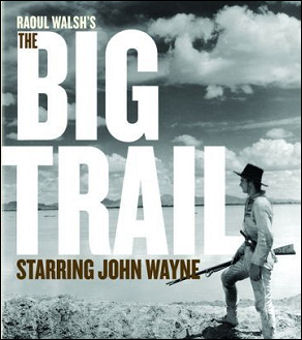
I was confused by two Amazon.com statistics regarding Fox Home Video’s 5.13 DVD release of Raoul Walsh‘s The Big Trail (1930). This staid, somewhat cornball John Wayne wagon-train western is immensely watchable due to its being the first Hollywood film to be shot and released in a 70mm widescreen format (which was called “Fox Grandeur”). The problem is that Amazon says the aspect ration is 1.85 when the true aspect ratio is 2.1 to 1. And the running time is given as 212 minutes despite the actual length (according to packaging) being 122 minutes.

Take no notice of the IMDB listing stating that the film’s varying running times are 125 min (35 mm version) and 158 min (70 mm version). Mordaunt Hall‘s N.Y. Times review (which ran on 10.25.30) mentions a Fox Movietone Newsreel as well as an “atmospheric prelude” to the feature. There’s your additional 26 minutes.

Gould Talk

Gothamist writer John Del Signore has posted an interview with Elliot Gould to discuss Richard LedesThe Caller, a Tribeca Film Festival pick in which Gould costars with Frank Langella and Laura Harring.
“I spoke with Jack Nicholson and told him I didn’t want to see The Bucket List,” Gould tells Del Signore. “I’m not a big fan of Rob Reiner. I respect Rob Reiner to some degree but, you know, Rob Reiner, whatever. I just didn’t want to see The Bucket List. It seemed so formulaic to me.
“But I told Jack I saw it anyway and I loved it. He was pleased to hear that and said to me, ‘I’m trying to change my attitude.’ And I said, ‘Oh?’ And he said, ‘Yeah, people are dying every month, every week.’ And I said, ‘Every day, Jack.’ It’s so mournful. There’s so much remorse and so much sorrow and I was so impressed because Jack’s very well read and I felt remorse.
“I really can’t consider being sorry for someone else because the only one you can be sorry for is yourself. And he said, ‘Oh, yeah that’s true.’ And I am never going to be sorry for myself. If I’ve done something that isn’t right I’ll make an adjustment. But to feel sorry for myself? Never. You know? So sometimes I get depressed but I won’t accept it. And I was depressed for a very, very long time; way before I got into movies. It is the way it is.
“When I was about 32 I was a very hot movie commodity, not knowing how it worked. I’ve realized that my problem when I fell out of favor in Hollywood was that I was unwilling and incapable of compromise. But I couldn’t come down and there was really no one there for me; everybody was just in business. But that was an opportunity and I can’t say that I have any complaints.
“This was during the early `70s. When I fell out was in February of 1971. [Note: a date concurrent with the release of Alan Arkin‘s Little Murders.] I didn’t know I had no perspective and I didn’t know I had no judgment. I just thought, ‘Here I am. I’m batting a thousand. I’m not going to fail. Why don’t you just follow me?’
“I didn’t know how political it was, that it was an industry, and that if I didn’t play ball on that level then that was that. I was so out there. You think you’re important? You think you have meaning? Boom. You’re dead meat. And you’re fucking crazy. I didn’t drown. I almost drowned in The Long Goodbye but I made it. I found my balance.
“There’s nothing of value other than what we have to share. And it’s one thing to share goodness and accomplishment and another thing to share a problem. And once people are willing and capable of communicating here like we are, then we can see that no one of us can have a problem another one of us didn’t have before. Therefore what we need to do is revolutionize and reorganize government so our government can evolve and really be what it was supposed to be at the beginning.”

Lido-Toronto Two-Step

Given persistent speculation about the Coen brothers’ Burn After Reading being destined to play at the 2008 Toronto Film Festival (9.4 to 9.13), it comes as no surprise that it’s now been chosen to open the 65th Venice Film Festival on 8.27. It’s a standard tactic for fall films with a modicum of class to do the old Lido-Toronto two-step prior to their commercial debut. Focus Features will open Burn stateside on 9.12. It will preem in the U.K. on 9.5.


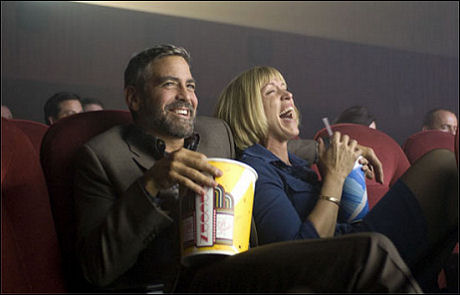
When is Focus going to release a decent assortment of stills from Burn After Reading? I’m getting sick of looking at this popcorn still over and over.

The third film in George Clooney‘s “idiot trilogy” (following his turns in the Coen’s O Brother, Where Art Thou? and Intolerable Cruelty), Burn After Reading, which the Coens wrote and directed, is about a couple of Washington, D.C. gym employees trying to shake down an ousted CIA official (John Malkovich) after they find a disc containing his inside-the-agency memoir.
I forget who plays the gym employees (read the script a long time ago and I wasn’t sure even then), but the costars are Brad Pitt, Frances McDormand, Tilda Swinton and Richard Jenkins.
Burn is a Working Title production, produced by Joel and Ethan and executive-produced by Working Title’s Tim Bevan, Eric Fellner and Robert Graf.

Slight Disparity

The only “hmmm” issue that may affect What Happens in Vegas is a cultural- chemical rapport thing, given that the Ashton Kutcher-Cameron Diaz romance may seem to some like an older-woman, younger-guy thing. (Which Kutcher is obviously familiar with in real life.) Kutcher turned 30 two months ago; Diaz is now 35. Thing is, Kutcher looks his age (if not a year or two younger) and she looks…well, like she’s almost nudging 40, no? The last time Diaz radiated anything close to a spring-chicken glow was when she costarred in There’s Something About Mary (’98).
It’s perfectly fine and cool for this kind of relationship to be depicted, of course. I don’t have any surveys to point to, but there are presumably plenty of slightly older women going out with slightly younger (or markedly younger) guys. It’s interesting. I can remember thinking when I was in my early 20s that the best women to know were in their early 30s — past the foolishness, earthier, more passionate, etc.

Remembering Jude

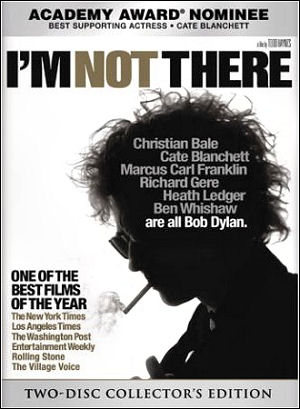
I still say Cate Blanchett should have won the Best Supporting Actress Oscar for her Dylan deal in I’m Not There — the most riveting, fascinating and feeling-ful peformance of 2007. The woman who did win….I can’t remember who that was. Thinking, thinking. It was Michael Clayton‘s Tilda Swinton but I had to look it up. She was very good, but I think her win was compensation because Clayton wasn’t going to win in any other big-five category and the Clayton lovers knew this, so Tilda was the lucky recipient.


I’m Not There DVD is out May 6th. Not a must-rent as much as a must-own.

“I will tell you right now — Cate Blanchett will win the Oscar,” George Clooney told the Associated Press last October about his Good German costar. “She’s the best actor working today. Not actress — she’s an actor. Intimidating, in a way, to work with an actor that good.”

Biodiesel Whatevs

Sean Penn‘s reason for appearing twice today at the Coachella Music Festival was to announce the Dirty Hands Caravan, a biodeisel caravan that will drive from Indio to New Orleans starting tomorrow Monday and is expected to arrive in New Orleans on May 4th for the city’s annual jazz festival.
“I see this as a reckoning,” Penn told the Hollywood Reporter‘s Leslie Simmons. “My generation and those that came before have to recognize the numbing of incentive that we’ve passed on to the change-hungry, imaginative, smarter-than-us youth of today.”

Respectable Past

Hillary Clinton “was in Chicago for three nights during the 1968 street confrontations. She chaired the 1970 Yale law school meeting where students voted to join a national student strike again an ‘unconscionable expansion of a war that should never have been waged.’ She was involved in the New Haven defense of Bobby Seale during his murder trial in 1970, as the lead scheduler of student monitors. She surely agreed with Yale president Kingman Brewster that a black revolutionary couldn’t get a fair trial in America. She wrote that abused children were citizens with the same rights as their parents.
“Most significantly in terms of her recent attacks on Barack Obama, after Yale law school Hillary went to work for the left-wing Bay Area law firm of Treuhaft, Walker and Burnstein, which specialized in Black Panthers and West Coast labor leaders prosecuted for being communists. Two of the firm’s partners, according to Treuhaft, were communists and the two others ‘tolerated communists.’ Then she went on to Washington to help impeach Richard Nixon, whose career was built on smearing and destroying the careers of people through vague insinuations about their backgrounds and associates.
“All these citations can be found in Carl Bernstein‘s sympathetic 2007 Clinton biography, A Woman in Charge.
“All these were honorable words and associations in my mind, but doesn’t she see how the Hillary of today would accuse the Hillary of the sixties of associating with black revolutionaries who fought gun battles with police officers, and defending pro-communist lawyers who backed communists? Doesn’t the Rev. Jeremiah Wright, whom Hillary attacks today, represent the very essence of the black radicals Hillary was associating with in those days? And isn’t the Hillary of today becoming the same kind of guilt-by-association insinuator as the Richard Nixon she worked to impeach?” — from Tom Hayden‘s Nation piece called “Why Hillary Makes My Wife Scream.”

Stupid Things

“In his 1991 book The Reasoning Voter, political scientist Samuel Popkin argued that most people make their choice on the basis of ‘low-information signaling’ — that is, stupid things like whether you know how to roll a bowling ball or wear an American-flag pin.” Or whether or not a political candidate seems like the kind of guy you can relax and have a beer with. I’ve read that Josef Stalin had a common-man touch. He could relate to Ukranian wheat-growers and their concerns. Not that this mattered in the Russia of the 1930s, ’40s and early ’50s.
“In the era of Republican dominance, the low-information signals were really low — how Michael Dukakis looked in a tanker’s helmet, whether John Kerry‘s favorite sports were too precious (like wind-surfing), whether Al Gore‘s debate sighs over his opponent’s simple obfuscations were patronizing. Bill Clinton was the lone Democratic master of low-information signaling — a love of McDonald’s and other assorted big-gulp appetites gave him credibility that even trumped his evasion of military service.” – from a depressing Joe Klein Time piece, dated 4.24, called “The Incredible Shrinking Democrats.”

Word From The Bunker

N.Y. Times reporter Michael Cieply has written a light-hearted, semi-whimsical piece about the persistence of big-business villains in modern movies — whatever. The odd thing is that Speed Racer producer Joel Silver declined to be interviewed for it. One images the reasoning: “Please…no light-hearted N.Y. Times articles about corporate villainy…leave us alone….the article might be slanted against the film!” The Wachowski brothers, true to form, also declined to be interviewed.