Snack and Debate


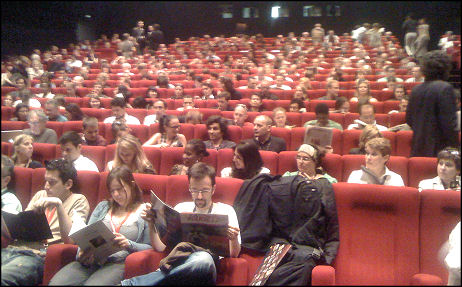
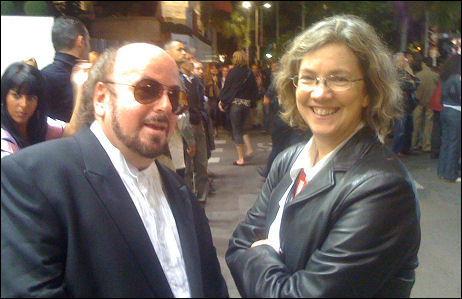
Tyson director James Toback, Variety‘s Anne Thompson about 15 minutes after last night’s Che screening — Wednesday, 5.21.08, 11:38 pm. They were both foursquare against me on the film. Not enough drama and emotion, said Thompson, and not commercial. “In the States it’s going to make about $5 million dollars,” said Toback. Che is not any kind of huge box-office hit waiting to happen — we all know that — but for guys like me (i.e., “Sodernerds”), the film is glorious.
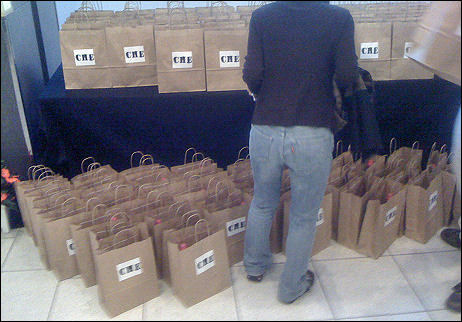
Complimentary snack bags, each containing a bland wonder-bread sandwich and a bottle of water — provided by the Wild Bunch marketers (perhaps by the same genius who arranged for the missing transportation to last night’s party!).
Bad Bunch

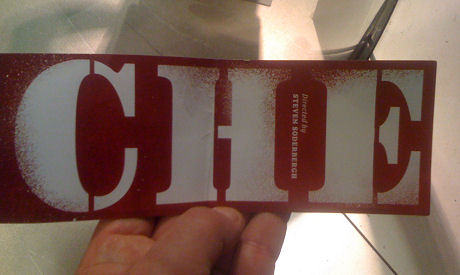
Whoever handled the transportation for the Wild Bunch’s Che party last night — i.e., arranging for rides from the front of the Miramar to Villa Murano, which is apparently way up in the damn hills — is inconsiderate and incompetent. The invitees were told to assemble on the corner in front of the Miramar. I arrived a little bit late (two women had been there for 20 minutes at that point), but for 40 minutes roughly 35 or 40 people waited around for a shuttle that never came.

Just after the 40- or 45-minute minute mark one lousy black SUV with the words “Villa Murano” pulled up and five or six people got in. That’s it? If the Wild Bunch person behind the transportation arrangements had for some reason intended to exasperate, insult and anger the invitees, this is exactly what he/she would have done. Congratulations, Wild Bunch!
I don’t know when I’ll find the time to sit down and write something longer and more exacting about Steven Soderbergh‘s Che movies — maybe this afternoon.

Rocchi Hearts Che

“I can’t predict how all of the questions and possibilities about Steven Soderbergh‘s Che will play out, but I can say — and will say — what a rare pleasure it is to have a film (or films) that, in our box-office obsessed, event-movie, Oscar-craving age, is actually worth talking about on so many levels,” writes Cinematical‘s James Rocchi.

“Bad biographical dramas try to tell you everything about a person’s life; good biographical dramas leave you inspired to find out the things not on-screen. Che is, by that yardstick, a very good biographical drama.
“To many, Che Guevara is an icon; to most, he’s an image on a t-shirt. To some, he’s a murderer; to others, an inspiration. Che (which I’ll use throughout this review to refer to both films for reasons of clarity) does not show us the man behind the T-shirt; instead, it takes the more interesting direction of showing us how the man wound up on the T-shirt.
“Che doesn’t wallow in Guevara’s personal life — this is how he felt, this is how he loved, this is what he believed, this made him what he is — but simply shows us some (not all) of the events in Guevara’s life and how they changed him and changed history.”

Guerilla Kills Also

The second half of Che, also known as Guerilla, just got out about a half-hour ago, and equally delighted although it’s a different kind of film — tighter, darker (naturally, given the story). But I’ve been arguing with some colleagues who don’t like either film at all, or don’t think it’s commercial. Glenn Kenny and Kim Voynar feel as I do, but Anne Thompson is on the other side of the Grand Canyon. Peter Howell is in the enemy camp also.

Che Is Brilliant

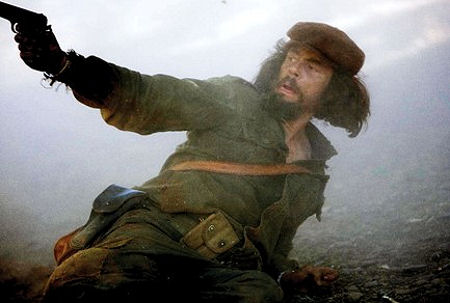
I know I predicted this based on a reading of Peter Buchman‘s script, but the first half of Steven Soderbergh‘s 268-minute Che Guevara epic is, for me, incandescent — a piece of full-on, you-are-there realism about the making of the Cuban revolution that I found utterly believable. Not just “take it to the bank” gripping, but levitational — for someone like myself it’s a kind of perfect dream movie. It’s also politically vibrant and searing — tells the “Che truth,” doesn’t mince words, doesn’t give you any “movie moments” (and God bless it for that).
It’s what I’d hoped for all along and more. The tale is the tale, and it’s told straight and true. Benicio del Toro‘s Guevara portrayal is, as expected, a flat-immersion that can’t be called a “performance” as much as…I don’t know, some kind of knock-down, ass-kick reviving of the dead. Being, not “acting.” I loved the lack of sentimentality in this thing, the electric sense that Soderbergh is providing a real semblance of what these two experiences — the successful Cuban revolution of ’57 and ’58, and the failed attempt to do the same in Boliva in ’67 — were actually like.
Oh, God…the second half is starting right now. The aspect ratio on the second film is 1.85 to 1, but the first film was in Scope 2.35 to 1.

Che Day

The most keenly anticipated film of the festival begins in two hours and 25 minutes. Four hours and 28 minutes plus a break between the two films, so figure five hours. I’m going to text a mini-review of Part One (i.e, The Argentine) during this break, and probably some kind of quickie judgment after the whole thing ends sometime around 11:30 pm. But a full-on review won’t happen until tomorrow morning.

Changeling, At Last


Prior to today’s 11:30 Changeling screening at the Salle de Soixentieme. It’s an Eastwood film, all right. Longish and leisurely (but not slovenly) paced. Delivers a keen sense of humanity and moral clarity. Offers a complex but rewarding story. Really nice music, as usual, that lends a feeling of warmth and assurance. Superbly acted, shot, and paced (not every movie has to feel like a machine gun). More than a few top-notch performances. Some overly black or white-ish characterizations, but not to the extent that they bug you horribly. A movie that understands itself and its subject matter completely. Aimed at adults (i.e., those 25 and over with the ability/willingness to process this sort of thing). Not a great film, but a very fine one. Terrible last line, though.

Old Kentucky Home

MSNBC Kentucky exit polls from yesterday, passed along by Mark Halperin‘s The Page: 78% of Clinton’s supporters with were 65 and older. 78% were described as “rural whites.” 74% were described as “non-college-educated whites.” 69% were described as “unhappy with the idea of a black guy in the White House.” Kidding about the last one, but not really.
Kentucky voters were also asked by MSNBC “which candidate best resembles your skin color, and therefore shares your values? Clinton tallied 73% and Obama got 47%. Kidding again, but not really.

Uncertainty Persists

“When Changeling was translated into French as L’Echange, many folks liked The Exchange better. Director Clint Eastwood was noncommital at the press conference, but [producer Brian] Grazer thinks it will stay Changeling in the U.S.” — from Anne Thompson‘s Variety column, posted a little while ago.
If Grazer “thinks” it will stay Changeling, that means he’s not 100% sure, which means the title is in play. I think The Exchange mildly sucks myself. It sounds dry and underdescriptive — close to meaningless . It suggests an allusion to some sort of financial-barter transaction rather than a switch. And even something that clearly refers to one young boy replacing another doesn’t sound right to me, having now seen Eastwood’s film.
Changeling without a “The” is probably the one to stick with.

Immeasurable

“One under-estimated factor is the nature of Mrs. Clinton’s ambition. As her life has progressed from those salad days at Wellesley, her own long march through the institutions has been fraught with awful moral compromise. In this campaign alone, the pacts she has made with various devils to keep ahead of the pretender to her throne have been particularly brutal.
“Somewhere in her head, she justifies all the principles she has trashed over the years, all the enemies she has allied with, all the racists she has won over, all the abused women she has smeared…on the grounds that if she becomes president, the good she can do will outweigh it all.
“These are the sacrifices all people who seek power for the good must undergo, she tells herself. To have it all taken away from her at the last minute — by someone who hasn’t made as many compromises — is therefore unimaginably cruel. She cannot accept it because her life’s work is at stake. So she struggles on. Her private life, her marriage, is fused with her public life. So she has nowhere else to go. Which is why she stays. This is all there is for her.
“Is that crazy? I don’t know. But it is immeasurably sad. Not sad enough for pity. She did this all herself. But sad nonetheless.” — 5.20 entry from Andrew Sullivan‘s Daily Dish blog.