Public Friction

With NBC’s Mark Murray reporting a new NBC/Wall Street Journal poll showing support for a government-run public-option insurance plan to be at its highest ever, it was heartening to learn today that Sen. Joe Lieberman, the McCain-supporting Democrat from Connecticut, has pledged to join a Republican filibuster to prevent a final yea-nay vote. This takes me back to Andy Samberg‘s legendary Rahm Emanuel riff on SNL in which he pledged to “strip Lieberman naked and make him walk his McCain-loving-ass back to Connecticut…you fucking turncoat!”

Leiberman won’t oppose efforts to get a health-care bill sent to the floor, but public option backers will of course need 60 votes to stop the filibuster, etc.

Wesworld

There’s a paywalled profile of Fantastic Mr. Fox director-cowriter Wes Anderson by Richard Brody in this week’s New Yorker, but I’d rather read it in print than online. Brody has also posted a free video on the site, however, that summarizes his feelings about Anderson and his work. Worth a looksee.

“I loved The Darjeeling Limited from the very beginning — whether you trace that beginning to the short film Hotel Chevalier, starring Jason Schwartzman and Natalie Portman, which preceded the film at its New York Film Festival screenings, or to the scene that culminates in Bill Murray running for a train and being overtaken by a younger man, which began the film at its commercial release — and I was dismayed by the mitigated critical response it received.

“In my profile of its director, Wes Anderson, in the magazine this week, I look at the remarkable way the movie was made and at some of the reasons for the critical misunderstanding. In this clip from the movie, I discuss a few of the movie’s many virtues.

“I’ve seen it many, many times since that press screening two years ago. It has not only held up but gotten richer; each viewing yields fresh wonders. Anderson’s work resonates with the tension between artifice and nature; in The Darjeeling Limited, which was shot on location in India, often in places that defied directorial control, that tension is particularly fruitful. With this film, Anderson returned to the freewheeling energy of Bottle Rocket, a road movie about a trio, and to the family dynamics of The Royal Tenenbaums, about a trio of siblings. The fraternal and parental relations he depicts here are powerful, deep, and strange, and he induces them with touches that are as witty and subtle as they are moving.”

I may as well paste a piece I wrote nearly 26 months ago about Anderson and longtime friend/collaborator Owen Wilson. I think it’s pretty good contemplation of Anderson’s issues. It’s called “Darjeeling Lessons”:

“The process that refines raw life into art is often necessarily harsh, I began. “And one thing that seems to work against good art or well-crafted entertainment is when the artist-filmmaker has chosen to absorb life from within the comfort of a protected membrane and is thereby absorbing less of the stuff that tends to inform and clarify and lead to some droppings of insight or excitement por what-have-you.

“It follows, therefore, that an artist who’s been through an especially rough and traumatic patch is on some level better positioned to create something richer and fuller than one who’s been gliding along on his own fumes.

“Nothing too earthshaking in this, but it does, I believe, cast light upon the situation of Owen Wilson and his longtime collaborator Wes Anderson, as well as, according to Venice Film Festival reviewers, the “smug”, “airless”, “chilly,” “under glass” and “self-satisfied” element that colors The Darjeeling Limited (Fox Searchlight, 9.29), which Anderson directed and co-wrote and Wilson costars in.

“Put bluntly and at the risk of sounding insensitive, Wilson’s recent attempted-suicide trauma may very well — in the long run, at least — make him a better artist, a better actor and a much funnier man. (Anderson’s comment during a Venice Film Festival press conference that the recovering Wilson has ‘been making us laugh’ indicates an admirable rock-out attitude.) Lying crumpled at the bottom of a dark pit does wonders for your game if you can climb out of it. Ask any artist who’s been there.

“Perhaps Wilson’s near-tragedy will rub off on his good pal Anderson (how could it not?) but what this obviously gifted director-writer with the carefully-tailored suits seems to desperately need — and his critics have been saying this for years, beginning with the faint disappointments of The Royal Tennenbaums — is to somehow climb out of his fastidiously maintained Wes-zone (i.e., ‘Andersonville’) and open himself up for more of the rough and tumble.

“I’m not saying Anderson is necessarily leading a bloodless life (he’s very tough and exacting, and can get pretty damn angry when rubbed the wrong way). And I’m not suggesting that he try to become someone else. Wes has obviously found a highly developed style and a sensibility of his own, and it would be folly to veer away from this in any drastic way. (Jacques Tati was Jacques Tati, Luis Bunuel was Luis Bunuel, etc.) At the same time Anderson needs to…I don’t know, do something.

“Maybe there’s no remedy. Maybe we’re all just stuck in our grooves and that’s that. What’s that Jean Anouilh line from Becket? ‘I’m afraid we can only do, absurdly, what it has been given to us to do. Right to the end.’

“What do I know about all this? Not that much. But I know — remember — Wes a little bit, and I know people who know him.

“Working with Wilson again on screenplays might help. (Although I’ve been told that Wilson’s writing-discipline issues may have gotten in the way of this in the past.) The general consensus seems to be that the somewhat stilted, self-enclosed qualities have seemed more pronounced in The Life Aquatic and The Darjeeling Limited, which Wilson didn’t co-write. Another thing to consider might be to focus more on two- or three-character stories (a la Rushmore) rather than ensembles.

Paul Schrader told me in an early ’80s interview that the two things that tend to kick your art up to the next level are (a) a jarring episode that turns your head around and reorders your thinking and (b) a mentoring by or a collaboration with someone you trust sufficiently to allow for experimentation and growth. Anderson has now had a taste of the former, and there’s nothing stopping him from at least attempting the latter.”

Twilight/Elegy

“Muhammad and Larry,” directed by Albert Maysles and Bradley Kaplan, will premiere this evening on ESPN’s “30 for 30” at 8 pm eastern. The ESPN copy follows the video:

“In October of 1980 Muhammad Ali was preparing to fight for an unprecedented fourth heavyweight title against his friend and former sparring partner Larry Holmes. To say that the great Ali was in the twilight of his career would be generous; most of his admiring fans, friends and fight scribes considered his bravado delusional. What was left for him to prove?

“In the weeks of training before the fight, documentarians Albert and David Maysles took an intimate look at Ali trying to convince the world and perhaps himself, that he was still ‘The Greatest.’ At the same time, they documented the mild-mannered and undervalued champion Holmes as he confidently prepared to put an end to the career of a man for whom he had an abiding and deep affection.

“In the raw moments after Ali’s humbling in this one-sided fight, it was not fully comprehended what the Maysles brothers had actually captured on film and, due to unexpected circumstances, the Maysles footage never received a public screening or airing. However, in the intervening years, the magnitude of this footage is now clear. An era ended when the braggadocio and confidence were stripped away in the ring, and the world’s greatest hero was revealed to be a man.

“Here for the first time is the unseen filmed build up to that fight, accompanied by freshly shot interviews by Albert Maysles with members from both the Ali and Holmes camps, as well as others who were prime witnesses to this poignant foolhardy attempt at courage.”

Green Zone

Why did Universal bump Paul Greengrass‘s Green Zone into March 2010? Oh, that’s right, I forgot — they figured the Academy would never nominate two Iraq War movies for Best Picture, and that The Hurt Locker was too well dug in in this respect (i.e., as one to nominate) so the hell with opening it during the ultra-expensive awards season, etc. Right? Seriously, I haven’t a clue. Has anyone posted hard facts about their decision, or at least a better theory? It opens on 3.12.

Solitary As Opposed to Lonely

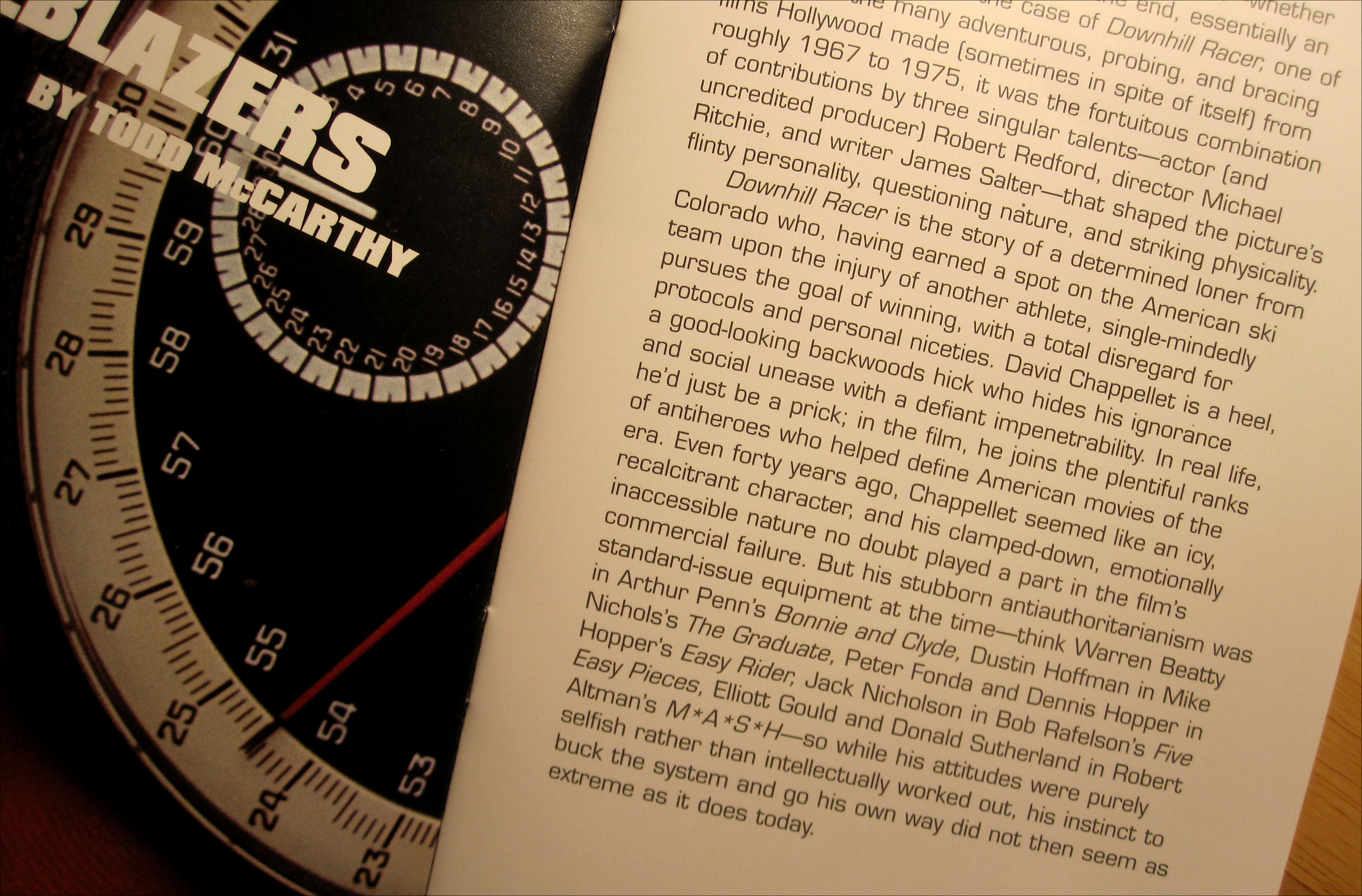
“Trailblazers,” a booklet essay by Todd McCarthy inside the forthcoming Downhill Racer DVD, explains the curious mystique of Robert Redford‘s David Chappellet, “a determined loner from Colorado who…singlemindedly pursues the goal of winning with a total disregard for protocols and personal niceties. He’s a heel, a good-looking backwoods hick who hides his ignorance and social unease with a defiant impenetrability.


Opening page of Todd McCarthy’s essay about lingering impact and making of Michael Ritchie and Robert Redford’s Downhill Racer, contained in a booklet inside the just-arrived Criterion DVD.

“In real life, Chappellet would just be a prick; he joins the plentiful ranks of antiheroes who helped define American movies from roughly 1967 to 1975. Even forty years ago, Chappellet seemed like an icy, recalcitrant character, and his clamped down, emotionally inacessible nature no doubt played a part in the film’s commercial failure.

“But his stubborn anti-authoritarianism was standard-issue equipment at the time — think Warren Beatty in Arthur Penn‘s Bonnie and Clyde, Dustin Hoffman in Mike NicholsThe Graduate, Jack Nicholson in Bob Rafelson‘s Five Easy Pieces, Elliott Gould and Donald Sutherland in Robert Altman‘s MASH — so while his attitudes were purely selfish rather than intellectually worked out, his instinct to buck the system andf go his own way did not seem as extreme as it does today.”

These last two graphs pretty much, sum up what I love about Downhill Racer. which is to say that I’ve always felt a kind of intuitive affinity for Chappellet. It’s clear who and what he is (i.e., a guy who could stand a lot less narcissim in his personality, a lot more in the way of manners and a liberal-arts education) but I’ve always gotten the guy. I understand how he got there, and why he’s not inclined to open up or reconsider his attitude or game plan. I get him all the way down to the marrow.

This prompted me to consider a list of the cinema’s Great Solitary Men. Not lonely guys (which automatically implies a distant angsty condition that a character probably wants to heal with a hug or a girlfriend of a mom or best friend) as much as guys who are more or less content with their aloneness. Guys who seemingly are ready to be and stay that way — unpartnered, uncomforted, self-sufficient, untethered — for the rest of their lives if need be. Not a state of happiness by any stretch of the concept, but at the very least a state of cool comfort that says, “Whatever happens and whatever comes, I’m sticking to me and I’ll be just fine that way because I know and trust myself like no other person on the planet.”

Lee Marvin‘s Walker in Point Blank is one of these guys. Clint Eastwood‘s tough-guy persona of the ’60s, ’70s and ’80s is pretty much built upon the solitary man mystique. Marlon Brando‘s “Johnny” character in The Wild One, I suppose. Montgomery Clift‘s Robert E. Lee Prewitt almost measures up except he’s looking for love from whore-girl Donna Reed so I guess not. Several Steve McQueen characters (i.e., in Hell Is For Heroes, Bullitt, The Sand Pebbles) fit the mold. We’re talking about an awfully long list here.

The Hangover

It’s not that I’ve chilled on Avatar anticipation. I was rocked by the special 3D ComicCon presentation, but the Avatar Day reel, as I wrote on 8,.22, left me “feeling a little Avatar-ed out…no bump-up…like before only less so…doesn’t play as well the second time.” I only know that every time I run Avatar in my head, I still see a flash of Bruno Ganz’s Hitler. Intriguing as the latest trailer is, I can’t expunge what’s been, for me, the funniest fan-rant of the year. Sorry…it’ll pass.

Read more

Aahh, Youth

“When you first start out you’re always striving for greatness and perfection and then after some years reality sets in and you realize that you’re not going to get it.” — Woody Allen between shots of his latest London-based film (allegedly titled You Will Meet A Tall Dark Stranger), talking to the Telegraph‘s John Hiscock in a piece than ran ages ago (i.e., 9.29).

Maybe you’re “not going to get it” just so, but urgent creative strivings of talented young (or younger) directors looking to mark their mark tend to produce their best films. Allen seems to be saying he’ll never make a film like Manhattan or Annie Hall or even Stardust Memories ever again, and that he’s more or less content with that. That’s a rather grim attitude. I’ll take the young Scorsese (Mean Streets to Raging Bull) over the latter-day version any day of the week. Ditto young Coppola vs. old Coppola. Or young Bertolucci (Before The Revolution, The Conformist, Last Tango in Paris). Or young DePalma (The Phantom of the Paradise, Sisters, Greetings). Or young Jim Cameron (Piranha, Terminator, T2, Aliens) over the silver-haired Avatar techno-maestro he’s since become.

RoPo Haters? Straighten Her Out

The Guardian‘s Daniel Nasaw reported today that Los Angeles authorities seeking to imprison fugitive film director Roman Polanski may face a new obstacle in the 32-year-old case — the victim wants no part in it.

Samantha Geimer, who was 13 years old when Polanski gave her drugs and had sex with her, today asked a Los Angeles court to drop the charges against the Chinatown director. Polanski fled the US in 1978 after pleading guilty to illegal sex. He was arrested in Zurich last month and is fighting extradition to the US.

“In a court filing today, Geimer said she has been besieged by nearly 500 calls from news media since Polanski’s arrest. She lives in Hawaii and long ago publicly identified herself as the victim and forgave Polanski, but said she and her family have to contend with pressure when he is in the news. She said she is being stalked by journalists from international news organizations and has received interview requests from Oprah Winfrey and CNN’s Larry King.

“The pursuit has caused her to have health-related issues,” the filing states. “The pursuit has caused her performance at her job to be interfered with and has caused the understandable displeasure of her employer and the real possibility that Samantha could lose her job.” I presume that “health-related issues” is a reference to anxiety and other nervous afflictions.

Damon, Brolin, Coens

I’m tapping the iPhone while waiting for my number to appear at the Cole Avenue DMV, but the key casting decision for the Coen Bros.‘s True Grit is the young-girl narrator (i.e., the Kim Darby role in the Henry Hathaway/John Wayne version). Not that the hiring of Matt Damon for the Glenn Campbell role and Josh Brolin as the baddy is inconsequential news.

Just Ten

I’ve reviewed Michael Moran‘s 50 Biggest Movies of 2010 piece in the London Times. The biggest money-makers, he means, which in itself implies a kind of synthetic Eloi quality. Because if these 50 were 2010’s absolute best there would be cause to seriously think about calling off the 2011 Oscars.

But forget awards. All I want to see just to see ’em are (1) Tim Burton‘s Alice in Wonderland, (2) Hot Tub Time Machine, (3) Paul Greengrass‘s The Green Zone, (4) Phillip Noyce‘s Salt, (5) The Rum Diary, (6) Ridley Scott‘s Robin Hood (but only somewhat), (7) Eat Pray Love, (8) Oliver Stone‘s Wall Street 2, (9) Unstoppable and (10) London Boulevard.