A Fine Madness

I went to a Magnolia Pictures holiday party just after tonight’s 7 pm Avatar screening exited, and then the damn wireless wasn’t working for about 30 minutes when I finally got home. The upshot is that I’m too whipped — it’s 12:35 am — to evaluate the ins and outs of this amazing film, but I’ll tell you right now there are very few outs. It’s half CG, half live action and it jumps back and forth so the dreaded sensation of being swallowed by a cartoon never happens. Avatar is a hybrid thing and a wild one at that.

All the energy and the madness and the money are right there on the screen, you bet, and the “yeah, I guess I’ll see Avatar but I’m in no real hurry” phase is over. This is too much of an adrenalized eye-popper not to see it as soon as possible, and absolutely in 3D and most desirably in 3D IMAX. (Believe it or not, 20th Century Fox showed it to the creme de la creme of New York journalists in a regular non-IMAX theatre this evening, although the 3D quality was perfectly fine.)

This is probably the goofiest, craziest, super-budgeted CG romper-stomper I’ve ever seen. A friend said it was three video games rolled into one instead of a movie, which is somewhat true in that the story and action-fantasy elements are aimed at your inner 14 year-old (whom I’d forgotten about until tonight — now I feel pleasantly re-acquainted).

You can’t say Avatar doesn’t impart a feeling of delirious abandon and wild-ass splendor. You could call it a kind of visual opera — a forest-primeval symphonic naturalist hard-on movie that technically knocks you flat, coheres emotionally, isn’t afraid to be silly or simplistic, delivers visual CG wonder like nothing I’ve ever seen before (really) and pays off like a gotterdammerung Apocalypse Now meets Tarzan meets the best-special-effects-flick-you’ve-ever-seen insanity ride. The two and a half hours just fly by, and the last 30 minutes alone — a truly nutty extended battle sequence — are worth the price.

I was in fact open-mouthed — faintly grinning but pretty much agog — during the big-ass finale. As Bruno Ganz‘s Adolf Hitler said in that YouTube satire, the 3D is so good it’s like your eyeballs are having sex. The only problem (which wasn’t a problem for me) is that it’s aimed at teenagers. I was wishing, in fact, that I could somehow revert to age 14 or 15 so I could see Avatar in the proper frame — then I’d really have something to do double-backflips over. I’m a little older than that, unfortunately, so instead of sending me into wet-dream action heaven Avatar gave me the wet-dream action heaven giggles, as if I’d toked up before it started.

I’ve seen and heard all the stuff that Avatar dishes out many times before — in Dances With Wolves and A Man Called Horse, for openers — but it’s thrown together with such punch and frenzy that it’s like Cameron somehow managed to time-machine himself back to his own mid teens in order to make it. This is one surging rush of a 3-D flying banshee jungle flick, and at the same time a respect-the-earth, Bush and Cheney-condemning political movie. They should be showing this to the climate change gang in Copenhagen.

That’s it, I’m finished…I’ll write more tomorrow morning.

Wilford Brimley’s Kid Brother

Here‘s an eloquent and highly persuasive four-star Roger Ebert review of Chris Smith‘s Collapse. “I don’t know when I’ve seen a thriller more frightening…I couldn’t tear my eyes from the screen…Collapse is even entertaining, in a macabre sense. I think you owe it to yourself to see it.”

Collapse is making its way around the country theatrically, but the best way to catch it is through movies-on-demand channels via Time Warner, Verizon FIOS, Cox, Rogers, Insight and Charter. It begins on Comcast this weekend.

Bigelow’s Oscar-History Moment

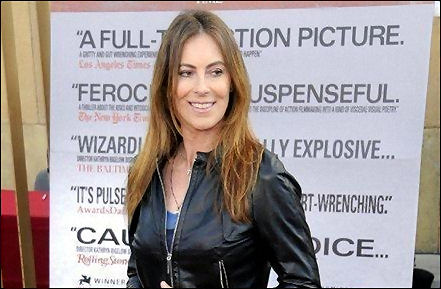
“I am convinced that the storyline of this year’s Oscars is that a woman will win a Best Director Oscar for the first time,” says director Rod Lurie (Straw Dogs, Nothing But The Truth), “and for a war film!” He’s speaking, of course, of Hurt Locker director Kathryn Bigelow, who’s been steadily gathering award-season esteem and is now only a few steps away from making history.

Only three female directors have ever been nominated for a Best Director Oscar — Lina Wertmuller for Seven Beauties (’76), Jane Campion for The Piano (’93) and Sofia Coppola for Lost in Translation (’03) — and of course none of them won.

“Bigelow has long been one of the unsung auteurs in the business,” Lurie writes. “She is among that elite group of filmmakers who (this is true for me, at least) will get me into a theater based on their name.”

The irony to which Lurie alludes is a powerful one. Wertmuller’s film aside, the two other nominated films listed above were about female characters, which faintly enforces the notion (or prejudice, if you will) that female directors are for the most part inclined to want to make films about women-friendly subject matter with strong female characters in the lead.

And yet if Bigelow wins (and I strongly suspect that she will) it will be for making a kind of movie — war-torn, violent, foreign territory, all-male cast — that’s been the exclusive province of male directors since the dawn of the film industry.

There’s almost a kind of Barack Obama analogy in Bigelow’s situation. Just as the first African American was elected president in part because he wasn’t seen by hinterland yahoos as being especially “black” (with his white mom and white grandparents), Bigelow seems on the precipice of an historic win in part because she didn’t direct a “woman’s film” and in fact dove right into guy territory. And perhaps also because she’s always been an X-factor female director to start with, being strictly from action and sci-fi and nuclear submarines and motorcycles and leather jackets and that line of country.

“Having been in the military myself, I can tell you that I found it astonishing that Bigelow captured something so well — a way of life, an attitude — that she’s been prohibited from experiencing for herself,” Lurie concludes. “I know that directors often make films in worlds they themselves have never entered, but the fact that Kathryn has not only made a war film but one of the best war films in, Jesus, I don’t know how long, is a testament to both her talent and her diligence.”

Wackjobby

I’m not as much of an Nagisa Oshima fan as I could be, and so I can’t figure from which Oshima film this black-and-white poster image was taken from. Does anyone know? I’m guessing it’s either from Death By Hanging (1968) or Diary Of A Shinjuku Thief (’68).


Poster currently mounted on a wall at Broooklyn Academy of Music.

Latest Avatar Numbers

Today’s tracking shows that Avatar‘s across-the-board first choice has risen from 16 to 20 — good news. The definite interest among under-25 males is now up to 57 (three points higher than the comparable 12.7 figure) and 59 for over-25 males (five points higher than the same demo on 12.7). The mixed news is that on 12.7 the definitely not interested number for under-25 females was at 9 and the over-25 sector was at 15, and now the same demos in the 12.10 report are 18 and 12, respectively. Under-25 female negative attitudes, in other words, have doubled while negatives among the older, presumably more literate over-25 females have dropped slightly.

“Shock and Awe”

The Guardian‘s Mark Brown has technically defied an Avatar review embargo by revealing that James Cameron‘s film “does not make you feel sick and it is not a disaster.

“All journalists watching the movie in Fox’s Soho headquarters had to sign a form agreeing not to publish a review or even express a professional opinion online or in print before Monday,” he writes. “So by saying Avatar was really much, much better than expected, that it looked amazing and that the story was gripping – if cheesy in many places – the Guardian is in technical breach of the agreement.

“It is not a breach, however, to report that other journalists leaving the screening were also positive: the terrible film that some had been anticipating had not materialized. It was good.

“There is, though, a certain amount of suspension of disbelief needed when watching Avatar. Cynics might sneer at the plot. The film, set in 2154, revolves around a paraplegic marine assigned to a planet where brutish humans are forcing the natives from their homes to mine a precious mineral, unobtanium, which is the only thing that will keep Earth going.

“To get it they need to blast away an agreeable species called the Na’vi – 12 foot or so blue humanoids with tails and pixie eyes. Sam Worthington as the paraplegic marine pretends to be a Na’vi through avatar technology. At first he’s on the nasty human military side but he falls in love, gains a conscience and so on.

“Perhaps most surprising was the politics. At one stage the deranged general leading the attack, with echoes of George W Bush, declares: ‘Our survival relies on pre-emptive action. We will fight terror, with terror.’ There is more shock and awe in this movie than almost any other.”

Pom-Pom Guy

This rave Avatar review in London’s The Sun doesn’t sound like the writer (a.k.a., “the Sneak”) is invested in anything other than crude enthusiasm and wanting to encourage those who are hoping that James Cameron can do it again. He may be telling the truth, but his words sound too cheerleader-ish, too eager-beaver.

I am, however, moved by the following passage: “The final battle scene is 20 minutes long and absolutely mind-blowing. The Sneak still recalls sitting in a cinema 12 years ago watching awestruck as Titanic slipped beneath the Atlantic waves. And your critic is sure that, even when he is pushing a Zimmer, he will remember the moment the main spaceship of the baddie corporation goes down in Avatar.

“It is overwhelming, and that is because you are emotionally tied up in the characters and the story.”

Hammond Softballs Mo’Nique

Yesterday afternoon L.A. Times/Notes on a Season columnist Pete Hammond took me to task for suggesting that the Academy might want to backhand Precious costar Mo’Nique for having said on her BET talk show that (a) she doesn’t understand why she needs to roll up her sleeves and campaign for a Best Supporting Actress Oscar nomination and (b) saying “what’s in it for me money-wise?”

Hammond says that Mo’Nique’s alleged “money demands for appearances related to a campaign are quite frankly old (non)news.” He means that Hollywood Reporter columnist Roger Friedman‘s report that “one source close to the production insists that Mo’Nique asked for $100,000 at one point to show up [at an event] with the rest of the cast” was posted last September.

And yet Mo’Nique did say to guests Terrence Howard and Taraji P. Henson on her talk show last month, “Now let me ask y’all this, because I know y’all are gonna school me correctly: What does it mean financially?” Surely Hammond hasn’t misunderstood what this question indicates.

I understand Hammond’s point about how you don’t have to campaign if you’ve really got the goods. Roman Polanski had the moralistic haters against him and didn’t say “boo” when The Pianist was in contention, and he still won the Best Director Oscar. But you do have to campaign if you have major negatives against you, as Russell Crowe did at the beginning of the Gladiator campaign, and as Mo’Nique clearly does now.

And it’s not just me saying this. Indiewire‘s Anne Thompson recently wrote that “Lionsgate has [an] issue” to deal with in its Precious campaign, which is the fact that Mo’Nique “is a piece of work.”

I’ll admit it — I’d love to see Mo’Nique not get nominated. I feel that her Mary character in Precious is so phenomenally despicable that it constitutes a special case — the mushroom-cloud atmosphere generated by her daughter-abuse in Lee Daniels‘ film is so toxic that it should, I feel, override the fact that Mo’Nique delivers a very strong performance. Call it a moralistic community statement warranted by special circumstances.

But I’m not trying to do a takedown campaign on Mo’Nique. Really. She’s clearly going to be nominated. But in a fair and just world (and in a politically realistic one as far as Hollywood is concerned), Mo’Nique shouldn’t win, and she if you ask me she most likely won’t.

Gang of New York

After catching Jacques Audiard‘s A Prophet I ambled over to the Museum of Modern Art last night for Universal’s big It’s Complicated party. There was the usual trouble at the door (the security apes were even challenging Peggy Siegal, who had handled the celebrity invitations) but I was eventually waved in by Universal marketing big-shot Michael Moses. Once inside I was enveloped by sublime climatorial comfort and spiritual calm — a murmuring, beautifully lighted, abundantly catered heaven filled with the best or most talented or hungriest people in town, and everyone in a serene and approachable mood.


Last night’s It’s Complicated party at Museum of Modern Art.

The stars were there, of course — Meryl Streep, Steve Martin, Alec Baldwin, Mary Kay Place. Everyone else was hovering and/or scheming to get closer, trying for a word or two, a moment’s grace, a touch of their garment. I didn’t see director Nancy Meyers but It’s Complicated producer Scott Rudin was there; ditto Universal honcho Ron Meyer. Tina Fey was in the hot-table area with husband Jeff Richmond. Barry Levinson was hanging around. And the food was delicious — roast beef, mashed potatoes, magnificent salads, pleasant wine — and plentiful as hell with several fully-staffed serving areas.

Columnists George Rush and Roger Friedman were looking for quotes, of course. It seemed from a distance as if Baldwin — obviously in good spirits but visibly sweating and clearly in need of a diet re-think and some daily treadmill time — wasn’t all that responsive to their conversation starters. I wasn’t feeling all that socially aggressive so I just wandered around and scanned the room. An instinct told me not to snap photos.

There were some other famous faces milling about. I chatted briefly with Oliver Stone (he asked what I thought of It’s Complcated, and told me he’s finished with Wall Street 2 and involved in a fast-and-furious edit). I also said hello to director-writer Paul Schrader, and talked at length with screenwriter Stephen Schiff and fiance Lois Cahall.

Pre-Fabricated

I sometimes…okay, frequently let go with nervy opinions, like that statement I made yesterday morning about how “mainstream Eloi tend to avoid [films] that look even slightly challenging — the movie with the brightest and most colorful wrapper with the plainest design tends to win.” It’s fairly obvious that the Eloi like emotionally simplistic, high-visual-energy movies because they’re lazy (i.e., ADD, not educated enough, narrow cultural influences), but you still feel slightly vulnerable when you write stuff like this because of…I don’t know but the sense of alone-ness that comes with the gig is part of it.

“Avatar looks like something you might have to get used to on some level,” I explained. “It seems rich and dense, like a realm you might need to explore and maybe study a little bit to fully enjoy. That’s not an Eloi magnet factor. They like fast-food movies that they can wolf down right out of the wrapper– no thought, no nothing, just ketchup. They can see that Avatar is no easy-lay Roland Emmerich film. They can tell it’s a sit-down meal.”

But occasionally someone else will come along and say something very similar, and it feels good. Last night around 9 pm Lauren A.E. Schuker, a writer for the Wall Street Journal‘s “Speakeasy” section, wrote that Avatar‘s original plot “presents a challenge to audiences inured to sequels, prequels, and films based on pre-fabricated properties, such as Transformers, Twilight and the coming Sherlock Holmes, starring Robert Downey, Jr.

The main thrust of Schuker’s piece was a report that Steven Spielberg saw Avatar on the Los Angeles Fox lot last Friday and that “he flipped for it,” according to “a person close to the acclaimed director.” It’s entirely possible that a lot of people are going to flip for Cameron’s film, starting with tonight’s press screenings in London, New York and Los Angeles, but c’mon….what’s Spielberg going to say, given the brotherly rapport he naturally feels with Cameron and given the kind of films he likes to make?

Narratives & Precedents

And The Winner Is blogger Scott Feinberg has come up with a brilliant analysis of several high-profile Oscar contending performances by way of listing previous award-showered performances that closely echo their own. Without further ado…naah, screw it. I was going to paste portions of it here but it’s too much work to reformat. Just read what Scott has composed.


Audrey Hepburn, Carey Mulligan