A Coarser Death

Death at a Funeral is one of the funniest films I’ve seen this century, as surprising, consistent and laugh-out-loud hilarious as any movie in the past 10 years,” writes Marshall Fine. “The original 2007 version, that is — the one directed by Frank Oz, with a British cast.

“The new remake of Death at a Funeral, the one with Chris Rock, Martin Lawrence and a who’s who of African-American actors — well, that’s another story. I mean, it’s the same story, practically scene for scene. And it’s funny with a handful of big laughs. But it’s not nearly as funny as the original.

“Unfortunately, the reality is that many millions more people will be drawn to this broad, raucous version of Dean Craig‘s script (directed, incongruously enough, by misanthropic playwright/filmmaker Neil Labute) than ever saw Oz’s version, which barely cracked the arthouse market. And they’ll laugh hard at surefire jokes involving hallucinogenic drugs, dead bodies, public nudity and poop.

“But Labute’s Death is the equivalent of one of those Hollywood translations of a Francis Veber farce from the 1980s and 1990s. Veber would craft a weightless French comedy starring, say, Gerard Depardieu and Pierre Richard — and then Hollywood would translate it into a ham-handed lump starring, say, Nick Nolte and Martin Short.

“Yes, Labute’s Death is virtually a photocopy, in terms of the story it tells and the comedy beats it hits. Yet everything in this version is coarser and more obvious, aimed at a lowest-common-denominator audience.”

In all fairness, I must point out that the opening graph of Fine’s review reminded me of the opening graph of A.O. Scott’s review of Michael Bay’s Pearl Harbor, to wit:

“The Japanese sneak attack on Pearl Harbor that brought the United States into World War II has inspired a splendid movie, full of vivid performances and unforgettable scenes, a movie that uses the coming of war as a backdrop for individual stories of love, ambition, heroism and betrayal. The name of that movie is From Here to Eternity.”
Little Butterflies

Focus Features’ decision to open Anton Corbijn‘s The American — the Italy-set, George Clooney-as-a-secret-assassin drama — on September 1st means they primarily regard it as a sophisticated high-end thriller and that’s all. If they saw it as having any kind of award-season potential they would obviously open it via Telluride, Toronto and Venice, but a Labor Day opening is almost the same thing as a mid-August debut.


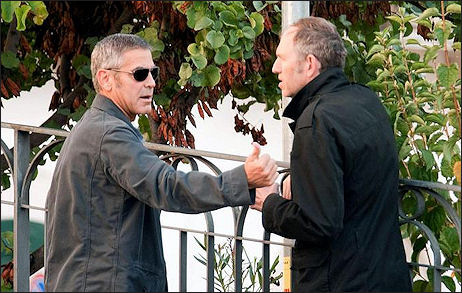
The American star George Clooney, director Anton Corbijn during shooting last fall

“It’s just a cool-ass adult popcorn movie,” Focus seems to be saying. Which is also a roundabout way of saying “if a 2010 Clooney film is going to attract any awards heat, it’ll be Alexander Payne‘s currently-shooting The Descendants….if it comes this year, that is.”

Rowan Joffe‘s American screenplay is based on Martin Booth‘s “A Very Private Gentleman,” which had its paperback release in ’05.

Consider this Publisher’s Weekly synopsis: “Booth’s brilliantly creepy psychological suspense novel follows a so-called ‘shadow-dweller’ (a technical weapons expert who creates and supplies the tools for high-level assassins) to a rural village in southern Italy where he poses as ‘Signor Farfalla,’ a quiet artist who paints miniatures of butterflies and has traveled to the area to capture a unique native specimen.

“As the artist, whose real name is Clark, settles into the local scene, most of his new acquaintances accept his enigmatic alias, with the notable exception of Father Benedetto, the priest who pushes him to reveal himself in a series of confessional conversations over glasses of Armagnac. Between painting the minutely detailed butterfly studies and preparing for his next job, Clark carouses with a pair of local prostitutes, Dindina and Clara, eventually slipping into a serious affair with the latter.

“As he gets weapons specs and begins constructing a new gun, he learns that his latest customer is a woman whose next target may be Yasser Arafat. Suddenly he senses another ‘shadow-dweller’ on his trail; this anonymous figure remains a mystery to Clark until their climactic showdown. The lazy, languid setting is an eerily effective backdrop for the fresh and beguiling murder intrigue, and the flashbacks into Clark’s cold, brutal past are cleverly juxtaposed against his budding romance with young, naive Clara.”


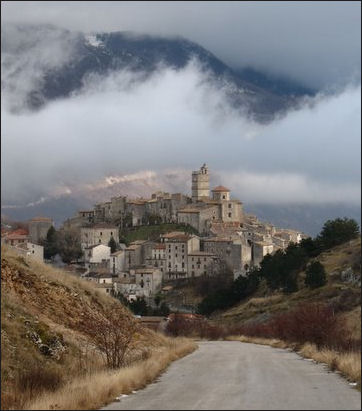
The ancient Italian village of Castel del Monte, where The American shot last fall.

Clara is being played by Italian actress Violante Placido. Father Benedetto will be performed by Paolo Bonacelli.

“With first-rate characters and a gradual buildup of suspense, Booth constructs his most focused, tightly written novel to date, reminiscent of William Trevor‘s classic ‘Felicia’s Journey’ and the late Patricia Highsmith‘s Ripley novels.”

For me, Martin Ruhe‘s black-and-white photography of Corbijn’s Control was the stuff of legend — it was the most deliciously composed monochrome film since Gordon Willis‘s Manhattan. Ruhe also handled The American‘s widescreen (2.35 to 1) color cinematography.

The American shot for 33 days last fall in Castel del Monte, a commune in the province of L’Aquila in Abruzzo, Italy.

Elements In Place

The calibre of Robin Wright Penn‘s performance as Mary Surratt, the rooming-house operator who was wrongly executed for allegedly conspiring with John Wilkes Booth and others to assassinate Abraham Lincoln, is unknown. But last night I read a shooting draft of James Solomon‘s The Conspirator, the Robert Redford-directed drama about Surratt’s trial, and it’s obviously a sturdily-written, high-calibre thing. And there’s no missing the grace and gravitas woven into Surratt’s character.

Half the work has been done, I’m saying, for Penn. All she has to do is play Surratt in a straight and solid manner, and she’s got a Best Actress nomination all but sewn up. If, that is, The Conspirator lands a distributor (which it almost certainly will) and comes out in the late fall or early winter, and gets a good campaign going, etc.

Redford may or may not have have peaked as a director (his last seriously strong film was ’94’s Quiz Show), but he’s always been good with actors. I’m basically saying that Solomon’s script is so fundamentally solid that all Redford has to do is get the period details right, shoot it handsomely and let his quality-level cast do what it does best, and he’s pretty much home free.

The Conspirator could land with a thud — noody knows anything at this stage — but if Redford gets it right I’m guessing we’ll see Penn competing against Anne Hathaway‘s performance in Love and Other Drugs for the 2010 Best Actress Oscar.

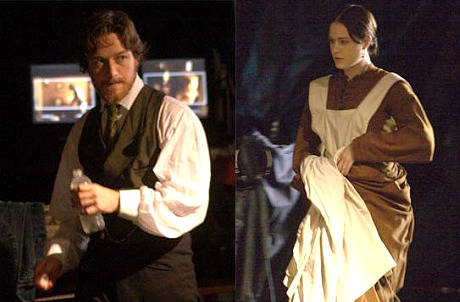
The basic plot of The Conspirator involves a young attorney (James McAvoy) being reluctantly assigned to defend Mary Surratt in his conspiracy trial. The main arc belongs to McAvoy — he starts out actively hostile, but comes to see that Surratt has been wrongly charged. But Penn, it appears, will provide the lump-in-the-throat moments.

The equally well-written costarring roles will be played by Evan Rachel Wood (as Surratt’s daughter), Kevin Kline (as the Dick Cheney-ish Secretary of War Edwin Stanton), Tom Wilkinson, Justin Long, Danny Huston, Alexis Bledel and Johnny Simmons.

Solomon (who used to work for Barry Levinson) shares story credit on the screenplay with Gregory Bernstein. The Conspirator‘s director of photography is Newton Thomas Sigel (Valkyrie, Leatherheads, The Brothers Grimm, Three Kings).


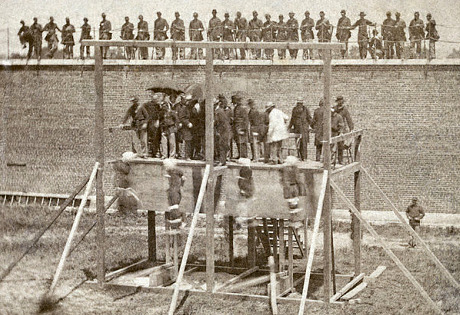
Aftermath of execution of Lincoln assassination conspirators; Surratt’s body is on far left.

And They're Off

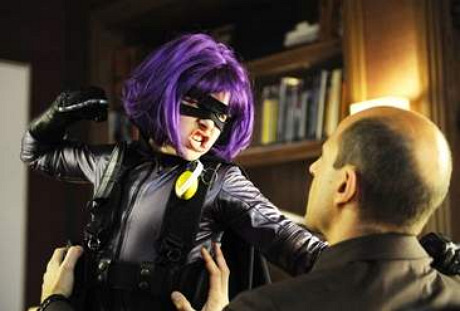
With a first-choice tracking advantage of 20 to 15, Kick-Ass will kick Death At A Funeral to the curb this weekend. Interestingly, definite Kick-Ass interest among under-25 females is at 39 vs. 34 for Death. But otherwise Kick-Ass is mostly, as ever, an under-25 guy thing. Definite interest is now at 54 vs. 41 for over-25 males. And over-25 females have a definite interest factor of only 29. That’s the Hit Girl-murdering-guys-with-knives-and-swords backlash factor, methinks.

What Kind Of Minds?

The mother-breast-feeding-her-four-year-old-kid joke isn’t the least bit amusing — it’s just trash-can material. The gag about Rob Schneider french-kissing his much-older wife in front of his old pallies could have been funny, but not the way they’ve done it here. And Kevin James‘ character would be in critical condition (or at the very least in intensive care) if he slammed into a tree and fell 25 or 30 feet onto a rocky hillside, etc. Repeat — this stuff isn’t funny.

The director is longtime Sandler butt-boy Dennis Dugan, who previously helmed You Dont Mess With The Zohan (parts of which I laughed at here and there), I Now Pronounce You Chuck & Larry (nope), and Big Daddy (which, I admit, wasn’t altogether terrible).

Family Name

The story about Harvey and Bob Weinstein (and their bucks-up partner Ron Burkle) looking to buy Miramax Films from Disney is essentially an emotional one. The Miramax name was Bob and Harvey’s to begin with, of course — an inspiration from their parents Miriam and Max. I’d like to see the boys win out; we all would. Just let me know when the bidding’s over and it’s a done deal — or not. I’ve got a film to watch.

Good Company

It’s time for another plug for WordTheatre — a theatrical enterprise that dispenses literary stimulation highs at reasonable prices. The next Manhattan performance happens at Soho House (29 9th Ave, New York, NY 10014) on Sunday, 4.18, at 5 pm. I only know that every time a Word Theatre show ends, I always feel nourished.

The headliners are Kathryn Erbe (Law and Order: Criminal Intent) performing a story by Mary Gordon; Mary Stuart Masterson (Benny and Joon, Fried Green Tomatoes) performing a story by Don Lee; and Jeremy Davidson (Army Wives, Windtalkers) performing the work of Ian Frazier.

Whom The Gods Would Destroy

Alex Gibney‘s Untitled Eliot Spitzer Film — a work in progress — will be shown once at the Tribeca Film Festival, at the School of Visual Arts theatre on Saturday, 4.24, at 6 pm. “An in-depth look [with] unique access to friends and enemies of the ex-governor, this documentary explores the hidden contours of this tale of hubris, sex, and power.” The theme is self-destruction.

A Lady of Quality

In a brief 4.14 item about that Jackie Kennedy project that Darren Aronofsky wants to direct with Rachel Weisz playing the former First Lady, I said “it doesn’t seem like Aronofsky-type material.” I was sharply disagreed with by a couple of HE readers. Anyway, last night I received a PDF of Noah Oppenheim‘s script (dated 2.12.10), and I’ve now finished reading it. And I’m right.

Jackie does indeed follow the former Mrs. Kennedy’s experience from the day of JFK’s assassination in Dallas on 11.22.63 to his burial in Arlington Cemetery four days hence. I’ve read enough about those four dark days to understand that Oppenheim’s script is basically a tasteful re-capturing of what happened, and that’s all. It’s an elegant, almost under-written thing — straight, clean, dignified. The dialogue seems genuine — trustable — in that it’s not hard to believe that Jackie or Bobby Kennedy or Larry O’Brien or Theodore H. White or Jack Valenti might have said these very lines in actuality.

The portrait that emerges isn’t what anyone would call judgmental or intrusive, or even exploratory. Jackie Kennedy is depicted as pretty much the same, reserved, quietly classy woman of legend, determined to honor her husband’s memory by making decisions about aspects of his state funeral in her own way, according to what she feels he would have wanted, or what would be appropriately dignified.

It’s a very decent script but my first instinct was right — it doesn’t have Aronofsky’s stamp at all. This is strictly an acting project for Rachel Weisz, which is fine. I’d be interested in seeing the film when it’s done, no question, but there isn’t so much as a hint of the feverish grit or edge associated with the Aronofsky brand (The Wrestler, Requiem for a Dream, Pi, The Fountain).

I don’t mean to sound like a smart-ass, but it’s more or less in the same wheelhouse as Roger Donaldson‘s Thirteen Days, the drama about the Cuban Missile Crisis. I had a feeling that while writing this Oppenheim was mindful of the screenplay style of Aaron Sorkin, and how the latter has almost authored a “how to” manual about writing emotionally reserved but affecting stories about people who live and work in the White House. The difference is that this time they’re well-known figures and the dialogue is based on historical accounts.

When I said this seemed far afield from Aronofsky’s natural turf, Deathtongue Groupie registered an opposite reaction, equating it to Requiem For Dream‘s story about “four people who live in a bubble of their own reality until it bursts and either crushes the spirit out of them or kills them outright,” etc. And Brandon Boudreaux said it sounded “exactly like Aronofsky material to me…a combination of The Wrestler‘s intimacy with Requiem for a Dream‘s psychological tautness. I don’t see this as being anything close to ‘let’s re-tell history again’ type of thing.”

Trust me, that’s almost exactly what Jackie is — familiar history re-lived and re-told with a veneer of class

Alternate Reality

“Shall I have feelings, or should I pretend to be cool?,” Roger Ebert asked yesterday in his review of Matthew Vaughn‘s Kick-Ass. “Will I seem hopelessly square if I find [this film] morally reprehensible and will I appear to have missed the point?”

My response to Ebert, of course, is that he’s not hopelessly square at all — he’s sharp and shrewd and never misses a trick — but (and this is a big “but’) by the laws of the comic-book action realm Kick-Ass isn’t morally reprehensible, it’s just “whoaa, dude!” But if you don’t get that realm you’ll never get that feeling, and people like Roger will look at you on the street like there’s something really and truly wrong with you.

“Let’s say you’re a big fan of the original comic book, and you think the movie does it justice,” Ebert says. “You know what? You inhabit a world I am so very not interested in. A movie camera makes a record of whatever is placed in front of it, and in this case, it shows deadly carnage dished out by an 11-year-old girl, after which an adult man brutally hammers her to within an inch of her life. Blood everywhere. Now tell me all about the context.”

The context is this: the comic-book action realm is about itself, which is to say a world of powerless young guys and their emotionally arrested elders who want to hold on in a sense to that feeling. It’s about notions of flash and dash and washboard abs, of studly lethal force and villains who seem to fit the same mold time and again. Nothing in the comic-book action realm represents anything “real” (including 11 year-old girls) because it’s all about stupid simplicity — about moral payback and lurid emotions and a visual ripeness that doesn’t exist anywhere else. It’s also about a huge need for reality-enhancing myth. For archetypes, intensity, testosterone, etc. And imagination, of course.

“The movie’s premise is that ordinary people, including a high school kid, the 11-year-old and her father, try to become superheroes in order to punish evil men,” Ebert writes. “The flaw in this premise is that the little girl does become a superhero. In one scene, she faces a hallway jammed with heavily armed gangsters and shoots, stabs and kicks them all to death, while flying through the air with such power, it’s enough to make Jackie Chan take out an AARP membership.

“This isn’t comic violence. These men, and many others in the film, are really stone-cold dead. And the 11-year-old apparently experiences no emotions about this. Many children that age would be, I dunno, affected somehow, don’t you think, after killing eight or 12 men who were trying to kill her?

“I know, I know. This is a satire. But a satire of what? The movie’s rated R, which means in this case that it’s doubly attractive to anyone under 17. I’m not too worried about 16-year-olds here. I’m thinking of 6-year-olds. There are characters here with walls covered in carefully mounted firearms, ranging from handguns through automatic weapons to bazookas. At the end, when the villain deliciously anticipates blowing a bullet hole in the child’s head, he is prevented only because her friend, in the nick of time, shoots him with bazooka shell at 10-foot range and blows him through a skyscraper window and across several city blocks of sky in a projectile of blood, flame and smoke.

“As I often read on the internet: Hahahahaha.”