Brassy Openings

I still really love hearing studio-logo fanfare music — those brassy and boastful intro chords that always accompanied the openings of mainstream flicks until…oh, roughly the mid ’60s or thereabouts. These beginnings revved audiences before the film started, selling them an often fanciful notion that something momentous was about to happen — despite the sometimes dispiriting truth of the matter.

Logo fanfare reflected the old-fashioned carnival-barker instincts of studio chiefs. This was especially true for Warner Bros. features, for which film-score composers would always throw in a vigorious “tah-dah!” before beginning the main-title music. Even if the show in question was a middling so-so caper flick starring Frank Sinatra and his booze-sipping homies, the fanfare promised much, much more.

What I’m saying, boiled down, is that the studio fanfare music that begins Lewis Milestone‘s Ocean’s 11 (1960) is the most enjoyable part of the film, hands down.

The second most pleasurable part is arguably Saul Bass‘s casino-attitude title sequence. It”s a little slow by today’s standards, but you can feel the cocky mentality of late ’50s showbiz culture — the chickie-baby attitude of Sinatra wearing those awful orange sweaters as he lounged around with Dean Martin and Sammy Davis, Jr. The mob guys who used to run things in Las Vegas would cater to their every whim, and there were always the broads to hand out back rubs and…uhm, whatever else.

“All But Gone”

My 2.17 review of Roman Polanski‘s The Ghost Writer came out decently, I think, given the haste and the coffee-shop conditions that influenced the writing of it. But David Denby‘s appreciation in the 3.8.10 issue of the New Yorker is the most eloquent I’ve read anywhere. I’m posting this to remind how utterly wrong and short-sighted the Doubting Thomases have been on this film. History will judge them fairly — i.e., without mercy.

The only weird part of Denby’s review is a statement that The Ghost Writer is “the best thing Polanski has done since the seventies.” It’s actually the best thing he’s done since The Pianist.

Excerpt #1: “The Ghost Writer offers not the blood and terror of Polanski’s early work but the steady pleasures of high intelligence and unmatchable craftsmanship — bristling, hyper-articulate dialogue (the stabs are verbal, and they hurt) and a stunning over-all design that has been color-co√∂rdinated to the point of aesthetic mania. [It’s an] extraordinarily precise and well-made political thriller.”

Excerpt #2: “Polanski takes care that the…story is never rushed, mauled, or artificially heightened — the usual style of thrillers now. He respects physical plausibility and the passage of time; he wants our belief in his improbable tale, just as Hitchcock did. There may be nothing formally inventive in this kind of classical technique, but, in the hands of a master, it’s smooth and satisfying, and I suggest, dear reader, that you gaze upon it, because it’s all but gone in today’s moviemaking world. There’s not much violence in the movie, but your scalp tightens anyway.”

Excerpt #3: “[Polanski] concludes The Ghost Writer with a twin flourish: first, a virtuoso travelling shot of an explosive note slowly but inexorably passed through many hands at a social occasion until it reaches its destination, and then a final shot of Lang’s manuscript, the fluttering pages now forlornly scattered about a London street. As in the famous last sequence of Chinatown, Polanski is close to despair, but his rejuvenation as a film director is a sign of hope.”

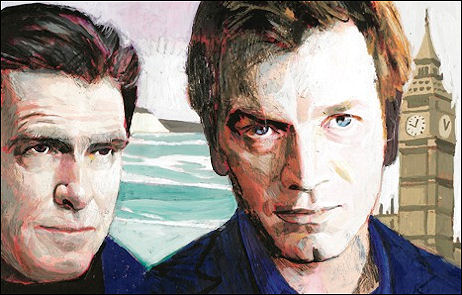
Excerpt #4: “Pierce Brosnan gives the strongest performance of his rather lazy career. He doesn’t imitate [former Prime Minister Tony] Blair; he offers his own interpretation of a public man’s impersonally brisk and hardened charm — the smile is reflexive, dazzling, and savage. Lang tells stories about his youth with hearty indifference to their phoniness — even in retreat, he’s a calculating pol, playing the angles, manipulating his eager amanuensis. And, when Lang is criticized or challenged in any way, Brosnan’s charm dissolves into fury; he catches the defensive self-righteousness of power, a leader’s disbelief that anyone might be seeing through him

Excerpt #5: “Olivia Williams is Ruth, Lang’s brilliant wife and longtime political adviser. Slender and tense, with short dark hair, Williams pulls her legs up under her chin as she sits . Williams’s gaze could sear the fat off a lamb shank, and her line delivery is withering, yet Ruth is badly wounded, and Williams makes her sympathetic — she’s one of the rare actresses who seem more intelligent and beautiful as they get angrier.”

Decade of Lightning

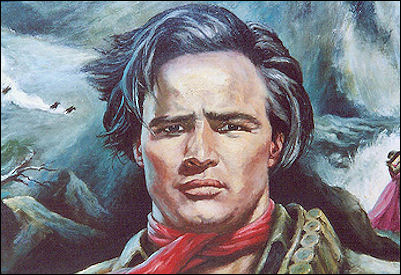
Yesterday I re-read a nearly six year-old piece I wrote on the day after Marlon Brando died (i.e., 7.2.04), and I really enjoyed some of it so I’m re-posting apropos of nothing. Well, something. I was researching yesterday’s Oscar death-tribute item that touched upon a decision not to to run a special tribute to Brando during the February ’05 telecast, and I happened upon it.

“We all knew death wasn’t too far off for Marlon Brando, what with his age (80) and his weight issues and all, but the news of his passing on Thursday night carries more than just sadness,” I wrote. “A guy I used to really and truly love is gone, and all kinds of backwash is starting to pour in.

“It’s hardly unique to say that my feelings about Brando will always be split between what he didn’t do when he got older along with the glories achieved during his phenomenal prime. Almost everything I’ve ever heard about the guy testified to his having been a tangle and never a day at the beach, but his obstinacies always seemed to pale when measured against the his once undeniable genius.

“The transcendent beauty of his acting in On The Waterfront, Viva Zapata, Julius Ceasar (his delivery of Marc Antony’s “cry havoc and let slip the dogs of war” speech is jolting, electrifying), A Streectar Named Desire, The Men…and then that brief one-two in the early ’70s with The Godfather and Last Tango in Paris…no one will ever forget his greatness. It will always burn through.

“Since starting this column in ’98 I’ve written more than once about how Brando had become a sad paragon of rot, ruin and failed potential. He became this (or gave in to the syndrome) over the last 25 years or so. In my mind, the beginning of the sag started with Guys and Dolls. The deeper degeneration period kicked in with Superman in ’78. When I think of the metaphor of that white wig he wore…

“Marlon should have tried harder, gone back to the theatre, eaten a lot less ice cream, directed more films (I’ve always loved One-Eyed Jacks, and I’ve always regretted that a remnant of the much longer and more experimental Jacks he originally shot had been saved somewhere), avoided being a recluse, hung with more people, gone back to school, worked out more, been a better dad….the things he seemed to do wrong! Endless!

“He got rolling as a New York actor in ’44 and had a ten-year run (until ’54) when he could do no wrong… then he got caught in the muck of Hollywood and was in and out (mostly out) for the next 16 or 17 years. He restored himself with The Godfather and Last Tango, and then he began to spiral down again. He never again caught serious heat or wind.

“In short, he was in a state of becoming for his first 20 years, an absolute God for 10 years, and a guy grappling with more than his share of disappointments, frustrations and pain for most of the other 50.

“I remember reading somewhere that his using the word ‘wow’ in On The Waterfront was one of the most revolutionary improvs ever spoken in the 1950s. Up to that point ‘wow’ was something you said when you sat on a blanket and watched the 4th of July fireworks. But Brando’s ‘wow,’ spoken to Rod Steiger‘s Charlie character after he pulls out a gun and threatens Brando’s Terry Malloy, his brother, was all about sadness… a stunned and wounded lament.

“There’s also that moment when Charlie urges Terry to join him inside a bar, and Terry, wanting to be alone with his feelings of grief for a friend named Joey who’s just been killed for squealing to the authorities about the waterfront rackets, begs off. I don’t know how Malloy’s reply actually reads in Budd Schulberg‘s script, but all Brando says to Steiger is, ‘Well, I’ll be around….’ and then the rest trails off. The acting is in the incompletion. It’s masterful.”

Steal and Appearances

I’m finally paying attention to a six-day-old Art of the Steal/Carrie Rickey/Paul R. Levy alleged-conflict of-interest story that’s been unfolding in Philadelphia. Gawker had it Monday, but I was otherwise engaged. A tipster e-mailed me the particulars this morning, and I wrote back saying “thanks…I really love being several days behind on a story!”

Last Friday Rickey reviewed Don Argott‘s Art of the Steal, a doc about the Barnes Foundation, its art collection and a controversial relocation plan. “As a movie, Steal is as finely wrought as the decorative ironworks that hang on the walls of the Barnes between Picassos and Seurats,” Rickey wrote, “yet as a narrative of the facts, it is as one-sided as a plaintiff’s brief.”

The rumpus is an argument/complaint that (a) Rickey should have let someone else review Art of the Steal given her marriage to Paul R. Levy, president and C.E.O. of the Center City District which allegedly benefitted from the contravention of Albert Barnes’ will, etc., as it is believed there are ties to local property tax assessments, or (b) failing that, she should have acknowledged her relationship to Levy as part of her review.

The matter seemed to be thoroughly addressed in a Philebrity story that was posted yesterday. The author quoted Levy as follows: “As advocates for filling in empty spaces on Philadelphia’s Benjamin Franklin Parkway so there is more pedestrian activity, we suggested new residential development (hasn’t happened), a new Calder family museum (didn’t happen) and were publicly supportive of the Barnes Foundation when it announced its move. But neither I nor anyone on my staff had any role at all (let alone any authority) to recommend, lobby or cause the Barnes Foundation, its board, or local foundations to decide to move to the Parkway.”

Levy added, “The CCD is supported by assessments on taxable real estate, and the Barnes is tax-exempt.”

I’ve never known Rickey to be anything but brilliant, very cool and as ethical as the next venerated critic. She’s one of the good people. But if I were she (or one of her editors), I probably would’ve included a full-disclosure statement about her marriage to Levy in the review. It’s always wiser to acknowledge the appearance of issues upfront and say “this is no issue in case you had any suspicions along these lines,” rather than just say nothing.

Oscar Death Montage

Some selective replies to Movieline‘s “In Memoriam” Oscar Montage Pool, to wit: (a) I have a feeling they might leave out Marilyn Chambers, although you can’t talk about the ’70s without mentioning Behind The Green Door, and Soupy Sales, due to his never being a Hollywood guy and much more of a local New York TV phenomenon; (b) If I were editing the death montage I’d open it with Al Martino or Maurice Jarre; (c) And I’d end it with an extended clip reel of John Hughes‘ films; (d) the first video clip will probably be about Farrah Fawcett; (e) the first dialogue clip may go to Ron Silver (probably from Reversal of Fortune) ; (f) the first actor named will be either Silver, Karl Malden or Edward Woodward; (g) the first actress named will be either Fawcett or Brittany Murphy; (h) Eric Rohmer will certainly be included; and (i) I don’t see them going all the big with a Michael Jackson tribute — two or three musical clips at most.

And as long as we’re on the topic, let’s remember once again how five years ago (i.e., on the Februay 2005 telecast) the great Marlon Brando — probably the most influential actor of the 20th Century, a God, a sphinx among men — wasn’t given a special video montage by Oscar show producers Gil Cates and Lou Horvitz, but that Johnny Carson was. Because Carson was better liked and Brando was a pain in the ass. This was one of the most shameful moments in the entire history of the Oscars.

Foot Locker

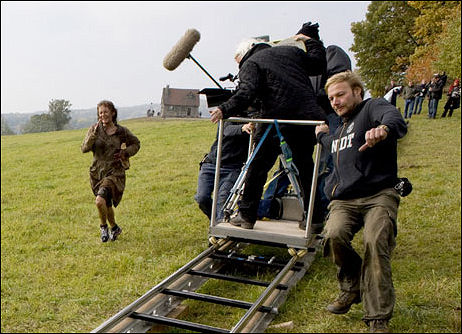
This snap, of course, shows the filming of Inglourious Basterds costar Melanie Laurent as she runs from the clutches of Christoph Waltz at the end of the famous French farmhouse house. if you know this scene you know she runs across the field barefoot. (Director Quentin Tarantino included an insert shot of her dirty bare feet.) You’ll notice in this shot, of course, that she’s wearing Nikes. My heart sank when I spotted this. I felt almost betrayed.

Tarantino, clearly, is no Eric von Stroheim-styled realist. If I’d been the director I would have told Laurent the following: “Closeups, inserts, master shots…you’re supposed to be running barefoot across a field and that’s the reality of the scene. I don’t care how good an actress you are or if no one ever suspects you aren’t barefoot in the closeup shots. I just don’t want you wearing fucking Nikes during a World War II film…period. Wearing them betrays the reality of the character, the period…it’s the same thing as being stoned before I call ‘action!'”

Hollywood legend has it that Von Stroheim insisted that actresses in an historical film he was directing had to wear authentic underwear from the period. The audience could have never known this, but von Stroheim knew. And on some level he felt it mattered in terms of the reality being portrayed. That’s the mark of a true madman.

Wants Money

Because he believes he’s the real-life model for Jeremy Renner‘s Sgt. James in The Hurt Locker, and because he could use the scratch, Sergeant Jeffrey S. Sarver yesterday filed a major-bucks lawsuit against the Hurt Locker team — director Kathryn Bigelow, writer-producer Mark Boal, Summit Entertainment and Nicolas Chartier‘s Voltage Pictures.

Sarver’s attorney Geoffrey Fieger, who’s also looking for dough, wrote in a prepared statement: “Plaintiff, Master Sgt. Jeffrey S. Sarver, is, in fact, the film’s main character ‘Will James’ or ‘Blaster One’ [which was Master Sgt. Sarver’s call signal during his tours of duty in Iraq].”

A Wrap summary states that “the suit alleges that Boal, was allowed, as part of an armed services press program, to be embedded in Master Sgt. Sarver’s unit. It further alleges that ‘virtually all of the situations portrayed in the film were, in fact, occurrences involving Master Sgt. Sarver that were observed and documented by Screenwriter Boal. Master Sgt. Sarver also coined the phrase ‘Hurt Locker’ for Boal.”

“Summit issued this statement on Tuesday: ‘We have no doubt that Master Sergeant Sarver served his country with honor and commitment risking his life for a greater good, but we distributed the film based on a fictional screenplay written by Mark Boal.'”

An AP story about the suit quotes Sarver as saying “he was never offered a role in the making of the movie. “I could have helped out a little bit,” Sarver said at today’s news conference in Southfield, Michigan. “But they chose not to (involve me).”

“Fieger said greed was the reason Sarver wasn’t permitted to participate in the film or be recognized for his role as the inspiration for the main character. Now, he said: ‘They’re gonna owe him a whole lot of money and recognition.’

“[I’m feeling] just a little bit hurt, a little bit felt left out,” Sarver said. “Just hoping that Mr. Fieger can make things right.”

Makeup Phase

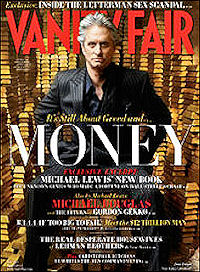
Vanity Fair‘s Evgenia Peretz has a nicely written profile of Michael Douglas, star of Wall Street 2: Money Never Sleeps (as well as a Toronto Film Festival fizzler called Solitary Man). The theme is about fatherhood, and how Douglas — a lousy dad in some respects when he was younger, which apparently had an unfortunate impact on his 31 year-old son Cameron — is determined not to screw it again with his new brood.

London, Cannes, Paris

North American rights to Woody Allen‘s You Will Meet a Tall Dark Stranger have been acquired by Sony Pictures Classics. A fall release is planned, but this seems to indicate that the London-shot film — which stars Antonio Banderas, Josh Brolin, Anthony Hopkins, Freida Pinto and Naomi Watts — will premiere at the Cannes Film Festival. A little man in my chest is telling me that Allen’s untitled next film, which will roll in Paris this summer with Owen Wilson, Marion Cotillard and Carla Bruni co-starring, has a certain apartness or special-tude. No reason, just a gut thing, etc.

Lincoln 2, Spielberg 0

So now there will be two Abraham Lincoln movies — Robert Redford‘s The Conspirator and Tim Burton‘s just-announced Abraham Lincoln: Vampire Hunter — before Steven Spielberg gets off his sorry sagging ass and pulls the trigger on his years-delayed, Tony Kushner-scripted Lincoln project, which once upon a time (i.e., five years ago) was seen as a golden opportunity for Liam Neeson to portray the nation’s 16th president.

Burton would be teaming with Timur Bekmambetov, the Russian-born, animal-level director of Wanted — i.e., one of the stupidest and most absurdly illogical high-octane thrillers ever made — on an adaptation of Seth Grahame-Smith‘s novel “Abraham Lincoln: Vampire Hunter,” which portrays the Great Emancipator as “an ax-throwing, highly trained vampire assassin,” to borrow from a sentence in a Variety story.

The Burton-Bekmambetov flick sounds cool, but I’m more interested in an Honest Abe Lincoln/vampire-killing video game. I’m fairly certain that John Ford and Raymond Massey would feel the same way if they were with us. This story needs a quote from Doris Kearns Goodwin.