Time Slide

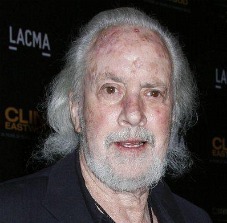
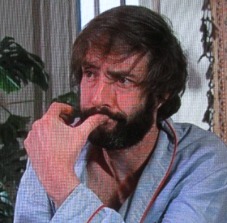
I’ve been on friendly terms with screenwriter Robert Towne since the early ’90s, give or take. We haven’t spoken in a while, but it’s all good (or was the last time I checked). Earlier today I popped in a Criterion Bluray of Jack Nicholson‘s Drive, He Said (’71) and lo and behold there’s a dark-haired Towne, nearly 40 years younger, playing a college professor whose wife (portrayed by Karen Black) is having an affair with a basketball player (William Tepper).


(l.) Towne in 1971; (r.) in 2008.

The backwards-in-time effect felt kind of “wow” to me. I can’t remember the last time I’ve seen a moving and talking living-color facsimile of someone I’ve only known in an older, somewhat craggier incarnation. Fascinating.

Drive, He Said has never had that great of a reputation, but it’s reasonably well directed and acted and never boring, at least according to my standards..

Say Again

Typepad log-in problems have blocked would-be commenters over the last two or three days, but I think things are okay now. It had something to do (idiotically) with the server clock being off and causing a synchronicity problem. In any case, Film Society of Lincoln Center associate program director Scott Foundas tried to respond two days ago to blogger reactions to the LAFCA voting, but was blocked by the malfunction. Here’s what he wrote:

“[LAFCA Best Supporting Actor winner] Niels Arestrup did not ‘exhaust’ his Oscar eligibility last year. In fact, he was never — and never will be — eligible for an Oscar because of the current Academy rule (much revised over the years) stating that any film nominated for Best Foreign Language Film can not be nominated in a subsequent year in any other categories, regardless of when it actually opens in the U.S. Had A Prophet been released for a qualifying run in 2009, then Arestrup would have been eligible at the 2010 Oscars. Had the film not been nominated for Foreign Film at the 2010 Oscars, then Arestrup would have a shot in the spring.

“This is the sort of thing one would assume would be common knowledge amongst such an august group of awards-season ‘experts,’ but then we all know the old adage about making assumptions…

“As for the suggestion that neither Arestrup nor Kim Hye-Ja will surface again during the remaining awards season, ‘just as it was the first and last we heard of LAFCA’s 2009 best actress Yolande Moreau,’ I suppose that was true of Moreau if one discounts Moreau’s similar wins at the National Society of Film Critics, the Cesar Awards [French Oscars], and even that hotbed of obscurantist cinephilia, the Newport Beach Film Festival.

“At the very least, you can expect to see Arestrup (who also already won a Cesar for his performance) and Kim’s names in the mix in the annual nationwide polls of film critics conducted by The Village Voice, Film Comment and Indiewire. Look back to the reviews these films received at the time of their release, and you will find that the performances in question — and the movies that contain them — were among the best received of the year.

“Sorry that the companies responsible for releasing the films in question didn’t paper the pages of Variety with ‘For Your Consideration’ ads or organize any cocktail soirees to parade their talent before the Oscar-blogging cognoscenti, thereby instantly ruling them out as contenders in the minds of some. (Hey, they’re no Frankie and Alice.) The job of film critics, however, remains to review movies, and not just the hype surrounding them.”

Whiz Bang Flash

These year-end compilations always seem to emphasize speed, flourish and pizazz over resonant themes, soul and emotionality, which of course are what the best films are always about. The G-Whiz team never lingers long enough to sample any dialogue or feeling? To go by this, 2010 was a relatively shallow and sensationalistic year. Hopefully someone will do a better job of it before long.

Straight-Faced

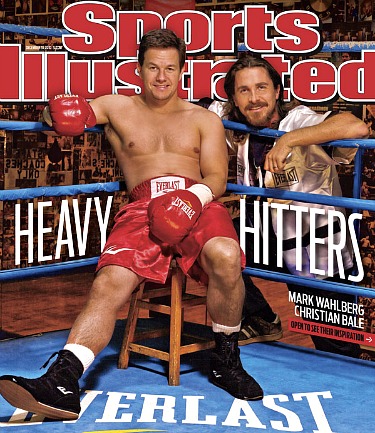
“All of us at Relativity are deeply grateful for the Hollywood Foreign Press’ recognition of The Fighter. I also want to congratulate my fellow producers, and David O’Russell for his extraordinary direction and leadership. Mark Wahlberg, Christian Bale, Amy Adams and Melissa Leo gave outstanding performances and are the heart and soul of this project.” — Fighter producer and Relativity Media honcho Ryan Kavanaugh (received at 11:11 am).

Flapjack

Regrettable, Wrong Headed Poland: “What does The Social Network winning [Best Picture from the NYFCC and LAFCA] do for The Social Network? Aside from some lovely ego play, nothing. The film has been in position to be nominated across much of the board since the first screening in September. Come February, no Academy member is going to vote for anything based on what awards groups said.” Repeating: “The Social Network still isn’t going to win Best Picture from the Academy…unless they’re starting a media branch.”

Wells response: Poland wrote yesterday that the Best Picture race “is between The King’s Speech, True Grit and Black Swan.” The older traditionalists want The King’s Speech, and so yes, it’s definitely a top contender. But while Black Swan will be nominated (of course!), I fear it can’t win because of the older-women-don’t-like-it factor. The yentas have been talking it down, I hear. And I don’t feel much of aTrue Grit locomotive effect at this point. It may become one of the ten, but a finalist? No way.

Right now the signs point overwhelmingly to The Social Network, The King’s Speech and The Fighter being the three most likely finalists. It’s also obvious at this point that The Social Network is sweeping the critics’ groups like The Hurt Locker did last year, and if Poland thinks this will have little or no effect on Academy determinations, he’s really, really out on his own island.

If nothing else critics group awards instill flutters of guilt and shame into the industry/guild/Academy mentality. They know deep down that the critics are a little less political and a bit more integrity-driven than themselves. And if The King’s Speech doesn’t win a Best Picture award with any critics groups at all (which it may not), then at the very least Academy members will be facing the fact that if they vote for it and not The Social Network and/or The Fighter, the world will regard them as tired, backward-gazing traditionalists and quality-deniers. And they’ll have that knowledge to live with every time they look in the bathroom mirror for the rest of their lives.

I’ve said over and over that 2010 is, if nothing else, a year of generational conflict and a within the Academy. The Social Network and Black Swan (adored by under-40s) and The Fighter (and, in my book, the regrettably ignored Let Me In) vs. The King’s Speech (favored by old farts) and The Kids Are All Right (particularly admired by over-40 women).

Agreeable, Right-On Poland: “I think Colin Firth is the cat’s pajamas. He probably should have won last year for a performance that was complex, to say the least. But he’s going to win this year for a more technical, but very high quality performance. I am at peace with that. That said, if you saw Javier Bardem‘s performance in Biutiful and you think that any of the other performances, including Firth’s, is even aiming for the kind of depth Bardem goes to there, you are an idiot. And the lack of any nods to Bardem, in a performance that makes the overlooked turn in The Sea Inside looks like a cake walk, from LAFCA, NYFCC, or BFCA is an embarrassment. This is how critics have become marginalized. It can’t stop handing awards to great, fun, movie-movie performances and disconnecting from the tough stuff.”

Pride and Embarassment

Semi-sincere congratulations are offered to all the Golden Globe nominees. No one on the planet is wholly sincere about this joke of an awards show, but it serves a purpose and is obviously accepted for this. Are the Globes entertaining? Kind of. Diverting? Sure. Amusing from a distance? Okay. Harmless? Mixed opinion. They help out certain films and performances, but they also insert, I feel, a kind of poison into the bloodstream.

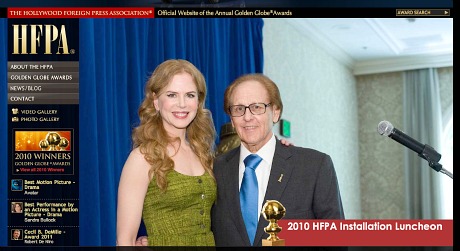
Unethical, whorish, an annual laughing stock and in some instances categorically insane — the Hollywood Foreign Press Association has it covered. We all know about the first three, but the HFPA’s idea of what constitutes a comedy has gone beyond odd and into the Valley of the Deranged. But because their award telecast helps to sell less-than-surefire-commercial movies to the schmoes and shore up Oscar cred, the film and TV industry industries work with these clowns each and every year.

I heard yelps of astonishment a few minutes ago when the nominations were announced and three were handed to The Tourist, which the HFPA regards as a comedy. (It has a slightly jaunty tone with a glamourish sheen.) The Tourist was nominated for Best Musical or Comedy, and costars Angelina Jolie and Johnny Depp were nominated for Best Actress and Best Actor, respectively, in a Musical or Comedy.

The Comedy/Musical category has been notoriously elastic in years past, but this feels to me like a new HFPA low. The Tourist has been slaughtered by critics, has under-performed at the box-office and is generally regarded as an embarassment. The HFPA sluts want Jolie and Depp to attend the telecast, of course, and they’re counting on people rolling their eyes and letting it go.

I like and respect most of The Kids Are All Right — it’s an above-average family relationship piece with rich performances, affecting emotion and intriguing sexual contours. But the HFPA is calling it a comedy, having given it a nomination for Best Picture (Musical or Comedy) and nominations for Best Actress (Musical or Comedy) to costars Annette Bening and Julianne Moore. This is sheer reality-defying political calculation.

Lisa Cholodenko and Stuart Blumberg‘s dialogue is smart and knowing and clever, and this level of discourse always results in an occasional smirk or chortle. But the bit about Bening and Moore watching male gay porn to get off is just flavor — it’s not “funny.” (The reaction of their son, played by Josh Hutcherson, to this information is straight and earnest.) Yes, the sex scenes between Moore and Mark Ruffalo are momentarily amusing (i.e., when Moore succumbs with an “oh, yeah!”) but this is mainly just lively writing and acting.

The darkest stories have little trickles of humor. The perversity is in the HFPA exploiting this tendency to suit its own ends. By the HFPA’s standard Macbeth is a comedy/musical because of the “knock knock” scene.

The political idea behind the Kids Are All Right noms, of course, is to spare Bening and Moore from having to compete against Natalie Portman, Michelle Williams, Nicole Kidman and Jennifer Lawrence in the dramatic category, and to assure that one or the other will win. It’s a completely corrupt inside move, but as long as the fix is in the HFPA should declare a tie and give the award to Bening and Moore. It would be the fair thing, and Scott Feinberg would approve.

I for one heartily approve of both Amy Adams and Melissa Leo getting nominated for Best Supporting Actress for their Fighter performances. The truth is that Leo’s performance as Wahlberg and Bale’s headstrong, chain-smoking mother is the livelier of the two, but not as likable or engaging as Adams’ girlfriend character, Sharlene. Adams is all about loyal, blunt and tough — the antidote to Leo’s bad-mom tendencies.

Lesley Manville (Another Year) didn’t make the cut. A real shame. She was also omitted by the BFCA nominations. She could conceivably land a Best Actress Oscar nomination (and let’s hope she does), but the concerns I shared on 10.27 and 11.20 about what may happen are apparently starting to come true. Sony Classics, no offense, should have put her up for Best Supporting Actress.

Hey, Anthony Breznican — what happened to True Grit?

The Kings’s Speech garnered the most nominations, followed by The Fighter and The Social Network.

The HFPA’s Best Picture (Drama) nominations are correct — Black Swan, The Fighter, Inception, The King’s Speech and The Social Network. If the Oscars still had five Best Pic noms, this is what they might be.

The HFPA has nominated Burlesque, a drop-dead awful film, for Best Picture (Musical or Comedy)…naturally! The other nominees are also a bit weird. Alice in Wonderland is spirited and bizarre but in no way “funny.” Red isn’t funny in the least — it’s horribly depressing. Why didn’t the HFPA nominate an actual comedy (like Due Date) or musical?

Best Directors: Darren Aronofsky (Black Swan), David Fincher (The Social Network), Tom Hooper (The King’s Speech), Christopher Nolan (Inception) and David O. Russell (The Fighter).

Best Actor (Drama): Jesse Eisenberg (The Social Network), Colin Firth (The King’s Speech), James Franco (127 Hours), Ryan Gosling (Blue Valentine) and

Mark Wahlberg (The Fighter)…Wahlberg and Gosling!

Here are the rest. The nominees list is everywhere. I have better things to do with my time than sit here like a stooge and type this stuff out.

Bears

Lethally slow pacing, no story tension, no wit or intrigue of any kind. This would be the reaction of any viewer who hasn’t seen and admired The Assassination of Jesse James by the Coward Robert Ford. On top of which we don’t get Booboo’s motivation, except that he’s conflicted about pulling the trigger. Does he resent Yogi’s dominance? What’s he going to do with the dough after Yogi’s dead? Cartoon characters don’t have wallets or bank accounts or money concerns.

Quiet Comforts

I visited Manhattan’s Standard Hotel early this afternoon to chat with Sofia Coppola, director-writer of the curiously haunting and altogether ballsy Somewhere (Focus Features, 12.122), which ranks in my book as a serious American art film in an age in which almost nobody makes them anything of the kind any more. Coppola calls it a film that “breathes,” or which dwells in a space in which breathing is easy and intriguing. I felt that way myself during our chat, which I recorded and will post sometime tomorrow.


Somewhere< director-writer Sofa Coppola -- Monday, 12.13, 2:25 pm.

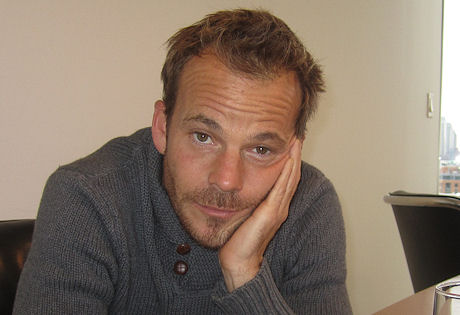
Somewhere star Stephen Dorff.

Copploa speaks quietly and concisely, maintains eye contact, has an attractive slight smile, doesn’t seem the least bit anxious about anything.

I also enjoyed a brief hotel-room discussion with Somewhere star Stephen Dorff, who knows how to smoke like Jean Gabin. He’s given his best performance in years in Somewhere. There’s a famous phrase: “He does very little, and does it very well.”

As soon as Somewhere began, I began to sink in and submit. I was fascinated, quietly chuckling, drifting in it, rapt. It’s the best film in which almost nothing “happens” (in an actively plottish sense) that I’ve seen in a long, long time. I said to myself, “More films need to go into these places. I miss meditation in movies. I miss quiet, stillness. I miss feeling trusted by a filmmaker to get what’s going in without being told.”

Why Kids Won Today

I don’t know exactly how it happened, but the Best Actress chances of Annette Bening were restored and then some by the New York Film Critics Circle today. She was named Best Actress by that venerated org, and is now no longer seen as being on the ropes…saved! The Kids Are All Right also scored surprisingly with a Best Screenplay award for Lisa Cholodenko and Stuart Blumberg, and — here’s a real shocker — Kids costar Mark Ruffalo, whom no one believed had any kind of shot at all, won Best Supporting Actor.

I haven’t done the reporting (I just came out of an interview with Sofia Coppola at the Standard) but I’m guessing that the reason Bening won for Best Actress is the same reason that Black Swan‘s Natalie Portman lost. Older women (including older female critics, a few of whom belong to the NYFCC) aren’t that big on Black Swan because it’s chock full of female nightmares that give them the willies. They just don’t like watching a film about a female character crippled by anxieties and insecurities, and who feels threatened by a female competitor, and who is goaded and manipulated by a controlling stage mom as well as a powerful alpha male at her workplace.

The Kids Are All Right is a female-directed drama about flawed women, yes, but the main characters, played by Bening and Julianne Moore, are feisty and willful, uncertain at times but far from weak, and the principal male figure in the film (i.e., Ruffalo) is basically passive and kid-like, and is ultimately defeated and shunted aside at the end. So Kids was, from a female perspective, a much more positive-minded, constructive-image thing to celebrate than Portman and/or Swan. Others in the NYFCC obviously joined the older-female contingent to make a majority (i.e., older mainstream-taste guys), but the NYFCC Kids win, I suspect, happened as much for political reasons (i.e., symbolic female self-image issues) as artistic ones.

The Social Network was named Best Picture, and David Fincher was named Best Director. The King’s Speech star Colin Firth won for Best Actor, and The Fighter‘s Melissa Leo won for Best Supporting Actress. Matthew Libatique‘s cinematography for Black Swan was honored, and The Illusionist beat Toy Story 3 for Best Animated Film. Inside Job won for Best Non-Fiction Film (i.e, Best Doc). OIivier Assayas‘s Carlos won for Best Foreign Language Film, and Animal Kingdom was named Best First Feature.

Network Me-Tooism

The Southeast Film Critics Association has totally submitted to boilerplate expectations by naming The Social Network as the best of 2010’s Top Ten, and by giving The King’s Speech‘s Colin Firth their Best Actor award and naming Black Swan‘s Natalie Portman as Best Actress. They surprised a bit by going with TKS‘s Geoffrey Rush for Best Supporting Actor and True Grit‘s Hailee Steinfeld for Best Supporting Actress. The Social Network also won for Best Ensemble, and David Fincher won for Best Director.

Tick-Tick-Tick

The New York Film Critics Circle is deliberating as we speak. Publicist Jeff Hill says that the winners will be announced in bulk “at the end [of the voting]…noonish.” In years past, the NYFCC website has revealed the winners as they were decided upon, category by category. Now it’s just sitting there like a dead steer, flies buzzing around, nothing updated since the winners were announced a year ago, not even acknowledging the date of the 2010 vote…nothing. This is not cool.

12:29 Update: Jeff Hill writes that the NYFCC is “halfway through now…patience, please.”

"Regular Snickers"

Tron: Legacy “may be the best movie I’ve ever seen that possesses a truly awful script,” says Film and Felt‘s Gabe Leibowitz. “There’s no sugarcoating it — the screenplay alternates between predictably hokey (a sunrise sequence is particularly galling), and flat-out cheesy (most of the dialogue exchanges).

“It’s less the romantic subplot between the freewheeling, seemingly-orphaned Sam Flynn (Garrett Hedlund) and the mysterious Quorra (Olivia Wilde ), which thankfully doesn’t get enough screentime to become a serious detriment. Rather, it’s the father/son relationship between former gaming/technology mogul Kevin Flynn (Jeff Bridges, reprising his role in 1982?s original Tron) and Sam that’s especially offensive on the ears. Seemingly every other exchange between the two contains some form of cloying schmaltz that should evoke regular snickers from the audience.

“The acting isn’t any great shakes either. Bridges is passable at times, but too often seems to be channeling The Dude from The Big Lebowski: seriously, he should never be allowed to say the word ‘man’ again. The rest of the cast mostly looks the part, but lack any sort of real acting chops.

“But you didn’t go to the IMAX theater near you to listen to Kevin or Sam wax poetic, did you? You came to break out the popcorn and get gloriously lost in [this] sweeping world, and here, Tron: Legacy succeeds brilliantly. With a first-rate, pulse-pounding soundtrack by Daft Punk and dazzling CGI, the action is rhythmic and often mesmerizing. A battle in ‘Zeus’s lounge’ is absolutely riveting (and Michael Sheen‘s Zeus is easily the coolest character in the entire film — he could easily be a droog), and indeed, most of the fights, chases and escapes are intense and thoroughly engrossing.

“Like Avatar, Tron: Legacy is more of an impressive experience rather than a great film, but there’s less pretension here, if not quite the capitalization of the IMAX technology.

Tron: Legacy seems to be very comfortable with what it is — namely, a video game fan’s wet dream. At some point, all gamers have fantasized about being transported into their console, be it the vast lands of Final Fantasy VII or the battlefields of Call of Duty. Here, they get to experience it in all the modern, hyper-digitalized glory. Be sure to see Tron: Legacy in IMAX and with friends. It’s very entertaining, and accomplishes its goals with gusto — its strengths are so prominent that it’s easy to view its weaknesses as quibbles rather than serious detractions, presuming you go in with proper expectations.”