A Lotta French

Last night HE attended the lavish hoo-hah opening of the City of Light City of Angels (COLCOA) Film Festival at West Hollywood’s DGA building. Elegant surroundings, cool-cat supporters (including directors Michael Mann and Larry Kasdan), great champagne, etc. I’ll be dropping into several screenings later this week because I find French films enormously soothing and transporting, and because they tend to be more emotionally supple and mature than American films.


Monday, 4.11, 8:45 pm.

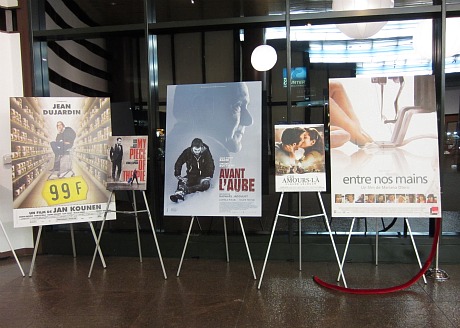
DGA lobby — Monday, 4.11, 8:45 pm.

Usually the opening-night attraction at any festival is on the bland and underwhelming side. So I was somewhat surprised to discover that last night’s film, Phillipe Le Guay‘s Service Entrance with Fabrice Luchini and Natalia Verbeke, was an exception to the rule.

Set in the early ’60s Paris, it’s about a highly regulated financial adviser (Luchini) who falls for a young Spanish maid (Verbeke) that he and his wife have recently hired, and who lives on the cruddy top floor with several other Spanish maids working for neighbors. I’m calling it a smooth and concisely written and generally agreeable light dramedy — the kind of French film that isn’t usually exported to the U.S. because of its unassertive, mild-mannered nature but works very nicely according to its own mood and pacing.

Service Entrance opened two moths ago in France and has reportedly done well. It’ll probably never open here, although it should.

I’ll be seeing a few other COLCOA films this week — Bertrand Blier‘s The Clink of Ice, Pierre Salvadori‘s Beautiful Lies, Katell Quillevere‘s Love Like Poison, Fabienne Berthaud‘s Lily Sometimes and Romain Gavras‘s Our Day Will Come, among others.

Every time I see that COLCOA acronym it his me the wrong way. Why decide on a name for a film festival that looks like a hybrid of cocoa and coca-cola? Why not just call it the annual Los Angeles French Film Festival?
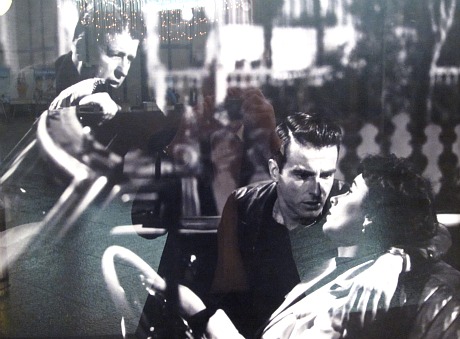
Mounted DGA-lobby still of George Stevens directing Montgomery Clift and Elizabeth Taylor in A Place in the Sun. All three are dead now.
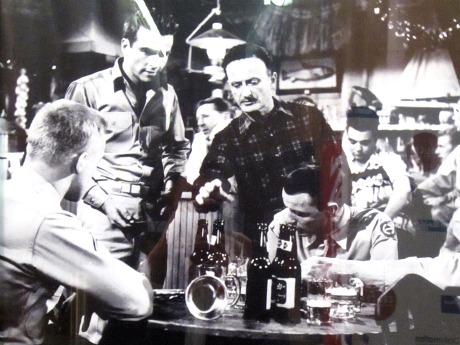
Fred Zinneman directing Montgomery Clift and Frank Sinatra during bar-confrontation scene in From Here To Eternity.
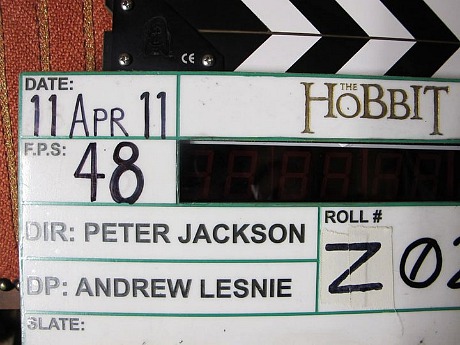

Jackson Embracing 48 fps

The 48 frame-per-second Director’s Club now numbers three — James Cameron, Douglas Trumbull and Peter Jackson. Late yesterday Jackson explained on his Facebook page why he’s shooting The Hobbit at 48 fps.

This is obviously a digital technology deal when it comes to exhibition (i.e., theatres that are still using reel-to-reel analog projection could never project at 48 fps) but what would this mean percentage-wise? How many top-tier urban theatres will likely show The Hobbit, Avatar 2 & 3 and Trumbull’s untitled latest in this format? And what about those behind-the-times houses in the boonies? Will Cameron-Trumbull-Jackson be shooting traditional 24 fps versions of their films to accomodate this sector? Because Jackson is clearly uncertain in his post about whether the 48 fps will be an exhibition reality by the time The Hobbit opens.

“We are hopeful that there will be enough theaters capable of projecting 48 fps by the time The Hobbit comes out where we can seriously explore [this] possibility with Warner Bros.,” Jackson writes. “However, while it’s predicted that there may be over 10,000 screens capable of projecting The Hobbit at 48 fps by our release date in Dec. 2012, we don’t yet know what the reality will be. It is a situation we will all be monitoring carefully. I see it as a way of future-proofing The Hobbit. Take it from me — if we do release in 48 fps, those are the cinemas you should watch the movie in. It will look terrific!”

You know what’ll be cool? When a director announces he’s using 48 fps on a modestly-scaled, dialogue-driven film that doesn’t need it. Because extra-clean visual clarity is beautiful and enjoyable in and of itself — you don’t 3D fairies and hobgoblins and hammerhead dinosaurs. I remember saying 28 years ago that a truly hip and beautiful use for Trumbull’s Showcan process (60 fps) would have been the film version of David Jones and Harold Pinter‘s Betrayal. I’ve also expressed support for Baz Luhrman‘s proposed 3D version of The Great Gatsby, precisely because it’s unnecessary.

Betrayal, by the way, is still unavailable on DVD/Bluray, possibly due to some thoughtless and/or obstinate descendant of producer Sam Spiegel, whose estate, I’ve been told, owns the rights.

Williams vs. Brooklyn Cool

So a network anchorman openly deriding what he sees as the foo-foo pretensions of Brooklyn hipster culture needs to be processed in quotes? Because the Brian Williams script, obviously, is basically saying that X-factor Brooklynites haven’t a culturally sincere bone in their bodies, and that they see and process everything in ironic terms.

You know what? Too much friggin’ stuff is in quotes nowadays. There’s something to be said for the old John Wayne-James Cagney ethos of planting your feet, looking the other guy in the eye and telling the fucking truth without any of that “do you get how I’m speaking ironically?” crap.

In Wayne and Cagney’s view, Brooklyn X-factor types have created a culture that may have began in the ’90s with their inability to afford Manhattan rents, but is primarily about (a) small businesses with an organic, cool-cat, anti-corporate aesthetic, (b) relatively few corporate chain stores except in some high-density areas where corporate-funded businesses are long established, (c) scraps of garbage on the sidewalks and (d) relatively few tourists. What’s not to like except for the stunningly ugly Hispanic neighborhoods (like Graham Avenue from Montrose Ave. south to Broadway/Flushing)?

You know what’s really, really nice about being back in West Hollywood? No garbage at all on the sidewalks. Not a single scrap. I wonder why that is. Any theories, Glenn Kenny?

Linear and Authentic

HBO publicists didn’t invite me to see Todd HaynesMildred Pierce miniseries in advance, but I’ve seen two episodes so far (#1 and #3) and found it pretty absorbing. I’d read that it might be a wee bit sluggish, but I wasn’t the least bit impatient or disengaged with any of it. I believed every shot, line and scene. And it’s obviously very well acted by everyone (and I haven’t even gotten to Evan Rachel Wood‘s section yet).

Kate Winslet‘s performance as the struggling titular character, a role previously owned by Joan Crawford in the 1945 Hollywood version, uncovers something anxious and frumpy and unmistakably genuine in herself. I think it’s one of her finest.

I read that Mildred Pierce opened to disappointing ratings. I’m guessing the numbers haven’t dramatically shot up since, and if so that’s a shame.

Last week’s Vulture‘s Jane Mulkerrins asked Haynes about criticism that the series is a bit too slow and luxuriant. “I’m sure some viewers are not up for this experience,” Haynes replied. “I don’t agree, but it is all according to people’s tastes. I think it’s good for us, in our era of constant distraction and digital multitasking, bite-size information and endless texting, to have an experience where you actually move through someone’s life without leaping hysterically, flashing forward, and jumping around.

“I’ve never done anything this doggedly linear in my career as a filmmaker, and that’s what the novel does — it spans nine years. The novel is intensely, realistically linear, and that is one of the challenges that I took on. I think if you enjoy getting in-depth, and you enjoy following characters over time, you will enjoy this. It’s an experience that is more akin to reading a novel than watching a single film. And with these performances, and this amazing era that you get to travel through, there’s an awful lot to enjoy beyond just the narrative.”

Dead April

Okay, maybe not “dead” but I’m getting enervated expectation vibes from all but a few April films. It feels worse than January-February right now. I haven’t yet seen The Double Hour (opening Friday) or Water for Elephants (4.22) or Prom (which screened for karaoke-singing junketeers last weekend) or Atlas Shrugged (the Tea Party movie) or 13 Assassins or Stake Land or Rio but I’m scanning the list and muttering to myself, “This?”

And with May just around the corner the summer-crap tentpolers (Pirates of the Caribbean, Effin’ Thor, The Hangover Part II, Kung Fu Panda 2) will soon be ruling (smothering?) the conversation. Thank God for the diversion of the Cannes Film Festival.

Bertrand Tavernier‘s The Princess of Montpensier (IFCFilms) is the best film opening this weekend that I’ve actually seen, and Werner Herzog‘s Cave of Forgotten Dreams (IFCFilms, 4.29) is…okay, minor Herzog, but the unusually geological, take-it-or-leave-it 3D photography makes it worth catching in a theatre with glasses.

Almost everyone was underwhelmed by Robert Redford‘s The Conspirator (4.15) at last September’s Toronto Film Festival. (I was surprised by how History Channel lifeless it felt.) Atlas Shrugged, also opening on Friday, has barely been shown to press, but is apparently/obviously a Tea Party movie that will die a quick death. Scream 4 (4/15) is something you either pay to see or you don’t, but conversational buzz is probably not an option.

Water for Elephants (4.22) hasn’t screened for anyone I know and isn’t having press screenings until next Wednesday, or two days before opening.

What else? I wouldn’t see Incendies again on a bet. I still haven’t seen Morgan Spurlock‘s The Greatest Movie Ever Sold and won’t be seeing it until next week. Nobody wants to even acknowledge Tyler Perry’s Madea’s Big Happy Family (4.22). I respect and admire Takashi Miike and the quality that has reportedly gone into his 13 Assassins (4.29) but Asian battleswords have never been my cup of tea. All I remember about the Sundance 2010 showings of Mark Ruffalo‘s Sympathy for Delicious is Ruffalo stating that “we got our asses handed to us by the critics and we’re still here.”

Hairy

A five-second clip of a CG WETA monkey from Rise of the Planet of the Apes (20th Century Fox, 8.5)? That’s it? But this, for me, is a more interesting hybrid-simian than the kind Tim Burton created ten years ago, and way better than the Rodeo Drive monkeys in Franklin J. Schaffner‘s 1968 original.

This is a chimp, obviously. It looks more or less like a “real” one instead of a human wearing an ape suit. The ears are well done and so, especially, are the intelligent eyes. The eyes, in fact, reminded me a little bit of the “Dawn of Man” apes in Stanley Kubrick‘s 2001: A Space Odyssey — still the high-water mark in this realm.

Rupert Wyatt‘s sci-fi-adventure, an origin story set in present-day San Francisco, costars James Franco, John Lithgow, Freida Pinto, Andy Serkis and Brian Cox. The generic p.r. paragraph says it’s “a reality-based cautionary tale, a science fiction/science fact blend, where man’s own experiments with genetic engineering lead to the development of intelligence in apes and the onset of a war for supremacy.”

Before They Mess It Up

Giuseppe Capotondi’s The Double Hour (Samuel Goldwyn, 4.15) “is a tremendous flick that [will] probably be remade by Hollywood with Katherine Heigl starring and McG directing with a tacked-on happy ending. Until then we have the original — a brutal, beautiful fusion of The Vanishing, A History of Violence, Mulholland Drive and Les Diaboliques” — 3.28 Quickflix review by Simon Miraudo.

Miraudo also called it “a haunting meditation on grief and guilt masquerading as an intense psychological murder mystery.”

John Anderson‘s 4.8 N.Y. Times story about spoilers mentioned that The Double Hour “faces information age challenges to keep its plot secret.”

I haven’t seen The Double Hour on either coast, but I’ve asked the good people at Ginsberg-Libby for help in that regard.

Those Days

Earlier today an HE reader ran a portion of my quote from John Anderson‘s 4.8 N.Y. Times piece about spoilers, so here’s the whole thing: “There’s no holding on to anything these days. It’s just a matter of minutes of searching around. And it’s a shame, because the greatest thing is seeing a film fresh, with no advance buzz. Now you know everything about a film before you go see it. But I’m part of that process, so who am I to complain?”

My point was that none of us can go home again. I used to see long-lead screenings of new films in the early ’80s as a Manhattan freelancer, and every now and then it was beautiful. One of my all-time transporting movie experiences was seeing Local Hero totally cold, before anybody had said a single word about it. But those days are long gone and no amount of accusatory finger-pointing and hand-wringing will bring them back.

Nobody should ever reveal a significant third-act plot point of any kind (and revealing that Meek’s Cutoff ends with the sight of a big, half-dead pine tree is definitely not a spoiler), but sometimes you have to let this and that detail leak out if you’re going to mix it up and discuss new angles and undercurrents in quasi-early bird fashion..

Cheese

One of the really great things about dogs is that they actually look at the camera when you take their picture. Cats might glance at it for a second, if that.


Sonya Kirasirova, Joey, Jett Wells somewhere in Central Park — Sunday, 4.10.

They All Stink

“You know what we haven’t seen? That small-town wrestling movie…what’s it called? Somebody told me it’s really good. You didn’t read the reviews? Paul Giamatti? You know and I know critics who do unqualified cartwheels over Meek’s Cutoff can’t be trusted, but they all really liked this thing. You don’t wanna…? Sure? ‘Cause I really don’t wanna see Arthur.”

Currency

Yesterday’s Sidney Lumet tribute by Salon‘s Matt Zoller Seitz was the most perceptive and best written of the nine or ten I’ve read so far. Lumet’s style of directing “has a subliminal effect on what we’re feeling as we sit there in the dark,” he said. “He thought about the story from the inside out, letting text and performance dictate visuals, rather than superimposing meaning.

“It’s not the only valid way to make a movie, but it’s demanding and illuminating, and there are not as many rewards in it as there are in the shoot-the-camera-out-of-a-cannon type of directorial pyrotechnics.

“That’s why, even though Lumet’s films sometime became hits and won awards, they never gained much currency with auteurist critics. [But] just because you don’t instantly notice what directors are doing doesn’t mean they aren’t doing anything.”