"Pile-Up of Poor Judgment"

Before Jesse Peretz‘s My Idiot Brother had been retitled Our Idiot Brother (8.26) by the Weinstein Co., it was slammed at Sundance by Hollywood Reporter critic John deFore. The film, he said, “shambles along with all the purposefulness of its title character, a kind of near-beer Lebowski who’s neither reckless enough to cheer for nor misguided enough to disdain.

Paul Rudd‘s Ned Rochlin, recently released from jail and broke, wanders through his three sisters’ homes, inadvertently revealing that each has as much to answer for as their brother who sold dope to a policeman in uniform. Each episode yields laughs, but the many parallel screw-ups don’t build to the kind of crescendo the film needs; it may be no worse than Rudd’s latest vehicle, How Do You Know, but it’s yet another leading role that fails to live up to Rudd’s talent, and it’s hard to imagine it approaching the commercial success of his more high-concept studio comedies.”

Talking Points

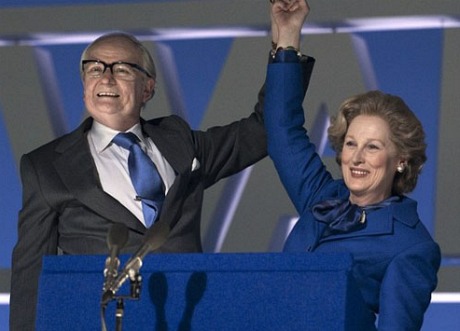
It’s already clear how Meryl Streep‘s Oscar-bait performance as Margaret Thatcher in The Iron Lady (20th Century Fox, late December) is going to be sold. One, as a tribute to a woman “who came from nowhere to smash through barriers of gender and class to be heard in a male-dominated world.” And two, as a respectful salute to a tough, steely conservative who doesn’t seem so bad compared to the Palin-Bachmann tea-bagger wackos.


Jim Broadbent (l.)as Denis Thatcher and Meryl Streep as Margaret Thatcher in Phyllida Lloyd’s The Iron Lady.

Oldie Bluray Short List

Yesterday I posted a fairly glum assessment of the fate of classic films on Bluray, but you can’t get too down-hearted about this stuff. So here’s a list of 30 films made (and for the most part released) in the 1950s — most of them large-format, nearly all in color — that need to be properly spiffed up and Bluray-ed. They certainly need looking after element-wise, particularly those released in the mid to late ’50s up until ’60 due to fading among those shot on “safety” stock.
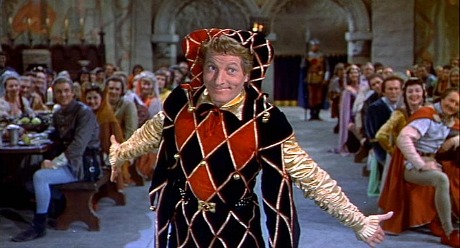

Danny Kaye in The Court Jester

It doesn’t matter if decent-looking DVDs of these films exist — they could all look much better and need to be re-done to satisfy the Movie Godz. If these films were properly restored and remastered for Bluray release we’d all be living fuller, happier lives.

One guy who helped me put this list together is Bruce Kimmel, former director (The First Nudie Musical), a motion-picture soundtrack record producer and a rabid film aficionado.

I need to mention the VistaVision problem before starting. Paramount shot and released over 100 VistaVision films in the ’50s, and so far we’ve only seen two of them properly transferred to Bluray — The Ten Commandments and White Christmas. It would be ecstasy if the original VistaVision version of Marlon Brando‘s One-Eyed Jacks (’60), a beautifully-shot western that’s has been mired in public-domain hell for several years, could be released on Bluray.

With three or four exceptions I’ve included large-format films that should play by today’s standards, and have avoided those that probably certainly wouldn’t work on Bluray due to being mediocre or awful by any measure.

1. William Wyler‘s The Big Country (’58…shot on SuperTechnirama, a horizontal 8-perf VistaVision-like format that renders a horizontally-squeezed image that came out un-squeezed at a 2.35-to-1 Scope ratio when projected anamorphically). The DVD of this Gregory Peck-starring western is so-so, nothing special, close to mediocre — a properly-rendered Bluray would be stunning.

2. Alfred Hitchcock‘s The Man Who Knew Too Much (’56…shot in VistaVivision). “The original negative has faded, and the two Universal Home Video DVDs so far have been blah-level. “It could and should be gorgeous…perfect,” says an east-coast source.
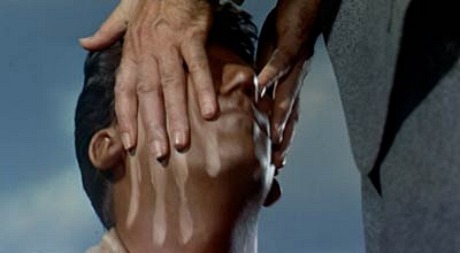

The Man Who Knew Too Much

3. Melvin Frank and Norman Panama‘s The Court Jester (56…shot in Vista Vision.). I’ve never even seen this film, mainly because I have an aversion to Danny Kaye. (Horrific images of Kaye coupling with Laurence Oliver flood my brain, etc.) A medieval spoof, gorgeously photographed. “The one Danny Kaye film that never dates,” says Kimmel.

4. Michael Todd‘s Around the World in 80 Days (’56…one of two films shot in 30-frame Todd-AO). A close-to-ghastly film that needs work, research, restoration. A film shot in 65mm 30 fps has to be saved, no matter how bad! Compared to what it should look like, given the exceptional elements, the DVD looks awful, bordering on out-of-focus. And yet the fact that it won the 1956 Best Picture Oscar (i.e., handed out in ’57) is perhaps the Academy of Motion Picture Arts and Sciences’ greatest embarassment.

5. John Wayne‘s The Alamo (’60…shot in 70 mm Todd-AO).

6. John Huston‘s Moulin Rouge (’52). Shot by dp Oswald Morris in reddish rosey tones as a kind of visual experiment meant to complement the color in the paintings of Toulouse Lautrec. Allegedly never rendered on DVD befitting Morris and Huston’s precise intentions.

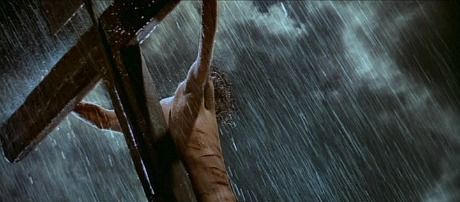
7. John Huston‘s Moby Dick (’56). Shot and processed by Morris in washed-out color and rendered in release prints that were printed with a “gray” negative which gave the color a certain black-and-white tonality meant to resemble Currier & Ives etchings. This special color experiment has been simulated on the Moby Dick DVD, but it’s not the real thing, of course. I happened to see a single reel of a ’56 black-and-white release print at the Academy back in the ’80s — riveting.

8. William Wyler‘s Roman Holiday (’53). Lowry Digital’s John Lowry delivered a grain-free DVD in 2002. “It was a low resolution DVD made from the wrong elements,” a source remarks. “It was the same thing with Sunset Boulevard…they couldn’t find the original negatives or the original fine-grain on either one…it didn’t look filmish…it looked like a ‘kinny'” — i.e, a kinescope.
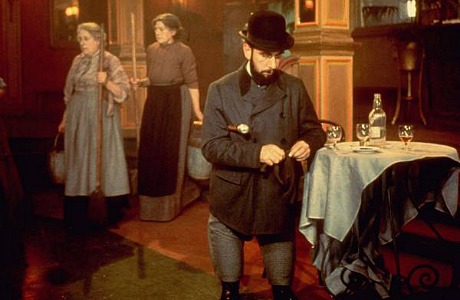

Moulin Rouge

9. Billy Wilder‘s Sunset Boulevard (’50). See Roman Holiday.

10. Billy Wilder‘s Stalag 17 (’53).

11. Vincent Minnelli‘s Gigi (’58). “They did everything they could [when they mastered the Bluray] but they were dealing with a faded original negative and bad color.”

12. John Ford‘s The Searchers (’56). “Needs to be re-done,” says Kimmel. “The Bluray is sharp but the color is wrong…they put too much yellow into it. Everything is wrong….Monument Valley sand is wrong….the sky is faintly greenish when it should blue….the clarity is fantastic but the adobe bricks in the opening credits are supposed to be gray but they’re blondish gold.”

13. George StevensShane (’53). “It could be done like they did The African Queen and The Red Shoes, a beautiful Bluray done by Bob Gitt. They have a three-strip Technicolor negative…they just don’t have a clean HD master so how are they going to bring it out on Bluay?…it’s not a huge undertaking…but they just need to buckle down and go in that direction.”

14. Fred Zinneman‘s Oklahoma! (’55, shot in 65mm Todd AO 30 frame and also in 35mm 24-frame — two different versions). Kimmel, like me, saw Oklahoma! projected in 30-frame Todd-AO at the old DGA theatre back in the mid ’80s. “It was beautiful…you felt as if you could walk right into that picture,” he says. A laser disc that delivered the Todd AO version was sharp and handsome but for whatever reason the same version looks atrocious on the DVD. Kimmel says that Fox Home Video restoration maestro Schawn Belston believes that “the image compression screwed it up” and that the Todd AO version is salvagable.

15. Otto Preminger‘s Exodus (’60). A mediocre film shot in 70 mm that looked awesome when it was projected in first-run engagements some 51 years ago. “The DVD is the worst thing ever made and it’s a 4 x 3 transfer,” Kimmel remarks. “That’s one I’d love to see done right.” (Even if the film itself is quite difficult to sit through, he could have added.)
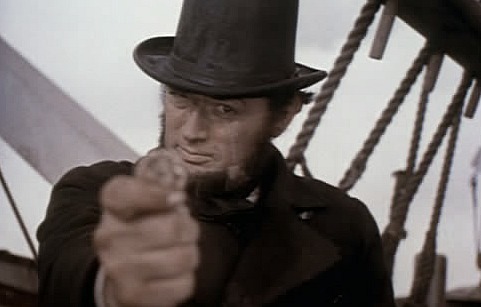

Moby Dick

16. The three James Dean moviesElia Kazan‘s East of Eden (’55, 35mm CinemaScope), Nicholas Ray‘s Rebel Without a Cause (’55, 35mm CinemaScope) and George StevensGiant (’56). “Giant is the worst of the three…the wrong process for the wrong film…they took the original Eastman negative and created a dye transfer print, which exacerbated all the problems….so they could say it was in Technicolor.”

17. Alfred Hitchcock‘s To Catch a Thief (’55, VistaVision). Paramount’s Centennial edition DVD, released in 2009, is the best-looking version of all, but just imagine how this exceptionally colorful thriller would look in Bluray.

18. Vincent Minnelli‘s Lust for Life (’56). Shot on Ansco, purportedly to get rid of the stock at hand.

19. Henry King‘s Carousel (’56), shot in CinemaScope 55mm, an eight-perforation process involving a slight horizontal blowup, the same process used on The King and I.

20. Edward Dmytryk‘s Raintree County (’57, shot in Camera 65mm, the process also used for Ben-Hur).

21. Joshua Logan‘s Sayonara (’57).

22. Stanley Donen‘s Funny Face (’57).

23. Morton DaCosta‘s Auntie Mame (’58, shot in Technirama — 35 mm anamorphic).

24. Richard BrooksCat on a Hot Tin Roof (’58, 35 mm).

25. Fred Zinneman‘s The Nun’s Story (’59, 35 mm).

26. Otto Preminger‘s Porgy and Bess (’58, Todd AO 65mm, 24 frame).

27. Fred Zinneman‘s The Sundowners (’60, 35mm).

28. Richard BrooksElmer Gantry (’60).

That's The Idea

Awards Daily‘s Sasha Stone and I have agreed to rent a car sometime in the afternoon on the day before the start of the Cannes Film Festival (i.e., Tuesday, May 10th) and drive into the hills above Cannes and Nice and maybe stop for a bite in Saint Jeannet, the smallish village seen from the home belonging to Cary Grant‘s John Robie in To Catch A Thief.

That Act One chase scene (cops in black car chasing Robie’s marooon convertible) in Alfred Hitchcock’s 1955 film is the basic inspiration — i.e., to take the same drive along those winding roads and scenic rocky cliffs. (I’d also like to stop for a minute in Tourettes-sur-Loup.)

We’ll be leaving at 2 pm or thereabouts and returning to Cannes in time for the annual 7:30 pm journalist get-together at La Pizza. If anyone wants to tag along, get in touch. I’m figuring no more than a four-hour trip all together. Okay, five hours. Stone and I are arriving in Cannes fairly early that day so there will plenty of time to get situated and pick up our press passes and whatnot.

Mitchell's Latest Ankling

As I explained three weeks ago, mentioning that Jeffrey Wright‘s character smokes a pipe in a review of Source Code, however sloppy and unfortunate, is not a whackable offense. It’s certainly something that now-former Movieline critic Elvis Mitchell, whose firing was announced last evening by Nikki Finke, could have finessed with one hand tied behind his back.


Former Movieline critic Elvis Mitchell

My guess is that Elvis didn’t respond to his employer (MMC’s Jay Penske) quickly enough with a reasonable-sounding explanation, or perhaps he doesn’t respond with any details at all. Because impersonating a black hole when it comes to responding to emails and phone calls is definitely what Mitchell does.

The “tell” is in this passage in Nikki Finke‘s story (which posted last night at 5:27 pm Pacific), to wit: “After the director’s tweet was brought to Movieline‘s attention, I questioned an editor there who emailed, ‘We’ve indeed been working hard for a week to ascertain exactly what happened…'”

Who works hard for a week to figure out an issue like this? You call or text and the employee responds…simple. Movieline editor: “So Elvis, what happened here?” Mitchell: “I don’t know. Fatigue or something. I read the script a while back and somehow the pipe-smoking thing found its way into my head. It happens. The brain does this on occasion. No biggie. I’ll write an apology and an explanation.” Movieline editor: “Cool.”

“When Movieline asked for a formal explanation,” Finke reports, “Mitchell told editors that he was at the screening and that it was all a misunderstanding and that he would provide a written explanation.” Except he apparently didn’t.

I wrote Mitchell this morning with the following message: “Can you PLEASE explain what the fuck happened with Movieline? I’m trying to write this up and the Jeffrey Wright pipe-smoking thing just ISN’T A FIRING OFFENSE. So what happened? Did they try to reach you and discuss this and you blew them off? This was an easily finessable thing.” And of course, no response.

Mitchell responded once to me via email when he left the NY Times film critic gig, or so I recall…but that was the exception. And you’d think he’d at least keep in touch with guys like me because he just keeps blowing, or blowing off, exceptionally cool gigs. The recent Roger Ebert movie-review co-hosting TV thing…phffft. That minority-filmmaker-scouting gig in Manhattan for Sony — a totally cushy job that he reportedly torpedoed by not showing up at the office. A director of development job at Paramount Pictures…blown. Right now he still has the NPR radio gig hosting “The Treatment” and…I forget what else.

I’m presuming that Mitchell not being quoted in Nikki Finke’s story was because he didn’t reply to her queries. Indiewire‘s Anne Thompson has written a knowledgable assessment. David Poland‘s take on this is worth reading. Roger Moore‘s Orlando Sentinel riff struck me as needlessly mean-spirited.

Bull-Headed

What kind of a raging butt-plugged Mussolini do you have to be to type “[Blogger X]” to avoid posting my name? MCN’s David Poland did this in the process of re-posting a short 4.20 Glenn Kenny/Some Came Running riff about a Times Square Starbucks installing wall outlet covers to keep people like me from sitting at their tables for hours on end.

I admire Poland for many things (particularly his take-no-shit responses to Nikki Finke), but every now and then he just floors you with his Zampano-like obstinacy.

I’m assuming, by the way, that Kenny’s experience describes the policy of just that one Starbucks he happened to be in. Because…whatever, the place has exceptionally high traffic and the manager is an asshole. It would be nothing less than a national five-alarm-bell tragedy if all Starbucks outlets were to install wall-outlet blockers. If there’s one thing you can count on at Starbucks cafes it’s the presence of at least two wall outlets. You can always plug in sooner or later, and that’s a truly wonderful and deeply appreciated thing.

Not Enough

Nobody, it seems, has covered the Tribeca Film Festival so far the way I would have, and did last year. No q & a videos, no party photos, no random observations. I’m not feeling the aromatic, atmospheric stuff. All I’m reading are movie reviews.


Taken last year in front of Chelsea Cinema during Tribeca Film Festival.

Half-Sincere Mayor

A lot of people saw Gaukur Ulfarsson‘s Gnarr last night at the Tribeca Film Festival; I saw it today in my living room. It’s a mild-mannered, good-enough doc about comedian Jon Gnarr running a half-farcical, half-sincere campaign for mayor of Reykavik. He ran as the candidate of the Best party, which was basically about throwing out the bums who’d played any kind of part in Iceland’s (and the world’s) financial crisis. And the voters did that, more or less, because Gnarr won…great! I wish this country had fewer Tea Party-ers and more Gnarrs.

A better film, I think, would have been a little tougher on Gnarr. It would have drilled a bit more into whatever shortcomings he may have (or had) and showed us more about his opponents. It feels too friendly, but it seems relatively honest as far as it goes.

End Of An Era

Why is a Bluray upgrade of From Here to Eternity that was supervised by Sony’s Grover Crisp in ’09 still without a firm release date (sometime in early ’12 is the best guess so far)? Why does Paramount refuse to even talk about producing a mint-condition Bluray of the breathtakingly beautiful Shane, one of the jewels in the Paramount crown? Why did it take personal pressuring by Steven Spielberg before Paramount honcho Brad Grey agreed to fund the full-boat restoration of the three Godfather films?

And why right now are there only three Hollywood-based, studio-berthed restoration guys who are serious Movie Catholics and plugging away at trying to bring out tip-top Bluays from the cream of their libraries — Paramount’s Ron Smith, 20th Century Fox’s Schawn Belston and Sony’s Crisp?

I’ll tell you why. Because the classic-film Bluray market is withering and perhaps even drawing to a close. (I’m not saying “dead” because it thankfully hasn’t come to that…yet.) High-def classics will return, I suspect, when and if high-speed digital download technology improves. But Bluray is almost certainly down for the count. This is nothing short of an earthquake-level development, and one worth pondering just before the start of Hollywood’s TCM Classic Film Festival (4.28 through 5.1), which is probably the most important celebration of classic films going on right now in this country.

For the last 25 years or so the elite film-buff culture has had a relatively steady stream of classic films being restored, remastered and replicated out on the most advanced format of a given time — laser discs from the late ’80s to the late ’90s, DVDs from ’97 until three or four years ago, and Blurays ever since. But these days classic titles aren’t selling like they used to (Warner Home Video’s Gone With The Wind and Wizard of Oz Bluray restorations costs mllions and failed, I’m told, to turn a profit), and those in positions of power in the Bluray distribution business aren’t about to risk their jobs by pushing for restored Bluray titles that might financially fizzle. And those who get occasional work from these same people are loath to say anything for fear of being blacklisted…omerta.

The result is that potential first-rate Bluray upgrades of many fine classic films are either being ignored or on hold, in large part because they cost too much to restore and/or remaster and market and distribute. Fewer and fewer classic titles are likely to appear until — this is key — digital home delivery becomes fast and fibre-optic enough that 1080p films can be downloaded in a short period of time, and then classic titles can be sold without heavy marketing, manufacturing and physical distribution costs.

But when and if this happens (five years from now? ten?) you can forget about savoring making-of docs and commentary tracks and in fact owning several of these films and holding them in your hands. Physical ownership of great films has been a fact of my life since the mid to late ’80s and now it’s coming to an end. That whole tradition is (for the time being at least) winding down, and speaking as a Movie Catholic and one who has savored high-end restorations and remasterings for 20 or 25 years I feel personally devastated and appalled.

As one post-production and restoration veteran says, “The situation’s not so bad…a lot of these films are going to look great on an iPhone.”

Don’t kid yourself — this is nothing short of a tragic development in terms of the soul and necessary spiritual replenishing of the film industry.

Why? Because the truly great Hollywood classics need to be remastered and represented to the public in the finest possible way in order to keep the faith going and the religion of film kept as a vital cause. I’m talking about maintaining a ritual that, in its own realm, is no less necessary or important than ministers and priests keeping alive the memory of a certain Judean wanderer and preacher through Holy Communion.

Those who believe in the transformative power of film need to pay tribute to the legacy of classic films and keep alive visions of the best that Hollywood has produced over the last several decades, and they need to support those who know how to restore and remaster classic films in order to remind everyone how good Hollywood films of the ’20s, ’30s, ’40s, ’50s and ’60s used to look and sound in state-of-the-art first-run theatrical engagements…before they were downgraded by inferior home-video transfers.

And this needs to be done — are you listening, Brad Grey? — even if it doesn’t bring in a sizable profit, or even if the endeavor merely breaks even. Because we’re talking about religion here. Spiritual sustenance. The faith of it.

Obviously scores of classic films have been restored and remastered for Bluray over the last few years, and let’s all breathe a sigh of relief for the expensive and time-consuming work that’s been done (or is being done) on any number of big-studio properties, especially on the large-format films of the ’50s and early ’60s. Ron Smith’s The Ten Commandments Bluray was terrific. Warner Home Video’s forthcoming Ben-Hur Bluray will hopefully be a knockout. A Bluray of Lawrence of Arabia is coming out next year from Sony.

But truly choice titles are few and far between on the Bluray market, and many great films (particularly those shot on large-format processes in the ’50s and early ’60s) are yellowing and rotting on the vine, and many of those that are making it into the Bluray realm are being visually misrepresented — i.e., made to look shiny and video-gamey.

One upside develpment, I’m told, is that a remastered, more celluloid-looking Bluray version of Franklin Schaffner‘s Patton (i.e., a 40th anniversay re-release) is coming out on May 10th. Certain large-screen Bluray connoisseurs felt that the earlier version was DNR’d (digital noise reduction’ed) to death and given overly smooth video-game textures. The “bad” Patton was created by HTV Illuminate, a San Fernando Valley-based company that could be called the ground zero of shiny Bluray makeovers.

Bad Bellflower

Now that a trailer for Evan Glodell’s Bellflower (Oscilloscope Laboratoreies, 8.5) is finally out, I’m reminding everyone to be extremely wary of too-cool-for-school critics (i.e., effetes who are so brainy and perceptive that they’ve levitated off the planet) who’ve praised it to the heavens. Because it is HE’s humble opinion that Bellflower is one of the emptiest and wankiest time-wasters ever made.

“I saw Bellflower almost two months ago at Sundance,” I wrote during SXSW, “and my general reaction was split between pique, boredom and watch-checking agony. There’s nothing going on in this film of any interest or intrigue whatsoever…nothing.

“It’s a portrait of backwater hell and grungeballs and lackadaisical scrotum-scratching. No story tension, a handmade flamethrower, no pizazz, no humor (or at least not the kind I was able to laugh or even smirk at), crappy-looking photography, no job or vision or income, godawful wardrobes, no rooting interest, no emotional involvement.

“It farts out a stunningly lame story about two low-rent 30something guys nursing some asinine notion of a coming apocalypse and one of them, a slacker beardo played by Glodell, getting lucky with a nice girl and beginning some kind of serious relationship and then the ex-boyfriend wheedles his way back in, etc.

“MSN’s James Rocchi has called Bellflower “one of the most strong and stylish critiques of the idiocy and confusion in young manhood since Fight Club” — not a chance.”

Double-Screwed on Rififi

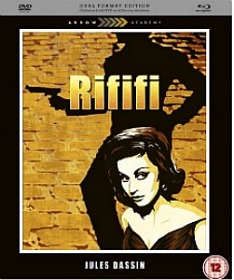
I was disappointed to read yesterday that the Arrow Academy Bluray of Rififi (out May 9th) is Region 2, which leaves Regon 1 Bluray player owners like me out in the cold. (And don’t start with the “re-program your BD player software to make it all-region” — I’m not smart enough to do that and half the time it doesn’t work anyway, I’ve been told.)

This plus the French Gaumount Bluray lacking English subititles means Rififi-lovers like myself are screwed both ways. (I could actually roll with the Gaumount since I know the dialogue backwards and forwards and the aspect ratio is 1.33 to 1.) The only thing to do is wait and hope for a Criterion Bluray version…if and when.

Elephants' First Hoop

Rob Pattinson‘s marquee attraction has apparently served Water for Elephants well. 20th Century Fox was reportedly estimating that Francis Lawrence‘s sadistic circus drama would bring in $13 to $15 million (a deliberate underprojection) on its first weekend. Last night Deadline’s Nikki Finke reported $7 million for Friday and $18 million for the weekend — “overperforming.” And Boxoffice.com’s Phil Contrino is forecasting $16.8 million with an entirely decent $5964 average on 2817 screens. So at best it’ll end up domestically with $50 million theatrical…right?

Needless to add if anyone paid to see Elephants last night and is so moved…