Nobody's Laughing

Boxoffice.com is projecting that The Green Lantern‘s total domestic theatrical gross will top out around $135 million after earning $52,685,000 this weekend. Indiewire‘s Anthony D’Allesandro reports that Green Lantern grosses “fell 22% between Friday and Saturday with another 15% today [i.e., Sunday].”

Warner Bros. will pocket around 90% of the $52 mill and maybe…what, 75% or 80% of the grand total? Even when you factor in overseas revenue, DVD/Bluray and pay/cable, etc., it still looks like a shortfaller considering the $300 million tab ($200 million to actually make the damn thing and, according to WB honcho Alan Horn, $100 million to sell it worldwide). So it’s a loser, a down-the-holer. No sequels, go away, etc.

What factors brought the curtain down upon The Green Lantern? Unfiltered Lens observer Ray DeRoussecites four killers: (1) Comic-book movies need a singular vision, and all Green Lantern really offered was soulless eye candy; (2) 3D is dead — “Nobody wants to pay $14 to $20 a ticket to watch Ryan Reynolds fight CG fart clouds in 3D… nobody“; (3) “Ryan Reynolds is not a movie star…yet”; and (4) “Comic-book movies have hit the end of the road.”

My Old Man

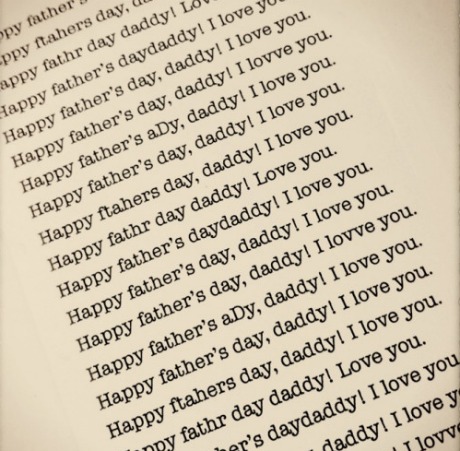
This Jack Torrance Father’s Day card was initially tweeted (I think) by Toy Story 3 director Lee Unkrich.

My father (who passed in 2008) turned me on to a few films that I admire, respect and still watch every now and then: The Four Feathers, Twelve O’Clock High, High Noon, Hiroshima Mon Amour, The Gunfighter, Gunga Din, Battleground, Sweet Smell of Success. I tried to return the favor occasionally, and he was generally receptive in the ’70 and ’80s and early ’90s. But I gave up on him when he called The Limey a piece of crap. “That’s it,” I told myself. “His taste buds are shot.”

Stacked

I’ve got an hour’s bike ride and other Sunday morning stuff to accomplish so I don’t know about attending the LA Film Festival’s Coffee Talk with Directors panel, which starts at 11 am (or 44 minutes from now) at Regal Cinema #12. The three panelists will be Phillip Noyce (Salt, Clear and Present Danger, Rabbit-Proof Fence), Richard Kelly (Donnie Darko, The Box) and Ruben Fleischer (Zombieland, 30 Minutes or Less).

I’ll definitely be attending the 5 pm Coffee with Screenwriters panel with Dustin Lance Black (Milk, J. Edgar), Diablo Cody (Young Adult, Juno), Christopher Marcus & Stephen McFeely (The Chronicles of Narnia, Captain America) and Josh Olson (A History of Violence, One Shot).

I’ll also be seeing Lisa Jackson‘s Sex Crimes Unit, a doc, at 7:15 pm, and then Paddy Considine‘s Tyrannosaur at 10 pm.

Last & Final

This morning at 8:51 am Glenn Kenny (@ExtAngel) tweeted that “reams and reams of furious debate and still no input from @wellshwood means ‘cultural vegetables’ (being re-discussed by Dan Kois, A.O. Scott and Manohla Dargis in tomorrow’s N.Y. Times) is really a complete non-issue.”

I didn’t get into it because I said it all on 5.4 in response to Kois’ original N.Y. Times Sunday Magazine article, and I was re-posting an old piece at that. Because I’d addressed the issue 12 years ago in an essay that basically said that vegetable-like, ever-so-slightly boring films are generally necessary, sometimes nurturing and almost always worthwhile.

(1) “Quality movies flirt with being boring from time to time. A good kind of boring, I mean. Nutritional, Brussels-sprouts, good-for-your-soul boring. So in the backwash of our constant cultural deprivation, ‘a little bit boring’ is a serious compliment these days. You just have to mean it (or hear it) the right way.”

(2) “It’s important to understand the degree of boring I’ve speaking of here. I don’t mean sinking-into-a-coma boring. Or regular boring. Or even mildly boring. But a little bit boring.

(3) “My point is, it’s often a mark of quality if something is a little bit boring. But I do mean a little bit. Too much of it and you’ll go to sleep. There are dozens of films released every year that are wonderful sleeping aids. I’m not talking about those. I’m talking about films that are laced with boredom. Like a couple pinches of salt in a bowl of egg salad. Just the right amount of it is usually an indication that a film is doing something right.”

Machine-Gun Clown

“Overall, the film is incredible. In the oldest sense of that word, it is awe-inspiring and grotesque. Stunning and heartfelt. It’s a love letter to a country, a time and a frowning clown singing mournfully about a weeping trumpet. We are all bad people. We hurt the ones we love. There can be no laughter without suffering.” — from a 10.5.10 Film School Rejects review by Cole Abalus.

Wait A Sec

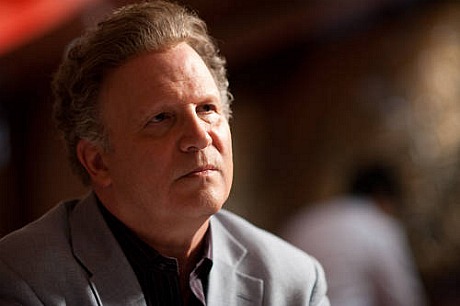
“God gave Mitt Romney the dashing handsome looks of a commanding Presidential candidate, but he stopped at the voice.” — Albert Brooks during last night’s Drive after-party at the Standard Hotel.

Where's The Hate?

I talked last night to a geeky guy at the Regal as we waited for Drive to begin, and he said he “loved” The Green Lantern. I also met a 30something mom and her daughter who really liked Lantern and had no trouble following the plot threads. “But all the critics hate it!,” I said to the mom. “I mean, really hated it.” She shrugged her shoulders.

What is this? Tell me there’s not a big wave of genuine hoi polloi support for this thing. Box-office numbers for CG megaflicks don’t mean a thing on the first weekend; it’s only about marketing.

No Slacking Off

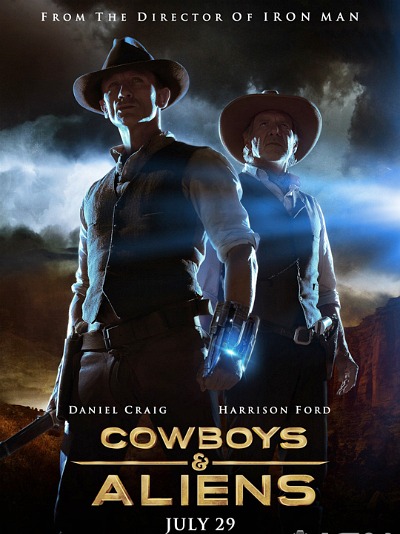
The IMDB says Harrison Ford has nothing lined up for the future. Cowboys & Aliens (Universal, 7.29) was his last activity. It’s probably the same old “I get my quote before I read the script” thing. If Ford was smart he’d just get to work with anyone who sounds or looks good, playing the crusty, weather-beaten oldster who can’t quiet bring himself to holster his six-shooter. Imagine Ford in a Nicholas Winding Refn film.

King of the World

I saw Drive again last night, and it felt just as assured and double-downed and Peter Yates-y as it did last month in Cannes. And then I ran into the very cool Albert Brooks at the after-party, which was held on the rooftop of the Standard Hotel on Flower Street. And he told me a few things about his part and the film and paid me a nice compliment (“I’ve read you all along, and you’re the ‘fuck you to the studios’ guy…somebody’s gotta do that, right?”) and…well, it was all to the good.


Friday, 6.17, 10:55 pm

Wait…is that a compliment? It felt like one when he said it, but I don’t see a “fuck you” guy when I look in the bathroom mirror. I suppose I gave off that vibe to some degree in the early to mid ’90s, okay. But my attitude has mellowed down a lot, especially since I started running the site myself in ’04. Today I see myself as more of a “fuck you to the geeks and grain monks” guy who’s enslaved to a daily column.

Brooks is so deliciously direct in Drive — cynical, snarly, smart-mouthed. And yet good-humored at times. His Bernie Rose, a former schlock movie producer, is one of those tasty-ironic characters, mostly “written”, of course, but also a series of riffs and rim-shots that Brooks seems to have co-written or half-improvised as he went along.

Bernie doesn’t like mincing words and futzing around with low-lifes but he does enjoy wordplay on a certain level and reflecting on the past, etc. He’s crafty and cunning and straight…and so corrupted he’s lost sight of whatever he might have been in the ’80s. I wish the script could have given Brooks/Bernie just a bit more humor and meditation (and less in the way of artery-slicing), but what’s there is fine, quite fine.

“Why did Refn come to you with this role?,” I asked him. “The character is obviously a big departure, in no way a reflection of anything you’ve done before.” Part of his answer alluded to Refn’s “Danish perspective.” But mainly, he said, the casting came out of his Winnebago temper-tantrum scene in Lost in America. “Refn said when he saw that scene as a child I scared him…my anger scared him half to death,” Brooks said.

“Why did you wear a toupee in the film?” I asked. “You’ve got enough hair…you’re fine.” Because, Brooks said, it added to the character — it put me into that place. I think he also meant that Bernie Rose is the kind of guy who might wear a rug, or something like that.

Brooks seems to be in some kind of peak mode these days. You should have seen him saunter out last night when Refn introduced him to the crowd. He came out like a punk, like a guy who doesn’t know how to play it humble or demure or be anything or anyone but himself. He’s unbowed, feisty, iconic. He’ll always be one of our smartest, funniest and most ambitious director-writers. (In a better world he’d be cranking out film after film after film like Woody.) He’s got a best-seller in stores, and he’s a world-class tweeter. He’s worth his weight in gold.

Kanamit Quandary

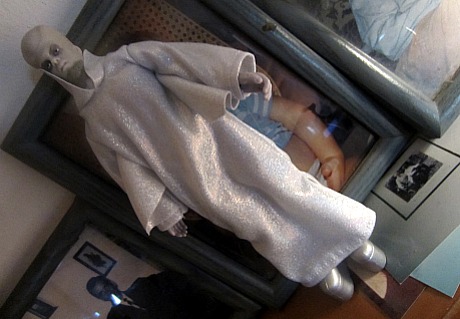
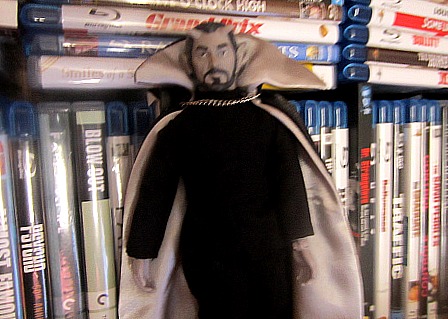
I recently got my mitts on some Twilight Zone action figures, and right away I was taken aback by the footwear worn by Richard Kiel‘s Kanamit character from To Serve Man (episode 89, season 3). Kiel was chosen to play an alien because he’s tall, and to make him even taller the producers had him wear high platforms…fine. But why would an actual Kanamit wear platforms? It makes no sense. Short people who can’t accept themselves wear platforms — not tall people. Why would a fat person wear a fat suit?

The odd thing is that the action-figure makers presumably copied Kiel’s Kanamit shoes from stills of Kiel wearing the super-high platforms during the shooting of the epsiode, And they didn’t realize what a nonsensical thing it would be for an actual Kanamit to wear platforms. They didn’t understand that the platforms weren’t supposed to be seen by the audience. And now they’ve blown it. The jig’s up, in a sense.


Robin Hughes’ devil from the finale of The Howling Man.

If you were in charge of manufacturing action figures based on the seven-foot-tall Martin goons in the original Invaders From Mars (1953), would you tell the designer to include the big zippers that are plainly evident on the back of their green-felt Martian suits in the film, or would you not include them?