Justice

Many years ago Ben-Hur screenwriter Gore Vidal dismissed the meaning of the title of Lew Wallace‘s 1880 novel, “Ben-Hur: A Tale of the Christ.” “It isn’t a tale of the Christ,” said Vidal. “It’s the tale of a war between a Roman boy and a Jewish boy.”

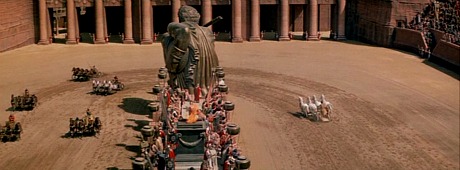
Which is why the movie ends after the chariot race sequence. Finito, resolved. Even though it continues for another half-hour or so because director William Wyler needs to be faithful to Wallace’s pious novel, and so we’re stuck with the sloggish remainder. And all you can do is look at your watch.

The crucifixion finale is supposed to be about Christ’s blood washing away the anger of an unjustly persecuted man and saving his mother and sister from leprosy. But the movie would be massively frustrating without the feeling of justice delivered to Stephen Boyd‘s Messala by what happens to him in the chariot race.

People don’t care about “happy” or “sad” endings — they want endings in which the characters receive their just desserts. Movies always “end” after the moment of justice occurs. The finale of The Godfather, Part II is satisfying because Al Pacino‘s Michael Corleone has met with a kind of justice, which is to say a state of solitude and spiritual frigidity after the murder of his brother Fredo. It’s a fate that he’s earned so it feels right.

And Vidal’s gay subtext in the relationship between Messala and Judah is unmistakably there in Ben-Hur. It’s an old story, but I love re-reading it:

Vidal, who wrote much if not most of the screenplay, says in the “Making of Ben-Hur” doc that he suggested to Wyler that the characters’ conflict scenes be written as “a lover’s quarrel.”

“Wyler said, ‘What do you mean?’,” Vidal recalls. “I said, could it be that the two boys had some kind of emotional relationship the first time around, and now the Roman wants to start up again and Ben-Hur doesn’t — and doesn’t get the point?

“Willie said, ‘Gore, this is Ben-Hur. You can’t do that to Ben-Hur.’ I said, well, if you don’t do something like that you won’t have Ben-Hur. You’ll have an emotiveless mess on your hands. And he said, ‘Well … you can’t be overt.’ I said, I’m not gonna be overt. There won’t be one line. But I can write it in such a way that the audience is going to feel that there is something emotional between these two that is not stated, but that blows a fuse in Messala. That he is spurned. So it’s a love scene gone wrong.”

Here’s that story I wrote yesterday about the forthcoming New York Film Festival showing of the restored Ben-Hur.
Elizabethan Detour

Trailer uploaded today, feature playing Toronto Film Festival, skepticism about the hand of Roland Emmerich prevailing, etc. I’m not fully persuaded that Anonymous, which sounds like kin to Untitled, is the greatest title.

No Middle Ground

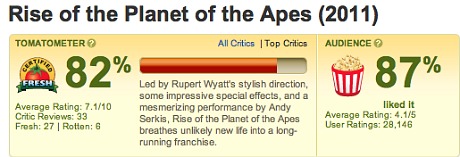
Critical response to Rise of the Planet of the Apes is 80% wowser, over-the-moon, delirious and ecstatic. The general tone isn’t “yeah, pretty good film, worth seeing” but “this is really an exception…summer’s best popcorn flick…Serkis deserves an Oscar nomination…much better than expected,” etc. And about 20% of the critical community just can’t seem to get it. Not in a somewhat or mostly negative way, but sharply, at times harshly…right into the trash bin. I haven’t read a single half-and-halfer except for Peter Debruge‘s Variety review.

Here’s a Vulture summary of Oscar nomination shout-outs for Serkis.

Less So

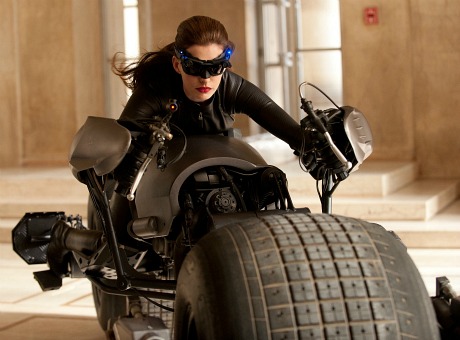
What am I supposed to do with this? Black-attired Anne Hathaway with black goggles, riding a totally standard fat-tire Batman motorcycle, etc., etc. Should I feel relieved that she doesn’t have cat ears? Fine.

Odd Chortles

As I noted earlier this week, the second half of The Change-Up is better — certainly more tolerable — than the first half, which is mostly foul, rancid and sub-mental. And there’s one second-half bit that got me. I didn’t laugh, exactly, but I guffawed or tittered in some kind of pleasurable way. Because I recognized the moment. Because I’ve been there.

Ryan Reynolds is inside Jason Bateman‘s attorney body, and is working late at the office. And Bateman’s wife, played by Leslie Mann, calls him about something or other. The punchy Bateman listens for a few seconds and asks, “Uhm…who is this?” Exhausted and resigned to his detachment, Mann answers, “Your wife.” Actually I didn’t titter or chortle — I laughed. Because that’s me. I fuzz out on all kinds of things, all the time.

Last night I was watching Ruben Fleischer‘s 30 Minutes or Less and just trying to hang in there and tough it out and make it through to the end, etc. And then came a moment when Danny McBride and Nick Swardson, playing crass, brain-dead asshole-antagonists who force Jesse Eisenberg‘s pizza-delivery guy to commit a bank robbery by strapping a remote-triggered bomb to his chest, decide to kidnap Eisenberg’s love interest and would-be girlfriend, played by Dilshad Vadsaria.

Like Aziz Ansari, who portrays her brother, Vadsaria is of Indian ancestry. And I smirked a bit when McBride and Swardson break into a toilet stall where she’s hiding and let her know she’s captured and call her “slumdog.” Which they’re using, of course, because of Danny Boyle‘s Slumdog Millionaire. We’re all familiar with how low-rent types tend to seize upon certain films or TV shows if they’ve made some kind of strong impression about exotic cultures, and for whatever reason it struck me as amusing that these dickwads would use Boyle’s film…that’s all.

There’s also a moment, by the way, in which Ansari talks about having rented The Hurt Locker but never watching it and the unopened Netflix package containing the Hurt DVD just lying around his apartment for weeks on end. I was wondering if this is a satirical reference to dumbasses who have trouble watching strong, well-reviewed films that don’t have that cheap, fast-food, big-corporate quality that doofuses tend to patronize on opening weekends, or are Fleischer and screenwriter Michael Diliberti slipping in a comment about their own faint dislike of Kathryn Bigelow and Mark Boal‘s film? It’s the former, I’m guessing, but I’m not sure.

Roger Ebert, by the way, has called The Change-Up “one of the dirtiest-minded mainstream releases in history. It has a low opinion of men, a lower opinion of women, and the lowest opinion of the intelligence of its audience. It is obscene, foulmouthed, scatological, creepy and perverted.”

Hydrangeas

I make factual and typographical mistakes each and every day on this site. Which I try to correct as quickly as I can. So I’m sure MCN’s Michael Wilmington will appreciate being told that he’s made a mistake in his 8.3 review of John Frankenheimer‘s The Manchurian Candidate (’62), or the MGM Bluray rather. Apart from the fact that Wilmington doesn’t mention that the quality of the Bluray is highly unexceptional, I mean, and smothered in digital mosquitoes.

The error, which readers are invited to spot, is in the following graph: “Now, as we watch, the scene keeps shifting from the New Jersey hotel lobby to the Manchurian theater and back again. Would we like a demonstration? The affable Doctor Yen, a man who almost never stops smiling, calls on Sgt. Shaw, asks him to pick the man he likes best of all his fellow soldiers — and Shaw picks Cpt. Marco. No dice, says Yen. They need Marco to get Raymond his Medal of Honor. Pick another. Raymond chooses the very likeable Ed Mavole, who is puffing away happily on a joke cigarette that Yen’s men have mischievously filled with yak dung. Fine.”

I’ll admit that the Candidate Bluray looks a little better on my 50″ Vizio than an earlier DVD version does, and that the blacks are richer, and that there’s more information on the sides.

Oscars Being Rattner-ized

Brett Ratner and Don Mischer will co-produce the 2012 Oscar telecast, it was announced earlier today. Ratner has promised an emphasis on laughs. Something tells me he doesn’t mean the brainy Steve Martin or Bill Maher kind…no offense. I’m guessing he’ll coarsen things up and take the show in a kind of drop-your-pants Animal House direction. I’m just guessing. It’s probably safe to say that the show will also be a little less gay, by which I mean it’ll have less of a song-and-dance Las Vegas glitter vibe.

Movieline‘s Christopher Rosen nailed it when he wrote that “the only way Tom Sherak and Dawn Hudson could have enraged the online community further with the selection of an Oscar co-producer for 2012 is if they’d hired Michael Bay.”

Vernacular

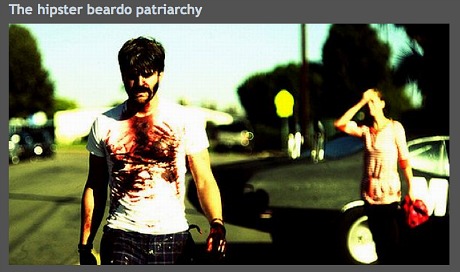
My first reaction to Glenn Kenny‘s Some Came Running pan of Evan Glodell‘s Bellflower was, “Hey, he likes using the term ‘beardo’ as much as I do!” I don’t know when it began to catch on, but I’ve used “beardo” a lot over the last two or three years (and twice in Bellflower riffs). It basically means “pretentious or self-centered jerkoff who wears a beard.”

“In his review of the inventive enfant-terrible indie Bellflower for The A/V Club,” Kenny writes, “Keith Phipps hits on something crucial about the film that I’ve yet to see any other reviewer mention. He says that ‘after a point’ it becomes ‘a film about men who hate women, and it comes awfully close to endorsing that point of view.’

“Well, screw that, I’ll go even further: it doesn’t ‘come close’ to endorsing that point of view, it absolutely embodies that point of view, it can see no other possibility but that point of view, it is that point of view.”

Scared Greedheads

“Dow’s 512 point drop [earlier today] underscores the state of unreality in DC.,” Howard Kurtz more or less tweeted about a half-hour ago. “Pundits felt crisis was over when a deal, however lousy, was reached.” If you consider the perspective offered by a ten-year graph, what happened today doesn’t seem quite as bad.

Ben-Hur at Lincoln Center

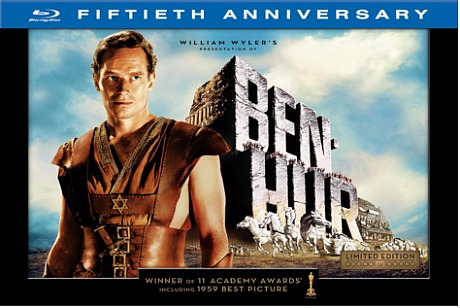
This morning the Film Society of Lincoln Center announced a special New York Film Festival showing of William Wyler‘s Ben-Hur (’59), or more specifically a digitally restored 8K version that is the source of the upcoming Warner Home Video Bluray that streets on 9.27. I’m told that the NYFF showing will probably happen on Saturday, 10.1, starting sometime in the morning.

The interesting angle is that the NYFF will be showing the Biblical epic at the full Camera 65 aspect ratio of 2.76 to 1, which may (emphasis on that word) be the very first time it’s been commercially projected on a big screen in this particular format. Maybe.

According to James Bond, president of the Chicago-based Full Aperture Systems, Inc., as well as a respected film expert and historian who asked not to be identified, the 1959 reserved-seat roadshow versions of Ben-Hur in New York and Los Angeles were probably projected at 2.55 to 1. That’s still pretty damn wide (2.55 was the aspect ratio of Fox CinemaScope films from The Robe, which opened in 1953, until sometime in the mid to late ’50s), although not as wide as Cinerama presentations.

“2.55 was the more common way to show [a film of this type],” says Bond. “The original wide screens of the mid 1950s were set up to handle 2.55 to 1.”

The other guy, hedging his bets, says Ben-Hurmay have opened in New York and Los Angeles at 2.76 to 1…I was too young to have noticed.”

The only way 70mm prints of Ben-Hur could have been seen in their full 2.76 to 1 widescreen splendor would have been to project the epic onto an extra-wide Cinerama screen, or like the one that was built for L.A.’s Cinerama Dome in 1963. New York’s Loew’s State, where Ben-Hur premiered in late ’59, never had a Cinerama screen, and I don’t think that the old Egyptian, which is where Ben-Hur opened in Los Angeles, did either.

Why, then, did 70mm prints of Ben-Hur allow for a 2.76 to 1 aspect ratio if no big-time theatres actually showed it this way? Beats me. I’m only passing along what Bond and the other guy have told me, which is that 2.55 to 1 was probably the format.

If Bond and the other guy are wrong and Ben-Hur did show at 2.76 to 1 in 1959, then at least the New York Film Festival showing at Alice Tully Hall will mark the first time the classic will be presented in a super-duper-wide format on a big screen in roughly 52 years.

Unless, you know, HE reader Cadavra is correct when he writes that Ben-Hur “screened at the Cinerama Dome about 15 or 20 years ago at 2.76:1 (and in 70mm, of course).”

Yes, the 2.76 to 1 version has been viewable on DVD versions in the past, but minus the big-screen pizazz. Even if you watch the Ben-Hur DVD or the forthcoming Bluray on a 50″ or 60″ screen, you’ll be looking at an image that isn’t very high (i.e., really thick black croppings on the top and bottom) and is clearly diminished compared to what Wyler and his cinematographer, Robert L. Surtees, wanted audiences to see. And watching the film at this aspect ratio on 40something- or 30something-inch screens is pretty close to ridiculous. Don’t even go there.

FSLC/NYFF co-honcho Scott Foundas says the widescreen image at Alice Tully (and at the earlier press screening at the Walter Reade) will obviously be less high than standard 2.35 to 1 widescreen projections, but only slightly.

The other thing that needs to be cleared up is that while Warner Bros. archivists have digitallly remastered the restored Ben-Hur at 8K, the NYFF projection (via a Barco) will be shown at 4K. But that will still deliver loads of incredible clarity and detail, probably more than the naked eye can fully detect or appreciate.