Abyss Stares Back

“There are scores of generic movie-dialogue lines that everyone recites on cue. ‘You’re gonna need a bigger boat,” ‘Laugh it up, fuzzball’, ‘Jack, I swear’, ‘Who are those guys?‘, ‘I can see you’re really upset about this, Dave‘, etc. Basic stuff, right?

“But the greatest loser line of all time — ‘I’ve been waiting all my life to fuck up like this‘ — has yet to make it into the pantheon. Run a search and it doesn’t pop up on any of those movie-dialogue sites. Which doesn’t seem right. Because this is a great and lasting utterance.

“The reason it hasn’t caught on, I suppose, is that despairing humor doesn’t connect with people all that well. People don’t like to chuckle about the possibility (one that is actually quite vivid and unmistakable) that their lives haven’t amounted to much, and that one way to quantify or evaluate this state of affairs is by those little realization-of-failure moments, as opposed to moments of pride and glory at some black-tie awards dinner.

“When I first heard this line in ’78, I saw myself as teetering on the edge of loserdom. I hadn’t really made it as a journalist, and had begun to consider the possibility that I might eventually enervate myself to death, or simply get sent to the showers. I was half-confident but also half-dispirited, and the latter was gaining. It had gotten to the point that I was starting to develop a bitter sense of humor about my prospects.

“So when Michael Moriarty said this line about 35 minutes into Karel Riesz‘s Who’ll Stop The Rain?, I didn’t just chuckle or laugh — I went “hah!” and slapped my leg in tribute. A movie had finally said what that little man inside my chest (i.e., the one who had reminded me of my low self-esteem since I was seven or eight years old) had been whispering for years. Hang in there, Jeff — your greatest fuck-up is yet to come.

“Every couple of years I’m going to chime in and remind everyone of this line (which was taken straight from Robert Stone‘s ‘Dog Soldiers‘, which this film was called until the Orion marketing guys got scared and switched titles). I wrote about it a couple of years ago, and I’ll probably do it again in 2012.

“There’s also this Rain passage, a back-and-forth between Nick Nolte and Tuesday Weld, and this chess-playing scene between Richard Masur and Ray Sharkey.

“I’ve said over and over that 21st Century dramas, action-driven or otherwise, could really use more dialogue of this calibre. ‘More’ is actually a generous allowance because this kind of sharp, echo-filled, rebop dialogue has all but disappeared from movies entirely. Tell me I’m wrong.” — originally posted on 9.8.10.

“Uhm…I…Uhm…I Didn’t Actually….”

Martin Sheen, previously known as Cpt. Willard as well as a strong critic of the torture scenes in Zero Dark Thirty, has flip-flopped on this concern, according to an article posted late this afternoon by N.Y. Times reporter Michael Cieply.

Okay, not “flip-flopped,” exactly. Sheen just wasn’t paying attention to begin with.

“Speaking by telephone Wednesday, Mr. Sheen said that through his own mistake, the actors David Clennon and Ed Asner had included Sheen in their opposition to what they saw as the film’s tolerance of torture,” Cieply reported. “‘It’s my own fault,’ Sheen told Cieply. He said he had “agreed to a statement about the film without fully understanding that it would condemn the movie, rather than simply condemning torture.”

Imagined Sheen Supplement: “I’m getting older, obviously, and I guess I didn’t pay attention to this matter as I should have. Or…actually, I don’t know what the fuck happened. Seriously, I’m in a fog right now. I know I was taking a nap the other day and I got up and was sitting on the edge of the bed and rubbing my eyes and my assistant came in and said something about torture being a very bad thing and I went ‘uhhm, yeah, whatever.'”

All joshing aside, Sheen did tell Cieply that “he shared Kathryn Bigelow‘s expressed opposition to the use of torture, and said that the film had ‘done great, great service to the issue‘ by bringing it to the fore. Mr. Sheen said he had watched the movie weeks ago and ‘was very moved and troubled by it.’

“The misunderstanding with Clennon,” Sheen explained, “occurred only because Sheen had failed to speak with him personally about the Zero Dark Thirty controversy, relying instead on communication through an assistant.”

Sheen added that he has fired his assistant and sent him packing on foot. Kidding!

Who’s The Culprit?

Derek Cianfrance‘s The Place Beyond The Pines (Focus Features, 3.29) has its fans, but it’s bizarre that Focus, a first-class distributor that has shown excellent marketing taste, would approve a poster as bad as this one. There’s something wildly off-balance about it. The three heads (Eva Mendes, Ryan Gosling, Bradley Cooper ) are too close to the top. The credit block is jammed in close below and too far north. And too much space is given to the dusky sky in the image that lies below (i.e., Gosling on his chopper).

From my 9.8.12 review: “I hate movies about blue-collar knockabouts and greasy low-lifes and teenage louts who constantly smoke cigarettes. The more a character smokes cigarettes the dumber and more doomed and less engaging he or she is — that’s the rule. If you’re writing or directing a film and you want the audience to believe that a character is an all-but-completely worthless scoundrel or sociopath whom they should not give a shit about, have that character smoke cigarettes in every damn scene.

“The principal theme of The Place Beyond The Pines is the following: ‘Dads Are Everything and Mothers Don’t Matter, but Cigarettes Sure Run A Close Second!'”

Queer Block

You might presume that Jules Stewart, a script supervisor since ’88, landed the gig to direct K-11, a jailhouse melodrama, because she’s the mother of Kristen Stewart. And you might be half-right. But this Breaking Glass release, which opens limited (NY, LA, Denver, Phoenix, Philly) on 3.15, looks interesting in a gnarly sort of way. Stewart also wrote the script.

In So Many Words

“The message of Dror Moreh‘s The Gatekeepers, formed from the collective wisdom of the six living former Shin Bet leaders, is this: The occupation is immoral and, perhaps more important, ineffective. Israel should withdraw from the West Bank as it did from the Gaza Strip in 2005. And the prospect of a two-state solution to the Palestinian conflict diminishes daily, threatening the future of Israel as a Jewish democracy.” — from Jodi Rudoren‘s 1.25 N.Y. Times piece, titled “Most Israelis Are Not Listening.”

Wall of Death

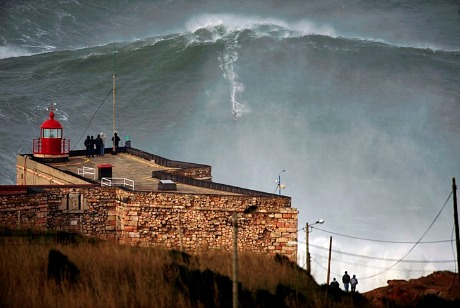
Is this not the greatest big wave shot ever taken? If not it’ll do until the greatest gets here. It was shot two days ago — Monday, 1.28 — off Praia do Norte beach in Nazare, Portgual, as U.S. surfer Garrett McNamara rode a wave reported to be 100 feet tall. In so doing McNamara beat his previous record of riding a 78-footer in the same spot in November 2011.

Read more

Clash of Aspect Ratio Titans

Yesterday Bob Furmanek politely declined my aspect-ratio podcast invitation, but he suggested that I get in touch with Jack Theakston, organizer-producer of Capitolfest (August 9th, 10th and 11th in Rome, New York) as well as an archivist, an AMIA member and Furmanek’s associate and partner in aspect ratio research. So I did, and Jack and I kicked it around for about an hour this morning. It’s a knowledgable and stimulating discussion. Recommended.

For faster loading here’s Part One and Part Two.

Six Characters In Search Of The Next Thing

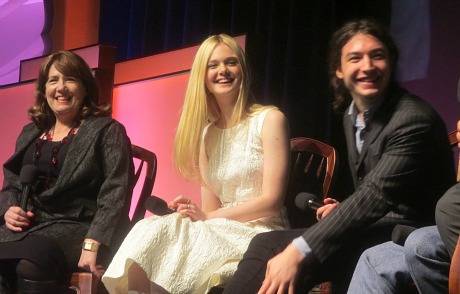
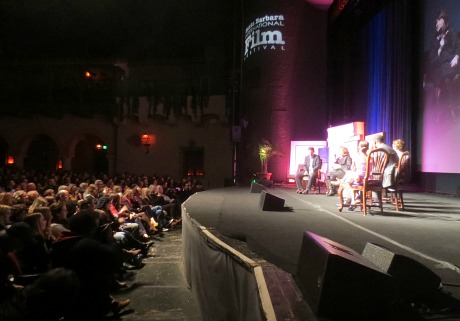
Last night’s Virtuosos Award Ceremony at the Santa Barbara Film Festival honored six actors who delivered noteworthy 2012 performances — Ginger & Rosa‘s Elle Fanning, Compliance co-star Ann Dowd , The IntouchablesOmar Sy, Perks of Being a Wallflower‘s Ezra Miller, Beasts of the Southern Wild‘s Quvenzhane Wallis and Les MiserablesEddie Redmayne.


Ginger and Rosa star Elle Fanning during last night’s Virtuoso Ceremony.

Fanning felt like a surprise to me because she conversed with emcee Dave Karger in a bubbly, giggly, teenage-girlish way. And all this time I’ve been under the impression that she’s old for her age. I know that when the role demands it, Fanning projects soul and depth and maturity. Acting! But she sure was a teenager last night.

Dowd was by far the wittiest guest. If I’m not mistaken I think I spotted Magnolia Pictures’ Eammon Bowles in the audience, offering a little moral support in the wake of that episode in which Dowd decided to pay for her own Compliance-screener mailings when Magnolia said that it made no financial sense because Compliance was a bust for them. Dowd was hanging at the after-party with friend and ally Scott Feinberg. She’s a classy lady, a mensch.

The best moment happened when Karger was speaking to Wallis about something or other, and she made a kind of squeaky sound. Karger asked what what kind of animal she’d just imitated, and Wallis said it was “a donkey…didn’t you get that?” (Publicist Carol Marshall says it was a dolphin noise.) Karger asked her to do it again and Wallis looked at him, shook her head slightly, sighed and said, “It’s not worth it.” Gales of laughter from the audience. This kid is a star!

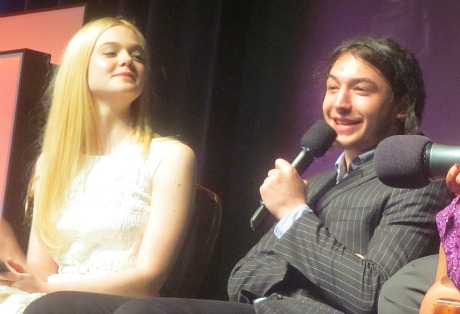
The eternally weird Miller, 20, leaned forward in the interview seat, hunched forward like a cat about to chase a mouse. I half-expected him to leave the stage on all fours. Miller has Haight-Ashbury hippie hair now, and was wearing a pair of almost shapeless brown serf shoes. And he smiled a lot.

Redmayne may have gotten the biggest applause. (There were a lot of young girls in the audience.) And the French-born Sy (who’s just signed to costar with Bradley Cooper in a Derek Cianfrance film called Chef) managed to be charming and funny despite a limited command of English.

The Shape We’re In

Recently resigned Arizona Congressperson Gabby Giffords delivered the opening statement at today’s Senate gun hearings. Nothing I could write could add to the import of this clip. I can’t imagine a more profound argument against the rank evil of Wayne LaPierre and the NRA gun lobby.

Quentin Tarantino is being honored at Santa Barbara Film Festival this evening. If and when he takes questions, I will ask the following: “If you were presented with a Lars Von Trier-styled filmmaking exercise in which you had to write a film that didn’t use flip, cynical, grindhouse-style, cartoon-panel violence in movies — no handguns, machine guns, samurai swords, grenades or violence of any kind, either naturalistic or ‘in quotes’ — what would your movie be about? What would you come up with? Or would you just throw up your hands?”