Manhattan Vice

Director-writer Paul Thomas Anderson’s Inherent Vice, the long-awaited, buzzed-about adaptation of Thomas Pynchon’s period crime novel, will be world-premiered on Saturday, October 4th, at the 52nd New York Film Festival. Hollywood Elsewhere will be there with bells on. The Warner Bros. release will open theatrically on 12.12.14 so this is a big deal — a look at a presumably major film 10 weeks in advance. Set in Los Angeles in 1970 (and not 1969, which is what I’ve been erroneously saying all along), pic is about Larry “Doc” Sportello (Joaquin Phoenix), a pot-smoking, space-case private dick involved in a complicated effort “to prevent his ex-girlfriend’s current lover being committed to a mental asylum”…or a plot to kidnap the guy or something like that. (The Manson Family murder trial was a backdrop in Pynchon’s novel so it presumably flashes in and out of the film also.) Costarring Josh Brolin, Benicio del Toro, Owen Wilson, Reese Witherspoon, Martin Short, Jena Malone, Katherine Waterston and Maya Rudolph.


Inherent Vice costars Joaquin Phoenix, Martin Short during filming.
Anything But Escapism

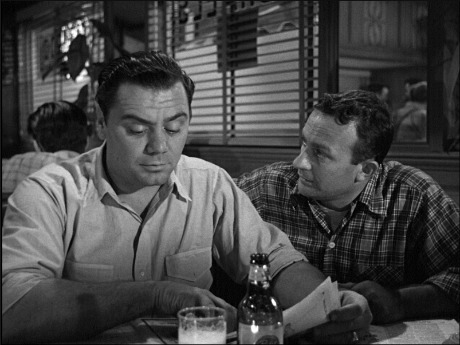
Nationally syndicated columnist and Washington Post op-ed contributor Michael Gerson has written an impression of Phillip Noyce‘s The Giver (Weinstein Co., 8.15), which he recently saw. He calls it an “updated but respectful re-telling” of Lois Lowry’s slim 1993 book about totalitarianism, euthanasia, suicide, sexual awakening and infanticide, and “clearly the labor of someone’s love.” He also calls it “an odd candidate for a blockbuster,” as much of what happens in the book and the film is “an interior moral struggle.” But he predicts it will “provoke political commentary” as The Giver‘s main point is that pain is a difficult but necessary component in any meaningful life as “the very things that make us vulnerable to loss — choice, emotion, desire — also make us human.” This, says Gerson, is “fairly serious stuff for a summertime movie. But it is precisely what causes Lowry’s book to transcend the genre of teen literature it created.”

Way It Goes Sometimes

I’ve just been disinvited from participating in next week’s Magic in the Moonlight press junket in Los Angeles. No biggie, no sweat…but I’m wondering who pushed the button. I’m guessing it was Colin Firth‘s publicist. On 3.31 I wrote a piece called “Repressed British Clod,” about Firth’s downward career trajectory following a remarkable three-year hot streak from ’09 to ’11 (A Single Man, The King’s Speech and Tinker, Tailor, Soldier, Spy), so perhaps they’re afraid I might get into that. (As Firth himself did, prophetically-speaking, when he accepted his Oscar.) I wouldn’t, of course. Firth’s performance in Magic in the Moonlight is his best since The King’s Speech, and that’s the current reality. Or was I deep-sixed because I recently lamented that crude-looking Magic in the Moonlight one-sheet? It can’t be because of today’s review, which was mostly positive.

Remember Nic Ray’s Art Forger in The American Friend?

“A well-rounded and compassionate portrait of an outsider with some degree of misdiagnosed mental illness, Art and Craft is an engrossing document of immense talents gone sideways. Art forger Mark Landis has a level of craft and mimicry that is unparalleled, which goes beyond copying. But its meticulous fastidiousness seems rooted in a mania he cannot control. Soft-spoken and shy, it’s clear Landis has no malicious intent, but he’s nevertheless a massive stain on the reputation of the art world that many want to blot out.

Read more

Marty Is Boxy After All…Glorious!

Ignore the 1.85 aspect ratio info on Amazon’s Marty Bluray page. Why? Because it’s incorrect. I’ve been asleep at the wheel for the last month but in mid-June Kino Lorber vp acquisitions and business affairs Frank Tarzi announced a decision to issue the Bluray of Delbert Mann‘s Oscar-winning 1955 drama in the preferred Hollywood Elsewhere aspect ratio of 1.33 (or is it 1.37?). I love the smell of napalm in the morning, and especially when someone ignores the advice of aspect-ratio historian Bob Furmanek, who, if he had his druthers, would chop every standard-Academy-ratio 1950s film made after April 1953 down to 1.85. Being on the winning side of these battles is wonderful!


Look at the headroom in this frame capture from DVD Beaver’s review of Kino Lorber’s Marty Bluray, which streets on 7.29.

All the 1.85 fascists were hopping mad about this last month, and here I am just joining the party. Did I miss anything?

On June 7th I reported that KL’s Marty Bluray would be presented “in the dreaded 1.85 with the tops and bottoms of the protected 1.37 image (seen on TV, VHS, laser disc and DVDs for the last five or six decades) severed with a meat cleaver.” A month earlier aspect-ratio historian Bob Furmanek noted in a Home Theatre Forum post that (a) the Marty Bluray would (a) be presented “for the first time since the original theatrical release with Mann’s intended 1.85:1 compositions,” and that (b) “we provided the documentation to insure mastering in the correct ratio.”

Read more

“Goofball”? Try “Demon From Hell”

Every comedy needs an antagonist of some kind. That’s what Harrison Holzer plays in Jake Kasdan‘s Sex Tape — a chubby little prick who tries to blackmail Jason Segel and Cameron Diaz when he discovers their accidentally uploaded sex-tape video and threatens to send it to YouPorn unless they cough up $25K. There are two problems with Holzer and his character. One, he’s not very funny — all you get are “evil little sociopath” vibes because his first and only instinct is to profit from Segel and Diaz’s misfortune despite the fact that he’s the son of their best friends, played by Rob Corddry and Ellie Kemper. And two, all villain or wicked witch figures get their comeuppance in Act Three and yet Holzer’s character skates. Segel is furious with him during Act Two and Three but when things settle down at the end and Holzer’s character tells Segel he’s dropping the blackmail plan because he wants to hang with Segel’s son, Segel dismissively and somewhat lightly calls him a “goofball.” That’s almost like calling Hannibal Lecter an eccentric gourmet.

After A Fashion, Woody Chats With God

There are four categories of Woody Allen movies — classics (Manhattan, Annie Hall, Crimes and Misdemeanors, The Purple Rose of Cairo, Hannah and Her Sisters), very goods (Husbands and Wives, Match Point, Stardust Memories, Mighty Aphrodite, Bullets Over Broadway, Vicky Cristina Barcelona), fairly goods (Everyone Says I Love You, Deconstructing Harry, Sweet and Lowdown, September) and duds or semi-duds (Scoop, Alice, Manhattan Murder Mystery, Hollywood Ending, Melinda and Melinda, You Will Meet A Tall Dark Stranger, Curse of the Jade Scorpion). His latest, Magic in the Moonlight, is mostly a third-category effort but in the general realm that equals a solid B grade. We all know how this goes. We’re all accustomed to our annual Woody fix, and as long as it’s not a burn (which this isn’t) there’s nothing to complain about. This one actually has a notable quality or current that kicks it up a notch and in fact makes it entirely unique in the Woody canon.


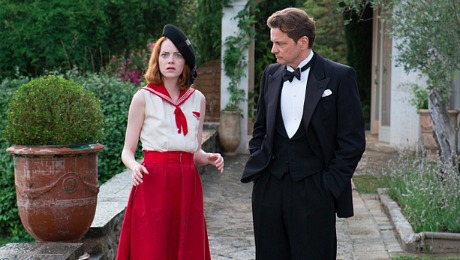
Emma Stone, Colin Firth in Woody Allen’s Magic in the Moonlight.

To the less perceptive Magic in the Moonlight presents itself as a typically mid-tempo ensemble piece, very dry and mild-mannered but often amusing. Set in various Cote d’Azur locations in 1928, it’s about Stanley (Colin Firth), a witty, curmudgeon-like magician who’s been asked to debunk Sophie (Emma Stone), a professional mystic who may be exploiting a rich Pennsylvania matron (Jackie Weaver), and who is also being aggressively wooed by the matron’s son (Hamish Linklater).

It’s obvious from the get-go that Firth will gradually fall prey to Stone’s charms, and I don’t just mean her big beautiful eyes but also her spiritual aura, and that she’ll eventually reciprocate in the end.

Read more

Run, Liz, Run

Breaking: Corporations are essentially sociopathic in their pursuit of greater profits, and they often cozy up to rightwing zealots and social regressives as part of this effort. They’re not “people” and they sure as hell aren’t religious (except in a politically-calculating, catering-to-the-rural-bubbas sense of that term). And yet three weeks ago the Supremes’ Burwell vs. Hobby Lobby Decision declared that “closely held for-profit corporations are exempt from a law its owners religiously object to”…hah! That’s shorthand for restricting women’s reproductive rights and choices, which are enforced by the contraceptive mandate adopted by the Department of Health and Human Services under Obamacare. It’s nice that at least one U.S. Senator has the cojones to explain what’s really going on.

I will vote for Hillary Clinton in 2016. I accept, grudgingly, that when elected she will do a reasonably good job of more or less continuing or building upon President Obama‘s center-right policies and philosophies, perhaps with more of a feisty style. But I love Elizabeth Warren.

Read more