Answering Service Wars

Voicemail has been a thing since the ’90s and old-fashioned answering machines have been around since the late ’70s if not earlier, but believe it or not some people (including a famous actor I call from time to time) still use “live” answering services. That’s right — in the year 2015 there are people who still pick up and say “may I take a message?” for someone else. These are people, of course, with personalities and attitudes and occasional faintly implied judgments about this and that aspect of your life. Which is why people prefer digital voicemail — who needs all that?

Anyway, I was reminded last night by Experimenter of an answering service war I got into with cartoonist-guitarist Chance Browne in the mid ’70s.

He started it, I recall, by calling my service and leaving a message about something vaguely unsavory, possibly having to do with my not paying a bill or my having been recently arrested or something. I got him back by telling his answering service lady that I was calling on behalf of the American Racial Purity Organization and that Mr. Browne’s annual contribution was overdue. He responded by pretending to be from a drug clinic, and regretfully informing my answering service that authorities were looking to speak to me regarding a recent theft of liquid morphine and could I get in touch with them? I returned fire with a message from the Connecticut Man-Boy Love Society and that new teenage boys under the age of 15 would be attending the next get-together and did my friend want to rsvp?

Read more

“Stop It, Lemme Outta Here…Aaaah!”

Michael Almereyda‘s Experimenter is somewhere between decent and diverting. It’s about famed psychologist Stanley Milgram (Peter Sarsgaard) and particularly the Milgram experiment of 1961, which proved that most Americans were willing to subject others to pain and torture as long as they didn’t have to bear the responsibility. Milgram’s peers criticized him for the obedience studies, mainly because they didn’t like the idea that most Americans were willing to behave like Nazis concentration camp guards.

What Experimenter lacks in emotion and story tension it occasionally makes up for in other ways.

The film more or less follows Milgram from the ’61 experiment and through his various trials and uncertainties until his heart-attack death in ’84. (The poor guy was only 51.) At times it’s like like watching an experimental play at the Cherry Lane Theatre. I enjoyed the fourth-wall destruction when Sarsgaard addresses the audience, and especially in two such scenes when he’s being followed by an elephant (probably CG, possibly not). I also enjoyed other reality-altering devices, such as the use of black-and-white backdrops instead of sets.

Read more

Shatner-Nichols Flashback

Last night I saw Michael Almereyda‘s Experimenter (Magnolia) in the subterranean recesses of Washington’s E Street Cinema. About halfway through renowned psychologist Stanley Milgram (Peter Sarsgaard) is speaking with William Shatner on the set of a 1975 TV movie about Milgram’s famous obedience-authority experiment, which happened in 1961. Shatner proudly mentions to Milgram that he planted the first inter-racial kiss in TV history upon Nichelle Nichols‘ Lieutenant Uhura in 1968. I YouTube’d the kiss when I got home, and it should be noted that the vibe between Shatner and Nichols was far from heated. It was an odd theatrical moment, a kiss in a play of some kind with the players dressed in ancient Roman grab, and Shatner made a point of not closing his eyes when he kissed Nichols but glaring at the audience. It’s more than a bit weird. I wonder when the first real inter-racial kiss happened — one in which the couple was experiencing real chemistry and desire.

Read more

Paris-Like Street Pattern, But There The Resemblance Ends

It’s not like downtown Washington is a ghost town on Sunday afternoons and evenings, but it’s not far from that. Not that I minded. I began my hike at 3 pm, partly, I’ll admit, to escape the 2.95 Mbps download speed in the Airbnb pad. (I have 85 to 90 Mpbs in my WeHo home.) I stopped for 90 minutes at Le Pain Quotidien near Dupont Circle for a little writing/editing, and then off to the races. To appreciate the Paris-like street scheme you need to have roamed Paris, of course. Not the usual rectangular grids but big, broad boulevards connecting roundabouts and wide-open plazas with huge, stunning, illuminated-after-dark buildings. D.C. was designed in the early 1790s by Pierre Charles L’Enfant. Paris didn’t become this kind of city until Napoleon III and city engineer Georges-Eugène Haussmann began their 17-year makeover, beginning in 1854.


Since last July the White House has been on some kind of double-security lockdown — extra fences, barriers, uniformed security guys. Keep your distance, citizens! All due to the Secret Service Improvements Act of 2015. It’s like they’re expecting some kind of armed assault. In the early Clinton days you could walk right up to the iron fence surrounding the property and put your hands on the bars — no longer.

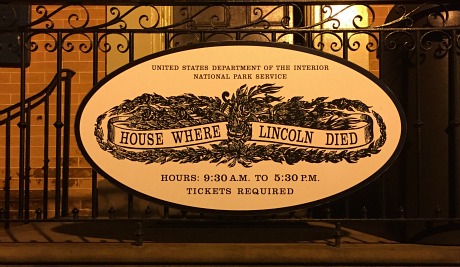
The exterior of the house where Abraham Lincoln died (a.k.a., the Petersen house, built in 1849) looks like brick but is actually some kind of fake plaster.

Read more

Goodfella

During yesterday’s post-screening discussion about The Armor of Light I asked director Abigail Disney why the word “regulate” or the phrase “treat guns like cars” hadn’t even been mentioned in her doc. I was feeling quite irritated by this. Disney’s response was that gun-right advocates would walk out of her film if they so much as heard those words, and I shook my head and seethed. The vibes were rather testy. There are two things you can do about gun wackos, I was thinking. One, convey the utmost contempt at every opportunity, and two, wait for them to die.


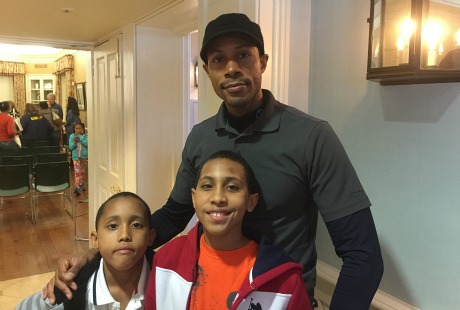
Virginia resident Phil Winfield and his two nephews, Jacob and Austin Winfield Jr. — Saturday, 10.24, 1:05 pm.

And then the vibe changed when a Virginia resident, Phil Winfield, spoke up. He asked the audience how many had received any kind of weapons training (about ten of us raised our hands, myself included) and then asked how many of us had been trained to give first aid and CPR. Maybe two hands went up. Winfield more or less said that knowing how to help people in some kind of medical distress was a better, more nourishing thing than knowing how to fire AK-47s or .45 automatics, and that maybe we should contemplate what kind of society we are given the focus on weapons and not activities of a more kindly and charitable nature. It was sort of a left-field remark but people applauded when he finished.

Read more

Good-Hearted Doc About Reprehensible Culture

Abigail Disney‘s The Armor of Light, which I saw yesterday afternoon at the Middleburg Film Festival, is an attempt to modify the knee-jerk attitudes of pro-gun conservatives by appealing to them on spiritual grounds. It’s not aimed at existential, Michael Moore-supporting, loose-shoe lefties like myself  but at rural obstinates.  She presents her case by profiling (i.e., following around) pro-life Evangelical minister Rev. Rob Schenck, a nice guy who regards himself as a spiritual leader of gun-toting Tea Party types, and showing how he gradually comes to believe that being pro-gun and pro-life are antithetical. But that’s as far as Schenck or the doc are willing to go.

Disney, the granddaughter of the rightwing Roy (brother of Walt) Disney and therefore possessed of a certain insight into conservative thinking, doesn’t want the word “regulate” or the words “treat guns like cars” to escape anyone’s lips. She just wants to put the teachings of the Bible and particularly the sanctity of life on the table. Here’s her statement.


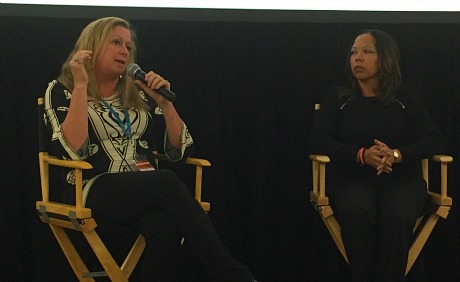
(l.) Armor of Light director Abigail Disney, (r.) Lucy McBath, mother of shooting victim Jordan Davis, during post-screening q & a at Middleburg Film Festival.

Disney believes that if you say “regulate” or “control” the gunnies will freak out. HE to Disney: They’re going to arch their backs no matter what. The God-fearing, cut-and-dried, John Wayne culture that they grew up with is more or less over and they know it, and they feel threatened. That’s what their guns are about — making them feel a little more potent, a little less scared, a little closer to God.

Every rightie heard in Disney’s doc believes that the left wants to confiscate the right’s firearms. No debate or discussion — that’s what’ll happen if we don’t stop any and all gun-control proposals, they all say.

Schenck never addresses the term “slippery slope,” which every NRA gun nut uses to justify opposition to common-sense regulation of firearms. Allow one regulation to be adopted and that’ll be the thin end of the wedge, they say. Before you know it another regulation will come along and then another, and one day semi-automatic and automatic rifles and shotguns will be banned (like Australia famously did in 1996) and then they’ll come for the handguns, etc.

Read more

“But What About Me?”

I flew to London in December 1980 to interview Peter O’Toole for GQ magazine, and while there I caught a reasonably-priced performance of the original, much-hailed stage production of Ronald Harwood‘s The Dresser. Set in the mid ’40s, it’s about a strained, codependent relationship between “Sir,” a bombastic Shakespearean actor in his ’60s, and Norman, his personal dresser who’s approaching middle age. The 37 year-old Tom Courtenay portrayed Norman and the brilliant Freddie Jones, 47, played “Sir.” Peter Yates‘ film version came out in 1983, again with Courtenay but also with a miscast Albert Finney, whose “Sir” was overly broad — nowhere near as commanding as Jones had been. Now comes a BBC televised version with two septuagenarians — Ian McKellen, 76, as Norman and Anthony Hopkins, 77, as “Sir.” Whatever. As long as it’s better than the Yates version. It airs on BBC Two on 10.31, will surface on Starz down the road.

Maureen O’Hara Rests

I can’t think of anything original to say about the late Maureen O’Hara, who passed earlier today at age 95. All I can summon are the usual cliches — she was tough and sharp, the original flame-haired Irish beauty, highly spirited, no pushover. Thank God for her collaborations with John Ford and John Wayne, right? Her career boiled down to nine movies — four made in her 1939 to ’52 peak period (The Hunchback of Notre Dame, How Green Was My Valley, Miracle on 34th Street, The Quiet Man) between the ages of 19 and 32, four made in her early-middle-aged period (Our Man in Havana, Mr. Hobbs Takes A Vacation, Spencer’s Mountain, McClintock!) between the ages of 39 to 43, and her swan song performance opposite John Candy in Only The Lonely (’91), when she was 70 or thereabouts. The rest were negligible or half-and-halfers. O’Hara was, of course, intensely attractive in the bloom of youth, especially in Hunchback (in which she played Esmeralda the gypsy) and How Green Was My Valley. In the mid ’80s an Irish girlfriend gave me a book called “The Joy of Irish Sex” — 150 blank pages. But I always had this fantasy that O’Hara was great in the sack. I remember being a bit disappointed when I read that O’Hara had proved she hadn’t been making out with some “Latin” guy in the rear section of Grauman’s Chinese, as a mid ’50s Confidential story had erroneously reported. I’m also sorry that she wore a body suit during the climactic scene in Lady Godiva of Coventry (’55). My ex-wife Maggie and I stayed at the Hotel Esmeralda when we got married in Paris in October ’87, and on some level I think I booked that hotel as a tribute to O’Hara.

Brave Decision

“We made a commitment to let the facts play. We said let’s commit to the process — in its thrilling nature, in its mundane nature, in its tedious nature, in its relentless nature. Let’s just commit to that and the process of high-level journalism and, hopefully, because of the subject matter and actual thrust of the investigation, it will be interesting to our audience because it’s the truth.” — Spotlight director Tom McCarthy quoted by L.A. Times reporter Saba Hamedy in 10.24 story titled “Truth and Spotlight reflect yesteryear journalism with hints at modern-day angst.”

She Drives Me Crazy

A 5.23 tweet from Matt Zoller Seitz: “Guy at the gym went on about how disappointed he was to have paid $30 to see Gravity in 3D then finally said, ‘Wait, I meant The Martian.'” This reminds me of several women I’ve known over the years who’ve expressed interest in seeing a film that I’ve described to them, and I don’t mean briefly. I’ll give them the whole rundown…title, cast, director, plot, visual style, snippets of dialogue…everything. And then we’ll pick a night and I’ll pop in the Bluray, and ten minutes in they’ll say “Oh, wait…I’ve seen this.” If this has happened once, it’s happened at least 20 or 25 times. Only women do this. Even HE’s own Svetlana Cvetko, a serious industry pro, has pulled this a couple of times.