Respect for Max Rose

As I wrote last night, Daniel Noah‘s Max Rose (Paladin, 9.2) is solemn, well honed and salutable. I love that Noah had the decency not to try to charm or tickle me into submission. It’s a melancholy film in some…okay, most respects, but not a downer because Lewis is so interesting to watch. His performance isn’t “performed” — he just divvies out a series of straight, no-bullshit, take-it-or-leave-it cards. These cards create a vibe, an aroma of hurt that doesn’t want to be sniffed or shared. But there it is nonetheless.

The trailers have told us that Max Rose is about the titular character, an elderly but mostly unbowed jazz pianist (Jerry Lewis), coping with a realization that his recently deceased wife Eva (Claire Bloom) had been unfaithful to him since the ’50s.
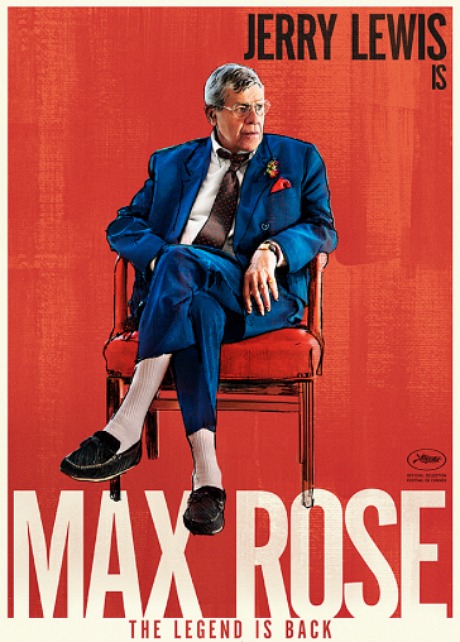
But Max has already digested this news before the film begins (thank God!), and so we’re spared the heartache scenes. Max, who’s been written as a riff on Lewis as well as The King of Comedy‘s Jerry Langford in his dotage, just sits there and more or less takes it like a man. He keeps to himself for the most part, meditating, scowling a bit. For me Lewis’s silences are a master stroke. He lets you sense what he’s thinking and feeling, and in so doing is spared the verbal effort, and the payoff is that much more than if Noah had written him pages and pages of dialogue.

As I watched I was muttering to myself to and particularly to Noah, “Thank you, thank you, thank you for not trying to make Max Rose into some irrepressible old codger with a cute little twinkle in his eye.”

Event-wise two things happen. Max’s frailty prompts his son (Kevin Pollak) and granddaughter (Kerry Bishe) to move him into a pricey assisted-living facility, and then sell his Los Angeles home to pay for this. But before moving out Max has found a gift (a snap-shut locket with a romantic inscription) that Eva’s boyfriend gave her in 1959. The guy’s name is Ben Tracey (Dean Stockwell), we’re eventually told. The climax comes when Max finds Tracey’s home and pays him a visit. I won’t spoil any further, but that’s what happens.
Read more

Huma Has Had Enough

In the wake of Anthony Weiner‘s latest texting scandal, his solemn-faced wife Huma Abedin — otherwise known as Hillary Clinton‘s top aide — has announced a separation. There was no other option for her. The man is a fool. Brilliant and impassioned in the political rhetoric realm, but a dude who’s unable to covertly channel his libidinal longings is an embarassment all around.

Somebody wrote this morning that if Weiner had been busted for merely having an affair with a fellow legislator or a campaign worker, he’d probably still be a New York Congressman.

The general response since the news broke is that Weiner, John Kriegman and Elyse Steinberg‘s much-praised doc about Weiner’s political implosion due to his absurdly self-destructive sexting, would have been more interesting if it had been more focused on Huma. Possibly but Huma would’ve never granted the access.

Does Huma’s decision to leave Weiner increase the chances of Weiner being nominated for Best Feature Documentary Oscar? Of course it does.

From my 1.23.16 Sundance Film Festival review:

“And poor, put-upon Huma Abedin, Weiner’s wife and Hillary’s top aide who endured a form of spousal abuse during these two scandals that has rarely been equaled in any area. The looks she gives her husband throughout the film are indescribable.

“All I felt was sympathy for Huma, just as most people felt sympathy for Hillary during the Monica Lewinsky scandal of ’98 and ’99. Almost all politicians have the same ravenous appetites, and almost all men are dogs. All the public asks is that they keep their canine urges private and discreet and consensual. Is that really so hard?”

Read more

The Organ Grinder Is In Heaven, But The Monkey Lives On

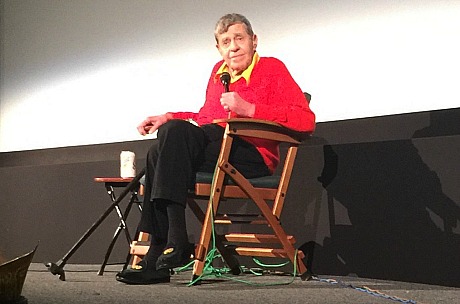
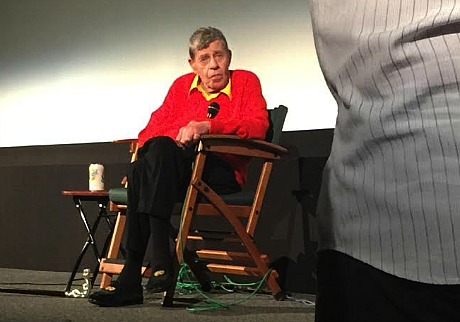
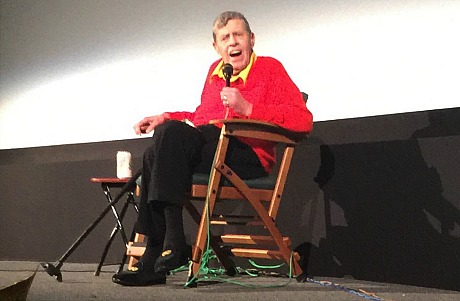
Last Thursday night (8.25) the legendary Jerry Lewis, 90 and undimmed and snap-dragonish as ever, conducted a 45-minute q & a inside Santa Monica’s Aero theatre. It followed a screening of Daniel Noah‘s Max Rose, in which Lewis gives a somber, nicely restrained and often moving performance as an elderly widower coping with a discovery that his deceased wife (Claire Bloom) had a secret boyfriend on the side for decades.

The film (which I’ll review tomorrow) is satisfying, well-honed, meditative. Lewis conveys a fair amount of solemnity but the film isn’t overly maudlin or doleful, which is what you might expect from a tale about a cranky…okay, blunt-spoken old guy.

The respect and satisfaction I felt for Max Rose was a tiny bit surprising given the film’s difficult experience at the 2013 Cannes Film Festival. After negative reactions were heard following an early screening, a decision was made to cancel a press screening. And that was over three years ago.

But I wasn’t the least bit surprised that Lewis was his usual snippy self during the q & a. No withered old codger, he. Most people become kinder and gentler as they get into old age. But not Lewis, bless him.

He was witty and corrosive at the Aero, obliging and polite in response to some questions but impatient with or dismissive of roughly 65% or 70% of the others, often critical or puzzled or unable to hear clearly or otherwise irked (“Why are you shouting?”) and getting laughs in any case.

If you ask me Lewis’s irritability is glorious.  This is his act, what Lewis does. If you ask me he’s raging against…well, a lot of things. But I love that he’s not just sitting there grinning and talking about how happy he is and how lucky and blessed his life has been and yaddah yaddah.

Read more

Ringo Starr’s “The No-No Song”

Speaking of Steve Jobs, there was a thing that happened at Universal’s Telluride after-party that I’ll never forget. The reactions to Danny Boyle‘s film following the 9 pm screening were up and down, this and that. Outside of the glad-handers, nobody I spoke to in the immediate aftermath was 100% about it.

I knew as I approached the gathering at 221 South Oak I knew I’d have to be careful not to say anything too candid. But I nonetheless found myself speaking quite honestly to First Showing‘s Alex Billington, and I soon realized he felt as I did, to wit: Jobs was a good, respectable, well-acted film, but it wasn’t very likable.

Boyle, screenwriter Aaron Sorkin, costars Kate Winslet and Seth Rogen, three or four Universal publicists and Apple co-founder Steve Wozniak were right nearby but we were cautious and careful. We kept our voices down to a murmur.

The small party began to fill up, and then Hollywood Reporter award-season columnist Scott Feinberg walked in and I went “hey, Scott!” and motioned him over, and without giving the invitation a moment’s thought Scott smiled but at the same time shook his head and went “noooo…no, no” and kept on walking toward the rear of the restaurant.

“What was that about?,” Billington asked.

“He doesn’t like the film any more than I do,” I speculated, “but he doesn’t want to discuss anything with the filmmakers standing ten feet away. He probably figured I’d challenge or debate him and he doesn’t want to do that within spitting distance of Seth Rogen. He’s just being careful.”

Read more

Shorter Steve Jobs Review

It’s taken me almost a full year to fully refine my 2015 Telluride Film Festival review of Danny Boyle‘s Steve Jobs to its essence. To really boil it down, I mean, and come to a clearer understanding of what I was getting at.

Here’s how I put on 9.6.15: “Am I a hotshot columnist from West Hollywood or a Riverside County housewife who goes to movies for emotional soothings? I’m better than that and so is the exceptional, high-throttle Steve Jobs.

Jobs is a three-act ‘talk opera’ (Sasha Stone‘s term) or ‘verbal action film’ (a guy at Universal suggested that one) or aggressive cine-theatre (my own) but also a film that, for me, feels more impressively conceived and poundingly ambitious than affecting or, truth be told, likable.

“You have to take each film by its own scheme and determinations, and with a film as aggressively verbal and drill-bitty as Steve Jobs terms like “affecting” and “likable” are almost certainly beside the point. With a film like this you either you jump on the luge and submit to the speed and the brain-cell exhilaration…or you don’t. And what would be the damn point of not submitting to it?

“I jumped on, all right, and by the end of the two-hour ride I felt tingly and throbbing and, yes, a bit drained and also a teeny bit sorry that I wasn’t as delighted as I’d expected to be. Which I fully concede is at least partly my fault as I’d fallen head-over-heels in love with Sorkin’s script two or three months ago. Dazzled by it, glad-to-be-alive contact highs, ‘this is what brilliance feels like,’ etc.

“You see a certain movie in your head when you’re reading a highly charged, original-attitude script, and then you see the film’s version and it’s like, ‘Oh…well, okay, this is how they saw it.’ It never bored me, it kept me on my toes, it delivers a kind of hammerhead contact high…but I wasn’t feeling that levitational thing.

Read more

Four Films, Four Upvotes

I’ve seen but haven’t yet reviewed (and am not about to review here and now) Daniel Noah‘s Max Rose (Paladin, 9.2), the Jerry Lewis drama about aging, legacy and unfinished marital business, and Oliver Stone‘s Snowden (Open Road, 9.16). But I caught them both within the last two days (8.25 and 8.26) and they’re both surprisingly good, which I wasn’t certain would be the case.

The Snowden embargo lift isn’t for a while yet, but I can at least say that in my view it’s Oliver’s best film since Any Given Sunday — a return to form. It’s lean, sober, intelligent and well controlled. Yes, we all know the Snowden saga due to Laura Poitras‘s Oscar-winning Citizen Four, but this is a bracing, well-acted, highly engaging companion piece. I especially loved a brilliantly designed digital sequence that shows how NSA surveillance works on a personal, always expanding, ultimately global basis.

I’ll tap out something about Max Rose tomorrow morning.

I also spoke this morning to a person who caught Clint Eastwood‘s Sully, which will premiere at next weekend’s Telluride Film Festival, and he, a tough, no-nonsense critic, says it’s quite good. Efficiently edited (only 96 minutes) by Blu Murray, and a nicely structured saga about the battle between the value of air industry technology vs. seasoned piloting by crusty, gray-haired pros.

Read more

Jump To Conclusions

I can’t imagine anyone being persuaded to vote for any Presidential candidate based on what Bruce Springsteen says or doesn’t say, but The Boss is apparently not going to be endorsing Hillary Clinton, to go from what he said at an 8.25 concert at MetLife Stadium in East Rutherford, New Jersey. The quote is from an 8.25 post from Backstreets, a Springsteen-endorsed fansite: “But while Bruce was content to let his lyrics do the talking, tonight we get his first direct comments on this election season, which he calls ‘the ugliest I’ve ever seen.’ So many people, he reminds us, ‘have been hurt so hard by American de-industrialization, by globalism, by NAFTA — and that can get lost in all the noise.” Hillary is something of a pro-NAFTA globalist, right?

Nate Parker Is Not Necessarily Satan’s Messenger

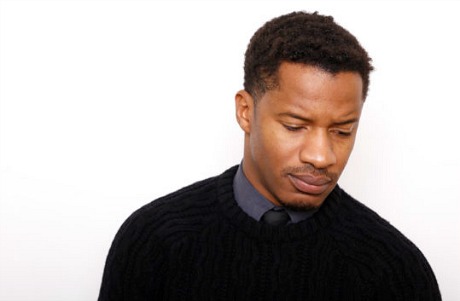
In the view of more than a few in the Hollywood community, Birth of a Nation director-writer Nate Parker has become Black Bart — a demonic figure whose lack of sensitivity during a Penn State episode 17 years ago resulted in a charge of rape (i.e., an unwanted menage a trois that the drunken victim properly regarded as a violation) and whose behavior may have contributed, certainly to some extent, to the suicide of the victim 13 years later. A rash verdict if you ask me, but the crowd wants what it wants.

The Birth of a Nation is almost certainly award-season toast — everyone seems to believe that. It even appears as if Parker himself might be persona non grata, industry-wise, for the next few months. But what he, Jean Celestin and the late victim got into during the 1999 incident in question was, however repulsive or appalling from her P.O.V., probably not hugely different from the bacchanalia that hundreds of thousands of inebriated college students got into in their dorm rooms going back to the mid ’60s, or the dawn of the libertine era.

Here, in an 8.27 interview with Ebony‘s Britni Danielle, is how Parker sees the differences between then and now:

Britni Danielle: “You started out tonight addressing the controversy, and you talked a lot about male culture and toxic masculinity. So I want to kind of compare. What, at 19, did you know about consent?”

Nate Parker: “To be honest, not very much. It wasn’t a conversation people were having. When I think about 1999, I think about being a 19-year-old kid, and I think about my attitude and behavior just toward women with respect [to] objectifying them. I never thought about consent as a definition, especially as I do now. I think the definitions of so many things have changed.

“Put it this way — when you’re 19, a threesome is normal. It’s fun. When you’re 19, getting a girl to say yes, or being a dog, or being a player, cheating. Consent is all about — for me, back then — if you can get a girl to say yes, you win.”

Read more

God, Look At That…

One way or another you have to witness some kind of natural, jaw-dropping vista every two or three years, if not more frequently. If you don’t or can’t, you’re missing something primal. All three videos were shot during a May 2012 visit to Lauterbrunnen, Switzerland with Jett and Dylan. #1, a pan of the Bernese Alps that tower over the village (Eiger, Monch and Jungfrau) was taken during a day-long hike. #2 is a pan of Lake Brienze (Brienzersee). #3 is of Staubbach Falls.

Read more

Two Different Systems

A capsule description of April Mullen‘s Below Her Mouth, a 2016 Toronto Film Festival attraction, from Toronto Star film critic Peter Howell: “Erika Linder and Natalie Krill play illicit lesbian lovers in a made-in-Toronto film that promises to push the boundaries for cinematic sex, as Blue Is the Warmest Color did before it. Shot by an all-female crew, the TIFF program calls it ‘one of the boldest and sexiest dramas of the year.'”

Wells thought: “If this scene was about (a) a guy attempting to make out with a cute girl in a bar, (b) the girl changing her mind and running outside and darting down an alley and (c) the guy chasing her down and more or less saying ‘wait, you can’t run away, I really want to fuck you’ and putting the moves on her again, a viewer might presume it’s about a predator engaged in a kind of aggressive date rape. But because it’s about lesbians, nobody raises an eyebrow.”

Read more

Different Business Attitudes

Reaction among execs running A24, the distributor of Andrea Arnold’s American Honey (opening on 9.30.16): “It’s so great when this kind of buzz gets around. This is why we love this business because when a movie has the right kind of chemistry and the right kind of chops, something magical happens and it just takes off with ticket buyers…it becomes this mystical, unstoppable act of art and nature that people feel they just have to see.”

Reaction among execs running IFC Films, the distributor of Olivier Assayas‘s Personal Shopper (no U.S. release date): “Why don’t guys like Lawson leave us alone? We’re letting the Toronto and New York film festivals show Personal Shopper, fine, but we’re not sure how we feel about it. Some people in Cannes weren’t fans and that gives us the willies. The concept of releasing Personal Shopper intimidates us financially, if you want to know the truth, and so we’re almost sorry we acquired it and we’re not sure we even want to release it any time soon. Okay, maybe sometime next spring. But please, just stop it. We hate tweets like this. They just make things worse.”