Best Picture Situation Favors Womanly Subject Matter

The 2016/2017 Oscar race taught us about a major seismic shift in the way younger Oscar voters (i.e., the Academy cool kidz) are seeing things now, as opposed to just five years ago when the old boomer-farty Oscar-worthy standards still applied. Traditional Oscar-bait movies are now regarded askance, and identity politics are almost everything. Oscar-bait now means indie, socially relevant, ‘woke’, tribal identity, etc.

Because Oscars are the new Spirits. Technical, artistic achievement means squat for the new-generation Academy. They want politically charged messages and they wanna take a stand, and tribal identity politics definitely drives their votes. “The under-40 crowd has invested Race, Gender and Sexuality with a kind of cosmic significance,” an HE commenter said earlier this year. “It doesn’t mean a lot to them — it means everything to them.”

So what does this mean in terms of the 2018 Best Picture race? There are 15 contenders right now, and eight of these are tribal-identity pics.

Two of the eight are POC dramas — Barry JenkinsIf Beale Street Could Talk and Spike Lee‘s Black Klansman. And six are about strong women — Josie Rourke‘s Mary, Queen of Scots (Universal, 11.2), Mimi Leder‘s On The Basis of Sex (Ruth Bader Ginsburg), Yorgos LanthimosThe Favourite (Queen Anne), Bjorn Runge‘s The Wife, Robert Zemeckis‘s The Women of Marwen (fantasy) and Steve McQueen‘s Widows.

There are also a pair of potentially stand-outtish political films — Adam McKay‘s Backseat (Dick Cheney) and Jason Reitman‘s The Front Runner (Gary Hart).

Plus five films that you could describe as character intrigue for character intrigue’s sakeDamien Chazelle‘s First Man, Bryan Singer‘s Bohemian Rhapsody (15-year period from the formation of Queen and lead singer Freddie Mercury up to their performance at Live Aid in 1985), David Lowery‘s The Old Man and the Gun, Richard Linklater‘s Where’d You Go, Bernadette? and Jennifer Kent‘s The Nightingale.

The numerical odds alone suggest that the Best Picture winner will be chosen from among the six strong women films. Handicappers said the 2018 Best Picture winner would reflect the #TimesUp, year-of-the-woman cultural zeitgeist thing. It didn’t happen, but it probably will next year.

The willingness of the Academy cool kidz to nominate genre films means that Steve McQueen‘s Widows and The Old Man and the Gun, both essentially caper films, have a clear shot.

The likeliest Best Foreign-Language Feature nominees right now are Terrence Malick‘s Radegund (Germany), Asghar Farhadi‘s Everybody Knows (Spain), Alfonso Cuaron‘s Roma (Mexico); Pawel Pawlikowski‘s Cold War (Poland) and Laszlo NemesSunset (Hungary).

Read more

“Black Klansman” Going To Cannes?

There’s an interesting bit of speculation in a 4.5 Cineuropa piece by Fabien Lemercier about next month’s Cannes Film Festival (“A New Phase For Cannes?“). “Several names from North America continue to pop up rather insistently,” Lemercier writes. “Namely, Under the Silver Lake by David Robert Mitchell, Domino by Brian De Palma and” — wait for it — “Black Klansman by Spike Lee.”

This is the first spitball piece to mention Lee’s fact-based melodrama as a serious possibility…no?

Black Klansman is based on on Ron Stallworth’s 2014 novel, the full title of which is “Black Klansman: Race, Hate, and the Undercover Investigation of a Lifetime.”

Set in the late ’70s, pic isn’t literally about a black guy joining the Klan but an undercover investigation of the Klan by Stallworth when he was “the first black detective in the history of the Colorado Springs Police Department.”

After initial correspondence with the Klan, Stallworth received a call in which he was asked if he wants to “join our cause.” According to an Amazon summary, “Ron answers the caller’s question that night with a yes, launching what is surely one of the most audacious, and incredible undercover investigations in history. Ron recruits his partner Chuck to play the ‘white’ Ron Stallworth.”

In Lee’s film Stallworth is played by John David Washington. The “Chuck” character is apparently called “Flip,” and is played by Adam Driver. Laura Harrier and Topher Grace costar. Corey Hawkins plays Stokely Carmichael.

Read more

Here’s To You, Franz Kafka

Last August Tatyana Antropova, the fabled SRO and wife of Hollywood Elsewhere, began the application process for a green card and Employment Authorization card. A lot of work, a lot of forms, roughly $1700 in fees.

We were informed on 10.16.17 via I-797 (“notice of action”) that the USCIS (U.S. Citizen and Immigration Services) had approved her application for employment authorization (otherwise known as an EAD or work permit card) and that it would be arriving soon in the mailbox. All seemed well.

Then it all went bad. In early November we were informed that the letter containing the work permit had been mailed to our address but sent back. This was apparently because the letter had a 90046 zip code instead of the correct 90069, and so the mailman decided not to deliver it. That was six months ago, and despite countless pleas, appeals, letters, phone calls and visits to the downtown L.A. USCIS office (300 No. Los Angeles Street, Los Angeles, CA 90012), the work-permit card senders, based in a building in Lee’s Summit, Missouri, about 10 miles southeast of Kansas City, haven’t re-mailed the card.

Because of one lame-ass decision by a West Hollywood mailman (the zip code is a meaningless distraction as there’s no other Westbourne Drive in the entire city and 90046 is right nearby), poor Tatyana has been without a work permit for a full half-year, and to this date we still haven’t received it in the mail.

We have received, mind, several USCIS letters about other immigration matters at this address, but never the work permit. We have received letters with the incorrect and correct zip codes. We have repeatedly informed the USCIS that the correct zip code is 90069, and they have confirmed to us that their “system” now understands this, but we’ve still gone six months without a card. So much frustration and hair-pulling, so much draining of the spirit.

What government agency mails you something, and then, when it gets sent back to the agency for a nonsensical reason, refuses to re-send? These people are bureaucratic fiends.

Gilda, Spirit, Cancer, Death

Lisa D’Apolito‘s Love, Gilda will open the 2018 Tribeca Film Festival on 4.18. The late Gilda Radner made millions laugh, but like any half-decent comedian she always told the unfettered truth. And she apparently never side-stepped or shilly-shallied when she was diagnosed with cancer in late ’86, at age 40. She wrote about it candidly in “It’s Always Something,” a 1989 autobiography. To go by a 2014 fundraising trailer [after the jump], the primary focus of Love, Gilda focus is Radner’s four-year battle with cancer. It’s also about Gilda’s Club, a community organization for cancer copers.

Read more

Friends and Admirers Always Lie

I’ve watched this old Steven Spielberg clip a few times. I love it because it’s a reminder that serious artists have no interest in hearing nice bullshit from their alleged friends and admirers. Give it to me straight or don’t say anything at all.

Stanley Kubrick had to sit on Spielberg’s chest and force him into being honest about his true, deep-down feelings about The Shining. He had to grill and interrogate the truth out of him, otherwise Spielberg (who has since come to love The Shining) would have never given it up.

Husbands and wives are like this also — they always lie to protect each other’s feelings. The only way you get the real truth from a husband or wife is when you’re arguing with them and they’re really angry at you and losing their temper, and so they’ll tell you some uncomfortable fact or observation they would otherwise keep quiet about.

Before I stopped drinking (I’ve been sober since 3.20.12) I told an ex-girlfriend that I was starting to feel horrified about my weight and that I was starting to resemble a 50ish lesbian in a cowboy hat. “Stop it…you look fine!” she insisted. She lied — I was turning into Wallace Beery in Min and Bill. Hell, I was turning into Marie Dressler. Everybody lies about everything, including your enemies.

Artsy French Zombies…Mai Oui, Bien Sur!

Once upon a time zombie movies were cool. Certainly between the debut of George Romero‘s Night of the Living Dead (’68) and Dawn of the Dead (’78), his first sequel. Since then mongrels have taken over the genre. As a matter of routine policy Hollywood Elsewhere spits on 21st Century zombies. I haven’t paid the slightest attention since Juan Carlos Fresnadillo‘s 28 Weeks Later (’07) and before that Danny Boyle and Alex Garland‘s 28 Days Later (’02).

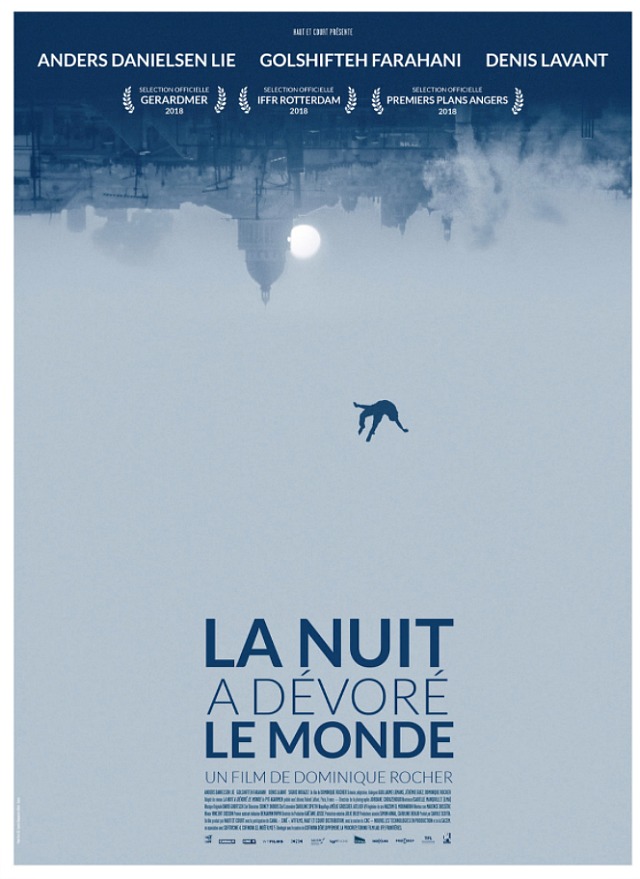
But I’m down for Dominique Rocher‘s Night Devours The World (La Nuit a devore le monde) because (a) it’s French, (b) it has a great poster, and (c) it avoids standard zombie movie tropes like the plague. This in itself wins my absolute allegiance.

From Jordan Mintzer‘s 3.7.18 Hollywood Reporter review: “Imagine 28 Days Later without the action, The Walking Dead without the ensemble cast or [Rec] without the video camera and white-knuckle suspense, and you’ll get an inkling of what goes on in The Night Eats the World.

“A minimalist arthouse zombie movie set almost entirely inside a Paris apartment building, this debut feature from director Dominique Rocher has some clever ideas and well-crafted moments, but in terms of horror fodder, it’s so pared down you’ll practically miss it if you blink. Still, it probably deserves a lower-case ‘z’ for “zeal,” taking the subgenre to a place it hasn’t quite gone before. You’ve got to give the filmmakers some credit for eschewing the predictable gory antics in favor of something more artsy and contemplative.”

Slight Pang of Worry

Six years ago Wes Anderson‘s Moonrise Kingdom opened the 2012 Cannes Film Festival. A great honor and much red-carpet hoopla, for sure, although an opening-night choice is sometimes excluded from festival competition.

At a mid-festival press conference Anderson told a story about sharing the news with a Parisian cineaste friend. “Competition is better,” the friend said. As it turned out Moonrise Kingdom was slotted as a competition film, but a film chosen to open the festival is always presumed to be slightly less consequential than a competition film…a tiny bit underwhelming or off-the-mark in some way. Or a political “gimme” of some kind. Always a cause for concern.

It is in this context that the selection of Asghar Farhadi’s Everybody Knows, a “psychological thriller” with Penelope Cruz, Javier Bardem and Ricardo Darin, as the opener at next month’s Cannes Film Festival…it is in this context that the announcement needs to be processed.


(l. to r.) Everybody Knows selfie: Penelope Cruz, Javier Bardem, Asghar Farhadi, Eduard Fernandez, Ricardo Darin.

A Separation, About Elly, The Past, The Salesman — nobody worships Farhadi like Hollywood Elsewhere. The man is hardcore and ultra-meticulous and thoroughly invested in character-driven stories, and is all but incapable of making a mediocre film, much less a bad one. It is a near certainty that Everybody Knows, a Spanish-language family reunion film about disturbances and disruptions, will be a strong, satisfying film. But the opening-night thing is scaring me a teeny-weeny little bit. A hint of slight foreboding.

Everybody Knows (aka Todos Lo Saben) is only the second Spanish-language film to open Cannes. Pedro Almodovar’s Bad Education (’04) was the first. It’s also a departure for the Iran-based Farhadi, having made his first film in Spanish and his second not in his native Farsi.

I’m in no way dismissing Everybody Knows because of its opening-night selection. It’s just that I know what “opening-night selection” tends to mean. Will it be better than last year’s opening-nighter, Arnaud Desplechin‘s Ismael’s Ghosts (Les fantomes d’Ismael), which, apart from Marion Cotillard‘s nude scene, was agony to sit through? Almost certainly.

A friend: “Moonrise Kingdom was in competition. Other opening nights, like Moulin Rouge, have been too. It’s at the determination of the festival and the filmmakers. The problem is that because most opening-night films at most festivals are NOT in competition, somehow even when you are in competition the film tends to get disregarded by the jury anyway. So it’s something of a double-edged sword, but those are the facts.”

Sounds Like It Stinks

Principal photography on John Cameron Mitchell‘s How to Talk to Girls at Parties (A24, 5.18) began on 11.9.15 in Sheffield, England. Elle Fanning, Nicole Kidman, Ruth Wilson. Synopsis: Female alien (presumably Fanning) hooks up with two earthling girls in London suburb of Croydon. HE suspicion/presumption: 21st Century Earth Girls Are Easy without the music? Bottom line: Iffy, don’t count your chickens. 26% on Rotten Tomatoes, 44% on Metacritic.

2018 Is 25% Over

With one-fourth of 2018 completed, it’s time to assess. What was the best film to open between January 1st and March 31st? Although nothing really rang my bell, I was mostly pleased with the last hour of Ryan Coogler‘s Black Panther. With everyone insisting that the hugely successful Disney release has to be ratified as a Best Picture nominee next January, I suppose I could call it 2018’s best film so far without sounding like too much of a whore.

Curious as it sounds, I was a little more admiring of Steven Spielberg‘s Ready Player One — another rousing third act but also with a relatively decent beginning and middle. “I came to scoff but came away placated, and even mildly enthralled by certain portions,” I said the other day. “For what it is, you could do a lot worse than Ready Player One…strange as this sounds there were times when I actually enjoyed the ride.”

But in terms of serious goodness and elemental nutrition, four foreign language releases share the prize — Sebastián Lelio‘s A Fantastic Woman, Andrej Zvyagintsev‘s Loveless and Samuel Maoz‘s Foxtrot (all from Sony Classics) and Ziad Doueiri‘s The Insult (Cohen Media Group).

Armando Ianucci‘s The Death of Stalin may have assembled the highest Rotten Tomatoes rating outside of Black Panther (95%) “I’ve no argument with the critics who are doing handstands and cartwheels,” I wrote on 3.8, “except for the fact that it’s more LQTM funny than the laugh-out-loud kind. There’s nothing wrong with LQTM humor, which I’ve also described as no-laugh funny — you just have to get past the idea of expecting to go ‘hah-hah, ho-ho, hee-hee’ because that never really happens.”

Alex Garland‘s Annihilation was easily the most overpraised film of 2018’s first quarter. “A visually imaginative, microbe-level, deep-in-the-muck monster-alien flick that will bring you down, down, down,” I wrote on 2.21.18. “Inventive in terms of the day-glo tree tumors and in a generally fungal, micro-bacterial, fiendish-mitosis sort of way, but it’s unrelentingly grim…basically a film about lambs to the slaughter.”

The 15:17 to Paris was half-tolerable but mostly underwhelming. “Weak docudrama tea and weirdly Christian to boot, but I didn’t hate it,” I wrote on 2.11. “Most of it felt like I was sitting in the back seat of an Uber or on a high-speed European train, waiting to reach my destination…was it horrifically boring? No, but it wasn’t what anyone would call engaging or riveting…it’s mildly weightless.”

Read more

First Female Shooter Since San Bernardino

Two different sources have told a CBS source heard that the “active shooter” situation at You Tube offices in San Bruno is a “white female.” “Multiple law enforcement sources” have told NBC News that the female shooter “is down.” Another says dead of a self-inflicted wound. Somewhere between 10 and 15 shots. Ten or eleven victims including a woman who was shot “multiple times.” Obviously a highly unusual occurence as shooters are almost invariably male. The last female shooter, Tashfeen Malik, was one of the two participants in the 2015 San Bernardino terrorist incident.