Okay, But Cuaron, Greengrass and Welles Are Still No-Shows

Yesterday Netflix CEO Reed Hastings expressed a modest mea culpa about his company’s Mexican stand-off with the Cannes Film Festival. What he said, boiled down: “We’re still not bringing Alfonso Cuaron‘s Roma, Paul Greengrass‘s Norway or Orson WellesThe Other Side of the Wind to the festival, but we’re kinda sorry we let things get so heated and…uhm, well, that’s it. Maybe next time.”

Actual Hastings statement: “At times we have a reputation as a disruptor, and sometimes we make mistakes. I think we got into a more difficult situation with the Cannes Film Festival than we meant to because, you know, we’re not trying to disrupt the movie system, we are trying to make our members happy. We make our content for them. We love the film festival and we still have buyers going. The festival is very sincere in trying to find a model that works for them and works for us. I’m sure over time we’ll definitely [go back].”

Rancid Hood Fantasy

The makers of this obviously ludicrous, video-game-level Robin Hood flick — director Otto Bathurst, producer Leonardo DiCaprio and Jennifer Davisson, costars Taron Egerton, Jamie Foxx and Ben Mendelsohn, screenwriters Ben Chandler and David James Kelly — need to walk into the woods, strip themselves to the waist, kneel and submit to two dozen lashes administered by monks.

The idea was to make a bullshit action fantasy in the vein of Guy Ritchie‘s King Arthur: Legend of the Sword (’17). Why I can’t imagine — Ritchie’s film was awful, and only made $148 million worldwide. Nonetheless, here it is. Anyone who finds this shit entertaining needs psychological counseling. Summit will release Robin Hood on 11.21.18.

Is Anyone Even Mildly Surprised?

Rudy Giuliani obviously wouldn’t have spilled the beans to Sean Hannity earlier today if he hadn’t previously convinced President Trump that it was better to admit he’s been lying all along about not knowing jack about Michael Cohen‘s payment of $130K in hush money to Stormy Daniels, etc. Better to come clean than Trump and Cohen continuing to stand by an obviously false account (i.e., “Who, us?”).

A startling turnabout in a way, but at the same time who’s even a bit surprised? Trump is a bullshitter, plain and simple — a stone sociopath.

From Michael Shear’s N.Y. Times story, posted a little while ago: “President Trump reimbursed Michael D. Cohen, his longtime personal lawyer, for the $130,000 payment that Mr. Cohen has said he made to keep a pornographic film actress from going public just before the 2016 election with her story about an affair with Mr. Trump, according to Rudolph W. Giuliani, one of the president’s lawyers.

Read more

Suburban Envy, Sexual Intrigue Sans Alcoholism

Set in suburban Connecticut and based on a same-titled novel by Darcey Bell, Paul Feig‘s A Simple Favor (Lionsgate, 9.14) is a female-angled thriller — marital deception, envy, sexual intrigue, hidden cards. Plot’s about Anna Kendrick‘s Stephanie, a mommy blogger with a child in kindergarten, trying to figure why her glamorous, well-connected friend Emily (Blake Lively) has suddenly vanished.

I’m sensing a blend of Big Little Lies, Gone Girl and The Girl On The Train minus the alcohol problem. More to the point: What’s up with Feig? He was quite the hotshot after Bridesmaids, then he followed up with the less-good The Heat, Spy and Ghostbusters. And now this.

A Cape Room?

For 40-plus years the Millennium Falcon was a souped-up “bucket of bolts” — a Kessel Run equivalent of a slightly grimy, seen-better-days 1965 Mustang that nonetheless had a powerful engine and could always jump into light speed if things got hairy.

No longer. In Ron Howard‘s forthcoming Solo (Disney, 5.25) the Falcon is new, spiffy and packed with luxury perks. It even has a special Lando Calrissian “cape room”…arrghh! Like it’s been refurbished for Kanye West, Kim Kardashian and the kids.

On top of which Donald Glover pronounces the first syllable of Falcon like Hal Ashby or HAL 9000. Jesus Christ, Howard can’t even get his actors to say it correctly? Harrison Ford, Billy Dee Williams, Carrie Fisher, Mark Hamill and James Earl Jones pronounced that syllable the way Humphrey Bogart, Mary Astor, Peter Lorre and Sydney Greenstreet pronounced it — like the season, rhymes with “all.”

Piano Scoring Suggests Complexity

Reinaldo Marcus Green‘s Monsters And Men is about a Brooklyn neighborhood’s response to an Eric Garner-like killing at the hands of the fuzz. Costarring John David Washington (BlacKkKlansman), Anthony Ramos (Hamilton, Netflix’s She’s Gotta Have It) and Kelvin Harrison Jr. (It Comes at Night), pic uses multiple perspectives to round things out. Winner of the Special Jury Prize at this year’s Sundance Film Festival, set for a theatrical award-season release via NEON.

Grain of Salt

Luca Guadagnino‘s Suspiria is “the most brilliantly scary film I have ever seen,” actress Jessica Harper wrote on her private Facebook page last weekend. “Luca’s Call Me By Your Name does not prepare you for it, but throws into relief the director’s brilliance and versatility,” she added. Harper has a small role in Suspiria, of course, so she’s not processing the forthcoming Amazon release from an impartial perspective.

Mostly Snake Oil Outside Of Cameron Realm

I don’t disagree with James Cameron‘s recent claim that the science-fiction genre has long been unfairly dismissed by Academy members as “not humanistic enough, not about real people” and therefore not Oscar-worthy.

When he gave this quote, however, Cameron chose to sidestep the fact that movies haven’t really produced a body of films that could be called science fiction, certainly not by the purist or literary definition of that term. What they’ve invested in is sci-fi fantasy, and more precisely CG-driven pulp-popcorn fantasias based on comic-book superheroes and the “hero’s journey” myth made famous by Joseph Campbell‘s “The Hero With A Thousand Faces.”

For the most part this attitude or approach has resulted in populist sludge that hasn’t begun to warrant serious consideration outside of the Saturn awards.

What Cameron really means, of course, is that a once in a blue moon a sci-fi fantasy flick like Avatar is good enough to be nominated for Best Picture (which it was eight years ago), and that his forthcoming Avatar sequels might warrant the same consideration.

Cameron: “All movies are artifice. Movies are innately artificial. The truth underlies the artifact. The truth of what you’re saying is the connection with the audience. Science-fiction can do that like any other genre. There is science-fiction that plays by the rules of good drama and that is important conceptually and that says something about our society and that has great characters. The Academy just has a blindspot about it. They’ll award it technical stuff but not the real stuff, not the acting.”

Black Klansman of ’66

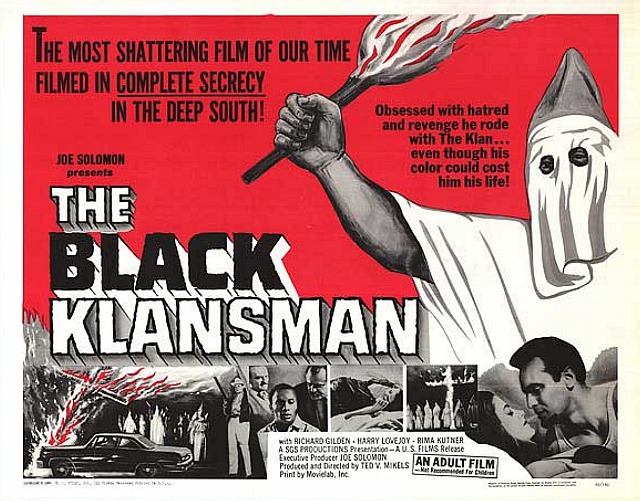
Within the last 52 years, there have been two films called Black Klansman that don’t precisely deliver on what the title implies. First and foremost is Spike Lee‘s BlacKkKlansman (inserting the third “k” is arguably the most irritating film-marketing strategy of the 21st Century), which will debut at the soon-to-launch Cannes Film Festival. Second is a 1966 blaxploitation film called The Black Klansman, shot in the Bakersfield area during the 1965 Watts riots and directed by Ted V. Mikels.

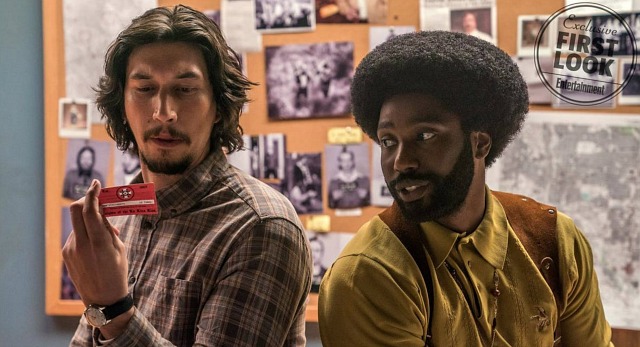
As noted a month ago, Lee’s ’70s drama isn’t literally about a black guy joining the Klan but an undercover investigation of the Klan by the real-life Ron Stallworth (John David Washington) when he was the first black detective in the history of the Colorado Springs Police Department.

After initial correspondence with the Klan, Stallworth received a call in which he was asked if he wants to “join our cause.” According to an Amazon summary, “Ron answers the caller’s question that night with a yes, launching what is surely one of the most audacious, and incredible undercover investigations in history. Ron recruits his partner Chuck to play the ‘white’ Ron Stallworth. The “Chuck” character is apparently called “Flip,” and is played by Adam Driver.

This morning I found a reasonable-sounding review of the ’66 Black Klansman on a blog called Scared Shiftless in Shasta.

Key passage: “My expectation was that [The Black Klansman] would be something campy, poorly constructed and/or preachy. To my surprise, it was none of those things, but an earnest, serious treatment of what was clearly exploitation subject matter, but which never elicits any unintended humor. Even with the Victor/Victoria-like mind-melting idea of a white actor playing a black man who pretends to be white, it doesn’t offend or condescend.”

Wiki boilerplate: “Set during the Civil Rights Movement, the film tells the story of an African-American man, Jerry Ellworth (Richard Gilden, a white actor), who is an LA jazz musician with a white girlfriend. Meanwhile, in an Alabama diner, a young black man attempts to exercise his civil rights by sitting at a local diner. When the Ku Klux Klan learn of this, they firebomb a church, killing Jerry’s daughter. When he learns of this, Jerry moves to Alabama to infiltrate the group responsible for his daughter’s death. Jerry dons his disguise and becomes a member of the inner circle, befriending the local leader and his daughter, and soon exacts his revenge.”

The original title of The Black Klansman was I Crossed The Color Line.

Read more

DSCU

In a 5.2 N.Y. Times article called “Dear Movie Industry, We Have Thoughts’, critics A.O. Scott and Manohla Dargis riff on this and that. A diverting enough thing until I came upon Scott’s startling suggestion that anyone offering a historical analogy about today’s near-tyrannical climate of politically correct admonishing is up to no good.

“Please read some history,” he implored. “About the Salem witch trials, the Spanish Inquisition, the martyrdom of early Christians, Joseph McCarthy, Joseph Stalin, the Gestapo, Pol Pot and any of the other historical monsters and catastrophes you like to invoke when talking about whatever is bothering you in contemporary culture. Also please refrain from hyperbolically throwing around words like ‘silencing,’ ‘thought police’ and ‘censorship’ in reference to criticism on social media or elsewhere. People who indulge in this kind of rhetorical inflation are like rats spreading bubonic plague.”

Really? So I can’t use the term “p.c. brownshirts” any longer? And the HE meme about zealous sentiments within the #MeToo and #TimesUp community recalling the mindset of Maximilien Robespierre…that’s no good either?

There’s a slight but horrifying possibility that Donald Trump could actually be re-elected in 2020. One factor that could bring about this nightmare scenario, it seems, is a generally held suspicion among rural bumblefucks that the left has devolved into a culture of p.c. scolding. But there’s nothing to this, right?

A Twitter guy named “32 acrosscalled this piece “the latest installment in the DSCU — the Dargis Scott Critical Universe. Please refer to it that way from now on.”

I for one began to have doubts about the DSCU last June when they posted a “Best Films of the 21st Century” piece and stated that Pete Docter and Ronnie del Carmen‘s Inside Out ranked seventh.

In a century that has celebrated Zodiac, Zero Dark Thirty, Manchester By The Sea, Leviathan, The Wolf of Wall Street, A Separation, The Social Network, No Country For Old Men, Memento, Traffic, Amores perros, United 93, Children of Men, Adaptation, The Lives of Others, Michael Clayton, Almost Famous (the “Untitled” DVD director’s cut), 4 Months, 3 Weeks and 2 Days, Collateral, Love & Mercy, Dancer in the Dark, A Serious Man, Girlfight, The Departed, In the Bedroom, Call Me By Your Name, Loveless, Personal Shopper, The Square and The Big Sick, the seventh-best is fucking Inside Out?


Bad Linkage

Ask any half-thoughtful person if they feel that the post-#MeToo reputations of Harvey Weinstein and Woody Allen are roughly analogous, and they’ll most likely say “hardly…a single, highly disputable allegation is a far cry from several credible accusations of sexual assault and rape.” The fact is that the association persists only in the minds of certain journalists. Claudia Eller’s just-posted Variety interview with Cannes Film Festival jury president Cate Blanchett is a case in point.

Blanchett’s answer to Eller’s tabloid-attitude question (“Would you ever work again with Weinstein or Allen?”) skillfully sidesteps what she seems to actually think, which is “where’s the legal proof in the Allen pudding?” Remember Blanchett’s response to a similar question from CNN’s Christiane Amanpour a few weeks ago? She said that social media is great for raising “awareness about issues,” but it’s “not the judge and jury,” and that if evidence comes to light that warrants prosecution then a prosecution should result, but if the evidence isn’t there…well, you know, maybe the Robespierres should settle down, take a breath and direct their energies elsewhere.

Read more

Cultural Mainstay

These days the 3rd arrondisement (northern Marais, intersection of rue Bretagne and rue Saintonge) is Hollywood Elsewhere’s favorite Parisian hang zone, but 15 years ago Montmartre (excepting the ghastly tourist section adjacent to Sacre Coeur) was my ground zero. One of the cultural lures of that neighborhood was and still is Studio 28, the nearly century-old repertory cinema on rue Tholoze. George W. Bush was in office the last time I caught a film there, but I’m very glad it’s still viable and thriving and using digital projection, etc. Those eccentric wall lamps designed by Jean Cocteau, the covered courtyard cafe, the literal aroma, the history…it’s Montmartre’s Film Forum. Honestly? I wrote this because I love the below photo, and I didn’t want to post without editorial comment.