Elliott’s First Serious Score

I strongly suspect that the Best Supporting Actor Oscar race is between Green Book‘s Mahershala Ali and Can You Ever Forgive Me‘s Richard E. Grant, and that Sam Elliott‘s stand-out performance in A Star Is Born…well, he’ll be nominated but that’s all.

Like all Oscar contenders Elliott has of course been getting a lot of media attention with career-highlight articles and whatnot. But his Wiki page pays almost no attention to his first half-decent theatrical feature — Daniel Petrie‘s Lifeguard, a 1976 character-driven story about aging and values — and in which Elliott gave his first semi-sturdy performance.

I saw Lifeguard when it first came out. It was obviously a low-budget beach movie (pre-Baywatch) that was partly green-lighted because of the bikinis, and was saddled with an occasionally clumsy, in-and-out script. But it also had a grounded, this-is-real, emotionally upfront quality, and was about the terror of hitting 30 with no clear idea of what to do with your life.

Elliott played Rick Carlson, a 30-year-old Los Angeles lifeguard (Elliott turned 32 in August ’76) who gets laid a lot. Rick begins to question his life when he reunites with Anne Archer‘s Cathy, an old girlfriend who’s now divorced with a young son. Sensing his beachside ennui, she urges Rick to to take a job as a Porsche salesman, which is being offered to him by another high-school classmate (Stephen Young).

Concurrently Rick is feeling a certain something or other for Wendy (Kathleen Quinlan, 21 at the time), a lonely teenager with a crush on him. Will Rick quit lifeguarding for a Porsche dealership gig? Will he hook up with Archer or relapse with the obviously-too-young Quinlan?

Variety review: “Lifeguard is an unsatisfying film, of uncertain focus on a 30-ish guy who doesn’t yet seem to know what he wants.” HE response: Wrong — it’s fairly satisfying. As for the main character not knowing which way to turn…yes, exactly!

Director David Frankel, writing six years ago in a N.Y. Times essay about Lifeguard:

“I remember Lifeguard all these years later, and that counts for something, doesn’t it? Isn’t that what art is, really? A work that makes you see the world differently, that answers questions you didn’t know you had, that perfectly captures a time and a place, that inspires you?
Read more

Saw Color Version of “Nebraska” Once

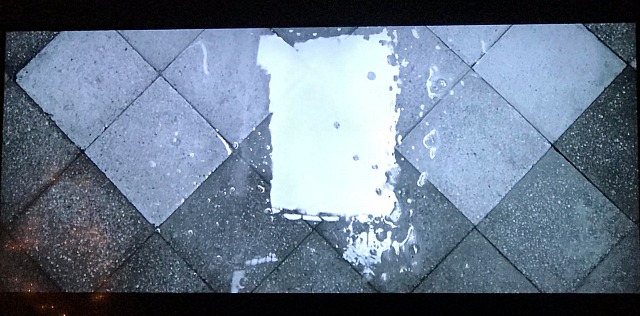
A couple of hours ago writer for hire, critic and feminist Monica Castillo tweeted that her mom “chose Roma for tonight’s movie, so we’re finally watching it together.” Cool, but the screen shot she posted shows what appears to be a natural color image. So Roma is somehow being streamed in color by some entity…?

Five years ago Nebraska director Alexander Payne told Variety that he was “contractually obliged” to deliver a color version of Nebraska so Paramount wouldn’t lose money on certain markets that have color-only stipulations.

A full-color Roma is obviously not what Alfonso Cuaron prefers to show, but I have to admit my curiosity is aroused. I wouldn’t mind seeing a color version if one was available. I’ve seen the b & w version four times now. My eyes want what they want.

12.26, 10 am update: A journalist friend informs that following an interview with Cuaron he “point-blank asked if he had a color version of Roma, like Alexander Payne was forced to do with Nebraska for certain territories.” Journo pally “pointed out that Payne’s leaked out and wound up on EPIX much to his dismay. Cuaron 100% dismissed this, was horrified, and said absolutely NO color version of Roma exists or ever will. End of story.”

Maybe so but Castillo’s image sure fooled me.

Read more

Another Misheard Rock Lyric

Few remember an old Herman’s Hermits song called “No Milk Today,” but indulge me. Toward the end of this 1966 tune, which is basically about a milkman feeling shattered because a woman he had an affair with has given him the brushoff, a chorus lyric goes as follows: “No milk today, my love has gone away / the bottle stands forlorn, a symbol of the dawn.”

All my life I’ve been hearing that last stanza as “the bottle stands forlorn, a symbol of the gore.”

All along I’ve been presuming that the lyricist (Graham Gouldman) was using “gore” to describe the aftermath of a love affair in the same vein of Bernie Taupin writing “love lies bleeding in my hands.”

On top of which “gore” is a much better rhyme with “forlorn” than “dawn” is.

Sign of the Times

Last night on twitter Chris McQuarrie was praising John McTiernan, Larry Gordon, Jeb Stuart, Stephen de Souza and Joel Silver‘s Die Hard.

He was especially impressed about how this 1988 film “spends a whole reel — 22 minutes — on set-up before the shooting starts.” Few filmmakers “have the huevos” to do that, McQuarrie remarked.

Yeah, by today’s standards. But back in the ’80s and ’90s it was actually considered de rigueur for the inciting incident to kick off roughly around the 20-minute mark, and no later than 25 minutes. Nowadays you have to hook the ADD morons within the first five or ten minutes.

14 years ago Man on Fire director Tony Scott waited 45 minutes until the inciting incident (i.e., the kidnapping of Dakota Fanning). 45 minutes spent on character and set-up!

Muted Window Seat Agony

The only way to endure a window seat on a long coast-to-coast flight is to submit to a kind of meditation. You have to slip into a Zen hibernation state. You have shut off those parts of yourself that want to get up and stretch or cross your legs or anything in that realm. You have to focus on writing and reading, and if you do a really deep drill that awful sense of suffocation and imprisonment will slowly go away.

For me watching mediocre films — 95% of the movie menu on this fight is pure fizz — seems to make the flight go more slowly.

Thank God there are only 90 minutes left, give or take. Right now we’re passing over western Colorado. Estimated LAX touchdown around 1:55 pm or so. Add another 30 to 40 minutes for runway taxi time plus the always interminable fuselage disembarking plus the luggage carousel.

2 pm update: Touched down five minutes ago.

When Memory Doesn’t Quite Serve

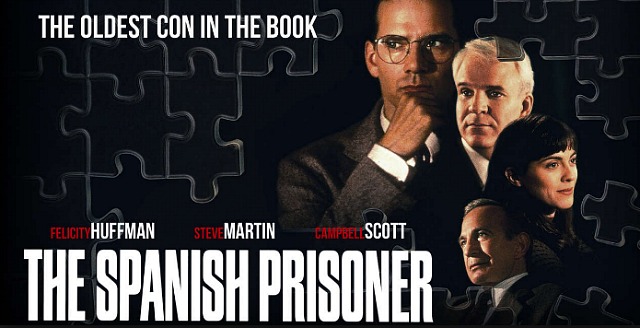
A Bluray of David Mamet‘s The Spanish Prisoner pops on 1.8.19; Amazon Prime members can stream it right now.

My recollections are a little fuzzy. Critics generally liked it. Mostly I remember the novelty of Steve Martin playing a smooth-talking bad guy. I recall that the first third or even the first half are highly intriguing, and then it kind of runs out of gas during the second half. I racked my brain but couldn’t recall any specific problems — just a vague sense of attrition. I know it always means something when you can’t recall much in the way of plot specifics, much less how a film ends.

So I read the fairly detailed Wikipedia synopsis and it still didn’t come back to me. So I’ve decided to watch it again. Tomorrow or the next day, I mean. Right now I’m stuck on a hellish, soul-suffocating N.Y.-to-L.A. flight, and of course the wifi isn’t strong enough to stream movies with. (It’s so shitty that I can’t even upload an image to the right folder on my server.)

The Spanish Prisoner is a dry, rather droll white-collar con movie. Everyone in the cast is a smooth villain (Martin, Ben Gazzara, Rebecca Pidgeon, the late Ricky Jay, Felicity Huffman). Campbell Scott, the creator of some kind of valuable financial “process” (blah McGuffin), is the increasingly frazzled mark.

This opens up something new for HE list queens — films that drop the ball during their second halves or third acts but are terrifically entertaining during their first 33% to 50%. Some of these films are so great during their first halves that I don’t even mind that they fumble it later on.

I love this Roger Ebert observation: “[Mamet’s] characters often speak as if they’re wary of the world, afraid of being misquoted, reluctant to say what’s on their minds: As a protective shield, they fall into precise legalisms, invoking old sayings as if they’re magic charms.”

Regretting The Fact…

..that I’m about to endure a six and a half hour Alaskan Airlines fight from Newark to Los Angeles. Every seat occupied, tight fit, possible filing during flight if I’m willing to pay astronnomical connection fee, etc. 2:30 pm arrival.

Scissors, Rabbits, Doppelgangers, Head Masks

Wiki synopsis for Bryan Bertino‘s The Strangers (2008), which costarred Liv Tyler and Scott Speedman: “Kristen (Tyler) and James (Speedman) are expecting a relaxing weekend at a family vacation home, but their stay turns out to be anything but peaceful as three masked intruders leave Kristen and James struggling for survival.”

“Around Seven It’s Marginal, Right?”

You have to figure that today’s seven-year-olds are probably more hip to the Santa Claus fraud than their 20th Century counterparts. I was tipped off when I seven or eight. More likely seven. A friend from across the street woke me. It was probably my first encounter with serious emotional betrayal, and at the hand of my parents yet! The feeling stuck, and one result was my inability to pass along the Santa myth to own kids with any conviction. I think I might have actually told them that Santa is more of a symbol of love and generosity than anything else.

Question: Melania needs a cue card to speak with kids about Christmas?

Defiant Message, Murky Lighting

Posted sometime around 1:30 pm eastern. YouTube commenter: “I don’t know what that was, but I definitely enjoyed it more than season 6 of House of Cards.”

On the other hand The Boston Globe is reporting that Kevin Spacey has been charged with felony sexual assault in Massachusetts. He allegedly sexually assaulted “the teenage son of former Boston WCVB-TV news anchor Heather Unruh at a Nantucket bar in July 2016,” according to Matt Rocheleau’s story.

Why Convert “Roma” to 70mm Film?

Last night I re-sampled Roma on Netflix. My fourth viewing. The black-and-white compositions have always looked great on theatrical screens, but they look even better on my Sony 930C 65″ 4K HDR, especially via the new Samsung 4K Bluray player. I could live in that film, that eye spa. The only film that offers a similar monochrome wonderland vibe is Pawel Pawlikowski‘s Cold War.

But I’m of two minds about some forthcoming 70mm presentations that Netflix has planned. On one hand I’d like to see what it looks like; on the other I know it can’t look as good as it does at home or via digital projection.

I’m slightly puzzled by a quote from Roma director Alfonso Cuaron in a 12.20 Variety piece by Dave McNary, to wit: “Roma is designed to be meaningful whether experienced at home or on the big screen but offering cinema lovers the opportunity to see it in theaters is incredibly important to me. The 70mm print of Roma shows unique details not available on any other version. Being shot in 65mm, these prints bring live detail and contrast only possible using a big format film. It is for sure the most organic way to experience Roma.”

I heard this morning from a tech-savvy friend who disagrees with Cuaron:

“The foundation of Roma is the beautiful, shimmering, nitrate-like black-and-white imagery,” he said. “I wonder if it was captured in color and affected in post?

“The strange thing is the announcement that they’re making some 70mm prints to have an ‘organic’ look, whatever that is. The publicity mentions a large-format 65mm negative, but Roma was shot as data.

65mm digital, straight from the chip, blows projected 70mm celluloid out of the ballpark. If you go from original finalized data to a recorded negative, and then to a print and then project it, and projection is almost always flawed unless you’re screening it in the Academy or some other first-rate venue…if you do all that you’ve lost probably 25% of the image quality. Not to mention trying to achieve the purity of the black-and-white data on color stock.

“So why project it on 70mm film?”

I’ve asked Cuaron about these disparate views, and whether my tech-savvy friend might be missing something. Haven’t heard back.