“Official Secrets”: Pure Political Pleasure

Like Scott BurnsThe Report, which was acquired by Amazon after debuting in Park City two or three days ago, Gavin Hood‘s Official Secrets (Entertainment One) is a fact-based whistleblower drama about exposing shifty, lying behavior on the part of the Bush-Cheney administration in the selling and prosecution of the Iraq War.

The Report is about Senate staffer Daniel Jones (Adam Driver) investigating, authoring and releasing a massive report on CIA torture; Official Secrets is about real-life translator and British intelligence employee Katharine Gun (Keira Knightley) revealing a U.S. plan to bug United Nations “swing”countries in order to pressure them into voting in favor of the 2003 invasion of Iraq, which of course was founded upon a fiction that Saddam Hussein‘s Iraqi government was in possession of WMDs and represented a terrorist threat.
The difference is that while The Report is plodding, sanctimonious and a chore to sit through, Official Secrets is an ace-level piece about pressure, courage and hard political elbows — a grade-A, non-manipulative procedural that tells Gun’s story in brisk, straightforward fashion, and which recalls the efficient, brass-tack narratives of All The President’s Men or Michael Clayton.

Official Secrets is exactly the sort of fact-based government & politics drama that I adore, just as The Report is precisely the kind of self-righteous, moral-breast-beating drama that I can’t stand.

The performances by Knightley, Matt Smith (as Observer reporter Martin Bright), Matthew Goode (as journalist Peter Beaumont), Rhys Ifans as Ed Vulliamy, Adam Bakri as Yasar Gun, and
Ralph Fiennes as British attorney Ben Emmerson are excellent fits — as good as any fan of this kind of thing could possibly hope for.

Hood’s Eye in the Sky was one of the finest and most gripping films of 2015, and here he is again with another winner. Hats off to a good guy.

Read more

Soderbergh on the Street

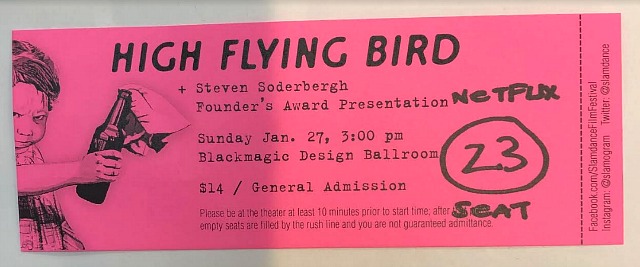
Following yesterday afternoon’s Slamdance screening of Steven Soderbergh‘s High Flying Bird, I walked outside to find Soderbergh chatting with fans. I strolled over to tell the 56-year-old powerhouse auteur that I was an admirer of his basketball film and that I regard it as much his own story as that of Andre Holland‘s Ray character. (Here’s my review.)

As I walked up Soderbergh, who knows me from way back and apparently reads Hollywood Elsewhere from time to time, started things off with a mock greeting:

Soderbergh: “So, the pariah!”
HE: “No, no, things are cool. I’m getting into films. No issues.”
Soderbergh: “With Slamdance, you mean.”
HE: “No, Sundance. Publicist friends are taking care of me. I’m seeing what I want to see.”
Soderbergh: “Okay.”


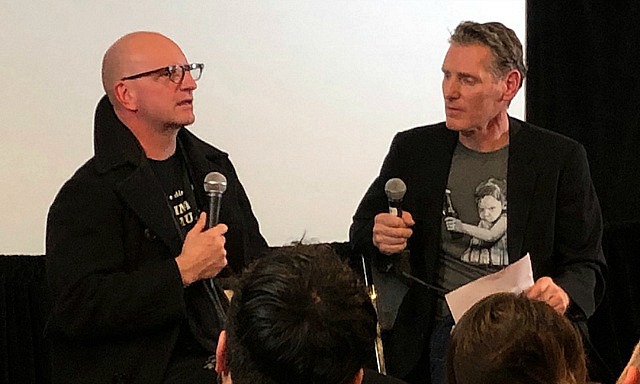
High Flying Bird director Steven Soderbergh, Slamdance co-founder Peter Baxter prior to Sunday afternoon’s screening.

Read more

’50s Atmosphere, In and Of Itself

“Despite allusions to The Twilight Zone and constantly cutting back to a faux tube TV perspective, Andrew Patterson‘s The Vast of Night never quite reaches that level of shock value or philosophical preponderance that made The Twilight Zone what it was.

“The climax is beautiful, to be sure, and the effects work is excellent given the low budget, but it doesn’t have much more meaning than is presented on its face, and the resulting feeling is one of hollowness in the face of the potential for so much more.

“Still, if one is looking for a mood of existential dread and bragging rights for seeing some of the industry’s next great talents’ early work, The Vast of Night certainly delivers on that front.” — from a 1.26.19 review by Leigh Monson on birthmoviesdeath.

Hollywood Elsewhere apologizes for having not yet watched The Vast of Night via streaming link. I plan to do so soon. Certainly by Tuesday or Wednesday.

What Killed “A Star Is Born’s” Oscar Hopes?

I was fairly shocked when Bradley Cooper‘s A Star Is Born lost the SAG ensemble award last night. I also heard a resounding THUD sound. Because this, to me, seemed like the final kiss of death — i.e., SAG being unable to give this popular musical drama a “poor baby, we still love you” award.

An obviously well made, convincingly performed and hugely successful romantic tragedy, ASIB had consistently failed to win anything big — no Best Picture or directing or acting awards — at the Golden Globes, the Critics Choice Awards or the Producers Guild Awards. So before last night the thinking was “okay, no Best Picture Oscar and no acting Oscars for Cooper or Lady Gaga, but SAG members surely feel sorry for A Star Is Born, and so they’ll probably give it a Best Ensemble award as a kind of consolation prize.”

Nope!

Obviously no one knows anything for sure about the final Oscar tallies, but the Academy Award ambitions of Cooper’s grand musical opus are almost surely dead, dead, deader than dead.

So what killed the award-season chances of what had seemed — on paper at least — like a film that might do exceptionally well with award-season voters and handicappers — a film that was obviously well crafted, expertly refined, beloved by audiences and extraordinarily successful all over ($206 million domestic, $413 million worldwide).

In a phrase, A Star Is Born was way overhyped in the early stages, and that avalanche of pre-release praise produced feelings of irritation (at least as far as Hollywood Elsewhere was concerned) and a kind of “oh, yeah? show us!” attitude among many others.

That plus the fact that it just seemed wrong, wrong, WRONG to give a Best Picture Oscar to a remake of a remake of a remake of a 1932 original.

Warner Bros. publicity, obviously, was the architect of the overhype. Their hubris bears the responsibility.

The first clue came when Warner Bros. decided not to show ASIB in Telluride — a decision that said “we know this is basically a hoi polloi popcorn movie, so we don’t want any critical slams coming out of an elite rarified setting.”

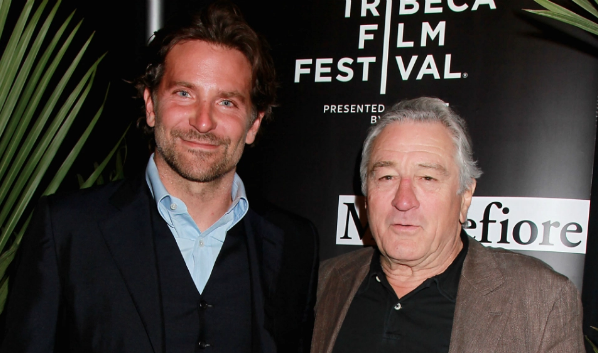
But if you want to focus on overhyping faces and personalities, A Star Is Born was primarily killed by the Murderer’s Row quartet of Robert De Niro, Sean Penn, Variety‘s Kris Tapley and Barbra Streisand.

Read more

Gosling’s Gloomhead Performance Smothered “First Man”

I for one admired Ryan Gosling‘s minimalist approach to playing Neil Armstrong in First Man. Armstrong, yes, was an allegedly dull and undemonstrative fellow, at least according to some, but in my eyes (and surely in the eyes of director Damien Chazelle) Gosling was conveying a complete emotive universe…all kinds of feeling, anxiety, ache and seasoned-pilot attitude, but with the tiniest and fleckiest of paint dabs.

I found it a fascinating and courageous performance because Gosling and Chazelle had made a conscious choice to not use the standard-issue emotional strategies that Ron Howard and others have resorted to in similar “solitary man vs. incredible challenge” dramas.

Obviously the ticket-buying public didn’t agree; ditto the industry when it came to handing out awards and acting nominations. File the Gosling-Chazelle experiment under “noble but unsuccessful.”

But another angle on this failure came to light when I read Owen Gleiberman‘s 1.24 review of Apollo 11, the CNN documentary that screened a few days ago at Sundance ’19.

“Even as a die-hard First Man believer, I have to say [that] while Ryan Gosling’s clean-cut, clear-eyed terseness matches up neatly with Neil Armstrong’s, the documentary confirms what I’d always remembered: that Armstrong’s face was frequently graced with the angelic hint of a smile — he was the Eagle Scout as Mona Lisa. Maybe he was just that way for the cameras, but I somehow doubt it.

“In Apollo 11, he comes off as genial and inviting, the very soul of a more optimistic America. I think if he’d come off that way a bit more in First Man, the movie might have won more fans.”