DuVernay Whispers

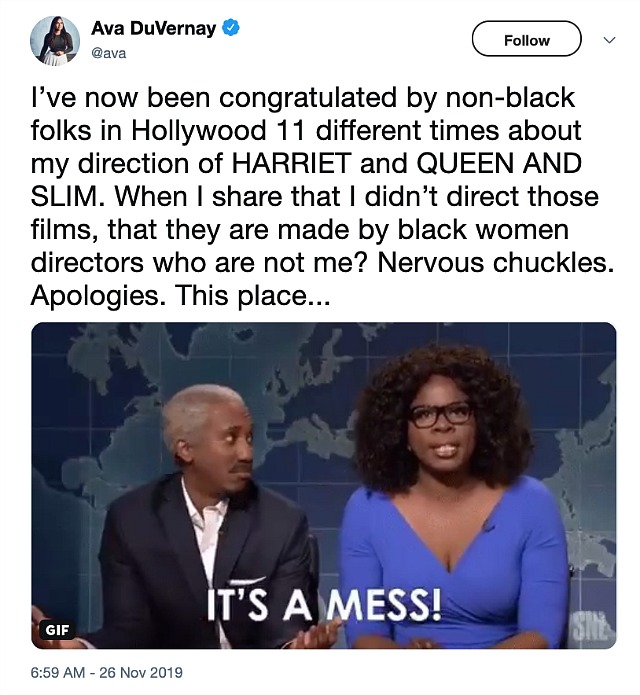
Hollywood Elsewhere sympathizes with the 11 white industry people who’ve congratulated Ava DuVernay for her direction of Queen and Slim as well as Harriet. This is an embarassing whitey thang, mistaking one person of color for another without looking deep into their souls and speaking to the individual.

Honestly? This is why so many POCs aren’t supporting Pete Buttigieg — because he doesn’t really know any black people all that well and when he greets this or that person of color he sometimes says the wrong first name.

What these above-referenced Anglo Saxons don’t realize is that DuVernay also shadow-directed The Lighthouse. Okay, Robert Eggers technically “directed” it, but DuVernay was the secret creative power behind the throne. It was DuVernay, for example, who suggested the idea of a hostile seagull.

One of the best-kept Hollywood secrets is that DuVernay is a film-set “whisperer” — she hangs around shoots, watches everything, and offers advice when the director runs out of ideas or otherwise gets stuck.

Seriously, Melina Matsoukas (who’s slightly thinner and has a lighter complexion than DuVernay) directed Queen & Slim while Harriet‘s actual director is Kasi Lemmons.

Yo…”Da 5 Bloods”

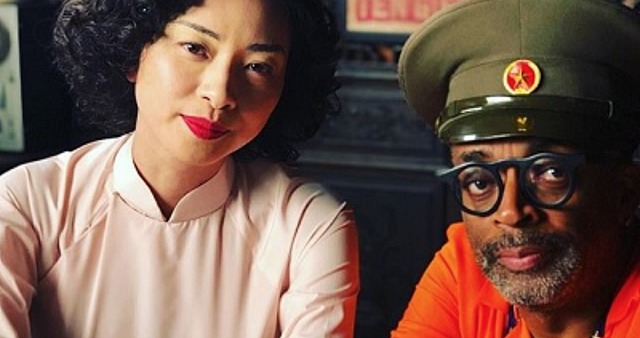
I’m told there’s a possibility that Spike Lee‘s Da 5 Bloods, a kind of “Last Flag Flying meets a buried-gold-treasure hunt” scenario set in Vietnam, may premiere at Sundance 2020. Possibly, maybe not, who knows?

Lee’s lengthy, Asian-set, character-driven drama sounds unlikely given that Bloods doesn’t sound woke enough for Park City, but we’ll know later this week (or early next week) when the Sundance slate is announced. It would be a huge score if Sundance lands Da 5 Bloods, as it would constitute a noteworthy exception to the SJW Sundance template.

Lee and Netflix would prefer a Cannes debut, I’m hearing, but the last time I checked Cannes was a no-go for Netflix…right? At least for the foreseeable future.

Wiki boilerplate: “Four African American Vietnam veterans return to Vietnam. They are in search of the remains of their fallen squad leader (played by Chadwick Boseman in flashback) and the promise of buried treasure. The fellow battle forces of man and nature while confronted by the remaining ravages of this half-century-old conflict.”

I’ve heard from a guy who attended a recent NYC-area screening of Lee’s film, which he says had a running time between 160 and 165 minutes and is pretty much completed with the credits in place. Here’s how he put it (although I’m skeptical of some of his impressions):

Tipster: “It’s a slick, fast-paced, 165-minute Vietnam War film.” HE: Bullshit — what he means is that it’s a film about the Vietnam War’s legacy. Tipster: “It’s not your typical type of war flick though. It’s a present-day thing about four aging veterans (Delroy Lindo, Clarke Peters, Isiah Whitlock, Jr., Norm Lewis) returning to Ho Chi Minh City (Saigon) to find the remains of the “fifth Blood” (played in flashback by Chadwick Boseman) who was killed in action. They’re also looking to retrieve a pile of gold that they buried during their Vietnam service.

“And so they head off into the jungle and reconnect with one another in various ways. There’s a sort of Last Flag Flying sense of bonding between these men, all living different lives from when they knew each other, and all of them they sharing a similar sense of fear with age and time closing in, and all haunted by the wartime histories.

“Spike opens with a montage of the violence of the late 60s and early 70s, set to the music of Marvin Gaye — there’s a lot of Gaye in this, actually, and he uses it so well, all fitting in smoothly and providing momentum from the start.

“I saw Bloods with two other critics, and they both loved it. Apparently Netflix gave him creative control to create his vision. I think Da 5 Bloods is a little too big for Sundance — if it weren’t for the Netflix blockage Cannes would be a better fit. Maybe they should wait until Venice, Telluride or Toronto. Either way it will be a major success for both Spike and Netflix, and I could even see a directing and picture nomination depending on how they decide to release it.

“The movie was practically finished — just some small things like explosions that were just a tad too loud and needed to be mixed a little bit, but nothing that major.”

Read more

2020 Spitballs

2020 will be upon us in less than five weeks. A new decade, no more teens…is it possible that after 20 years of the 21st Century people might finally begin to identify the forthcoming years as twenty-something rather than two-thousand-whatever? When are people going to finally let that infuriating Arthur C. Clarke and Stanley Kubrick-ism go?

Now’s as good a time as any to begin spitballing the 2020 films that might make a difference. Right now Hollywood Elsewhere is most looking forward to four, and a couple of these might not open before 2021. I really don’t know much.

[Click through to full story on HE-plus]

John Simon Concludes

On 5.1.19 I asked the 94 year-old critic John Simon, whose occasionally cutting and cruelly dismissive judgments I had found perversely amusing during his critical heyday period, if he could be persuaded to submit a list of the ten-best films of the 20-teens. (I was doing this on behalf of Jordan Ruimy, who was compiling a list.)

I knew from Simon’s website that he was keeping up with theatre reviews to some extent, and I was presuming he was streaming films or catching them on Bluray or something in that realm.

Simon’s reply arrived on 5.5.19: “I am afraid I can no longer keep up with the movies, and so am not qualified to respond.”

Simon passed earlier today, and I think this finale deserves a certain respectful pause. I know there are some who will make cracks about what a prick he was, about how his passing is analogous to the deaths of Harry Cohn or the fictional Hugo Shields in The Bad and the Beautiful.

I think Simon, whose profile peaked from the mid’ 60s to mid ’90s, was a near-great critic, and I don’t think it matters all that much if he was regarded as an unkind or callous person. He had a voice, a signature, a certain history, an honest attitude. That’s what you want in a critic. You want to feel the presence of a specific seasoned being with likes, loves, preferences, distastes, a certain education and a full rundown of experience of one kind or another.

Critics who muffle themselves in favor of bland consensus opinions aren’t worth spit. Critics who don’t seem to care if people like them or not are rare.

We’ve all heard the Simon stories. I’ve long presumed that many if not most of Simon’s peers sided with Roger Ebert‘s view, expressed in “Life Itself,” that “I feel repugnance for Simon, who made it a specialty to attack the way actors look. They can’t help how they look, any more than John Simon can help looking like a rat.”

John Simon vs. Mere Gapers,” posted on 1.7.14:

“In a piece about Roger Ebert in the wake of this death, the downshifted film and theatre critic John Simon wrote the following: ‘I firmly believe that the film critic should have a special expertise, like any kind of art critic. Like a physician, he should know more about medicine than a layman who picks an over-the-counter drug for a cold; like an architect, he should know more about architecture than a mere gaper at buildings.

Read more

Go Easy On “Little Women”

The word went out weeks ago among name-brand critics and their editors, not just among the especially political bend-with-the-wind types (i.e., Indiewire staffers) but all over: If at all possible, give Greta Gerwig‘s Little Women a pass.

The fact that no one wanted to ignite any political blowback from the #MeToo crowd and/or didn’t have the heart to give the enormously well-liked Gerwig any noise…this is not a tragedy. It happens from time to time, and lesser films have been favored for similar reasons. When Little Women opens it will connect with Joe and Jane Popcorn or it won’t, and political industry currents will have nothing to do with that final verdict.

I happen to believe that Little Women is somewhere between decent, passable and not that bad. A month ago I called it “highly respectable, nicely burnished, well performed, lusciously authentic,” etc. I was mildly taken with much of it, and I especially loved the scenes between Saoirse Ronan‘s Jo and Tracy Letts‘ “Mr. Dashwood.”

But I have to admit I was a wee bit taken aback by the Rotten Tomatoes and Metacritic ratings of 97% and 88% respectively.

Whenever a politically well-liked film has failed to charm the pants off a certain senior critic, the trades usually often assign a friendlier critic to write the review. Why haven’t Variety and The Hollywood Reporter‘s top-dog critics, Owen Gleiberman and Todd McCarthy, reviewed Little Women? I only know that when these guys step away from the plate and hand the bat to Peter Debruge and David Rooney…well, there’s a reason.

Again, it’s not a tragedy when this happens. Little Women has a lot of support right now and at the end of the day will end up with…well, a lot of affection in certain quarters. And that’s fine.

Screen Daily‘s chief critic Fionnuala Halligan: “An often cloyingly self-satisfied, over-stuffed riposte to the endless Jane Austen adaptations from across the pond, Little Women is American heritage cinema at its most lavishly nostalgic. Doused in autumnal-coloured quilts, throws, patterned shawls and swaddled so deeply in amber light it looks almost baked, this is a film which knows its (female-skewing, festive-led) audience and plays aggressively to it.”

Vanity Fair‘s Richard Lawson: “It’s a paean to the loving of a thing, rather than a movie that gives that thing an entirely new existence, free-standing and self-possessed in its own right, despite Gerwig’s narrative tinkering.”

A critic friend recently complained that Little Women “rambles all over the place,” and that he regarded it as “a scattered piece of storytelling that feels, at times, like an overly long rough cut,” and that “it’s more than a bit precious in its vision of marriage as nothing more than a conspiracy of the patriarchy.”

My view is that Ronan’s Jo is the emotionally fine-tuned engine that makes the film work as well as it does, but that the flashback device doesn’t work, and that the film feels splotchy at times, and that Florence Pugh‘s character is dislikable, and that I was asking myself “wait…what’s going on?” when Better Call Saul (i.e., Bob Odenkirk) showed up at the end of Act Two, and that the heart of Timothee Chalamet‘s “Laurie” is all over the map and spinning like a weather vane.

Sir Thomas More to “Laurie”: “See here, Theodore. For some time and until fairly recently you were head over heels in love with Jo. Now that she’s told you she doesn’t think it will work you’ve not only fallen in love with but proposed to Amy (Florence Pugh). I can only hope that when your heart stops spinning it will operate as normally as God intended.”

Woked Itself Into A Corner

Sundance 2020 (1.23 thru 2.2) will begin announcing this week. World of Reel‘s Jordan Ruimy is hearing that Netflix may want to premiere Spike Lee‘s Da 5 Bloods there. There’s also the possibility of seeing Josh Trank‘s Fonzo, Barry Levinson’s Harry Haft, Julie Taymor’s The Glorias: A Life On The Road, Dee ReesThe Last Thing He Wanted, Chloe Zhao’s Nomadland, Sofia Coppola’s On the Rocks, and Benh Zeitlin‘s allegedly problematic Wendy.

So eight keepers plus the usual five or six docs (possibly including Todd Haynes‘ Velvet Underground portrait) — enough to make the trip worthwhile — fine. I’m naturally interested, but then again Sundance isn’t really classic Sundance any more, As I lamented last week, it’s become Camp Woke.

For a ten-day period in January, Sundance used to be the hippest and most vital winter wonderland and spiritual getaway in the world. It was like this annually-renewed, extra-cool reality TV series that took the temperature of the culture — you had to be close so you could breathe in the vapors and receive that special ahead-of-the-curve information. It was essential, necessary — a great way to begin the new year.

I know that Sundance ‘20 will probably deliver the usual five to eight…okay, ten noteworthy films that will be part of the early conversation, but the odds of another Manchester By The Sea playing there (or even another flash in the pan controversy like The Birth of a Nation) are slim to none. Or so it seems right now.

For Sundance has basically woked itself into a corner — it used to be one of the big three powerhouse festivals (along with Cannes and Telluride/Toronto) but now I’m not so sure.

Right now it’s flirting with being a larger, snowier but more politically secular version of SXSW.

Sundance is where films go to get their official badge and stamp of approval from the indie-woke-feminist-MeToo-identity politics-POC-LGBTQ, anti-white-patriarchy SJW comintern crowd. But then what?

The question is, what kind of serious cultural or commercial value does that badge deliver these days? The 2020 version of a Sundance breakout hit almost certainly means it’ll be received with muted enthusiasm (if that) when it opens, but of course most indie-level films don’t “open” any more — they go straight to streaming.

Read more

Ruby Slippers

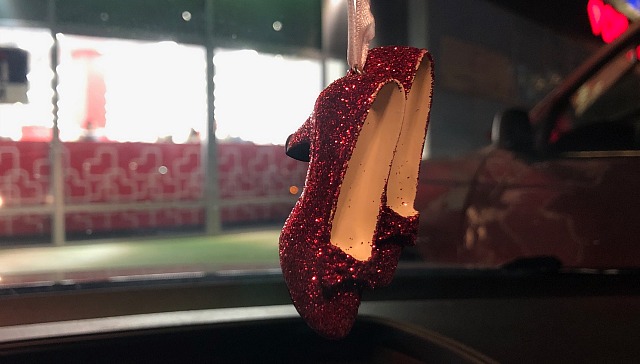
One of the coolest swag items — mementos — of the 2019/20 Oscar season…wooden, seemingly hand-crafted ruby slippers from LD Entertainment’s Judy. Presumably sent at the urging of Oscar strategist David Pollick, who has been with Garland-channeller Renee Zellweger from the get-go. Somebody worked very hard to create these. Real “ruby” sequins, etc. Now hanging from VW Beetle’s rearview mirror.

Many Saints of Secaucus

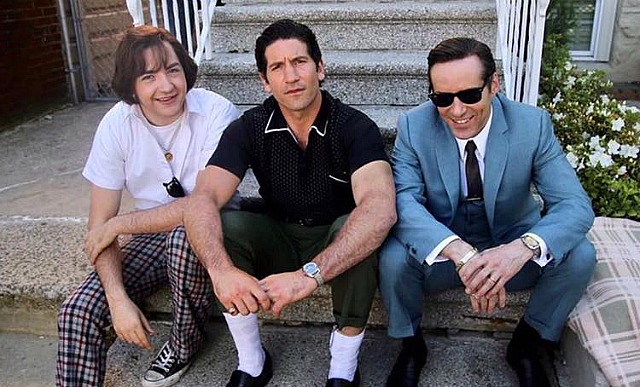
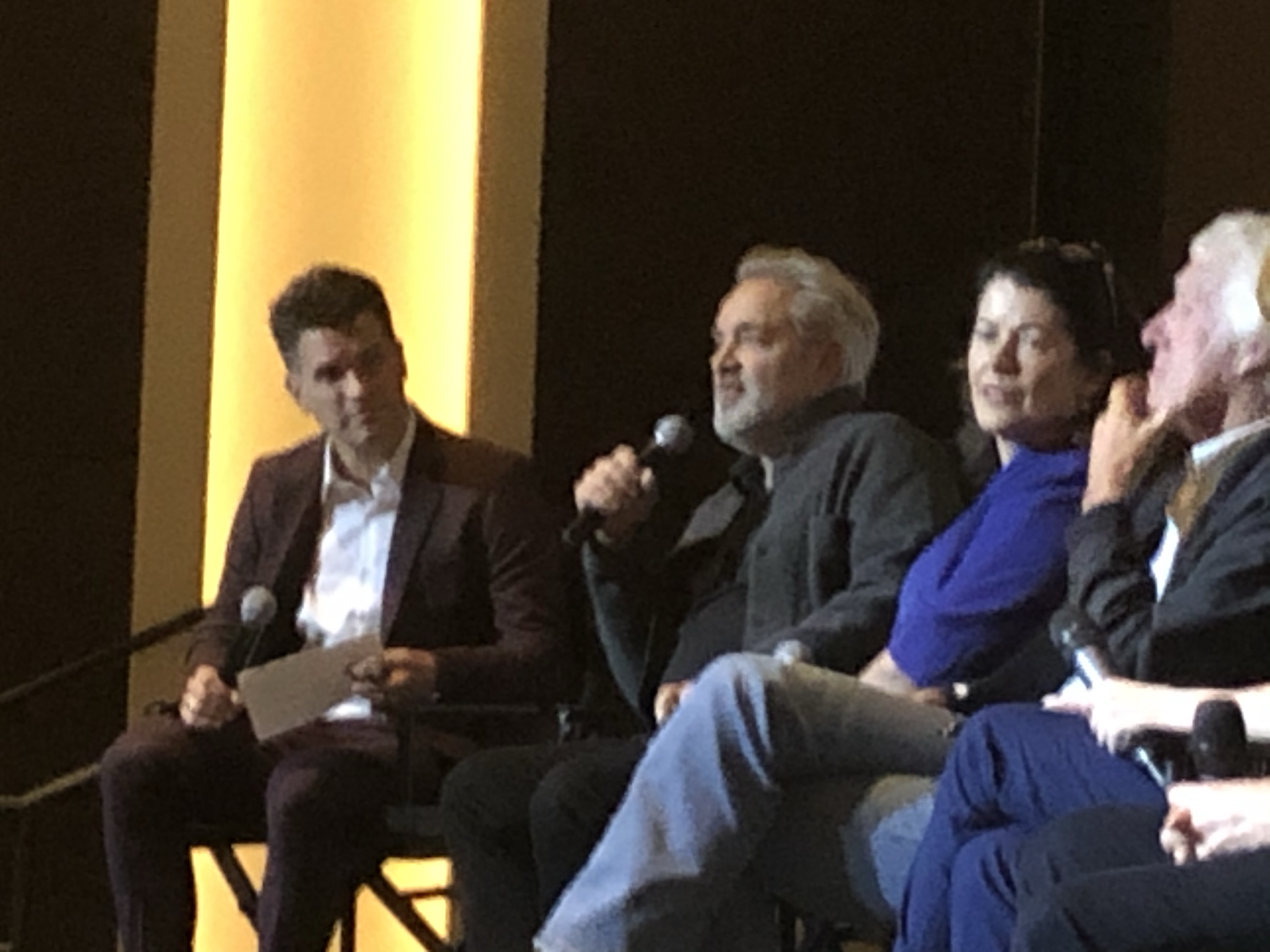
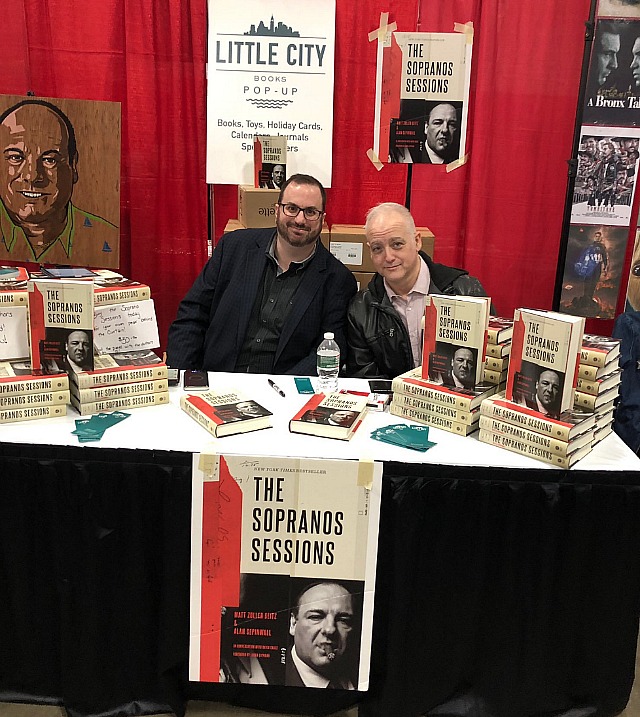
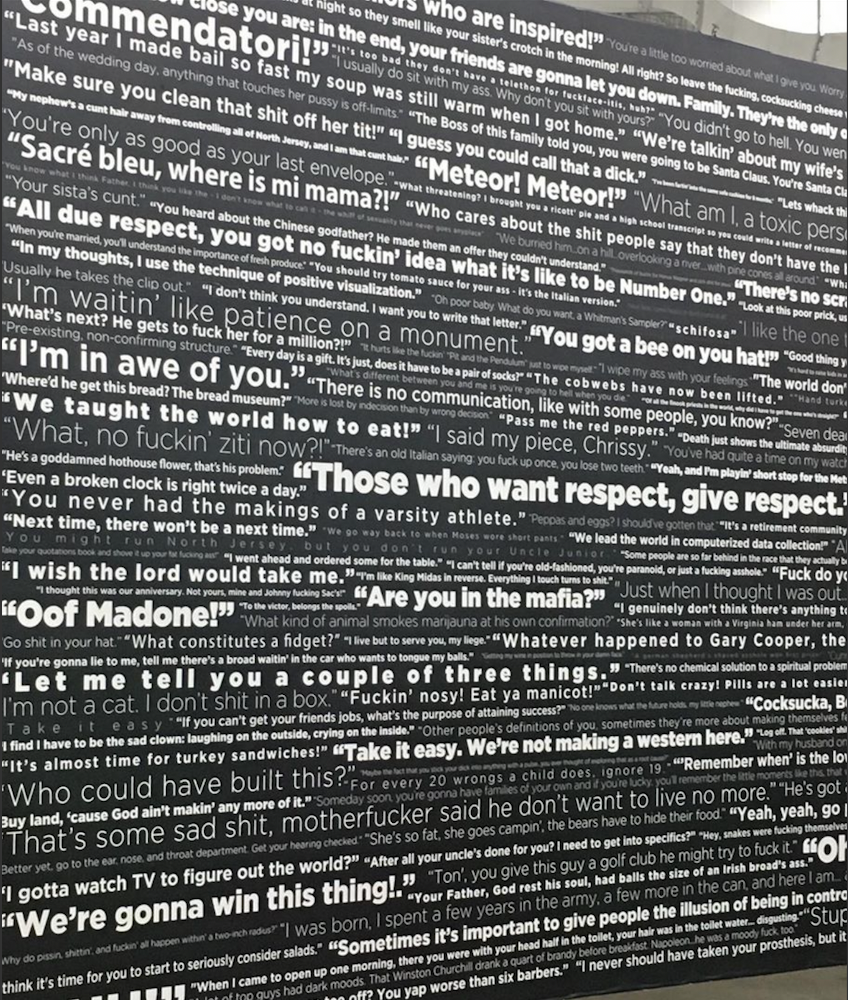
Sopranoscon (i.e., Comic-Con meets The Sopranos) is happening this weekend at the Meadowlands Exposition Center in Secaucus. (Or, as Joe Pesci‘s Tommy pronounced it in Goodfellas, “SEE-kawkus.”) “Sopranos Sessions” co-authors Matt Zoller Seitz and Alan Sepinwall were the Sunday stars.

Sidenote: Among all the classic Sopranos lines immortalized on the wall [pictured below], I don’t see “they don’t sell hot dogs here — they took the bleachers out two years ago.”

Read more

Bloomberg Factor

Mike Bloomberg has entered the Democratic presidential nomination because he sees an opening. The top four candidates have serious weaknesses. No major consensus candidate is riding the crest of the wave. Younger voters don’t relate to Droolin’ Joe, African Americans are refusing to support Pete Buttigieg, the far-left agendas of Elizabeth Warren and Bernie Sanders are scaring Midwestern battleground voters.

And so Bloomberg, who would certainly be a saner, restorative, more progressive president than Donald Trump and whom I’d vote for in a New York minute if he was the Trump-opposing candidate, is looking to buy his way in at this late date.

From “Peak billionaire: a billionaire tries to purchase a party nomination to outflank anti-billionaires so he can run against another billionaire,” posted by Boingboing’s Cory Doctorow on Sunday, 11.24.19 at 7:27 am:

“The plutocrats — Time‘s Anand Giridharadas calls them ‘plutes’ — spent 40 years telling us that anything that doesn’t embrace the above is ‘socialism,’ with the inevitable and totally foreseeable outcome that Americans now embrace socialism at rates not seen since the New Deal.

“As Giridharadas writes: “History is the story of conditions that long seem reasonable until they begin to seem ridiculous.”

“So now the plutes are panicking: the Business Roundtable is promising a new form of capitalism (but refusing to even consider kicking out or even censuring members who violate that promise). Michael Bloomberg is buying his way into the Democratic race because he’s worried that the frontrunners ‘aren’t plutophilic enough,’ leading to peak plute: ‘A billionaire deciding to possibly attempt to purchase a party nomination because of his fear that some candidates in the race aren’t plutophilic enough, and then running against a maybe–billionaire who promised that being a billionaire would make him specially incorruptible and now is in impeachment proceedings over his alleged corruption.”

Read more

Dalton’s “Cooler King”

I for one was seriously impressed with the Once Upon A Time in Hollywood clip of “Rick Dalton” playing Cpt. Virgil Hilts (the role Steve McQueen actually played) in The Great Escape. The implication is that Dalton (Leonardo DiCaprio) screen-tested for the Hilts role or perhaps had even been cast before director John Sturges changed his mind and gave the role to McQueen. McQueen’s voice was deeper than Dalton’s — he had the surly-insolence-mixed-with-confident-swagger thing down pat. The Great Escape clip wasn’t ready when OUATIH premiered in Cannes or, as far as I know, opened last summer. Thanks to Aurora for posting this a couple of days ago.

Read more