Bernie Is a Death Card

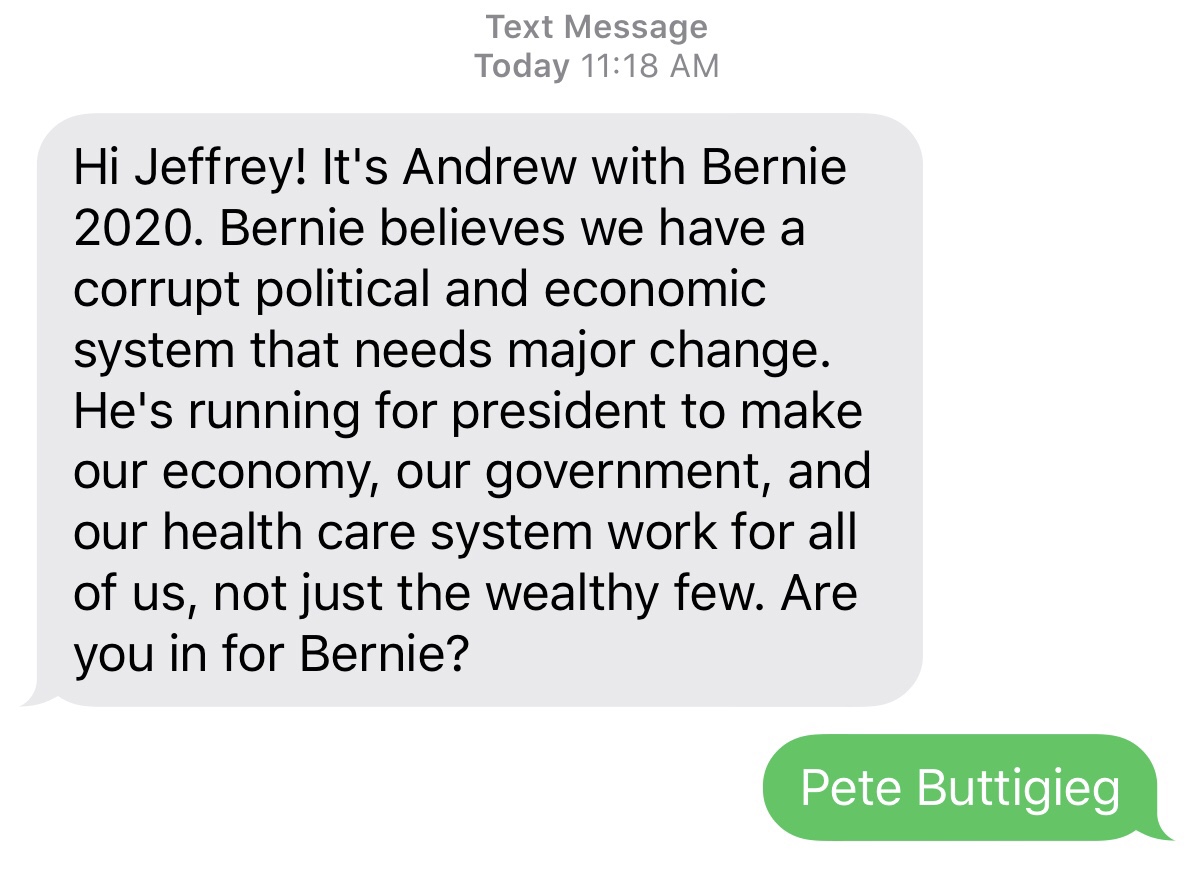
Reader comment: “I hate to say this, but Pete needs to drop out now. Along with Warren and Klobuchar [and Steyer and Bloomberg]. The goodwill Pete would earn would do a lot for his future.”

His point was that stopping Bernie the Destroyer is the paramount thing above all, and that if the left-moderate voters could focus entirely on Biden there’s a half-assed chance that Bernie’s momentum might be slowed down or even sputter out.

HE to reader: “Disheartening as your suggestion feels to me right now, Pete sacrificing his candidacy in order to stop Sanders may be the smartest move he could make right now. Of course, Buttigieg and the others will stay the course until after Super Tuesday.”

Would Bernie Survive First Term? Maybe.

Bernie Sanders may survive his first four-year term as President. Then again who knows? He’s a tough old goat, and he might trudge on through. But he’s also a 78 year-old man who had a heart attack five months ago. And the odds don’t seem to favor his being in robust health at the start of a theoretical second term in January ’25, when he’d be 84.

Bernie almost certainly wouldn’t run for a second term — be honest. Oh, and he’d better pick his vp running mate very carefully.

From Chris Cillizza‘s “The Delicate Issue for Bernie Sanders That His Democratic Opponents Won’t Touch,” posted on 2.28.20

“The scrutiny applied to a front-running candidate covers their policy positions, their personality and preparedness for the nation’s top job, and yes, even their health.

“Consider what President Donald Trump would do with the issue of Sanders’ health, given (a) that Sanders had a well-documented heart attack last fall while campaigning in Nevada and (b) the way in which Trump tried to make Hillary Clinton’s health an issue in 2016.”

Consider a 2.21 Slate piece by Jeremy Samuel Faust, titled “What Are the Chances Sanders Has Another Heart Attack Before November?”

Excerpt #1: “I considered the risk that, between now and Nov. 3, Sanders might experience any of the following: a second heart attack, another life-threatening emergency, any event that would require hospitalization (including any “false alarm”), or even death. The risk is not trivial, and is worth explaining in full.

“First, there appears to be little evidence that Sanders’ current health is a hindrance to the daily rigors of a national campaign. Considering the extent of his heart attack in October, he appears to be doing well, able to campaign vigorously, and likely up to the demanding position of president, from an endurance standpoint at least.

“Nor is his life expectancy the central question, though, yes, his remaining expected life span dropped from around 10 to five years after his heart attack.”

“But his one-year risk is low, meaning his chance of surviving the campaign is good. When Sanders entered the hospital in October (given what we’ve been told by his doctors), his calculated six-month risk of death was rather harrowing, likely between 11 and 19 percent. Fortunately, by virtue of surviving his initial hospitalization, and the incident-free intervening four months, those numbers have improved, to better than 95 percent.”

Excerpt #2: “Using Medicare claims data, researchers at Yale analyzed millions of patients who suffered heart attacks like Sanders’. (As an aside, using adjectives like mild, moderate, or severe to describe Sanders’ heart attack is not helpful. What we can say is that these researchers were looking precisely at patients like Sanders who had experienced approximately the same problem as his, in the same time frame.)

“Here’s what they found: From the day they left the hospital, the one-year risk of at least one rehospitalization for any reason in Medicare beneficiaries who suffered a heart attack like Sanders’ was about 50 percent (the baseline annual risk among his age cohort is more like 1 in 6).

“Again, by virtue of four incident-free months on the trail, that number is now lower for Sanders. But his chance of another hospitalization between now and November alone likely remains between 30–35 percent. While the daily risk is low, around 0.17 percent, we have more than 250 days to go until Election Day. The risks add up.”

Woke Woman vs. Lunatic Patriarch

Who in the HE community has the courage to stand up and tell the #MeToo kowtow crowd that they’ve gone overboard in their praise for a decent shock-scare flick?

“Unraveling the dusted bandages of H.G. Wells’ classic 1897 science-fiction novel, writer-director Leigh Whannell has refashioned The Invisible Man as a bracingly modern #MeToo allegory that, despite its brutal craft, rings hollow. Whannell has the talent and cunning to turn The Invisible Man into a chilling and well-crafted B-movie. But if you’re looking for anything more than that, you’ll probably come up empty.” — AP critic Jake Coyle.

Read more

“Goodfellas” Copa Song

There are two vaguely irksome problems with “And Then He Kissed Me“, the 1963 doo-wop song that became legendary when Martin Scorsese used it to score the famous Copacabana tracking shot in Goodfellas.

The naive and drippy lyrics (written by Phil Spector, Ellie Greenwich and Jeff Barry) comprise irksome problem #1. Irksome problem #2 is the lead vocal track by the proficient Dolores “LaLa” Brooks, whose nasal singing style serves to underline the banality of the fairy tale that the song is selling.

But the arrangement by the legendary Jack Nitzche is rhapsodic and transportational — so much so that the song works better without the vocals. Not to mention the engineering by Larry “Wall of Sound” Levine. The song was recorded at Gold Star Studios (6252 Santa Monica Blvd., near Vine Street) in April 1963.

Evil Thrives, Procreates, Infects

Mohammad Rasoulof‘s There Is No Evil has won the Berlinale’s Golden Bear prize. Here’s an excerpt from Peter Debruge’s 2.28 Variety review:

“In Iran, executions are often carried out by conscripted soldiers, which puts an enormous burden on the shoulders of ordinary citizens. And what are we to make of the condemned, for whom guilt can sometimes be a capricious thing, dictated by a severe and oppressive Islamic regime — the same one that accused Iranian director Mohammad Rasoulof of ‘endangering national security’ and ‘spreading propaganda’ against the government?

“When Rasoulof returned from Cannes in 2017, following the premiere of his film A Man of Integrity, he was banned from filmmaking for life and sentenced to a year in prison. But as a man of integrity himself, the director could not stop.

“His latest film, There Is No Evil, premiered in competition at the Berlin Film Festival, where instead of being silenced, Rasoulof launches his most openly critical statement yet, a series of Kafkaesque moral parables about Iran’s death penalty and its perpetrators, made in open defiance of the restrictions the government put on him.

“The resulting feat of artistic dissidence runs two and a half hours, comprising four discrete chapters, each one designed as a standalone short film exploring a different facet of the subject. By subdividing the project like this, Rasoulof was able to direct the segments without being shut down by authorities — who are more carefully focused on features — and, in the process, he also builds a stronger argument.

“The truth, the film clearly understands, is more complicated than its title: There is evil in the world, and it corrupts us when we don’t take a stand. What would you do in the characters’ shoes? What will you do in your own?”

Word Around The Campfire

Gavin O’Connor‘s The Way Back (Warner Bros., 3.6) looks like a redemption drama — a former basketball star turned boozing middle-aged construction worker (Ben Affleck) lands a gig as a high-school basketball coach, and despite problems and potholes and setbacks along the way a certain feel-better catharsis…well, we can all sense where it’s going. Which is why we pay to see this kind of film. I’m hearing, however, that it’s not Hoosiers. That’s all I’m going to say.

If Rahm Disagrees…

Rahm Emanuel (starting around the 50-second mark): “[Bernie Sanders‘] candidacy is built on a false premise, both strategically and policy-wise. On the political side, if you look at President Clinton’s two wins and President Obama’s two wins plus the ’06 and 2018 midterms…they all come with the same paradigm of a victory. Which is a big urban and big suburban turnout which leads to a majority. Bernie Sanders’ view is ‘I don’t want these moderate fickle voters…we just have to turn out our base.’

“And to me, in six elections we have won one simple way, and very straightforward — a center-left strategy. [Bernie’s] view is ‘forget the center…we just want to be left.’ And that’s never been tried, and the turnout in three elections…not a big number but at least you can look at it…has not been generated the way he says it has.

“I don’t think there are 70 million socialists waiting to be woken, but don’t know that they’re socialists yet. He’s upending six successful national models of an election.”

Nascent Feminism

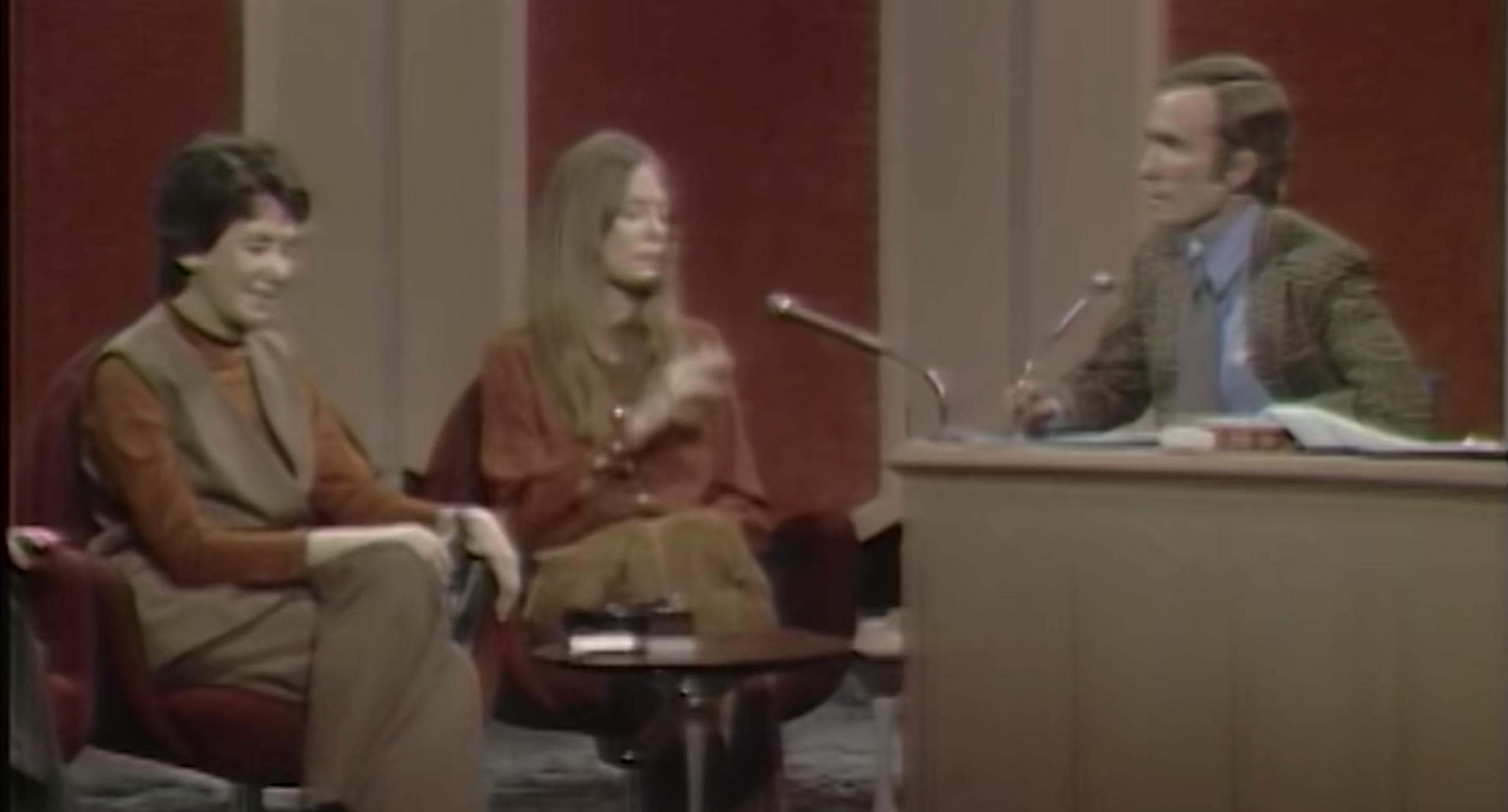
A half century ago a fascinating dispute about the then-embryonic feminist movement happened on The Dick Cavett Show. The combatants were Playboy publisher Hugh Hefner and feminist writers Susan Brownmiller and Sally Kempton.

You can immediately sense currents of vague alarm from Hefner and to some extent even from Cavett, and a certain patronizing tone from an avuncular psychiatrist who was sitting next to Hefner on the couch. Hefner blew himself up early on by addressing Brownmiller and Kempton as “girls” — so clueless.

A good deal of what Brownmiller and Kempton said during this segment is so conventional by present-day standards and not even approaching controversial.

Imagine if Brownmiller or Kempton had said to Cavett, “Just wait…50 years hence we’re going to have such a strong and compelling narrative that the older male establishment will be trembling…there will be a thing called ‘cancel culture’ that will have certain abusers shaking in their boots.”

Brownmiller: I think most of the marriage laws are very discriminatory. Against women.
Cavett: Except in California with alimony, apparently. [to Kempton] Would you accept alimony if you were divorced?
Kempton: No.
Cavett: You wouldn’t.
Kempton: Except I would think that a woman who has spent her whole life being a housewife and mother should [accept alimony]. I think that in such cases alimony is really the price that men pay for women’s oppression.
Cavett: How do you explain the Margaret Chase Smiths and Helen Gurley Browns and Bess Myersons…women who’ve somehow fought through the system.
Brownmiller: Society always allows a few to get through. There are always loopholes.
Cavett: You speak as if there’s a conspiracy to keep women in their place.
Brownmiller: There is a conspiracy.
Cavett: But not a conscious one. You don’t think I go around consciously oppressing women, do you?
Brownmiller: No, I don’t think so. Watching your shows, I really wouldn’t think [so]. You seem to like intelligent women, and you’re not afraid to have strong, intellectual women on your show. You’ve had marvellous intellectual discussions with Beverly Sills
Cavett: That’s because I’m weak and like to be dominated.

Polanski’s Best Director Cesar Riles Wokesters

How dare the French Film Academy ignore the army of anti-Roman Polanski protestors by giving him the Cesar award for Best Director? Don’t they understand that the Cesars are not about honoring the finest in artistic achievement but about submitting to the current political narrative among #MeToo progressives and in furtherance of concurrent cancel-culture decrees?

Seriously, the members who voted for Polanski are to be commended for not allowing the militants to intimidate them into voting differently.

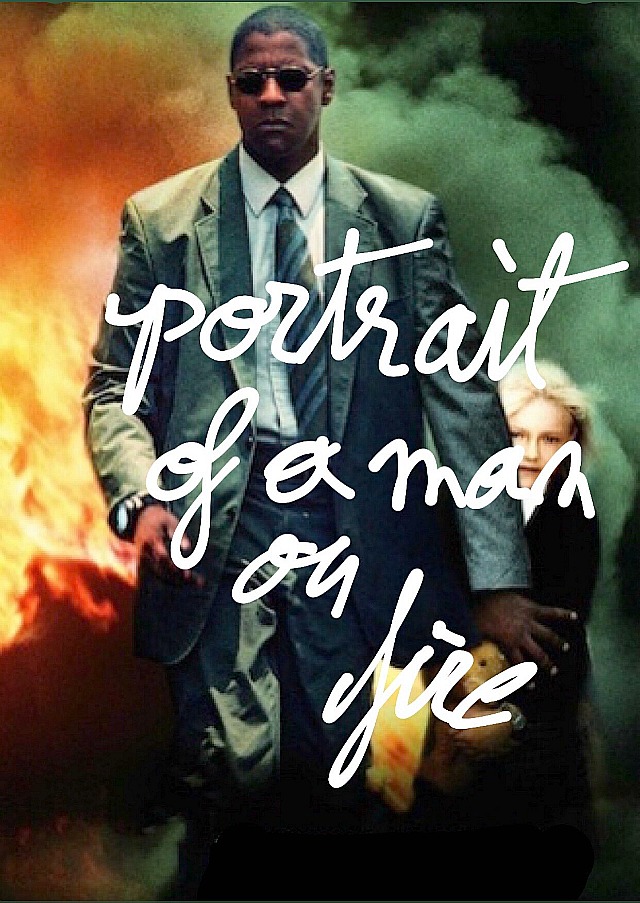
Variety is reporting that “numerous walkouts” happened at the Salle Pleyel when the Polanski win was announced. One of the evacuees was Best Actress nominee Adele Haenel, star of Portrait of a Lady on Fire.

Ladj Ly’s Les Miserables, one of the HE’s 2019 faves, won the Cesar for Best Picture. It also won the people’s choice prize. Les Miserables costar Alexis Manenti (he played the pugnacious racist cop) won for best male newcomer. The film also won for best editing.

I realize that institutional film awards are rarely about quality in and of itself and are usually about what the majority of voters believe to be the most the urgent political concerns (or moods or trends) of the moment.

In the French film industry there are two camps — the old guard and the progressive anti-Polanski-ites. The latter group, wanting to send a message to the industry about patterns of sexism and sexual exploitation, were angered that Polanski and An Officer and a Spy were nominated for several Cesar awards, and are now doubly appalled that he won.

The director and co-writer of An Officer and a Spy (aka J’Accuse) actually took two Cesar awards in Paris on Friday night — one for Best Director and another for Best Adapted Screenplay, shared with co-writer Robert Harris. An Officer and a Spy‘s Pascaline Chavanne also won a Cesar for best costume design.

Variety‘s Elsa Keslassy: Polanski didn’t attend the festivities. He announced a day or two ago that he feared a “public lynching” by feminist protestors if he went. Earlier today An Officer And A Spy producer Alain Goldman and star Jean Dujardin also announced they also wouldn’t be attending the Cesars. Goldman told AFP “an escalation of inappropriate and violent language and behavior” towards Polanski was the reason.

“All Those Who Died…”

After all these months of dismissing Typewriter Joe Biden, I’m now in the double-back position of wanting him to prevail against Bernie the Destroyer.

I know Bernie has the nomination all but locked up, but even with the coronavirus + recession advantage, Bernie will still scare the shit out of right-leaning voters and thereby excite their turnout on 11.3. Biden won’t scare them so much; ditto Buttigieg. That’s an extremely critical factor.

Not that it stands a chance of becoming a determining or decisive factor. Not unless the COV-19 outbreak becomes so bad and the economy goes into such a terrible tailspin that Trump’s wounds prove insurmountable…unless that comes to pass we’ll be stuck with The Beast until January 2025. And that’s pretty close to death.

The heart portion of this CNN town meeting video begins at 6:00. HE readers will note that Chris Cuomo is wearing whitesides.

80 Years on Planet Earth

Without even thinking it through it’s my earnest belief that Harrison Ford‘s best performance ever is Jack Ryan in Clear and Present Danger (’94), followed by his Philadelphia detective in Witness (’85 — his only Best Actor nomination), Han Solo in The Empire Strikes Back (’80), Ally Fox in The Mosquito Coast (’86), Deckard in Blade Runner (’82), the widower in Random Hearts, the hosthot executive in Working Girl and the TV anchor in Morning Glory.

[Posted two years ago] “Frantic is an example of the kind of film that we used to make in the olden days, and for me [there were certain] directors were really important in the formation of a career. I didn’t actually do it all myself. I got to work with Alan Pakula, Sydney Pollack, Mike Nichols, Phillip Noyce, Roman Polanski, Peter Weir, Ridley Scott, Wolfgang Petersen].

“Those kinds of films are as important on a human level as, uh, those more successful films” — the Star Wars and Indiana Jones franchises. “Which I keep revisiting in interview situations, because they are the most successful films.” [Unspoken: “Most successful” because your basic whiteside and T-shirt-wearing knuckle draggers obsess over these films and seem to need them like babies need their blankies.]

“But [making big franchise movies for the unwashed salivating hordes] is not what makes a life. That’s not what makes a career. That’s not what brings pleasure to the pursuit of something effable.” — Harrison Ford, starting around the 8:26 mark.

Why, then, did Ford turn down the Michael Douglas role in Traffic? And why did he make something so flagrantly non-organic and digitally antiseptic as Call of the Wild? Legend has it that a lot of what Ford agreed to do over the last 20 years was first and foremost about producers meeting his quote. The bottom line (and please correct me if I’m wrong) seems to be that “the kind of films that we used to make in the olden days” are to some extent still being made, but their producers can’t afford Ford.

Read more