“Modest and Winning”

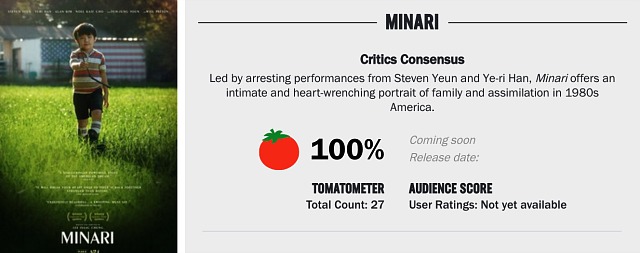
In this time of terror, you can’t trust Sundance-approved, virtue-signalling critics on Lee Isaac Chung‘s Minari (A24, sometime in late October or early November). Well, you can but I wouldn’t. I’ve actually heard it’s pretty good, but for an honest take you have to wait for people like me to weigh in. Or seasoned critics like The Hollywood Reporter‘s Todd McCarthy.

Minari “is a modest pic but very human and accessible, and quite distinctively so in comparison to the vast majority of high-concept and/or violent movies rolling out today. The charming low-key humor and the actors are all winning without being coy or cutesy. Director writer Lee Isaac Chung has a light touch and a predilection for dry mirth, both of which serve him well here. Some significant new adversity — the last thing this family needs — provides an anchor for the third-act climax.” — from McCarthy’s 1.27.20 review.

Best of 2020 So Far…Again

A little less than a month ago Esquire‘s Nick Schager posted his choices for the 40 best films of 2020, most many of which struck me as highly unwarranted if not flat-out absurd. Josh Trank‘s Capone, Jean-Pierre and Luc Dardenne‘s respectable Young Ahmed, Corneliu Porumboiu‘s underwhelming The Whistlers, Leigh Whannell‘s respectable but wildly overpraised The Invisible Man, Andrew Patterson‘s Slamdance-level The Vast of Night, Kleber Mendonça Filho‘s ultra-violent Bacurau…c’mon!

A lot has changed over the last month. Here’s my rundown of 2020’s top 15, and in this order (I won’t be seeing Sofia Coppola‘s On The Rocks until next Monday):

1. Chloe Zhao‘s Nomadland.

2. Roman Polanski‘s J’Accuse (An Officer and a Spy): “Crafted with absolute surgical genius…a lucid, exacting and spot-on retelling of an infamous episode of racial prejudice…a sublime atmospheric and textural recapturing of 1890s ‘belle epoque’ Paris, and such a meticulous, hugely engrossing reconstruction of the Dreyfus affair…a tale told lucidly…clue by clue, layer by layer. Pretty much a perfect film. The fact that it can’t be seen in this country has no bearing whatsoever on the fact that it’s an absolutely brilliant film.” (Reviewed on 3.25.20.)

3. Aaron Sorkin‘s The Trial of the Chicago 7.

4. Florian Zeller‘s The Father (Sony Pictures Classics, 12.18.20 — saw it a week or two ago, completely floored ahd hugely impressed but haven’t written my review yet — Anthony Hopkins is an obvious Best Actor lock).

5. Chris Nolan‘s Tenet — a major conceptual knockout that definitely needs subtitles.

6. Judd Apatow and Pete Davidson‘s The King of Staten Island — the views of people who didn’t care for it as much I did are not “wrong” — they just don’t have big enough souls.

7. Michael Winterbottom‘s The Trip to Greece (reviewed on 5.24.20)

8. Rod Lurie‘s The Outpost.

9. Diao Yinan‘s The Wild Goose Lake.

10. Cory Finley and Mike Makowski‘s Bad Education.

11. Eliza Hittman’s Never Rarely Sometimes Always.

12. Gavin O’Connor and Ben Affleck‘s The Way Back.

13. Vaclav Malhoul‘s The Painted Bird.

14. Ken Loach‘s Sorry We Missed You.

15. Kelly Reichardt‘s First Cow.

Poise, Focus, Gentility

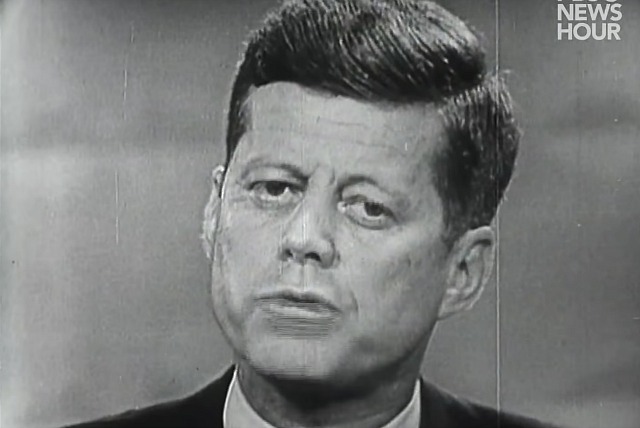
The two Presidential candidates of 1960 were certainly better behaved and more dignified than Orange Plague was a couple of nights ago. Seriously, what a degradation in standards and values (spiritual, cultural) and it’s all on the boomers — the elitist greed of older urban liberals in the 21st Century and and especially the despair and nihilism of the bumblefuck boomers and GenXers.

Nixon would live another 34 years; Kennedy would be dead just over three years (roughly 38 months) hence.

Nixon’s sometimes decisive but often arch and paranoid presidency would end in disgrace in ’74, and yet he pushed for universal health care and established the Environmental Protection Agency.

Kennedy turned out to be a far less progressive president than his successor, Lyndon Johnson. His greatest moment was his mature and measured handling of the Cuban Missile Crisis; his achievements were more defined by a certain spirit and verve than concrete legislative advancements.

JFK would have sailed to victory over Barry Goldwater in ’64, but to achieve this he would have had to pledge to stop worldwide Communism whenever or however. His hand would’ve been subsequently forced in Vietnam — commit to a massive military investment or cut bait and let North Vietnam overrun the South. I’m having trouble imagining that he would have firmly stood up to the military-industrial complex and totally followed the advice of George Ball.

However you slice it the mid ’60s (SDS, Stokely Carmichael, burning cities, anti-establishment counterculture, anti-war protests) would have been a dispiriting ordeal for the nation’s 35th President. Fate saved him from all that, not to mention the dispiriting possibility of Nixon succeeding him in ’68.

Chicago Jazz Vibe

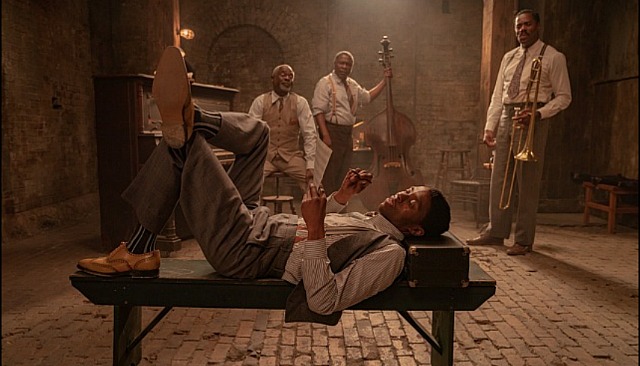
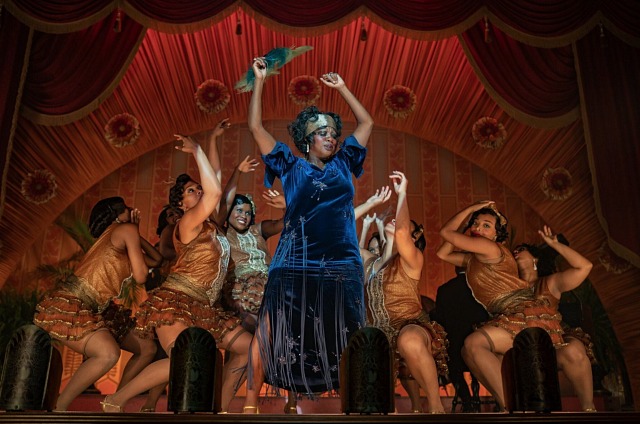
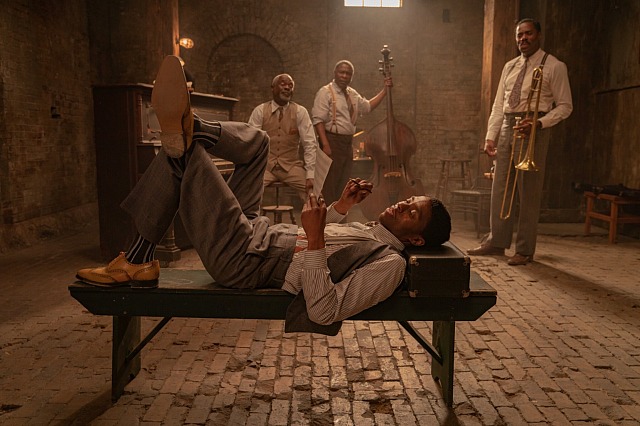
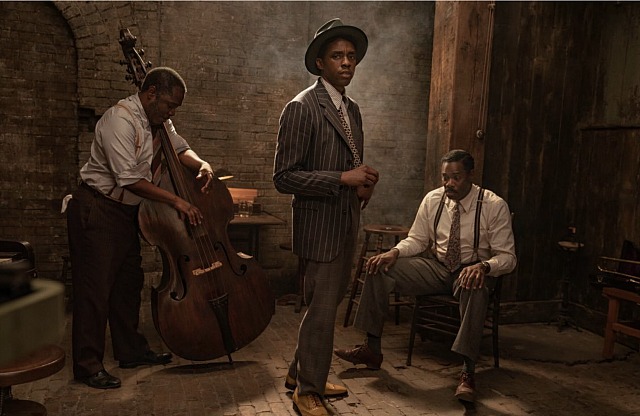
I intended to post these Ma Rainey’s Black Bottom stills yesterday, but my energy waned.

They tell us that (1) Chadwick Boseman is greatly missed and (2) this 1920s-era film (“fateful recording session in 1927 Chicago, exploitation of black recording artists”) will deliver a certain poignant, painterly atmosphere by way of dp Tobias A. Schliessler (Patriot’s Day, The Taking of Pelham 123, Dreamgirls, Friday Night Lights).

The director is George C. Wolfe. Ruben Santiago-Hudson‘s screenplay is an adaptation of August Wilson’s 1982 play. Boseman aside, the costars are Viola Davis, Glynn Turman, Colman Domingo and Michael Potts. The Netflix film pops on 12.18.